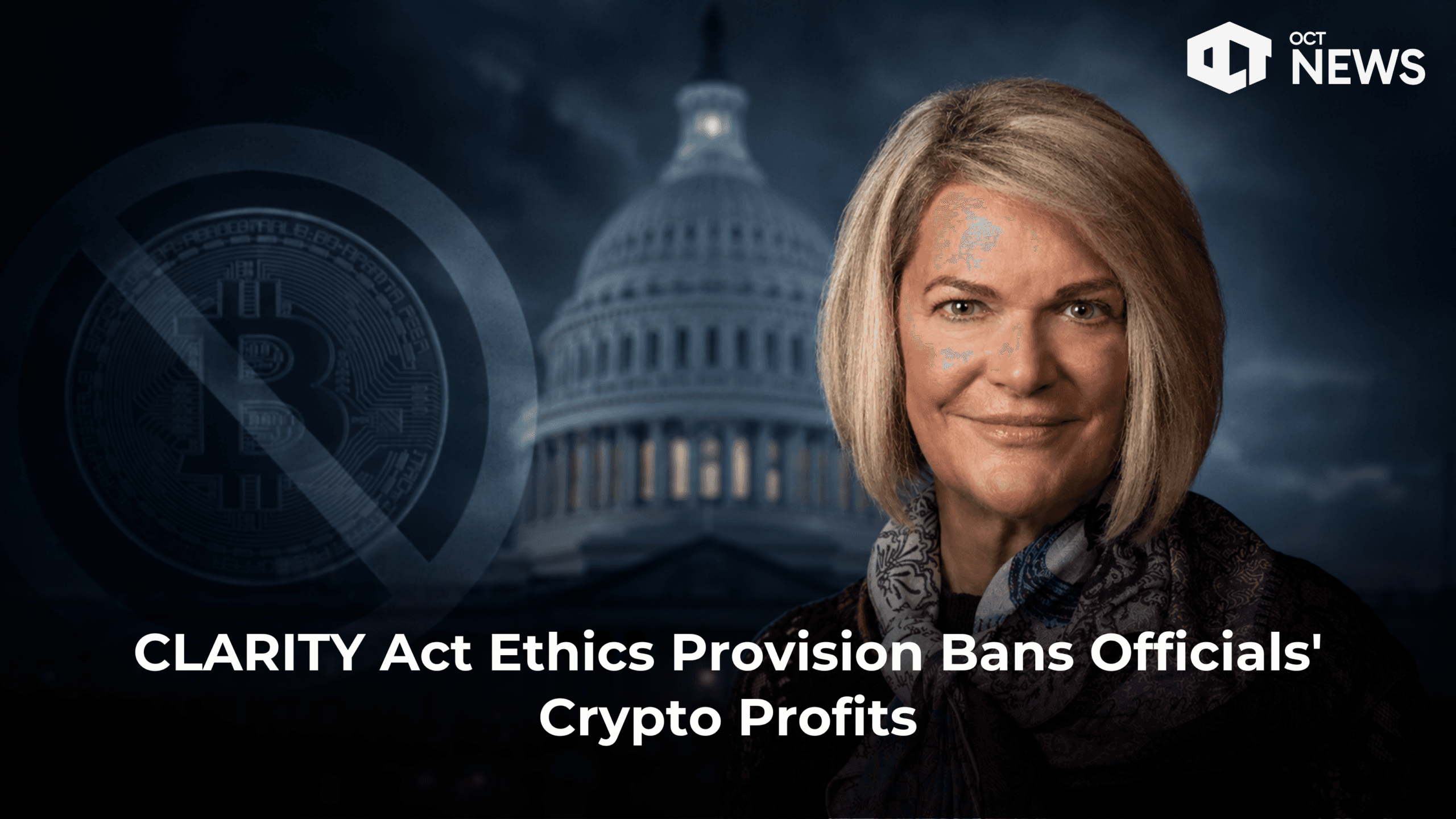
Senator Cynthia Lummis defended the CLARITY Act against Elizabeth Warren's money laundering accusations during a heated Senate Banking Committee markup.

Author: Sahil Thakur
2nd July 2026 – Senator Cynthia Lummis defended the CLARITY Act against Elizabeth Warren’s money laundering accusations during a heated Senate Banking Committee markup.
The fued has reignited again on X with the Cynthia Lummis responding to Warren’s post.
High Signal Summary For A Quick Glance

X Deplorable VET
@XDeplorableVET

@SenLummis @ChadSteingraber SHOULD’VE PASSED THIS SIX MONTHS AGO. SHAME ON ALL OF YOU “POLITICIANS”. WORTHLESS DEN OF VIPERS https://t.co/t2TfdOh5vA

The Clarity Act has 16+ illicit finance safeguards, not loopholes: ✅ Sec 201: BSA/AML applies to crypto ✅ Sec 303: new sanctions to hit Iran ✅ Sec 305: exchanges can freeze dirty money If you don’t like crypto, then say it, but stop these baseless attacks. https://t.co/JZVhjC9Efn
12:30 AM·Jul 2, 2026

Tango
@tango4748
@SenLummis Old heads do not like innovation because they do not understand it. She could read the clarity act 17 times front to back and still come out asking "what's a crypto?"
The Clarity Act has 16+ illicit finance safeguards, not loopholes: ✅ Sec 201: BSA/AML applies to crypto ✅ Sec 303: new sanctions to hit Iran ✅ Sec 305: exchanges can freeze dirty money If you don’t like crypto, then say it, but stop these baseless attacks. https://t.co/JZVhjC9Efn
12:05 AM·Jul 2, 2026

Frank😎
@Francis86340619
@SenLummis @SenWarren may not realize how banks are exploiting everyone; the world is cursing those who oppose granting freedom to the people.
The Clarity Act has 16+ illicit finance safeguards, not loopholes: ✅ Sec 201: BSA/AML applies to crypto ✅ Sec 303: new sanctions to hit Iran ✅ Sec 305: exchanges can freeze dirty money If you don’t like crypto, then say it, but stop these baseless attacks. https://t.co/JZVhjC9Efn
11:29 PM·Jul 1, 2026
Elizabeth Warren put out a post on 29th June pointing out crypto’s money laundering loopholes to which Senator Lummis responded with “just say if you don’t like crypto”.
Warren, the committee’s Ranking Member, set the tone in her opening remarks. She accused the bill of creating loopholes for money laundering and illicit finance.
According to Warren, the risks run through decentralized platforms, crypto mixers, and foreign adversaries. She framed the CLARITY Act money laundering gap as a national security problem, not just a financial one.
To back the claim, she pointed to a National Sheriffs Association request for fixes on cartel laundering. She also cited a Treasury and FinCEN alert on Iranian use of crypto, issued on May 11, 2026.
Warren then quoted public analyses in her opening statement. “Multiple public analyses document that drug cartels are shifting their money laundering to crypto, and, quote, the ‘cops can’t keep up,'” she said.
On June 29th, she put out a tweet re-iterating her position on the topic.
Lummis chairs the Subcommittee on Digital Assets and helped write the bill. As a result, she led the defense during debate on Warren’s amendments.
One amendment targeted sanctions authority and mixing tools like Tornado Cash. Lummis pushed back directly. According to contemporaneous reporting of the hearing, she said Titles 2 and 3 already address illicit finance and sanctions.
In other words, Lummis argued the bill does not ignore the money laundering risk. Instead, she said it writes existing anti-money laundering rules into clearer digital asset law.
Warren’s amendments then failed on party-line or near-party-line votes. For example, one such amendment fell 11-13.
This clash did not start in May. The two senators have sparred over crypto rules since 2022.
Back then, Warren and Senator Roger Marshall introduced the Digital Asset Anti-Money Laundering Act. It focused on closing crypto AML gaps.
Around the same time, Lummis and Senator Kirsten Gillibrand introduced the Responsible Financial Innovation Act. That framework leaned toward innovation and lighter-touch rules.
In 2025, the House passed the CLARITY Act, and the GENIUS Act on stablecoins became law. The GENIUS Act passed with a promise of later illicit finance fixes. As a result, the May markup became the venue for that overdue fight.
The debate centered on two parts of the bill. Title II is labeled “Protecting Against Illicit Finance.” Title III is labeled “Responsible Innovation in Decentralized Finance.”
According to the bill text, Title II updates how the Bank Secrecy Act treats digital asset activities. It also creates examination standards and study provisions for illicit finance.
Title III then addresses decentralized finance, mixers, and foreign adversary risks through rulemaking. Supporters say this clarifies existing law rather than weakening it.
Under current rules, exchanges must register with FinCEN, run AML programs, verify customers, and file suspicious activity reports. Supporters say the bill extends that same framework rather than carving new exemptions.
Critics disagree. They argue the bill under-regulates certain decentralized elements and leaves gaps that banks would never get.
Both sides lean on hard numbers. In 2022, OFAC sanctioned Tornado Cash for helping launder roughly $7 billion. About $450 million of that traced to a North Korean hacking group.
More recent data comes from Chainalysis. Its 2026 Crypto Crime Report found illicit addresses received about $154 billion in 2025, driven largely by sanctioned entities.
Still, the illicit share of tracked crypto volume stays small. According to the same research, it has run between roughly 0.14% and 1.2% historically, and below 1% recently.
Compliance experts also note that crypto is often easier to trace than cash. At the same time, they admit enforcement in decentralized finance remains hard.
The committee advanced the bill to the full Senate by a 15-9 bipartisan vote. Notably, some Democrats backed it, including Ruben Gallego and Angela Alsobrooks.
The vote coincided with a modest crypto rally. Around May 14 and 15, Bitcoin rose above $81,000 from levels near $79,000 to $80,000. Meanwhile, XRP and Dogecoin each climbed about 5%.
Some analysts described the move as a knee-jerk reaction that was partly priced in. As a result, they cautioned against reading too much into it.
Warren, however, did not drop the fight. On June 28, 2026, she criticized the bill again after a Wall Street Journal report on CoinEx facilitating Iranian transactions. She said the bill “would make this problem worse.”
The CLARITY Act money laundering debate now moves toward the full Senate. Negotiations continue on ethics rules, stablecoin yield, and further anti-money laundering tweaks.
Lummis, for her part, has highlighted $150 million in anti-scam and fraud funding inside the bill. Warren, meanwhile, keeps pressing for stronger standards over what she calls “new loopholes.”
The final language on decentralized finance and mixers is still open. So the fight over whether the bill strengthens or weakens crypto oversight is far from settled.
This article is informational and not financial advice. Always do your own research before making any investment decision.
Our Crypto Talk is committed to unbiased, transparent, and true reporting to the best of our knowledge. This news article aims to provide accurate information in a timely manner. However, we advise the readers to verify facts independently and consult a professional before making any decisions based on the content since our sources could be wrong too. Check our Terms and conditions for more info.


Ledger Probes User Fund Losses Tied to Reseller CryptoBilis
Why Provenance Blockchain (HASH) Is Up 39.6% Today?
Halborn Clears XMAQUINA RCM Audit With Zero Critical Bugs
Fidelity Scoops $354M Bitcoin, ETH & SOL in 20 Days
Ledger Probes User Fund Losses Tied to Reseller CryptoBilis
Why Provenance Blockchain (HASH) Is Up 39.6% Today?
Halborn Clears XMAQUINA RCM Audit With Zero Critical Bugs
Fidelity Scoops $354M Bitcoin, ETH & SOL in 20 Days