FDIC stablecoin rules under the GENIUS Act introduce 1:1 reserves, redemption safeguards, and bank-level oversight for issuers.

Author: Kritika Gupta
Steady attention without excessive speculation.
8th April 2026- In a major step toward bringing stablecoins into the regulated banking system, the Federal Deposit Insurance Corporation (FDIC) on April 7, 2026, approved a proposed rulemaking that establishes the first comprehensive federal prudential framework for payment stablecoin issuers under the Guiding and Establishing National Innovation for U.S. Stablecoins (GENIUS) Act. The FDIC stablecoin rules mark the first comprehensive federal prudential framework for payment stablecoin issuers under the GENIUS Act.
Under the proposal, issuers must maintain 1:1 asset backing, provide on-demand redeemability at face value, strictly segregate reserves, and comply with bank-like capital, liquidity, and risk-management standards. In addition, the rules explicitly prohibit issuers from paying yield or interest to holders simply for holding the stablecoin.
High Signal Summary For A Quick Glance

X Finance Bull
@Xfinancebull

BREAKING 🚨FDIC just approved stablecoin rules under the GENIUS Act. Tokenized deposits now treated the same as traditional bank deposits. Ripple's RLUSD is built to comply with exactly this framework. More RLUSD adoption means more $XRP demand. The regulatory moat is filling https://t.co/8dSdprwJEV

04:00 AM·Apr 8, 2026

BMNR Bullz
@BMNRBullz
🚨 FDIC MOVES ON STABLECOINS The U.S. just took another step toward full stablecoin regulation under the GENIUS Act. Banks now have a clear path to issue stablecoins, under strict rules. 🔹 Reserve requirements 🔹 Capital standards 🔹 Risk management This is what https://t.co/Kk1pyEADsu https://t.co/LDrKQDpOH6
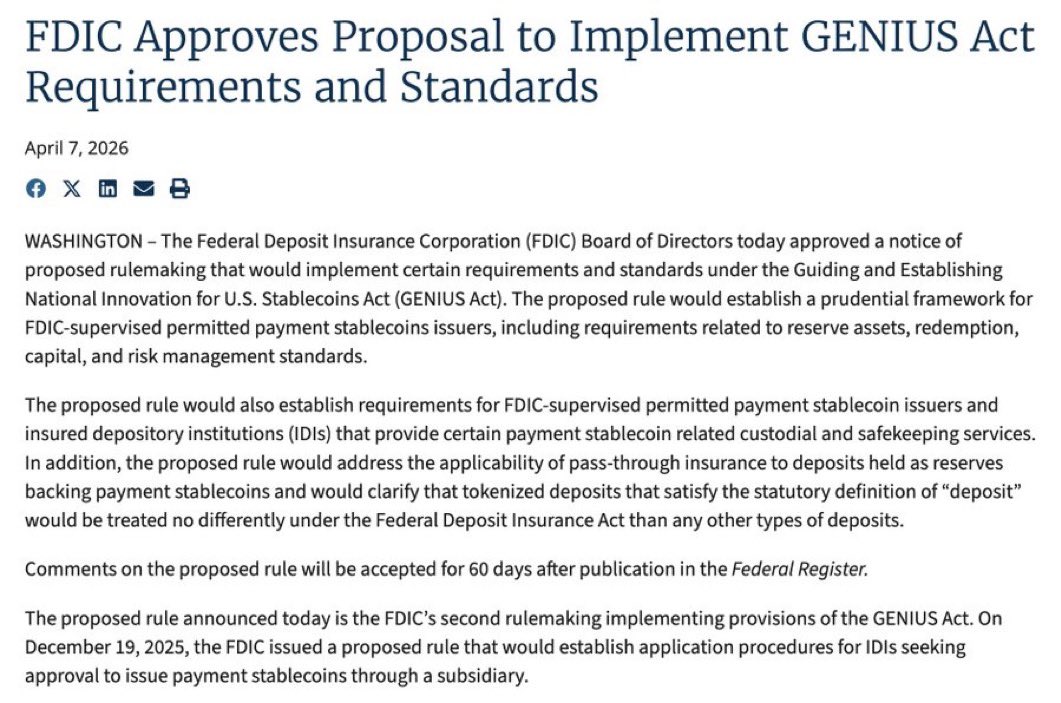
🇺🇸 FDIC Chair Travis Hill just dropped: Moving full speed on GENIUS Act rules for stablecoin issuers. -> Tokenized deposits officially treated as real bank deposits. -> Stablecoins get framework. -> Banks get on-chain deposits. Win-win? https://t.co/r673U4HVbS
08:17 PM·Apr 7, 2026
The GENIUS Act was signed into law by President Donald Trump on July 18, 2025, following years of bipartisan negotiations in Congress. Before the law, stablecoins had expanded rapidly and crossed the $200 billion market capitalization mark by early 2025. However, they largely operated outside a dedicated federal prudential regime, which raised concerns around reserve transparency, consumer protection, systemic risk, and competition with traditional banking infrastructure.
Moreover, the 2022 collapse of TerraUSD significantly intensified regulatory pressure. That event exposed the risks of insufficient backing and weak redemption mechanisms, prompting lawmakers and regulators to push for a dedicated federal framework.
Previously, regulatory efforts remained fragmented. For example, oversight mainly came through state-level licensing frameworks such as New York’s BitLicense. By contrast, the GENIUS Act established the first true federal statute dedicated specifically to payment stablecoins.
The FDIC had already introduced an earlier proposal in December 2025 focused only on application procedures. The April 2026 rulemaking now goes much further by defining the actual prudential operating rules governing custody standards.
Meanwhile, markets responded strongly to the GENIUS Act’s passage. Stablecoin market capitalization surged during 2025 as institutional confidence improved and issuers such as Circle Internet Group accelerated real-world payment use cases.
Relative positioning against previous FDIC stablecoin rule announcements
The proposed rules closely align with the core principles established under the GENIUS Act and apply to FDIC-supervised permitted payment stablecoin issuers (PPSIs).
This proposal significantly reduces one of the biggest barriers to institutional adoption: regulatory ambiguity. Banks, pension funds, corporations, treasury desks, and payment processors now have a much clearer legal pathway to interact with compliant stablecoin issuers. This could accelerate adoption across cross-border payments, real-time settlement, treasury management, and tokenized financial infrastructure.
For crypto markets, this development strengthens the legitimacy of regulated stablecoins as core infrastructure rather than speculative products. In practice, fully backed, segregated, and auditable stablecoins could begin functioning as programmable digital dollars with safeguards closer to traditional banking standards.
Our Crypto Talk is committed to unbiased, transparent, and true reporting to the best of our knowledge. This news article aims to provide accurate information in a timely manner. However, we advise the readers to verify facts independently and consult a professional before making any decisions based on the content since our sources could be wrong too. Check our Terms and conditions for more info.