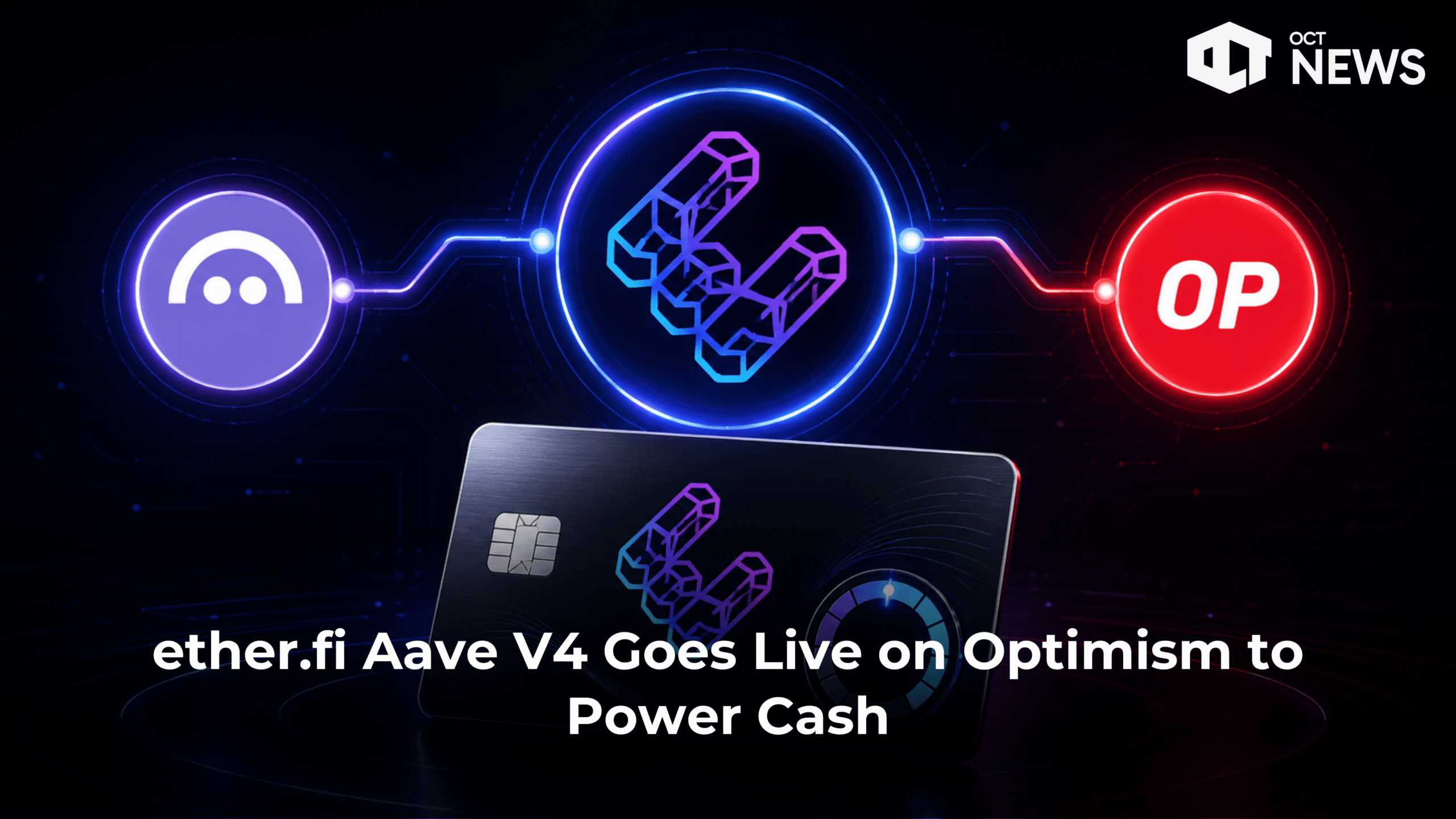
ether.fi Aave V4 powers Cash borrowing on Optimism, letting users borrow USDC at around 4% while their collateral continues earning yield.

Author: Akshay
19th August 2026 – ether.fi now runs a dedicated Aave V4 instance on Optimism, and it powers borrowing inside ether.fi Cash.
High Signal Summary For A Quick Glance

Nina Ledwinka-Uhrich
@VaidikaAvaidika

@ether_fi @aave @Optimism Good luck EVERYONE
Our new integrated @aave market on @Optimism allows your to borrow against the value of their entire portfolio, at around 4% Use it to spend with your card, send payments, or buy more assets, while your collateral keeps earning https://t.co/RPnhOJjqYg
12:16 PM·Aug 19, 2026
High attention and emotional sentiment detected.
The new market went live around 13 August 2026 as part of the Summer release. It replaces ether.fi’s in-house Debt Manager. So Cash users now borrow through Aave, not a bespoke lending system.
ether.fi started as a liquid restaking protocol built around eETH and weETH. It then grew into Cash, a non-custodial Visa card and neobank. Earlier in 2026, Cash moved from Scroll to Optimism, and it now counts roughly 70,000 active cards.
The ether.fi Aave V4 market sits on a non-custodial Safe. Users enable Borrow Mode inside the app. Their assets then move into the Aave V4 Etherfi Spoke as collateral.
The app counts borrowing power in dollars. From there, users can draw USDC for spending or payments. The card can also auto-borrow USDC at checkout.
Supply is open to anyone. Borrowing, though, stays limited to KYC-verified Cash users. In short, the vault earns yield while the card spends against it.
Collateral keeps earning its underlying yield too. Staking and restaking rewards still accrue. Liquid vault yields also continue while the assets sit as collateral.
ether.fi puts the borrow rate at standard DeFi levels, currently around 4%. The rate is variable and tracks utilization. So it can move as demand shifts.
Interest accrues continuously. There is no grace period and no billing cycle. For context, Aave V3 USDC borrows on Optimism sat near 3.8% at launch, according to The Defiant.
That rate still beats most credit cards. Typical card APRs run 15% to 25% or higher. Many home equity lines also cost more.
Why ~4% matters: ether.fi Cash compared with common borrowing options
The launch collateral list is broad. It covers weETH, wETH, eBTC, and major stablecoins like USDC, USDT, EURC, and frxUSD. GHO and eUSD sit on the list too.
ETHFI, sETHFI, and OP also qualify. So do ether.fi’s Liquid vault tokens, from LiquidETH to LiquidRWA. Newer additions include wHYPE and beHYPE.
The market reaches beyond crypto as well. Tokenized stocks such as SPYx and QQQ arrive through xStocks. Metals like PAXG round out the mix.
Collateral factors vary by asset. Stablecoins sit near 90% to 95%. weETH lands closer to 55% to 75%, according to the Aave ARFC.
The deployment cleared the full Aave DAO process. It passed a TEMP CHECK, then an ARFC, and finally an AIP. In return, the Aave DAO takes a 20% cut of the revenue.
Mike Silagadze, ether.fi’s founder and CEO, framed the deal as a scaling move.
Aave and Optimism are the right partners to help us scale from tens of millions to half a billion dollars in lending capacity.
He also said Aave V4 lets ether.fi underwrite against the diverse collateral users actually hold. The Optimism Foundation added treasury liquidity and joint incentives, per the Optimism blog.
Stani Kulechov, founder of Aave Labs, pointed to the flexibility of the design.
Aave V4 provides foundational lending infrastructure tailored for ether.fi’s product and user base.
The whitelabel setup gives ether.fi full control over risk and market configuration. Meanwhile, Aave keeps the revenue and distribution. Analysts have called the model Aave becoming the AWS of onchain credit.
The design carries real risk. Every purchase becomes a borrowed position. So each swipe adds debt that accrues interest right away.
Liquidation is the main danger. If collateral value drops or debt climbs, the health factor can fall too far. At that point, liquidators can seize collateral for a bonus.
There is no grace period and no auto-repay. A refund on a purchase does not clear the loan. One analyst put it bluntly: your coffee is now a collateralized loan.
Mobile confirmations add to the concern. A quick tap can open leverage in seconds. So users should watch the health factor closely.
Governance reviewers raised flags too. During the ARFC, some questioned high collateral factors on complex assets. Others cited reputational risk for the Aave DAO.
Momentum is building fast. Active borrowing sat near $22M to $25M at launch, according to DefiLlama. ether.fi targets $500M in lending capacity by 2027.
The EtherFi Borrowing Market now holds roughly $160M to $189M in TVL on DefiLlama. Community trackers report supplied assets climbing from about $22M toward $77M since launch.
ETHFI traded near $0.48 on 19 August, roughly flat on the day of the promotional tweet. Still, the token rose about 25% to 30% over the launch week.
GHO borrowing and more tokenized assets should follow. For now, the feature is live for eligible users, though ether.fi still blocks some regions and certain U.S. states. None of this is financial advice, and leverage cuts both ways.
Our Crypto Talk is committed to unbiased, transparent, and true reporting to the best of our knowledge. This news article aims to provide accurate information in a timely manner. However, we advise the readers to verify facts independently and consult a professional before making any decisions based on the content since our sources could be wrong too. Check our Terms and conditions for more info.


Ether.fi