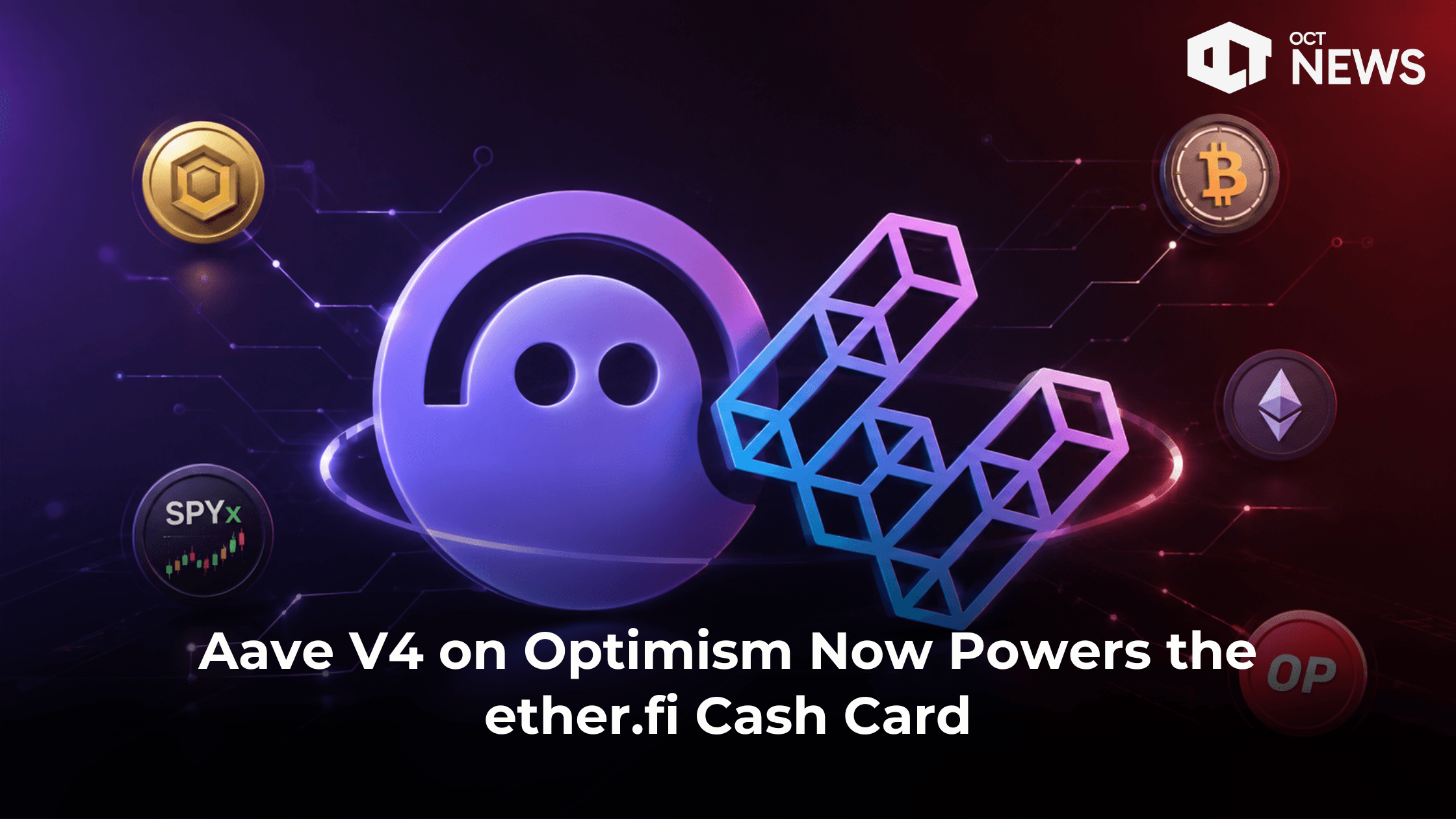
Aave V4 Optimism now powers ether.fi Cash, enabling users to borrow against crypto, tokenized stocks, and gold for card spending.

Author: Kritika Gupta
14th August 2026 – Aave V4 on Optimism is now live. It powers the credit engine behind the ether.fi Cash Visa card. Aave announced the activation on August 14, 2026. ether.fi fully manages the new instance, which stays dedicated and isolated. So it replaces the older proprietary Debt Manager that ran ether.fi Cash before.
Cardholders now borrow stablecoins against their crypto without selling it. According to ether.fi, the switch caused no disruption for users. The company also reported roughly $22 million in active borrowing just before the move.
High Signal Summary For A Quick Glance

Nick
@nikxbt

@aave @ether_fi @Optimism @Paxos @xStocksFi Aave V4 backing on Optimism is a solid upgrade, PAXG and SPYx options are interesting for sure
The @ether_fi Cash credit backend is now powered by Aave V4 on @Optimism. Cardholders can borrow against PAXG from @paxos, SPYx from @xStocksFi, WBTC, ETH, and ETHFI, with more coming soon as the integration expands. https://t.co/dwRVsy77pa
03:49 PM·Aug 14, 2026

Gregor
@bygregorr
@aave @ether_fi @Optimism @Paxos @xStocksFi SPYx only has price discovery during market hours. Aave liquidators running at 2am against a stale oracle is not a corner case, it is the design constraint.
The @ether_fi Cash credit backend is now powered by Aave V4 on @Optimism. Cardholders can borrow against PAXG from @paxos, SPYx from @xStocksFi, WBTC, ETH, and ETHFI, with more coming soon as the integration expands. https://t.co/dwRVsy77pa
02:40 PM·Aug 14, 2026

Atlaz
@atlaz_karim
@aave @ether_fi @Optimism @Paxos @xStocksFi ETH, WBTC, gold, tokenized stocks, ETHFI. having all of those sit behind the same credit line is a pretty different financial product from a normal crypto card.
The @ether_fi Cash credit backend is now powered by Aave V4 on @Optimism. Cardholders can borrow against PAXG from @paxos, SPYx from @xStocksFi, WBTC, ETH, and ETHFI, with more coming soon as the integration expands. https://t.co/dwRVsy77pa
02:16 PM·Aug 14, 2026
High attention and emotional sentiment detected.
The new deployment is a dedicated, ring-fenced Aave V4 market. It sits on Optimism Mainnet, and it serves ether.fi Cash alone. Borrowing stays permissioned, so only whitelisted Cash users can tap it.
This is not the first Aave V4 launch. Aave V4 first went live on Ethereum on March 30, 2026, according to Aave’s launch blog. Avalanche followed on July 15, 2026, as the first non-Ethereum market.
Now Optimism joins the list with a twist. Unlike the shared Ethereum and Avalanche markets, this instance is a private whitelabel deployment. As a result, ether.fi keeps full control over market configuration and risk. You can read the original Aave announcement for the details.
The headline change is the collateral menu. Aave named PAXG, SPYx, WBTC, ETH, and ETHFI as accepted assets, “with more coming soon.” PAXG is Paxos gold, while SPYx is a tokenized S&P 500 product from xStocks.
Because of that mix, a cardholder can post tokenized gold or stocks as collateral. Then they borrow stablecoins against it and spend at merchants. Meanwhile the underlying asset stays in the vault, so the user keeps market exposure.
The migrated set is broader than the five named tokens. It also preserves prior Cash collateral such as weETH, wETH, eBTC, stablecoins, and sETHFI. Notably, the cited borrow rate for cardholders sits near 4%.
Aave V4 uses a hub-and-spoke design, and that design makes this instance possible. A central Liquidity Hub holds assets and issues credit lines. Spokes are modular markets, so each one sets its own collateral, loan-to-value limits, and liquidation rules.
This structure shares liquidity while it isolates risk. Therefore a specialized product like ether.fi Cash can run its own spoke without exposing other Aave markets. Aave explains the architecture in its technical overview.
The borrowing itself works like any over-collateralized Aave loan. First, the user supplies a token as collateral. Next, they borrow stablecoins up to the LTV, subject to oracle pricing and liquidation thresholds. For RWA collateral, risk teams usually set more conservative limits.
Accepted collateral in ether.fi Cash on Aave V4
ether.fi wanted deep liquidity and tight control at the same time. Aave V4 on Optimism gives it both, because the whitelabel model hands over configuration while it taps Aave’s infrastructure. Nonce Capital serves as the risk admin for the instance.
Mike Silagadze, ether.fi’s founder, framed the benefit clearly. He said V4 lets ether.fi Cash “support a broad range of digital assets within a single lending market.” At the same time, ether.fi retains “full control over market configuration and risk management.”
Aave founder Stani Kulechov echoed the point on August 13. “ether.fi Cash and Aave V4 are live on OP Mainnet today,” he said. “Cardholders will notice no disruption at all.” Governance approved the deal earlier, and it sends 20% of revenue to the Aave DAO.
Key milestones in Aave V4’s path to powering ether.fi Cash
Aave Labs introduced the development proposal that would evolve into V4’s modular architecture.
V4 moved through development, security reviews, testing and final preparations for production deployment.
The first production V4 deployment launched on Ethereum with its Hub-and-Spoke architecture.
A dedicated Aave V4 instance on Optimism became the credit and borrowing backend for ether.fi Cash.
PAXG, SPYx, WBTC, ETH and ETHFI are supported, with additional collateral planned but no fixed date announced.
New collateral brings new risk, so the excitement comes with caveats. Tokenized equities like SPYx track markets that can gap fast. On-chain liquidity for these assets also stays thinner than blue-chip crypto.
Oracle pricing is another concern. Because equity markets close and gold moves on macro news, RWA feeds must stay accurate through volatile windows. Regulators may also restrict borrowing against tokenized US equities for some users.
Still, the isolated design limits the blast radius. The instance is ring-fenced, so trouble in the Cash spoke should not spill into core Aave markets. Instead, operational risk concentrates on ether.fi and its risk admin.
ether.fi wants to scale hard from here. The company targets $500 million in lending capacity by 2027, up from roughly $22 million in borrows today. GHO integration is also planned as part of the governance package.
Exact on-chain contract addresses and the live TVL of the instance are not yet broken out publicly. So watch Optimistic Etherscan and DefiLlama for fresh data as capital flows in. The “more coming soon” collateral list remains open too.
For now, Aave V4 on Optimism marks a clear step toward crypto-backed everyday spending. As always, borrowing against volatile collateral carries liquidation risk, and this article is not financial advice.
Our Crypto Talk is committed to unbiased, transparent, and true reporting to the best of our knowledge. This news article aims to provide accurate information in a timely manner. However, we advise the readers to verify facts independently and consult a professional before making any decisions based on the content since our sources could be wrong too. Check our Terms and conditions for more info.


Aave