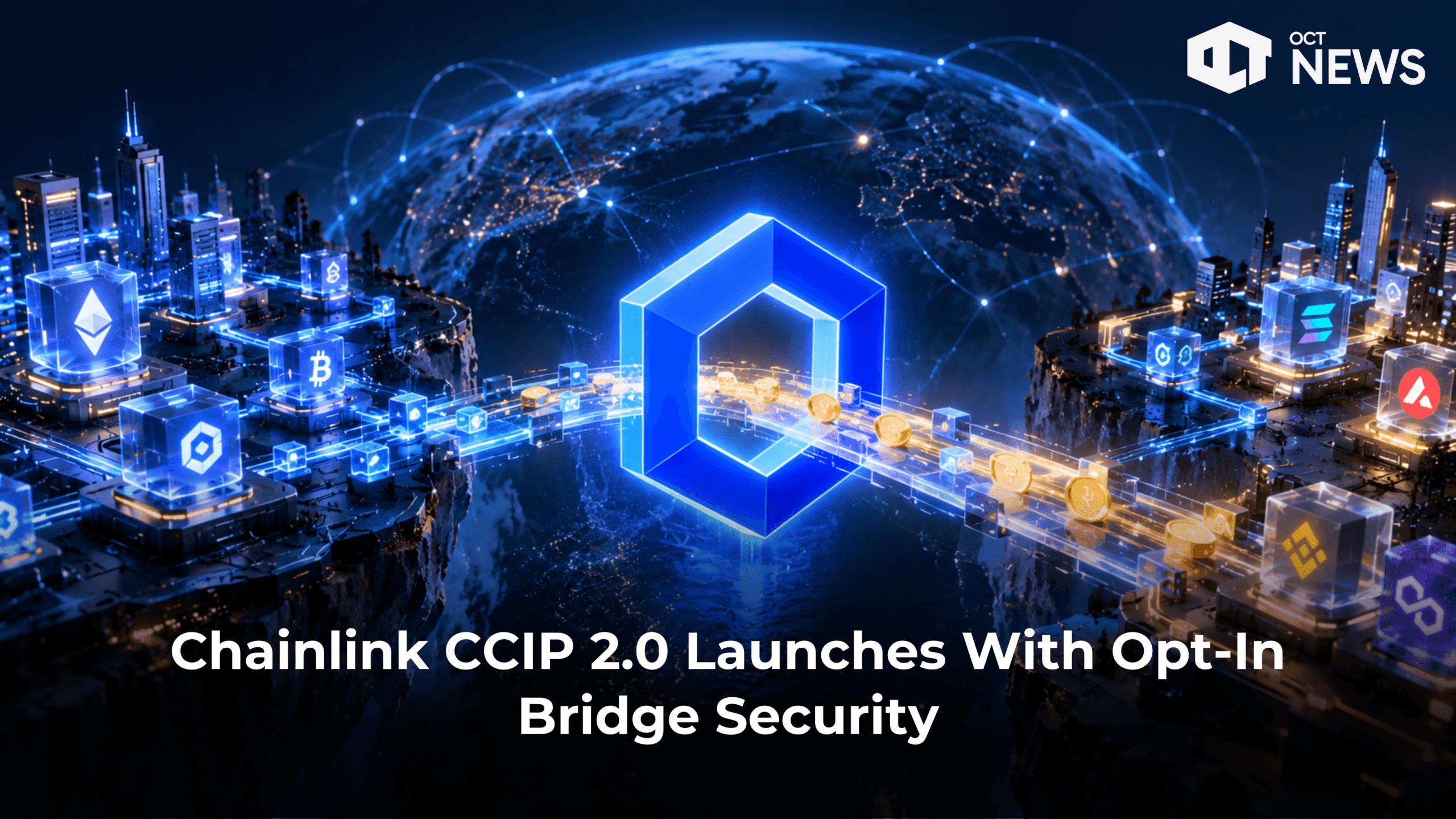
Chainlink CCIP 2.0 adds modular security, compliance tools, and flexible settlement. See what changed, what’s live, and what remains phased.

Author: Akshay
28th September 2026 – Chainlink CCIP 2.0 went live on Monday. The team is pitching it as bridge infrastructure built for banks. Issuers can bolt on extra security checks, wire in compliance rules, and set how fast a transfer settles. Chainlink says more than $84 billion in token value already moves across the protocol.
High Signal Summary For A Quick Glance

Changelly
@Changelly_team

@chainlink cross-chain infrastructure getting more robust is good for everyone building in this space. congrats on the launch
CCIP 2.0 is officially live. The infrastructure for the next $600 trillion in onchain finance is now in your hands. 🧵⬇️ https://t.co/5fvK4A4X40
12:37 PM·Sep 28, 2026
High attention and emotional sentiment detected.
The launch landed at 12:33 UTC through an official post on X. A company blog and fresh architecture docs backed it up. Yet the rollout started quietly a month earlier. Independent tracker L2BEAT dates the first Ethereum routes moving to version 2.0 to 31 August. So the “floodgates open” framing describes a migration that was already underway.
CCIP is Chainlink’s protocol for sending tokens and messages between chains. Chains do not share a ledger. So a bridge must prove an event on one chain and act on another. That proof step is where attackers have historically drained bridges.
The core change in this release is modular security. In version 1, a fixed committee verified every transfer. Now that committee is just the default. On top of it, issuers can add optional Cross-Chain Verifiers, which the company calls CCVs.
The other pillars stack on the same idea of choice. Issuers get flexible settlement, so they pick full finality or a faster confirmation path. They also get a native hook into Chainlink ACE for compliance, covering sanctions screening, allowlists, and exposure limits. Meanwhile, a new Token Pools v2 design uses LockBox custody, so a pool can upgrade without moving liquidity.
Comparison: CCIP 1.x vs. CCIP 2.0
Cross-Chain Verifiers are the headline feature, and they are permissionless. An issuer can require one verifier or several before a transfer clears. Each verifier independently attests to a single message ID after the chosen finality.
Operators can run a CCV themselves on AWS or Google Cloud. Alternatively, they can hire firms like Infosys or Nethermind to run one. Third parties can also charge a fee for verification, which opens a new service market around the bridge.
The pitch to institutions is control. As launch supporter Archax put it, issuers can define rules once and enforce them everywhere the asset moves. Chainlink Labs chief business officer Johann Eid framed the alternatives as worse. “Historically, legacy bridges have lost billions due to insecure infrastructure, while in-house builds are slow and expensive,” he told CoinDesk.
The upgrade adds optional security, but it also narrows a default protection. In version 1, a separate Risk Management Network acted as a second live check on every transfer. Now that network no longer verifies transfers in real time. Instead, it remains only as an onchain switch that can pause the system in an emergency.
The practical effect matters for anyone who adds nothing extra. As CoinDesk noted, a user who skips the optional verifiers now leans on one verifier network rather than two. So the stronger security is real, yet it is opt-in rather than automatic.
L2BEAT’s mapping sharpens the point. At the block it tracked, all 13 Ethereum version 2 routes had empty mandated verifier lists. In other words, those lanes still run on the default committee alone. The default resolver is backed by a 9-of-16 signature threshold from 16 signers, according to the same page.
L2BEAT also flags a governance risk on its Ethereum analysis. The page warns that a malicious code upgrade could let funds be stolen. It notes that no time delay guards those upgrades. Chainlink says it audits its contracts, though the overview docs name no audit firm or date.
Adoption claims sit alongside a long list of launch supporters. Chainlink names AWS, Google Cloud, ANZ, Fidelity International, SBI Digital Markets, Sygnum, Archax, and roughly a dozen more. For now, those are logos on the announcement. They are not yet confirmed production users of the new verifiers.
CoinDesk reported that existing users were moved to the new version automatically. Still, no named institution is yet using the custom verifiers in production. Aave and Maple are said to be adopting some of the other features. On the numbers, Chainlink reports $15 billion in token value migrated over the prior four months. Wrapped assets led the way, like BitGo’s WBTC and Coinbase’s cbBTC.
The launch thread closed with a big number. “The infrastructure for the next $600 trillion in onchain finance is now in your hands,” the company wrote. That figure is a market-size slogan, not a forecast of what will flow across the bridge.
The gap between slogan and estimate is wide. Citi projects tokenized assets of roughly $2.7 trillion to $8.2 trillion by 2030. McKinsey sees more than $2 trillion, and BCG models $88 trillion by 2035. So $600 trillion works as a ceiling for global assets, not as a near-term CCIP throughput number.
Competition also complicates the story. A Standard Chartered note in August, reported by Decrypt, still put tokenized assets at about $4 trillion by end-2028. The same analysis said Chainlink trails LayerZero on interoperability volume. Both points temper the winner-take-all framing.
The market reaction was muted. LINK traded around $13.97 on CoinGecko near the announcement, inside a 24-hour range of roughly $13.97 to $14.50. The token had already climbed from the low teens into the week, so the news did not trigger a clean spike.
Onchain activity looks steady rather than explosive. DefiLlama showed about $66 million in 24-hour bridge volume, while L2BEAT logged roughly $53 million across 927 transfers. The launch post also left out tokenomics. So it did not spell out how CCVs or ACE might route fees back to LINK. Traders on X quickly asked that question.
None of this is financial advice. LINK’s price depends on far more than one product release, and the migration will play out over months. Readers weighing the token should treat launch-day figures as a snapshot, not a trend.
The real test is usage, not messaging. Watch for the first institution to publicly run a custom verifier in production. Watch, too, for the Ethereum lanes to move off the default-only setup toward the multi-verifier model the pitch describes.
Chainlink says more networks join each week, and the metrics page still reports $84 billion in token value on the protocol. For now, the ambition is clear and the plumbing is live. Banks will either turn the new security dials on or leave them off. That choice will decide if CCIP 2.0 becomes the standard it claims to be.
Our Crypto Talk is committed to unbiased, transparent, and true reporting to the best of our knowledge. This news article aims to provide accurate information in a timely manner. However, we advise the readers to verify facts independently and consult a professional before making any decisions based on the content since our sources could be wrong too. Check our Terms and conditions for more info.



Chainlink