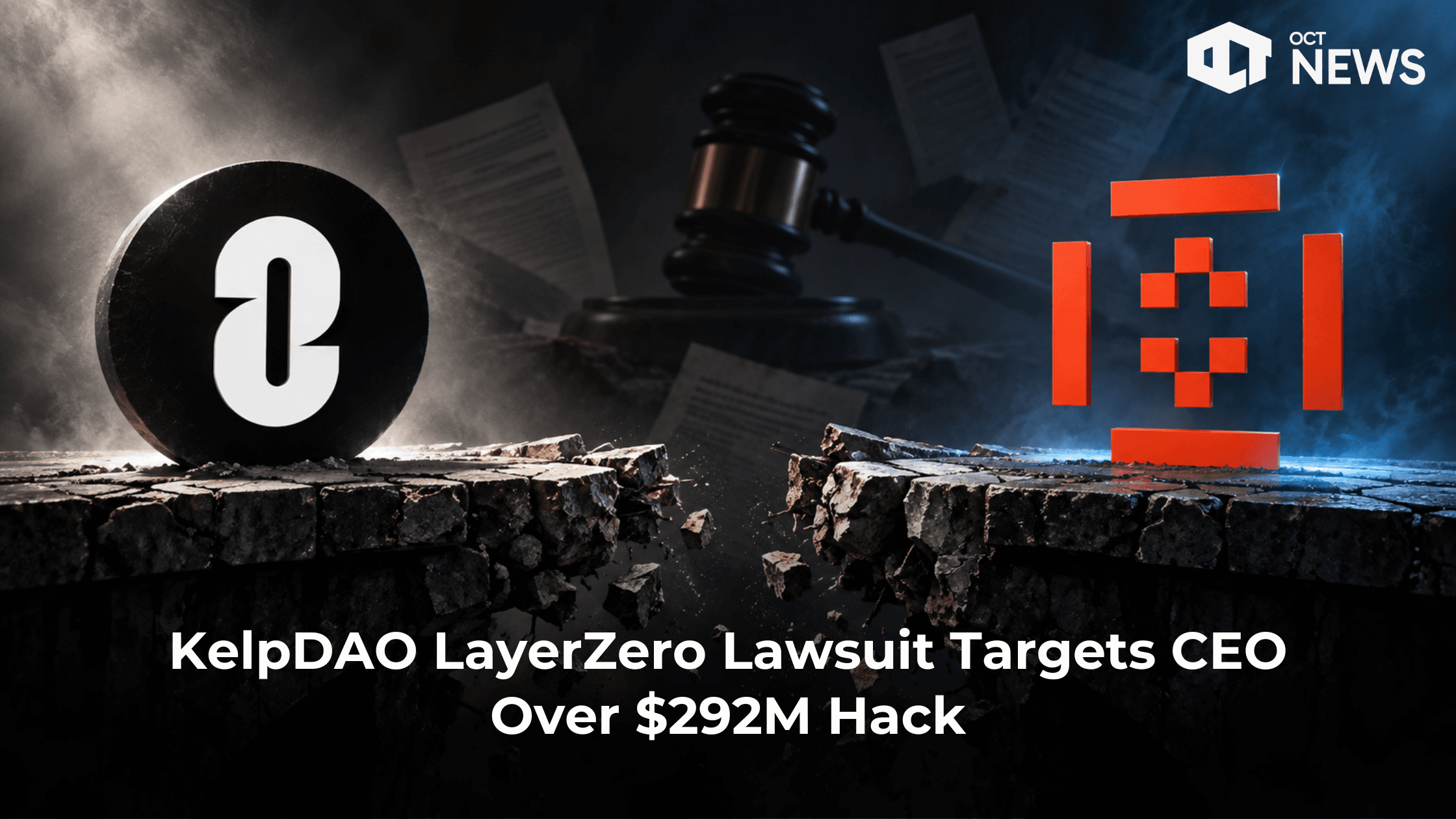
KelpDAO LayerZero lawsuit: Kelp alleges LayerZero failures contributed to the $292M rsETH exploit. Here’s what each side says.

Author: Kritika Gupta
25th September 2026- Evercrest Technologies, the company behind KelpDAO, has sued LayerZero over the $292 million rsETH bridge exploit. The KelpDAO LayerZero lawsuit also names co-founder Bryan Pellegrino personally. It landed in the Supreme Court of British Columbia.
High Signal Summary For A Quick Glance

Manu0X51
@Manu0X51

@KelpDAO The $292 million is already resolved for depositors — Aave completed restoration back in June. What a Vancouver court decides now is who carries the legal and reputational cost of the configuration choice, not whether users get repaid. Worth being explicit about that distinction,
Today we filed a lawsuit against LayerZero and its co-founder, Bryan Pellegrino, to right the wrongs associated with the exploit of rsETH’s LayerZero bridge earlier this year. For more details, please refer to the statement below. https://t.co/gPQTPeM0Zh
07:10 AM·Sep 25, 2026

WAGMI | Finance. For All. On Autopilot
@wagmidotglobal
@KelpDAO An exploit can leave users confused long after the transaction is over. Credit to Kelp for setting out its position publicly; regardless of the lawsuit, clear incident timelines and recovery updates help keep accountability focused on facts.
https://t.co/D17UbUbixh
06:31 AM·Sep 25, 2026

AOB nomad
@Internfud
@KelpDAO the part that matters is "reviewed and endorsed in writing." if LZ signed off on a 1/1 DVN setup, blaming the integrator gets a lot harder. their ToS will still be a big hurdle for Kelp though
Today we filed a lawsuit against LayerZero and its co-founder, Bryan Pellegrino, to right the wrongs associated with the exploit of rsETH’s LayerZero bridge earlier this year. For more details, please refer to the statement below. https://t.co/gPQTPeM0Zh
05:26 AM·Sep 25, 2026
High attention and emotional sentiment detected.
Pellegrino said Kelp filed the notice of civil claim on Thursday. Kelp confirmed it publicly early Friday. The filing names LayerZero as a corporate defendant and Pellegrino as an individual. Trial is expected in Vancouver.
Kelp frames the April exploit as the direct result of LayerZero’s own failures. In a public statement, the team said LayerZero failed to disclose weaknesses in its technology.
Kelp also alleges that attackers infiltrated LayerZero’s own security infrastructure. According to the team, that breach let the attackers exploit those weaknesses.
The third claim is the sharpest. Kelp says LayerZero reviewed and endorsed its deployment in writing. Then LayerZero publicly blamed Kelp after the funds vanished. You can read Kelp’s full statement on X.
Importantly, no public court document with an action number has surfaced yet. So the exact legal counts stay unconfirmed. The precise damages figure is also unknown. The $292 million number is the exploit loss, not a stated demand. News outlets including crypto.news reported the same caveat.
The loss traces back to 18 April 2026. On that day, attackers drained 116,500 rsETH from the Ethereum adapter. It happened in a single transaction worth about $292 million.
The root cause was not a bug in the rsETH token. Instead, attackers poisoned LayerZero’s view of Unichain state. They did so through compromised internal servers.
As a result, LayerZero’s verifier attested a cross-chain message that Unichain never sent. The forged packet carried nonce 308. Yet the real source nonce still sat at 307, per on-chain records.
Because that route required only one verifier, Ethereum treated the message as final. It then released the escrowed rsETH. Kelp’s multisig froze the contracts about 46 minutes later. That pause blocked a second forged packet worth roughly $95 million.
Investigators later tied the attack to North Korea’s Lazarus group. LayerZero, Mandiant, and CrowdStrike all pointed to the TraderTraitor unit. That link remains an attribution, not a court finding.
The stolen rsETH stayed a transferable token. So the attacker posted it as collateral on lending markets before they froze.
Aave took the hardest hit downstream. The attacker used about 89,567 rsETH across eight positions. From there they borrowed tens of thousands of ETH and wstETH.
Bad-debt estimates ranged from $177 million to $230 million on Aave alone. Separately, the Arbitrum Security Council froze about 30,766 ETH of downstream funds. These figures sit apart from the original $292 million drain.
An industry recovery effort later refilled the drained adapter. Kelp also moved its bridging to Chainlink CCIP, per The Block.
The two sides have argued since the day after the drain. On 19 April, LayerZero called the incident “isolated to KelpDAO’s rsETH configuration.” It blamed the single-verifier setup in its incident statement.
Pellegrino later said Kelp started with a multi-verifier setup. Then it manually switched to a one-of-one design in April 2024. Kelp counters that the setup matched LayerZero’s own documentation.
Then the framing shifted again. In May, LayerZero admitted fault for servicing that risky setup. “We made a mistake by allowing our DVN to act as a 1/1 DVN,” the firm said, per CoinDesk.
Still, that apology owned the configuration decision. It did not concede the full loss. The blame fight then simmered for months before the suit.
Pellegrino responded quickly and directly. “Evercrest (KelpDAO) filed a notice of civil claim today in BC against myself and LZ,” he wrote on X.
He added that the claim “continues to be meritless.” He also said he will defend himself in Vancouver. LayerZero Labs keeps a Vancouver presence, which explains the venue.
The core legal question is genuinely contested. Analysts ask whether a messaging provider can be liable here. After all, the app itself set the verifier threshold to one.
Kelp argues the provider ran the only verifier. It also let its own servers stay compromised for weeks. LayerZero argues the customer chose an insecure setup against clear guidance.
Despite the $292 million headline, ZRO is not crashing on the filing. The token traded between roughly $1.46 and $1.54 on 25 September, according to OKX data.
That relative calm reflects context. ZRO was already volatile from a 32.6 million token unlock on 20 September. So the suit adds little fresh pressure.
On the other side, rsETH backing looks stable. Kelp reported more than 100% ETH backing after the mid-May refill. No fresh depeg appeared around the filing.
The next milestone is service and LayerZero’s formal response. That could take weeks under British Columbia rules. Until a court document surfaces, treat the specific counts as alleged, not proven. This article is informational only and not financial advice.
Our Crypto Talk is committed to unbiased, transparent, and true reporting to the best of our knowledge. This news article aims to provide accurate information in a timely manner. However, we advise the readers to verify facts independently and consult a professional before making any decisions based on the content since our sources could be wrong too. Check our Terms and conditions for more info.


PROPS Token Set to Launch on Robinhood Chain
ASTRA 2.0 Migration: Snapshot Nov 7, Trading Nov 10
Starknet Weighs Leaving Ethereum to Become Post-Quantum L1
Vitalik Backs ZKsync Airbender Prime & Eyes zkEVM Security
PROPS Token Set to Launch on Robinhood Chain
ASTRA 2.0 Migration: Snapshot Nov 7, Trading Nov 10
Starknet Weighs Leaving Ethereum to Become Post-Quantum L1
Vitalik Backs ZKsync Airbender Prime & Eyes zkEVM Security

LayerZero