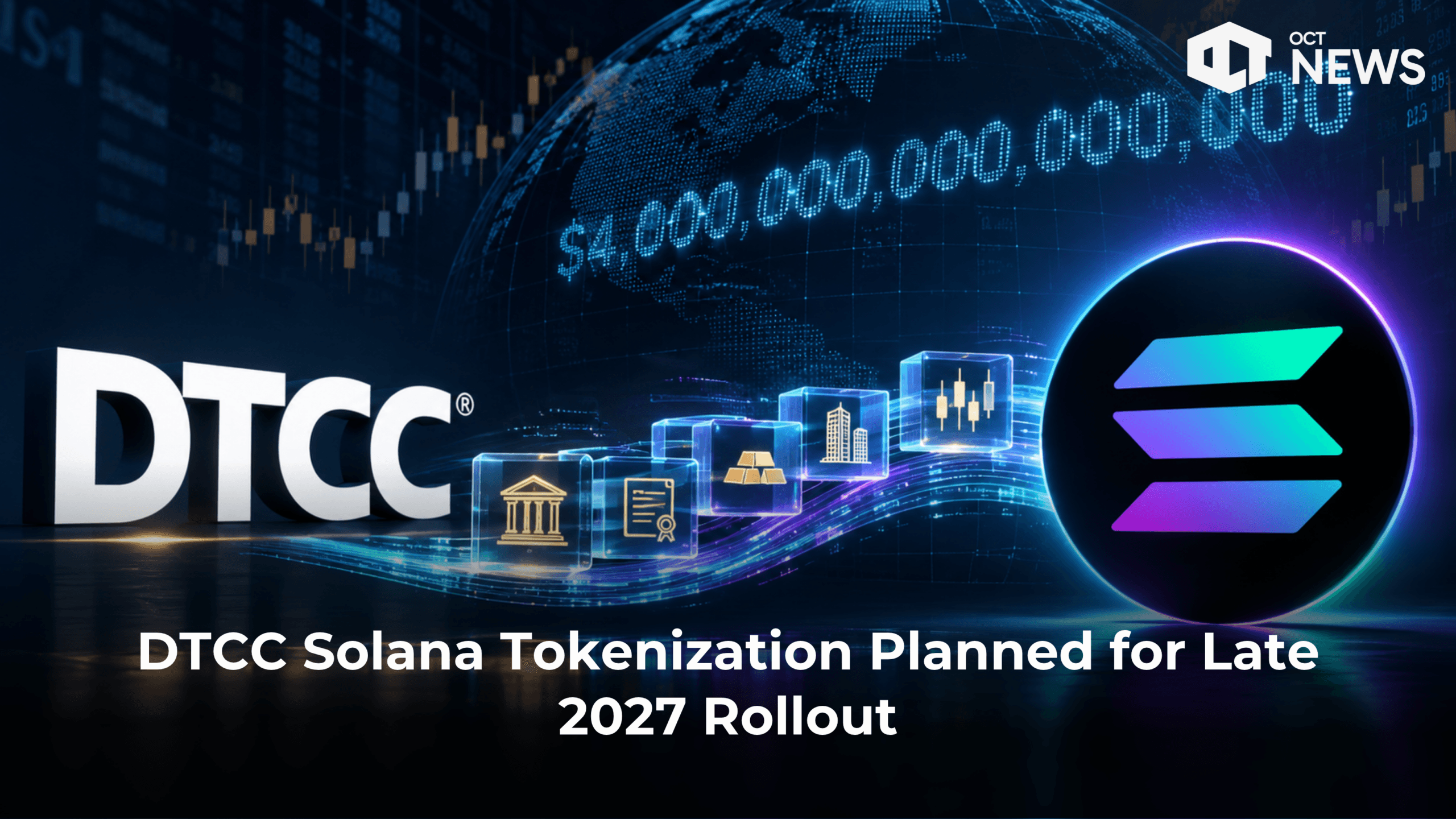
DTCC Solana plans to bring regulated tokenized securities to its public mainnet in H2 2027, expanding institutional blockchain adoption.

Author: Akshay
13th November 2026 – DTCC plans to bring regulated, tokenized securities to Solana’s public mainnet, with the connection targeted for the second half of 2027.
High Signal Summary For A Quick Glance

charvelario
@charvelario

@solana when DTCC stops testing the water and just moves in, the rest of the industry has to stop pretending this is still an experiment
Nick Ducoff, GM of Institutional Growth at Solana, on DTCC coming to Solana in 2027. “Over four quadrillion dollars in transactions were processed last year by the DTCC. When it connects a tokenization service to a network like Solana, it signals to the entire industry that https://t.co/uijNTGa2yn
11:40 AM·Nov 13, 2026

Ubik Capital - 0% Fee on Solana
@ubikcapital
@solana "Not a pilot" raises the bar: production settlement means the network's incident history gets read like a vendor SLA, and every validator's uptime becomes part of that record.
Nick Ducoff, GM of Institutional Growth at Solana, on DTCC coming to Solana in 2027. “Over four quadrillion dollars in transactions were processed last year by the DTCC. When it connects a tokenization service to a network like Solana, it signals to the entire industry that https://t.co/uijNTGa2yn
11:13 AM·Nov 13, 2026
High attention and emotional sentiment detected.
The announcement landed on November 12, 2026. According to DTCC, the plan extends its live DTCC Tokenization Service, known as DTS, onto Solana. As a result, assets custodied at its subsidiary could later move on-chain. That subsidiary is The Depository Trust Company.
First, the service already exists. DTS went live on October 28, 2026, on the Canton Network and DTCC’s private Besu network. At launch, it signed up 20 DTC participants and supported roughly 34 eligible securities.
Those securities include select Russell 1000 equities, ETFs, and U.S. Treasuries. Together, they represent about $30 trillion in assets available to tokenize. For context, DTC holds roughly $114 trillion in total custody.
So the Solana step is an expansion, not a launch. Instead of building something new, DTCC would connect an already-running service to another network. According to the company, this advances its multi-chain strategy for interoperability.
Importantly, DTCC calls the timeline “planned” and “expected.” It also notes that roadmaps can change. For now, there is no live pilot and no migration of settlement to Solana.
DTS creates tokenized representations, or “digital twins,” of securities already held in DTC custody. Each token keeps the same CUSIP as the traditional holding. More importantly, it retains the same ownership rights, investor protections, and economic entitlements.
Because of that, these tokens differ from existing synthetic tokenized stocks on Solana. Products from issuers like Ondo and xStocks are often wrappers, and they do not carry DTC entitlements. DTC tokens, by contrast, point back to official books and records at the depository.
On-chain, eligible participants can move tokens between registered, whitelisted wallets. Those transfers can run 24/7 on the same chain. However, conversion orders between traditional and tokenized form are still limited to business-day windows.
Custody ultimately stays with DTC. The token is an entitlement representation, not a free-floating asset. Therefore, Solana would host the ledger movement while the depository keeps the official record.
Solana offers high throughput, low latency, and token extensions that add compliance controls. Those extensions support features like freeze and transfer restrictions, which matter for regulated instruments. As a result, the network can handle rule-bound financial activity at scale.
Nick Ducoff, who leads institutional growth at the Solana Foundation, framed the move as validation. “Institutions choose Solana because it already runs real financial activity at scale,” he said in the DTCC release.
Ducoff pushed the point further on X and on The Block’s podcast. “This is not a pilot,” he said. He added that DTCC’s processing scale signals that tokenized securities are becoming real market infrastructure.
That scale is large. In 2025, DTCC subsidiaries processed over $4.7 quadrillion in securities transactions. Still, that figure is gross processing volume. It is not settlement value, and it is not assets that would move on-chain.
DTCC President and CEO Frank La Salla tied the move to choice and liquidity. He said the company is “bringing regulated, DTC-tokenized securities to another major blockchain ecosystem.” The move also preserves the protections of traditional markets.
Brian Steele, who leads DTCC Clearing and Securities Services, stressed neutrality. Steele said these tokens keep “the same investor protections, ownership rights and regulatory safeguards” as traditional securities.
Nadine Chakar, who heads DTCC Digital Assets, pointed to interoperability. She called it “the essential bridge to creating scalable, resilient and liquid digital markets.” In short, DTCC wants an open platform across multiple ledgers, not a single-chain bet.
DTCC’s digital-asset strategy has progressed from collaborative blockchain experiments to a live securities tokenization service, with a planned Solana integration targeted for the second half of 2027.
DTCC introduces Digital Launchpad, an industry sandbox for collaborative digital-asset pilots and testing, with a pathway toward production deployment. The announcement also includes results from a Japan Securities Clearing Corporation (JSCC) collateral proof of concept.
DTCC unveils a digital collateral management platform built on a Besu-based AppChain as the first major demonstration of Digital Launchpad. It also announces plans for a live demonstration called The Great Collateral Experiment.
DTCC conducts a multi-party demonstration of tokenized collateral mobility across different assets and participants using its AppChain infrastructure.
The SEC Division of Trading and Markets issues a three-year no-action letter to DTC, authorizing a limited tokenization service for DTC Participants and their clients on pre-approved blockchains. Eligible assets include Russell 1000 securities, major index ETFs, and US Treasuries, with tokenized representations retaining existing ownership entitlements and protections.
DTCC and Digital Asset announce a partnership to tokenize DTC-custodied US Treasuries on the Canton Network. The initial minimum viable product is targeted for the first half of 2026.
DTCC announces a Chainlink integration involving its Runtime Environment and data standard to support 24/7 collateral workflows. The AppChain is expected to go live in Q4 2026. Related research also examines the potential capital and liquidity benefits of tokenized collateral.
DTCC reports its first successful limited production trades using DTC-tokenized assets on Canton and its private Besu network. More than 30 firms participate, marking progress toward the full service launch.
DTCC launches its Tokenization Service (DTS), enabling digital representations of DTC-custodied securities while preserving ownership rights and protections under the same CUSIP. Initial networks include Canton and DTCC’s private Besu network. Around 20 DTC participants have signed up, covering approximately 34 eligible securities. Transfers between registered wallets are supported 24/7, while conversion orders remain restricted to business-day windows.
DTCC announces plans to connect its Tokenization Service to Solana’s Layer 1 blockchain, allowing eligible DTC-custodied assets to be tokenized on the network. Availability is targeted for the second half of 2027. The announcement forms part of DTCC’s broader multi-chain strategy, alongside Canton, Besu, and planned integrations with Stellar and Arc.
Solana Foundation’s GM of Institutional Growth, Nick Ducoff, comments on the DTCC announcement on X and The Starting Block podcast. He cites DTCC’s $4.7 quadrillion in transaction processing during 2025 and $114 trillion in assets held at DTC, describing the Solana connection as a signal that tokenized securities are becoming real market infrastructure, rather than simply a pilot. Solana’s official account amplifies his comments on November 13.
DTCC’s broader multi-chain roadmap includes a planned Stellar connection targeted for the first half of 2027, expanding the networks supporting its tokenization strategy.
DTCC expects its Tokenization Service to connect with Solana’s public mainnet in the second half of 2027. The planned integration is intended to support tokenization and related asset lifecycle functions while preserving DTC investor protections and regulatory safeguards. The roadmap remains subject to change.
The precise list of securities eligible for Solana, network-specific restrictions, registered-wallet requirements, fees, technical design, and go-live criteria remain unpublished. DTCC’s existing service is live on Canton and Besu within a limited scope, while the underlying SEC no-action authorization operates under a three-year pilot framework.
This step follows a clear sequence. The SEC issued a no-action letter in December 2025. It authorized DTC tokenization on pre-approved chains for three years. Then DTCC ran limited production trades in July 2026. After that, DTS launched in October 2026.
Solana is not alone on the roadmap. Canton and Besu are already live. Meanwhile, Stellar is planned for the first half of 2027, and Arc is also expected in 2027. Unchained described Solana as the fifth named network, targeted for the second half of the year.
Several questions remain open. For example, the exact asset list for Solana is not final. The mechanics of registered-wallet rules on a permissionless chain are also unclear. Likewise, fees, onboarding, and how open DeFi markets could interact with the tokens are undecided.
Markets stayed calm through the news. SOL traded in the low $80s around November 12 and 13. It slipped roughly 1% to 4% amid broader weakness. So far, reports show no clear isolated bounce tied to the announcement.
For now, DTCC Solana tokenization remains a 2027 target rather than a live product. The service works today on Canton and Besu, yet the Solana connection still needs final technical design and participant onboarding. Until then, the plan sits on the roadmap.
Watch three things through 2027. First, whether the H2 2027 date holds. Second, which assets actually reach Solana. Third, whether regulators extend the current no-action scope. Each will show how far this moves from announcement to infrastructure.
None of this is financial advice. Readers should do their own research before making any investment decision tied to Solana, DTCC, or tokenized real-world assets.
Our Crypto Talk is committed to unbiased, transparent, and true reporting to the best of our knowledge. This news article aims to provide accurate information in a timely manner. However, we advise the readers to verify facts independently and consult a professional before making any decisions based on the content since our sources could be wrong too. Check our Terms and conditions for more info.


DTCC Solana Tokenization Planned for Late 2027 Rollout
JPMorgan XRP ETF Holding Climbs to 539 Shares in 13F
ASTRA 2.0 Migration Live: New Contract, Fixed Supply
Asentum Ships Auras v2 With Upgraded AMM Contracts Live
DTCC Solana Tokenization Planned for Late 2027 Rollout
JPMorgan XRP ETF Holding Climbs to 539 Shares in 13F
ASTRA 2.0 Migration Live: New Contract, Fixed Supply
Asentum Ships Auras v2 With Upgraded AMM Contracts Live

Solana