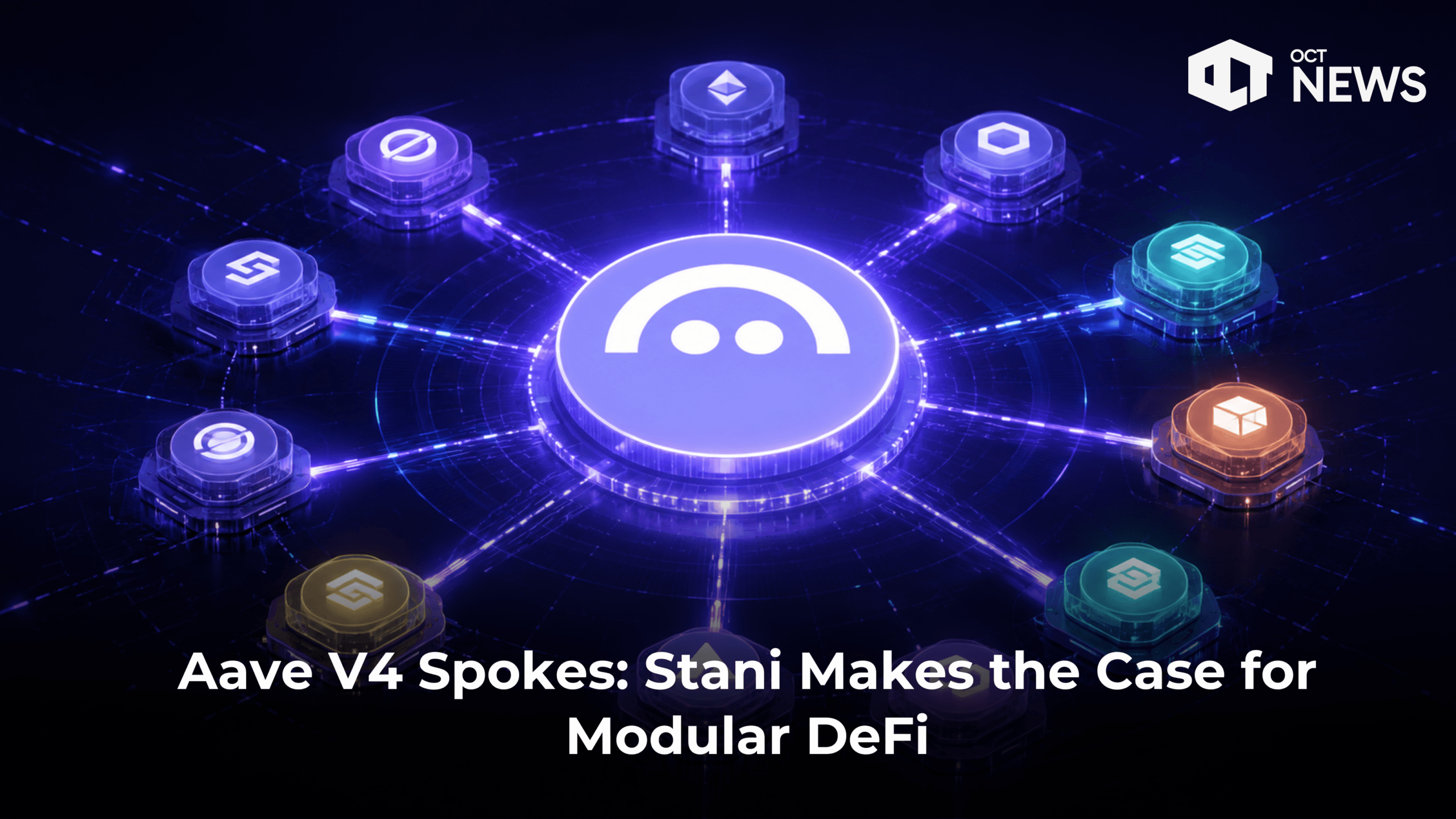
Aave V4 Spokes introduce shared liquidity and modular markets, enabling custom DeFi use cases while creating new revenue opportunities.

Author: Akshay
On June 15, 2026, Aave founder Stani Kulechov posted a thread on X explaining why Aave V4 spokes matter. He argued that spokes turn Aave into a platform other teams build on, not a product that competes alone.
High Signal Summary For A Quick Glance

ROMI
@Romiinft

@StaniKulechov this modular play is how they scale fast
Why Aave V4 spokes are important for Aave. The spokes are simply lending markets that can have generic or expand custom use-cases. DeFi moves incredibly fast and its time consuming to build everything ourself even if we wanted to. Spokes allow to partner with external teams that
12:43 PM·Jun 15, 2026
Steady attention without excessive speculation.
Spokes are simply lending markets, Kulechov wrote. So they can run generic lending or expand into highly custom use-cases. Because of that flexibility, Aave can partner with outside experts instead of building everything itself.
Spokes are the modular, user-facing markets in Aave V4. Each one is where people actually deposit and borrow.
Yet each spoke carries its own rulebook. That includes risk parameters, collateral rules, oracles, liquidation logic, and pause controls. As a result, a perps market and a real-world-asset market can live side by side without sharing the same risk.
Every spoke connects to a central Liquidity Hub. So the spoke handles the experience, while the Hub holds the money and keeps the books.
Think of the Hub as a central vault for one network. It holds the supplied assets and tracks them with share-based accounting.
Then it hands each spoke a credit line and a debit line. In other words, the Hub caps how much any single spoke can pull from the shared pool.
So when you supply into a spoke, your assets flow into the Hub. Meanwhile, a borrower in a different spoke draws from that same pool, subject to their spoke’s credit line. Because users only ever touch spokes, the Hub stays in the background enforcing global accounting and authorization.
Aave detailed this design in its architecture explainer. The live contracts back it up too. For example, the Core Hub sits at 0xCca8…26c9 on Ethereum, alongside Prime and Plus Hubs.
V3 used isolated markets to contain risk. Still, that isolation came at a cost. Separate pools could not easily share capital, so liquidity ended up fragmented.
V4 fixes that split. Spokes share one deep liquidity pool instantly, yet they keep risk isolated at the same time.
That balance is the whole point. Because a problem in one spoke is capped by its Hub credit line, it does not cascade across the protocol. So Aave gets shared depth and contained risk together, instead of trading one for the other.
At launch on March 30, 2026, Aave shipped three Hubs, named Core, Prime, and Plus. As Kulechov told The Block, “Prime is the low risk, Core is the risk-adjusted, and Plus is the risk return.”
Relative positioning between Aave V3’s isolated market architecture and Aave V4’s hub-and-spoke design
The bigger story in the thread is business, not plumbing. Spokes let Aave partner with teams that already specialize in a niche.
For example, Kulechov named AMMs, perps, fixed-rate lending, and crypto or securities custody. “Spokes allow to partner with external teams that have expertise on a subject,” he wrote, “and expand Aave’s liquidity into these new use-cases.”
The deal runs both ways. Partners tap Aave’s deep liquidity and distribution. In return, Aave gains speed, outside expertise, and new fees.
Aave Service Providers review each implementation first. Then the Aave DAO takes a cut through fee-sharing. So the partner builds the market, and the DAO monetizes the integration at the protocol level. Kulechov called it “a scale, speed and monetization advantage” and added, “Aave will win.”
The model is live but still early. Aave V4 holds roughly $122 million in TVL on Ethereum, according to DefiLlama. That figure reflects conservative initial caps, which the DAO is actively expanding.
For context, Aave’s total TVL sits near $12.66 billion, still mostly on V3. So V4 is a small slice for now.
The token has cooled since launch. AAVE traded around $95 to $99 on March 30. It sits near $71 to $72 as of June 15, according to CoinGecko data. Recent sessions, however, showed sharp 7 to 8 percent swings. None of this is financial advice, and crypto prices stay volatile.
Several questions remain open. Aave has not named the external teams building custom spokes yet, and the exact cap-increase timeline is unconfirmed.
The deployment path to other chains also lacks a firm schedule. Earlier roadmaps mentioned a full cross-chain liquidity layer, but Aave has not detailed that rollout.
Community reaction, meanwhile, has run strongly bullish. One builder, @0xSam_21, described a depeg-aware stablecoin protection spoke in the replies. Another reply argued the real moat is control of the float and reserve income, not generic lending.
So the spoke model is a bet that openness scales faster than building alone. Whether external partners arrive at scale will decide if Kulechov’s “Aave will win” call holds. You can track live spoke and Hub activity on the Aave V4 Dune dashboard as the DAO lifts its caps.
Our Crypto Talk is committed to unbiased, transparent, and true reporting to the best of our knowledge. This news article aims to provide accurate information in a timely manner. However, we advise the readers to verify facts independently and consult a professional before making any decisions based on the content since our sources could be wrong too. Check our Terms and conditions for more info.


Floyd Mayweather FLOYD Token Post Deleted After Dump
Chirp 3.11 Adds Lens Cameras and One-Click Solutions
Binance to ShutDown Binance Pool and Cloud Mining on Nov 10
Solana Tokenized Equities Volume Reclaims Top Spot
Floyd Mayweather FLOYD Token Post Deleted After Dump
Chirp 3.11 Adds Lens Cameras and One-Click Solutions
Binance to ShutDown Binance Pool and Cloud Mining on Nov 10
Solana Tokenized Equities Volume Reclaims Top Spot

Aave