10 Blockchain Metrics That Reveal Chain Health
Learn 10 essential blockchain evaluation metrics to analyze any chain like a pro and how this data reveals true network health.


Author: Chirag Sharma
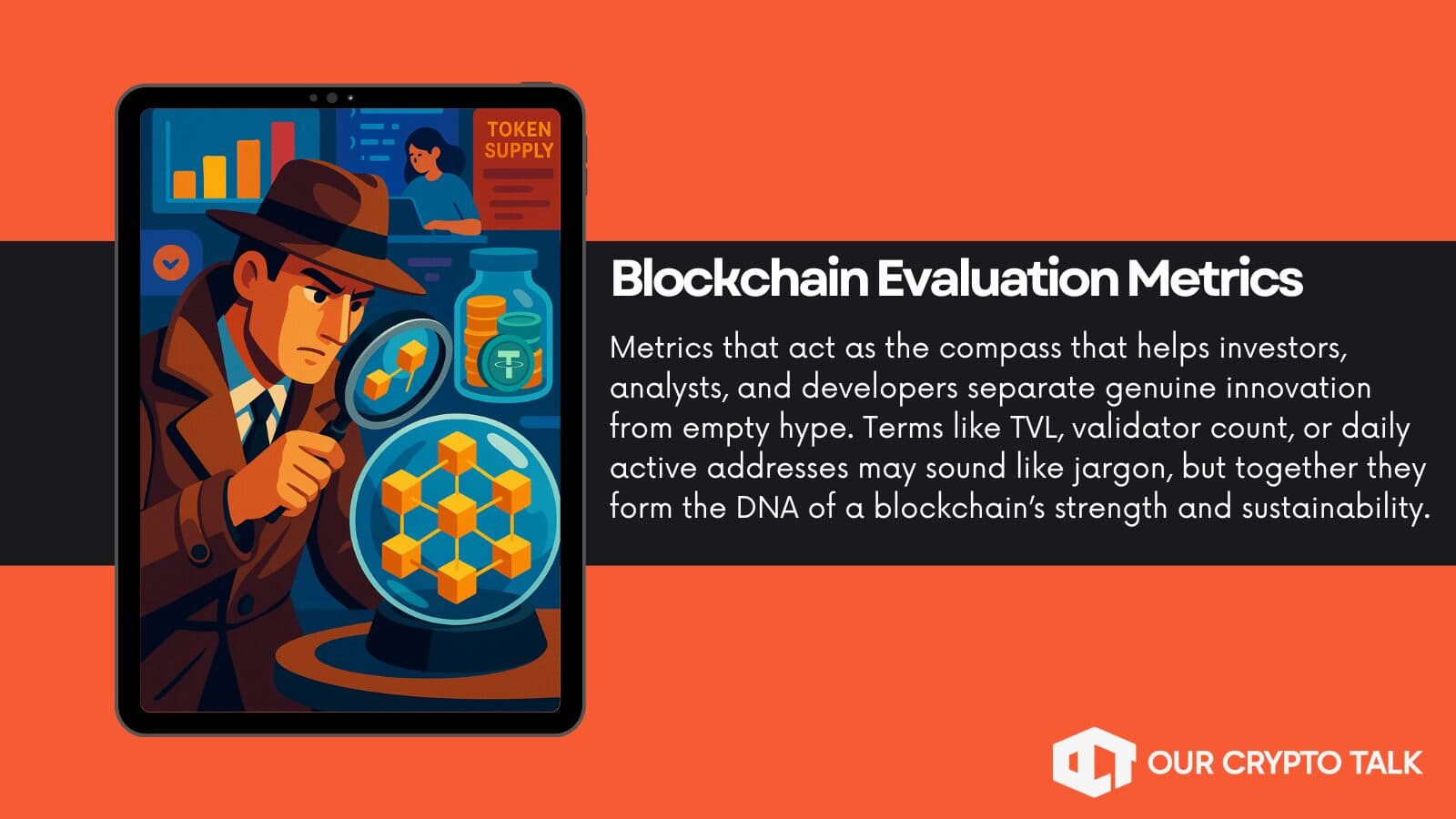
The blockchain industry has grown far beyond speculation. What began as an experiment in decentralized money has become the foundation for digital economies, smart contracts, and institutional-grade finance. As of late 2025, more than 15,000 active protocols compete for liquidity, developers, and users across Layer 1s, Layer 2s, and modular ecosystems. Yet, amid this explosion, one truth stands out: not all chains are created equal. That is where blockchain evaluation metrics come in. They act as the compass that helps investors, analysts, and developers separate genuine innovation from empty hype. Terms like TVL, validator count, or daily active addresses may sound like jargon, but together they form the DNA of a blockchain’s strength and sustainability.
Whether you are analyzing Ethereum’s dominance, Solana’s speed, or emerging ecosystems such as Monad and ZetaChain, standardized blockchain evaluation metrics reveal which projects are building for the long term. In this guide, we will explore ten core metrics that create a professional-grade framework for evaluating any blockchain network. These metrics cover liquidity, decentralization, developer activity, inflation, and much more.
The need for clarity has never been greater. By mastering these blockchain evaluation metrics, you can identify networks that will not only survive market cycles but also attract real users, consistent capital, and sustainable growth.

Why We Need Structured Blockchain Evaluation Metrics
In traditional finance, investors rely on well-known ratios such as price-to-earnings, free cash flow, or return on equity. These allow comparisons between companies and industries. In crypto, however, that structure has often been missing. The result is confusion and hype-driven decision-making.
Investors chase narratives like “DePIN season” or “modular summer,” while developers choose chains that later suffer from congestion or poor tokenomics. Retail users get caught in ecosystems that appear decentralized but are actually controlled by a handful of insiders. Without structured blockchain evaluation metrics, decisions are often based on emotion rather than fundamentals.
A clear framework helps solve three major problems:
- Comparability: Standard metrics make it possible to evaluate Solana, Avalanche, and Sui on equal footing.
- Risk Detection: Concentration risks, unsustainable inflation, and liquidity outflows can be identified early.
- Flywheel Validation: You can confirm whether developer activity leads to higher TVL, fee revenue, and stronger network security.
Research leaders such as Electric Capital, Messari, and Artemis already use similar frameworks internally. This guide brings that same analytical approach into a format anyone can apply, whether you are an investor, a builder, or an informed community member.
In short, structured blockchain evaluation metrics turn speculation into strategy. Let’s begin with the first and most visible indicator of blockchain health: total value locked.
1. Total Value Locked (TVL)
Definition: TVL represents the total dollar value of assets deposited in a blockchain’s smart contracts. It includes staking, lending, liquidity pools, and yield strategies. Essentially, it measures how much capital is actively working within a network.
Why it matters: TVL signals economic trust. When users deposit significant capital into a blockchain, they are showing confidence in its infrastructure, stability, and long-term potential. Ethereum’s $600 billion TVL in 2025 shows deep liquidity and trust across DeFi. On the other hand, Terra’s TVL collapse in 2022 demonstrated how inflated numbers can disappear overnight when built on weak foundations.

Benchmarks:
- Healthy: More than $500 million with at least 20% quarterly growth
- Warning: Below $100 million or a drop of more than 50% within 30 days
- Always adjust for token inflation or short-term liquidity farming
Pitfalls: Not all TVL is organic. Incentivized liquidity and bridged assets may cause double counting. Check if deposits are genuine user activity or temporary yield-chasing capital.
Takeaway: TVL should be the starting point in any blockchain evaluation metrics framework. It is the most direct reflection of economic gravity. Where liquidity moves, builders and innovation follow.
2. Active Addresses
Definition: Active Addresses, whether daily or weekly, represent unique wallets that interact with a blockchain. This includes sending tokens, executing smart contracts, or staking assets. The number helps estimate real network engagement.
Why it matters: A blockchain with high TVL but low user activity is fragile. Active Addresses reveal real adoption, not just locked capital. For example, Base recorded more than 500,000 weekly active addresses in mid-2025, showing consistent participation through events like Onchain Summer.

Benchmarks:
- Strong: Over 100,000 daily active addresses, or 500,000 weekly
- Weak: Fewer than 10,000 daily active addresses
- Growth target: More than 50% annual increase after filtering bots
Pitfalls:
- Sybil attacks can inflate numbers when one user controls multiple wallets.
- Cross-chain duplication occurs when the same wallet interacts with several networks.
Platforms such as Nansen and Dune Analytics now provide “real user” metrics that help distinguish organic participation from automation.
Takeaway: Combine Active Address data with TVL per user in your blockchain evaluation metrics. A healthy ratio is usually above $10,000 per active user, showing that participants are committed and capital is sticky.
3. Transactions and TPS
Definition: Transactions per second (TPS) and total transaction count reveal a blockchain’s throughput and scalability. They measure how efficiently a network handles user activity and smart contract operations.
Why it matters: Scalability defines usability. A blockchain must process transactions quickly and at low cost to support mass adoption. Ethereum processes around 15 transactions per second on its main layer but exceeds 150 when Layer 2 activity is included. Solana’s 2,000-plus TPS supports real-time applications like Pump.fun and on-chain gaming.

Source : Chainspect
Benchmarks:
- For Layer 1: More than 50 average TPS, and 500 or higher during peak periods
- For Layer 2: Over 100 average and 1,000 at peak
- Red flag: Frequent congestion or average fees above one dollar per transaction
Pitfalls: Some projects inflate TPS numbers by batching small or empty transactions. Always consider value transferred per transaction to detect genuine usage.
Takeaway: TPS is the scalability checkpoint in any blockchain evaluation metrics system. Without sufficient throughput, adoption slows down and costs rise. Sustainable blockchains show both speed and real user demand, not artificially boosted data.
4. Whale Concentration
Definition: Whale concentration measures how much of a token’s total supply is held by the largest wallets, typically the top 10 or top 100 holders. It acts as an early warning signal for potential manipulation or governance imbalance.
Why it matters: A blockchain might look decentralized on paper, but if a small group of wallets holds most of the supply, control is effectively centralized. High concentration increases the risk of large sell-offs, price crashes, and coordinated governance votes. Bitcoin’s top 100 addresses hold less than 15% of supply, showing broad distribution. In contrast, Aptos at launch had its top 10 wallets holding more than 60%, which led to heavy selling after token unlocks.
Benchmarks:
- Safe zone: Top 100 wallets below 30% of supply, top 10 below 15%
- Risk zone: Top 10 above 50% or known centralized custody (for example, exchanges)
- Ideal: Gradual distribution with no single wallet above 5%
Pitfalls: Custodial wallets, such as those owned by Binance or Coinbase, can distort these numbers since they represent thousands of users. Similarly, staking pools like Lido hold large amounts of ETH, but that does not always mean control.
Takeaway: When using blockchain evaluation metrics, combine whale concentration data with validator distribution. A chain that scores poorly on both is highly centralized and risky to hold long term.
5. Validator and Staking Decentralization
Definition: For proof-of-stake blockchains, validator count and the distribution of staked tokens determine how decentralized and censorship-resistant a network is. These metrics directly influence the cost and difficulty of attacking the network.
Why it matters: Decentralization is not just philosophy; it is the network’s defense mechanism. Ethereum’s 900,000 validators in 2025 make it one of the most secure blockchains, with an estimated $20 billion required to coordinate an attack. On the other hand, some newer chains rely heavily on a few validators or foundation nodes, which exposes them to manipulation.
Benchmarks:
- Secure: More than 1,000 validators with no entity controlling over 10% of total stake
- Caution: Fewer than 100 validators or one entity controlling 33% or more
- Ideal Nakamoto Coefficient: 20 or higher, meaning at least 20 independent entities would need to collude to attack the chain
Pitfalls: Some validators operate multiple nodes under different names, masking real centralization. Hosting concentration is another risk, as a large portion of nodes running on AWS or Google Cloud makes the network vulnerable to coordinated downtime.
Takeaway: In your blockchain evaluation metrics, validator health is the foundation of security. Always check both diversity and distribution. A network with many validators spread across independent operators and geographies is built to last.
6. Fee Revenue and Economic Security
Definition: Fee revenue represents the total amount of transaction fees users pay daily, usually in USD terms. Economic security measures how much of these fees contribute to validator rewards or are burned to offset inflation. Together, they show whether a blockchain’s economy can sustain itself without excessive token issuance.
Why it matters: Fees are not just income; they reflect real demand for block space. A blockchain that consistently generates fees proves it delivers value worth paying for. Ethereum’s daily fee revenue of over $2 million in 2025 shows strong usage. Solana’s $500,000 per day supports more than 2,000 validators. If fees fall below the cost of running the network, inflation must fill the gap, which weakens token value over time.
Benchmarks:
- Healthy: More than $500,000 in daily fees, with at least 50% of validator rewards coming from transaction revenue
- Weak: Below $50,000 per day or over 90% reliance on inflation rewards
- Ideal: Fee burn higher than new issuance, similar to Ethereum’s “ultrasound money” model
Pitfalls:
- Temporary fee spikes during congestion do not equal real sustainability.
- Check 30-day moving averages for a better view.
- Some chains hide emissions under treasury allocations or staking incentives.
Takeaway: Fee revenue is one of the most powerful blockchain evaluation metrics for measuring long-term health. Networks that earn real, recurring fees can sustain security without endless token printing.
7. Developer Activity
Definition: Developer activity tracks GitHub commits, active contributors, and the frequency of protocol upgrades. It captures the human side of blockchain growth: the builders behind the code.
Why it matters: Developers are the lifeblood of any blockchain ecosystem. They create the applications, tools, and integrations that attract users and liquidity. High developer activity usually predicts long-term resilience, because a constantly improving protocol adapts to market and technical changes. According to Electric Capital’s 2025 report, Ethereum leads with more than 4,000 monthly active developers, far surpassing any other network.
Benchmarks:
- Thriving: Over 50 monthly active developers and at least 100 commits per week in core repositories
- Weak: Fewer than 10 developers or no major updates in the last six months
- Growth: Year-over-year developer count increase of 30% or higher
Pitfalls:
- Forked repositories can artificially inflate commit numbers.
- Counting all ecosystem projects instead of core repos can give a misleading picture.
Use tools such as Electric Capital reports, CryptoMiso, or Santiment’s developer activity index, which weights commits by quality and frequency.
Takeaway: Among blockchain evaluation metrics, developer activity is the best leading indicator of innovation. A vibrant builder community means the network is improving continuously, making it more likely to survive multiple market cycles.
8. Stablecoin Market Cap
Definition: Stablecoin market cap measures the total value of USD-pegged tokens (like USDT, USDC, or DAI) issued on a blockchain. It reflects how much real-world capital has entered and is circulating within that ecosystem.
Why it matters: Stablecoins are the bridge between traditional finance and on-chain liquidity. When investors move stablecoins onto a blockchain, they bring spending power, yield farming liquidity, and transaction volume. Ethereum hosts over $15 billion in stablecoins, serving as the backbone of DeFi. Chains with limited stablecoin activity often struggle to attract serious users or institutional flows.
Benchmarks:
- Mature network: Over $1 billion in stablecoin supply and at least 20% of TVL
- Growing network: Over $100 million and consistent month-to-month increase
- Weak network: Below $10 million, showing poor integration or low trust
Pitfalls:
- Some stablecoins are issued off-chain and do not appear in blockchain data.
- Double counting occurs when bridged assets are included twice.
- Always track mint and burn events for accurate measurement.
Takeaway: Stablecoins are a clear sign of liquidity health in your blockchain evaluation metrics. They show whether real money is entering the ecosystem or if capital is just rotating internally.
9. Bridge TVL and Cross-Chain Flows
Definition: Bridge TVL represents the total value of assets locked in cross-chain bridges. Cross-chain flows measure the capital moving between ecosystems over time. Both reveal how connected a blockchain is to the broader crypto economy.
Why it matters: No blockchain thrives in isolation. Interoperability is now one of the strongest indicators of network maturity. High bridge TVL suggests that users trust the chain enough to move assets into it. Continuous inflows mean growing adoption, while frequent outflows hint at capital flight. Arbitrum’s $12 billion bridge TVL in 2025 is a prime example of network stickiness.
Benchmarks:
- Sticky network: Bridge TVL exceeds 20% of total chain TVL, with steady net inflows
- At risk: Outflows above $100 million weekly or shrinking bridge activity
- Secure: No major bridge exploit for at least 12 months
Pitfalls:
- Bridges have been the most common target for hacks. Always check audits and history.
- Some bridges inflate TVL through internal loops or test deployments.
Takeaway: Bridge data is essential in any set of blockchain evaluation metrics. It helps identify which chains are truly interoperable and where liquidity is likely to flow next.
10. Inflation Rate and Emission Schedule
Definition: Inflation rate measures the annual percentage increase in a token’s circulating supply. The emission schedule outlines how new tokens are distributed over time. Together, they reveal how sustainable a blockchain’s incentive design really is.
Why it matters: Inflation erodes value if not balanced by real demand or burning mechanisms. Bitcoin’s inflation has fallen below 1% in 2025, reinforcing its scarcity narrative. By contrast, some newer Layer 1s still inflate above 30% annually, creating constant sell pressure. Investors should look for transparent, predictable emissions that reward participation without destroying token value.
Benchmarks:
- Sound: Annual inflation below 5%, ideally with a programmed halving or burn system
- Caution: Between 10% and 20%, especially if governance can mint arbitrarily
- Risky: Above 20% or unlimited supply potential
Pitfalls:
- Some projects hide inflation through “treasury” or “foundation” wallets.
- Always review token contracts to confirm actual minting permissions.
Takeaway: Inflation management is the final piece in your blockchain evaluation metrics. It determines long-term holder alignment and whether the project’s economy can sustain itself without constant new issuance.
TL;DR : Blockchain Evaluation Metrics
- TVL: Measures total liquidity and investor confidence.
- Active Addresses: Tracks genuine user activity.
- Transactions & TPS: Tests scalability and network speed.
- Whale Concentration: Highlights centralization risks.
- Validator Distribution: Reflects security and censorship resistance.
- Fee Revenue: Indicates real economic sustainability.
- Developer Activity: Signals innovation strength.
- Stablecoin Market Cap: Shows real capital inflow.
- Bridge TVL: Measures interoperability and capital retention.
- Inflation Rate: Reveals long-term token health.
When combined, these ten blockchain evaluation metrics create a complete diagnostic toolkit. They transform blockchain research from speculation into informed, data-driven analysis.
FAQs — Blockchain Evaluation Metrics
What are blockchain evaluation metrics used for?
How often should these metrics be reviewed?
Is Total Value Locked always the most important metric?
Which metrics matter most for early-stage projects?
Where can I find reliable data for these metrics?
How do inflation and emissions affect token price?
Can these metrics predict future performance?
In this article
Why We Need Structured Blockchain Evaluation Metrics1. Total Value Locked (TVL) 2. Active Addresses 3. Transactions and TPS4. Whale Concentration 5. Validator and Staking Decentralization 6. Fee Revenue and Economic Security 7. Developer Activity 8. Stablecoin Market Cap 9. Bridge TVL and Cross-Chain Flows 10. Inflation Rate and Emission Schedule TL;DR : Blockchain Evaluation Metrics