Stablecoin Market Cap: Why Does It Matter?
A complete breakdown of stablecoin market cap, including chain level distribution, dominant tokens, DeFi usage, risks.


Author: Chirag Sharma
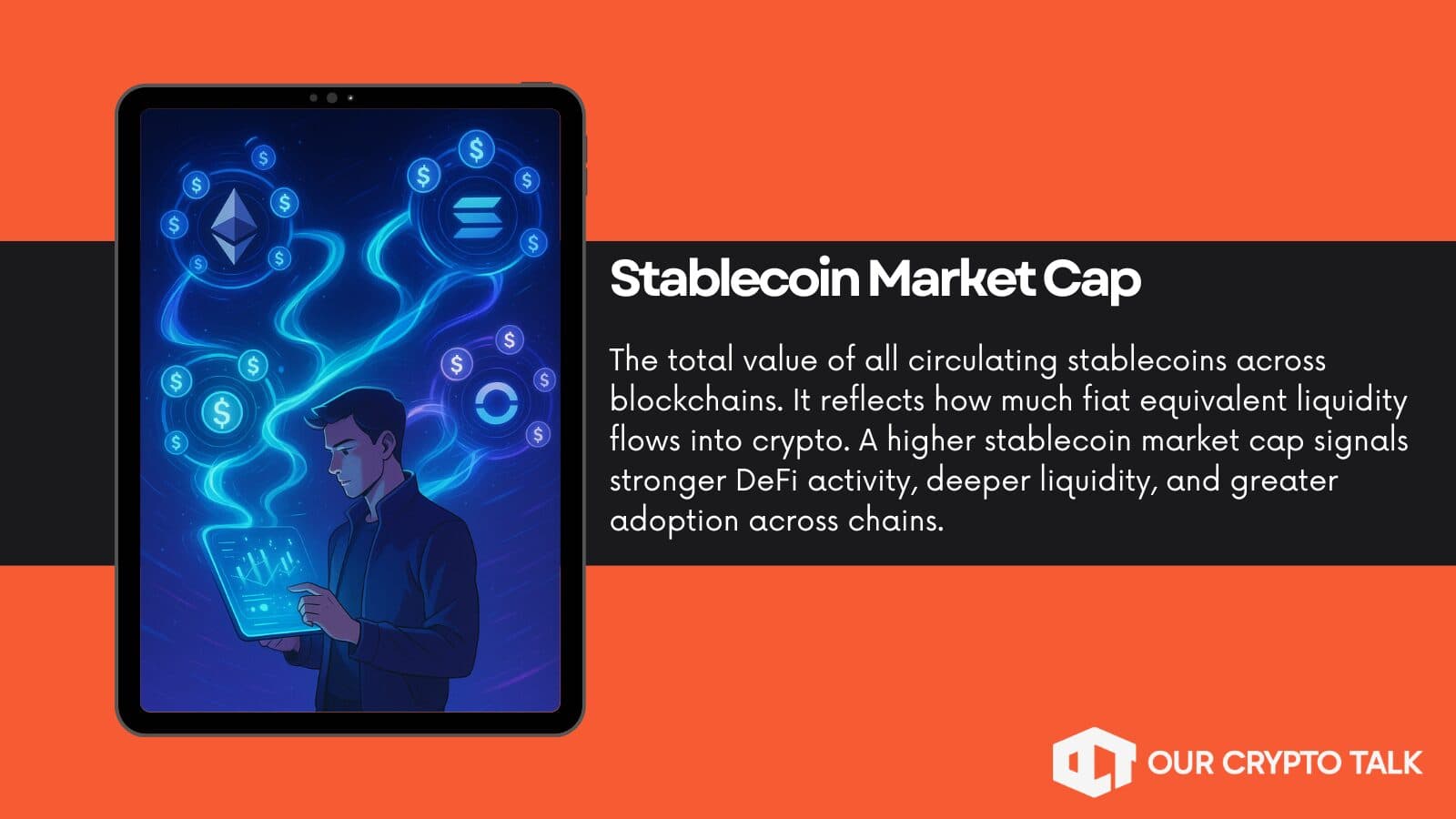
Stablecoins have become the backbone of the digital asset economy. They were created to solve a simple but critical problem in crypto. Traders and users needed a reliable way to store value without exiting to fiat. As the crypto market matured, stablecoins evolved into much more than a temporary parking asset. They now power exchanges, payments, lending protocols, institutional flows, and cross chain transfers. Because of this, the stablecoin market cap has become one of the most important indicators of on chain liquidity and ecosystem health.
In the fast changing environment of 2025, stablecoins bridge traditional money with the Web3 world. Their growth runs parallel to rising adoption, deeper financial integrations, and the expansion of blockchain networks. Every chain competes to attract liquidity, and the stablecoin market cap distribution across these chains tells us which networks users trust the most. It reveals where capital prefers to stay, where DeFi thrives, and where stablecoin users find the best mix of speed, low fees, and application support.
Today, the total stablecoin market cap is above 300 billion dollars. Ethereum still leads, but the rise of Tron, Solana, Base, Arbitrum, and newer chains shows a clear trend. Users follow the path of efficiency. This article breaks down how stablecoins evolved, how market capitalization works, why chain level distribution matters, and what these flows tell us about the future of liquidity in Web3.

Foundations and Evolution of Stablecoins
Stablecoins were introduced as a response to crypto’s extreme volatility. In the early era of Bitcoin and Ethereum, price swings made it difficult for traders and builders to operate with predictable value. The answer arrived with fiat backed models such as Tether in 2014, which offered a one to one value peg with the US dollar. For the first time, users could stay on chain while holding an asset that behaved like cash.
Over time, stablecoins evolved into different categories.
- Fiat collateralized tokens like USDT and USDC rely on bank reserves and audited assets.
- Crypto collateralized assets like DAI depend on over collateralized deposits and smart contracts.
- Algorithmic models attempted to maintain their peg through supply adjustments. Some succeeded for short periods, while others failed dramatically.
- Newer interest bearing stablecoins enable yield generation while maintaining stable value.
This evolution shaped the modern stablecoin market cap. Demand surged during the 2020 DeFi boom, pushing the market cap from under 10 billion dollars to more than 100 billion dollars in a single year. By 2025, continued integration with financial institutions, cross chain applications, and real world asset protocols pushed stablecoin usage into the mainstream.
These foundations matter because the type of collateral and the design of a stablecoin influence trust. Trust determines adoption, and adoption drives the stablecoin market cap across chains. Networks that support sophisticated smart contracts, strong applications, and high transactional throughput naturally attract more stablecoin liquidity. Ethereum is the prime example, hosting the widest stablecoin variety and the deepest DeFi markets. Meanwhile, chains with cheaper fees attract high volume payment users, which is one reason Tron became a major force.
Understanding this history helps explain why liquidity settles where it does today and how stablecoin market cap continues to evolve across blockchain ecosystems.
How Stablecoin Market Cap Works
Market capitalization for stablecoins looks similar to that of other digital assets but carries unique characteristics. Since stablecoins aim to stay near one dollar, their market cap mostly reflects circulating supply rather than price fluctuations. The formula stays simple. Circulating supply multiplied by price equals market cap. Because the price barely moves, any increase or decrease in the stablecoin market cap directly represents inflows or outflows of real world liquidity.
Several components influence this metric.
- Circulating supply shows how many tokens are actively used in the market.
- Total supply includes tokens not yet issued or locked in contracts.
- On chain reserves and off chain audits determine confidence in the peg.
- Fiat redemptions burn tokens and reduce market cap.
- High issuance periods increase market cap as more value enters the ecosystem.
A rise in stablecoin market cap often signals growing participation in DeFi, preparation for market volatility, or capital rotating into safer positions. A decline may indicate users exiting into fiat, making redemptions, or lowering exposure during uncertain market conditions.
Another key detail is bridged stablecoins. When tokens move across chains using bridge protocols, they contribute to the stablecoin market cap on the destination chain even though they were minted originally elsewhere. This is why chains like Base, Arbitrum, and Polygon show strong numbers. They borrow liquidity from Ethereum rather than minting stablecoins natively.
These metrics provide a clearer picture of the economic health of each chain. A rising stablecoin market cap signals expanding liquidity and user confidence, while declining levels may suggest shifts toward other networks or short term market caution.
Stablecoin Market Cap Across Blockchain Chains in 2025
The distribution of stablecoin liquidity across chains offers one of the most reliable ways to understand user preferences and productivity within Web3. Based on the dataset provided, Ethereum continues to dominate with a stablecoin market cap of 168.656 billion dollars. Despite a negative 24 hour TVL change, Ethereum’s massive bridged TVL of more than 463 billion dollars shows its role as the core liquidity source for the entire multi chain ecosystem. Ethereum remains the home of DeFi infrastructure, RWAs, institutional flows, and sophisticated smart contract applications. These attributes naturally attract stablecoin activity.
Tron follows with a significant 81.362 billion dollar stablecoin market cap. Tron appeals to users seeking fast and low cost transfers, making it popular for global payments and remittances.
Solana holds a stablecoin market cap of 16.005 billion dollars, supported by its speed and efficiency. As Solana’s DeFi ecosystem expanded, stablecoin flows increased. Its bridged TVL of 49.006 billion dollars shows strong cross chain connections and rising developer activity.
BSC maintains 14.654 billion dollars in stablecoin market cap, drawing users who prefer Ethereum compatible tooling but lower fees. Its role as a retail friendly chain keeps stablecoin liquidity consistent.
Base, Coinbase’s Layer 2, reports 4.869 billion dollars. Its growth rate is impressive given its young age. With strong USDC dominance and tight integration with Coinbase products, Base is becoming an important liquidity hub.
Arbitrum and Polygon remain leading scaling solutions, showing stablecoin market caps of 4.612 billion dollars and 2.858 billion dollars respectively. Both chains benefit from DeFi adoption, NFT economies, and applications seeking lower fees than Ethereum mainnet.
Emerging chains like Plasma show notable growth. Plasma’s 15 percent rise in stablecoin market cap puts it at 2.221 billion dollars.
Some chains, such as Aptos and Sui, show declining stablecoin values. Aptos at 1.8 billion dollars and Sui at 514 million dollars reflect a temporary slowdown.
Dominant Stablecoins and Their Chain Preferences
The distribution of stablecoins across chains is shaped heavily by which tokens users prefer and why issuers choose to deploy on certain networks. The three dominant stablecoins, USDT, USDC, and DAI, account for the majority of the global stablecoin market cap. Their chain preferences influence liquidity depth, user behavior, and the growth potential of each ecosystem.
Ethereum hosts the richest mix of stablecoins. USDT controls roughly half of Ethereum’s stablecoin market cap while USDC holds a large portion as well. DAI and newer alternatives like USDS also play meaningful roles.
Tron tells a different story. It is overwhelmingly dominated by USDT, representing more than 98 percent of its stablecoin liquidity. This heavy concentration comes from Tron’s core use case as a fast, low cost settlement layer for global transfers.
Solana leans toward USDC because of its speed and growing DeFi environment.
Base is almost entirely USDC driven, with more than 90 percent of its stablecoin market cap coming from a single token.
BSC maintains a healthy balance between USDT and BUSD, attracting retail users who appreciate lower fees.
These differences are not random. They reflect the habits and needs of each ecosystem’s users. Payment heavy chains choose USDT, DeFi centric chains choose USDC, and multi protocol environments mix several stablecoins to maximize liquidity. This dynamic directly affects how stablecoin market cap is distributed across blockchains.
Factors Driving Market Cap Variations Across Chains
Stablecoin liquidity does not stay still. The stablecoin market cap on each chain moves because of a mix of technical, economic, and behavioral influences. Understanding these variations helps understand why some ecosystems grow quickly while others see temporary declines.
Technical Factors
• Transaction fees directly affect where users hold and move stablecoins. High fee environments push stablecoins toward cheaper alternatives.
• Scalability and throughput determine how many transactions a network can handle without congestion.
• Security and uptime influence trust and encourage long term liquidity storage.
Economic Factors
• Chains offering strong yield opportunities attract inflows. Pools that pay high APYs in stablecoin based strategies can quickly raise a chain’s stablecoin market cap.
• Incentive programs from new chains often distribute rewards to stablecoin depositors, pulling liquidity away from older chains.
• Market sentiment plays a major role. During volatile conditions, users shift into stablecoins, increasing market cap temporarily.
Cross Chain Factors
• Bridging efficiency makes it easier for stablecoins to migrate. Chains with smooth and low risk bridging options grow faster.
• Applications that operate across multiple networks encourage stablecoin movement into ecosystems with better performance or lower cost.
• Native minting also influences market cap. When issuers decide to mint directly on a chain, liquidity surges.
User Behavior
- Payment focused users usually choose the fastest and cheapest environments.
- DeFi users prefer chains with strong lending, borrowing, or derivatives platforms.
- NFT and gaming users bring stablecoins into ecosystems where fees can stay predictable.
These factors interact constantly. This is why stablecoin market cap can grow on a rapidly developing chain and shrink on a chain that fails to keep users engaged or competitive.
Role of Stablecoins in DeFi and Web3 Ecosystems
Stablecoins form the base layer of modern DeFi. Without them, most decentralized applications would lack reliable liquidity and predictable pricing. Their importance goes beyond trading. Stablecoins support lending markets, collateral systems, derivatives, remittances, and on chain treasury operations. The size of a chain’s stablecoin market cap often mirrors the strength of its DeFi ecosystem.
Stablecoins in Lending and Borrowing
Platforms like Aave, Compound, Benqi, and similar protocols rely heavily on stablecoins. High liquidity allows users to borrow against assets, earn yield, and manage leverage. Without large amounts of stablecoin liquidity, these systems cannot function efficiently.
Stablecoins in Trading and Derivatives
Decentralized exchanges need deep stablecoin pools to maintain tight spreads and smooth swaps. Perpetual futures protocols also depend on stablecoins as collateral, making liquidity a critical element for leverage based markets.
Stablecoins in RWAs and Institutional Finance
Real world asset tokenization depends on stablecoins for settlement and payouts. Treasury bills, commercial loans, and yield bearing instruments rely on stablecoin infrastructure to move capital efficiently across borders.
Stablecoins in Payments and Cross Border Transfers
Chains like Tron, Solana, and Base see strong stablecoin usage for simple payments. Users prefer stablecoins because they reduce volatility and allow instant settlement. This practical utility lifts a chain’s stablecoin market cap over time.
Stablecoins have become the universal language of value in Web3. They remove volatility from the equation and allow users to interact with decentralized systems in predictable ways. Chains with high stablecoin market cap benefit from healthier liquidity, more development, and stronger network effects.
Risks and Challenges in the Stablecoin Ecosystem
Stablecoins bring reliability to volatile markets, but they also come with their own risks. These risks shape how stablecoin liquidity moves across chains and can impact the overall stablecoin market cap. Understanding them is essential for anyone analyzing ecosystem strength or long term sustainability.
Peg Instability
Stablecoins rely on maintaining a consistent value. If a stablecoin loses its peg, confidence drops instantly. This happened during the collapse of algorithmic models like UST, which wiped billions in value from the global stablecoin market cap. Even fiat backed tokens can experience temporary slips during high volatility or liquidity crunches.

Reserve Transparency
Stablecoins backed by fiat depend on issuer integrity and reserve audits. Lack of clear disclosures reduces trust and can trigger redemptions. When large redemptions occur, the stablecoin market cap declines as tokens are burned and converted back into fiat.
Regulatory Pressure
Regulators around the world are now focusing on stablecoins. Many countries are drafting laws that may restrict issuance, require stricter audits, or ban specific models. These changes can shift liquidity from one chain to another or reduce a token’s supply, directly impacting the stablecoin market cap.
Bridge Risks
Bridges play a major role in distributing stablecoins across chains. They also represent one of the biggest security vulnerabilities. Bridge hacks and exploits can freeze or drain large sums, impacting bridged portions of the stablecoin market cap and reducing trust in certain networks.
Concentration Risks
Several chains rely heavily on a single stablecoin. Tron depends almost entirely on USDT. Base relies on USDC. If something goes wrong with a dominant stablecoin on a chain, it affects the entire ecosystem’s liquidity. Over concentration makes chains vulnerable to issuer decisions, regulatory changes, or technical issues.
Chain Specific Risks
Some blockchains experience outages, congestion, or technical failures. If users cannot transact reliably, they move liquidity away. This reduces the stablecoin market cap on that network and can slow ecosystem growth.
These risks show why stablecoin market cap is not just a measure of liquidity but also a measure of user confidence. Stability, security, and transparency will determine which chains maintain or grow their share of the global stablecoin landscape.
Conclusion
Stablecoins have become the most important on chain asset class in crypto. Their steady value and broad utility make them the foundation of DeFi, payments, on chain finance, and cross border transactions. Tracking the stablecoin market cap provides a clear lens into where liquidity is flowing, which chains are thriving, and how users choose to interact with digital money.
Ethereum continues to lead because of its deep DeFi roots and institutional involvement. Tron dominates global transfers. Solana and Base are rising because of their performance and ecosystem support. Layer 2 chains are growing as users seek scalability, while newer chains compete through incentives and unique use cases.
As the total stablecoin market cap now crosses 300 billion dollars, its distribution across blockchains tells a story about adoption, user preferences, and the evolution of Web3. The future will bring more stablecoin types, more institutional integration, and more cross chain liquidity. With proper risk management and transparent issuers, stablecoins will only become more central to global digital finance.
In this article
Foundations and Evolution of StablecoinsHow Stablecoin Market Cap WorksStablecoin Market Cap Across Blockchain Chains in 2025Dominant Stablecoins and Their Chain PreferencesRole of Stablecoins in DeFi and Web3 EcosystemsRisks and Challenges in the Stablecoin EcosystemConclusion