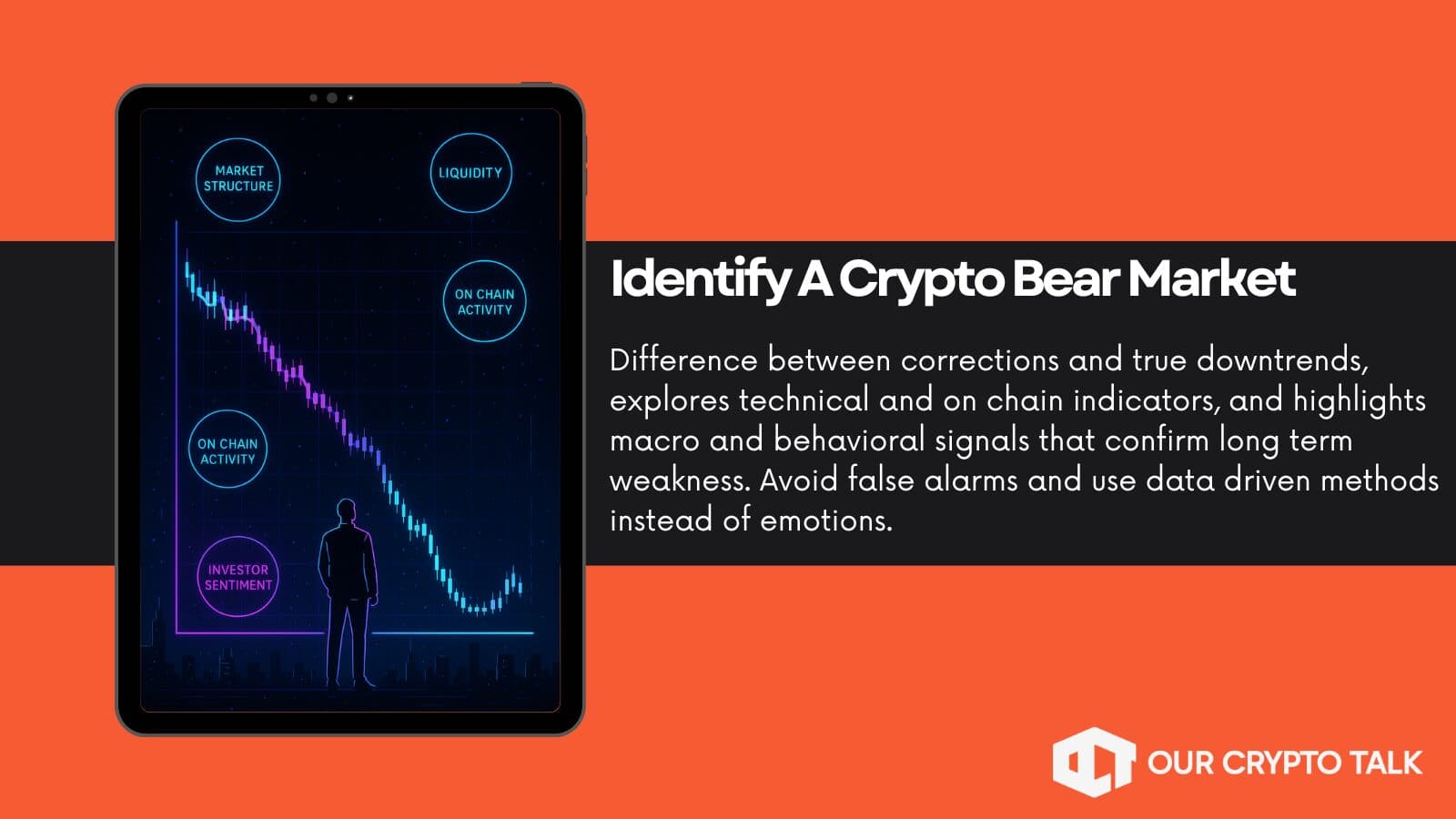
Crypto Bear Market: 8 Signals to Spot One
How to spot a crypto bear market: the 8 technical, on-chain, and macro signals that warned before every majordrawdown since 2018.


Author: Chirag Sharma
Markets move in cycles. They rise, fall, consolidate, trend, and reverse. For new investors, it can feel confusing when prices drop sharply and headlines immediately warn of a collapse. However, not every correction is a long lasting downturn. This is why it is essential to learn how to identify a bear market using clear definitions and reliable signals rather than emotions or social media noise. A crypto bear market can be a difficult period, but it is also one of the most valuable learning experiences for any investor. It shapes long term discipline, risk management, and strategy.

This guide will help you identify a bear market with confidence by breaking down how traditional finance and crypto define it, which indicators matter, and how to avoid false alarms. The concepts here will remain relevant across multiple cycles regardless of short term events. By the end, you will understand the mechanics of bear markets, how to confirm them, and how to prepare for them with logic instead of fear.
What Is a Crypto Bear Market?
A bear market is a prolonged period of declining prices that reflects a broad shift in investor sentiment from optimism to caution. It is often driven by economic weakness, falling liquidity, or structural changes in the market.
In traditional finance, analysts use a simple rule. When a major index like the S&P 500 or NASDAQ falls 20 percent or more from recent highs, it is considered a bear market. This rule helps investors identify a bear market quickly, but it is not perfect. It treats all declines the same, even though many drops recover without leading to a deeper downtrend.
Crypto markets behave differently. They move faster and with more volatility. A 20 percent decline in crypto can happen in a single day. Therefore, using the same definition does not work well. Instead, crypto analysts rely on duration, structure, and on chain behavior to identify a bear market. In crypto, a short dip does not qualify. A true bear market must last several months or longer and must show clear signs of weakening demand.
Understanding these differences is important because it helps you build an objective way to identify a bear market rather than react to short lived price swings.
Bear Markets vs Corrections
Not every dip is a bear market. Corrections play a healthy role in both traditional and crypto markets. They shake out excess leverage, rebalance positions, and create better entry points.
Here is a table that shows the difference between a correction and a bear market.
Corrections are common. Bear markets are less frequent but more impactful. Learning how to identify a bear market requires understanding these differences clearly.
How Traditional Finance Identifies a Bear Market
Financial institutions rely on a combination of price action, economic indicators, and investor behavior to identify a bear market. While the 20 percent rule is widely used, analysts look at deeper signals too.
1. Prolonged Downtrend
A major index trending lower for several months signals long term weakness. The trend becomes more important than the percentage drop.
2. Declining Earnings and Growth
If companies report falling profits, lower revenue forecasts, and slower expansion, it often leads to sustained selling pressure.
3. Tightening Liquidity
When central banks raise interest rates or reduce balance sheets, borrowing becomes expensive. This reduces investment and increases risk aversion.
4. Rising Unemployment
Weak job markets reduce consumer spending and generally mark the early stages of recessions.
5. Negative Investor Sentiment
Surveys that track fear and confidence shift sharply. Investors pull money out of equities and move into safer assets.
These signals combine to help analysts identify a bear market early. However, crypto requires a different approach due to its structure.
How Crypto Markets Identify a Bear Market
Crypto cycles follow a rhythm. They move from accumulation to uptrend, then from euphoria to breakdown. The signals in crypto are unique because of its open on chain data and heavy reliance on liquidity.
Here are the core indicators used to identify a bear market in crypto.
1. Duration of the Downtrend
Crypto corrections can be sharp and temporary. A bear market lasts months or longer. The momentum fades gradually and bounces become weaker over time.
2. Breakdown of Key Technical Levels
Crypto analysts monitor levels like:
- 200 day moving average
- 21 week moving average
- Long term support zones
A clean breakdown of these levels with no quick recovery is one of the first steps to identify a bear market.
3. Rising Exchange Reserves
When investors send coins to exchanges, it usually signals an intent to sell. Exchange reserves rise noticeably at the start of bear markets.
During bullish phases, reserves decline as investors move assets into cold storage. This change in behavior is a reliable way to identify a bear market early.
4. Long Term Holder Distribution
Long term holders tend to hold during volatility. They distribute heavily near cycle tops. A spike in long term holder selling is a major signal. On November 20th, 2025, Owen Gunden, a holder since 2011 sold Bitcoin for $1.3 billion

5. Declining Network Activity
Blockchains show lower transaction volumes, fewer active addresses, and slower network growth during bear markets. This decline reflects weakening demand.
6. Weak Funding and Leverage Conditions
A shift from positive to negative funding rates, combined with falling open interest, often indicates that market momentum has reversed.
Together, these signals help investors identify a bear market without relying only on price.
Technical Indicators That Help Identify a Bear Market
Technical analysis adds structure to market behavior. These tools help clarify whether a market is in a correction or a deeper downtrend.
1. Moving Averages
Long term moving averages smooth out price movements. If the price stays below the 200 day moving average for months, it often confirms a bear market or 50-SMA on the weekly timeframe

2. Death Cross
This occurs when the 50 day moving average crosses below the 200 day moving average. It reflects weakening momentum, although it must be combined with other indicators because it can appear late.
3. Lower Highs and Lower Lows
Markets trend downward in a staircase pattern. Repeated lower highs and lower lows confirm a bearish structure.
4. Relative Strength Index (RSI)
Persistent RSI readings below 40 often align with bearish phases. Oversold conditions that fail to recover can indicate deeper weakness.
5. Volume Trends
Falling volume during price declines may show exhaustion. Rising volume during declines often shows strong selling pressure.
Using these tools helps investors identify a bear market based on objective market structure instead of reacting emotionally.
On Chain Indicators That Signal a Bear Market
Crypto’s unique advantage is transparent on chain data. This data makes it easier to identify a bear market early because it reveals how long term investors behave.
1. Exchange Inflows Rising
A rise in coins flowing to exchanges usually means selling pressure is increasing. This signal appears early in most bear markets.

2. Declining Long Term Holder Supply
Long term holders begin distributing coins near tops. When this trend accelerates and holdings decline for months, it supports the case for a bear market.
3. MVRV Ratio
The Market Value to Realized Value ratio shows whether the market is overheated or undervalued.
Here is a simple table.
A bear market often begins when the MVRV stays below 1.0 for extended periods.
4. Lower Network Activity
Fewer transactions, fewer active addresses, and lower mempool usage indicate weakening demand.
5. Miner Stress
Miners often sell Bitcoin to cover operational costs during weak markets. Rising miner outflows can add selling pressure.
These signals create a clearer framework to identify a bear market using real on chain behavior rather than speculation.
Macro Signals That Help Identify a Bear Market
Crypto is highly sensitive to global liquidity. When liquidity dries up, risk assets decline. When liquidity expands, markets recover.
Here are the macro conditions that help identify a bear market.
1. Rising Interest Rates
Higher borrowing costs slow investment and reduce demand across markets.

2. Balance Sheet Reduction
When central banks reduce liquidity, it often triggers downtrends in risk assets.
3. Strong Dollar
A strong dollar withdraws liquidity from global markets and places pressure on assets like crypto.
4. Economic Slowdowns
Weak job data, falling growth, and declining spending contribute to long lasting market weakness.
5. Decline in Corporate or Institutional Flows
Lower investment levels from companies or funds can signal a shift to caution.
These macro conditions influence the broader environment and help investors identify a bear market even before it becomes obvious on charts.
Behavioral Indicators: How Investor Psychology Confirms a Bear Market
Markets are driven by psychology as much as economics. Human behavior plays a major role when trying to identify a bear market.
Here are the most common behavioral signs:
1. Loss of Retail Interest
Search trends fall. Social media activity declines. New investors stop entering the market.
2. Decline in Media Coverage
News coverage becomes less frequent or more negative.
3. Selling Pressure From Panic
Fear driven selling increases. Investors prefer stable assets or move to cash.
4. Longer Consolidation Periods
Markets stop reacting to good news. Even positive developments fail to create strong rallies.
5. Lower Participation
Trading volumes fall. Communities become quieter. Forums lose activity.
These signals often appear before technical confirmation and help investors identify a bear market early.
How to Avoid False Bear Market Signals
Not every scary chart marks the beginning of a bear cycle. Investors often confuse short corrections with long term reversals.
To avoid false alarms, follow these rules:
1. Look for multiple confirmations
Use at least three categories of signals:
- Price structure
- On chain data
- Macro environment
One signal alone is not enough to identify a bear market.
2. Focus on duration
A decline that lasts days or weeks is not a bear market. It must persist for months with consistent weakness.
3. Avoid relying only on price percentage drops
A 20 percent drop is meaningful in stocks. In crypto, it is normal during bull markets.
4. Use weekly trends instead of daily charts
Short term volatility can mislead you. Weekly trends reveal major shifts.
5. Watch how long term holders behave
Long term holder selling is one of the most reliable signs of a market top.

Conclusion
Identifying a bear market is not about watching every dip. It is about understanding market structure, investor behavior, on chain trends, and macro conditions. When several categories align for weeks or months, the trend becomes clear. A bear market is rarely confirmed by a single event. It forms gradually as demand fades and confidence weakens.
By using the tools in this guide, you can identify a bear market early, avoid emotional decisions, and position yourself with clarity. This framework is designed to remain relevant across traditional markets and crypto markets, helping you stay grounded through volatility and uncertainty.
Understanding how to identify a bear market is one of the most important skills for long term success. Use these principles, stay objective, and let data guide you rather than fear.
FAQs — How to Identify a Bear Market
How do you identify a bear market in simple terms?
Is a 20 percent drop enough to confirm a bear market?
What is the most reliable signal of a bear market in crypto?
How long does a typical bear market last?
Can you identify a bear market before it becomes obvious?
What is the difference between a correction and a bear market?
Do bull markets always follow bear markets?
In this article
What Is a Crypto Bear Market?Bear Markets vs CorrectionsHow Traditional Finance Identifies a Bear MarketHow Crypto Markets Identify a Bear MarketTechnical Indicators That Help Identify a Bear MarketOn Chain Indicators That Signal a Bear MarketMacro Signals That Help Identify a Bear MarketBehavioral Indicators: How Investor Psychology Confirms a Bear MarketHow to Avoid False Bear Market SignalsConclusion