Crypto Gas Fees Explained: How They Work and Cut Costs
Learn what a gas fee in crypto is, how it’s calculated, why it fluctuates, and how to reduce blockchain transaction costs across networks.


Author: Chirag Sharma
If you have ever sent cryptocurrency or interacted with a decentralized application, you have paid a gas fee. Sometimes it was barely noticeable. Other times it made you reconsider whether the transaction was worth it. Either way, that extra charge is not arbitrary. It is one of the most important mechanisms that keeps blockchain networks functioning. A gas fee in crypto is the cost required to process and record a transaction on a blockchain. The term “gas” originated from Ethereum as a metaphor. Just as a car requires fuel to move, a blockchain transaction requires computational resources to execute.
Every action on a blockchain consumes resources:
- Sending tokens
- Swapping assets on a decentralized exchange
- Minting an NFT
- Interacting with a smart contract
- Voting in a DAO
Validators (or miners, depending on the network) use computing power to verify and include these transactions in blocks. The gas fee is how users compensate them. Without gas fees, two major problems would immediately arise.
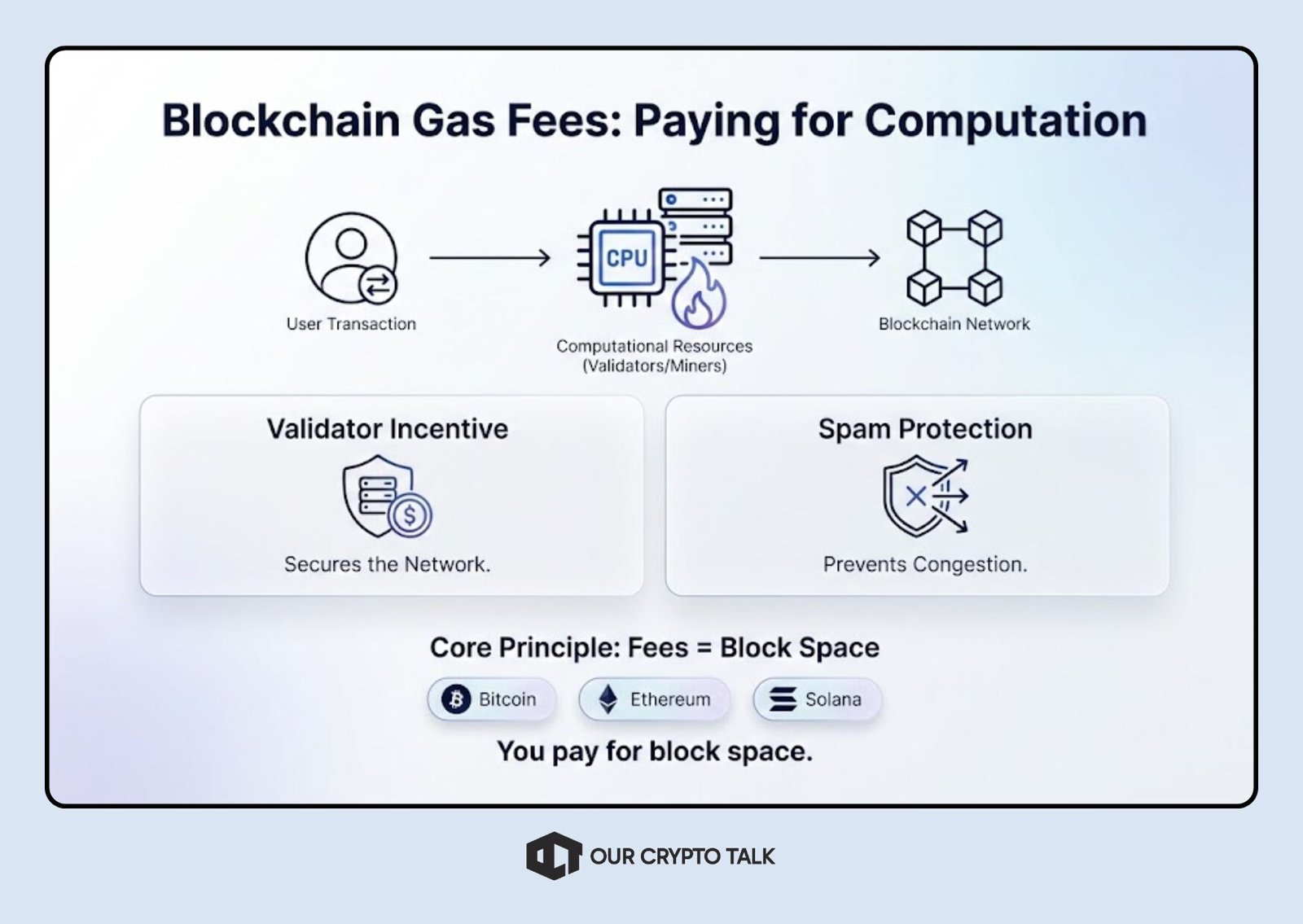
1. No Economic Incentive for Validators
Validators operate hardware, maintain nodes, and secure the network. They are economic participants, not volunteers. Gas fees reward them for:
- Confirming transactions
- Maintaining uptime
- Securing the chain against attacks
Gas fees form part of the revenue model that keeps decentralized networks operational.
2. No Spam Protection
If transactions were free, malicious actors could flood the network with meaningless requests. Imagine millions of automated transactions submitted every second with no cost barrier. The blockchain would become unusable. Gas fees prevent this by attaching a price to computational work. Every transaction must be economically justified.
In this sense, the gas fee serves both as:
- A validator incentive mechanism
- A spam deterrent
Although Ethereum popularized the term, the concept exists across blockchains.
- Bitcoin uses transaction fees within its own fee market.
- BNB Chain applies gas in a similar model to Ethereum.
- Solana refers to transaction fees, though typically much lower.
Different terminology, same principle: you pay for block space.
How Gas Fee in Crypto Works
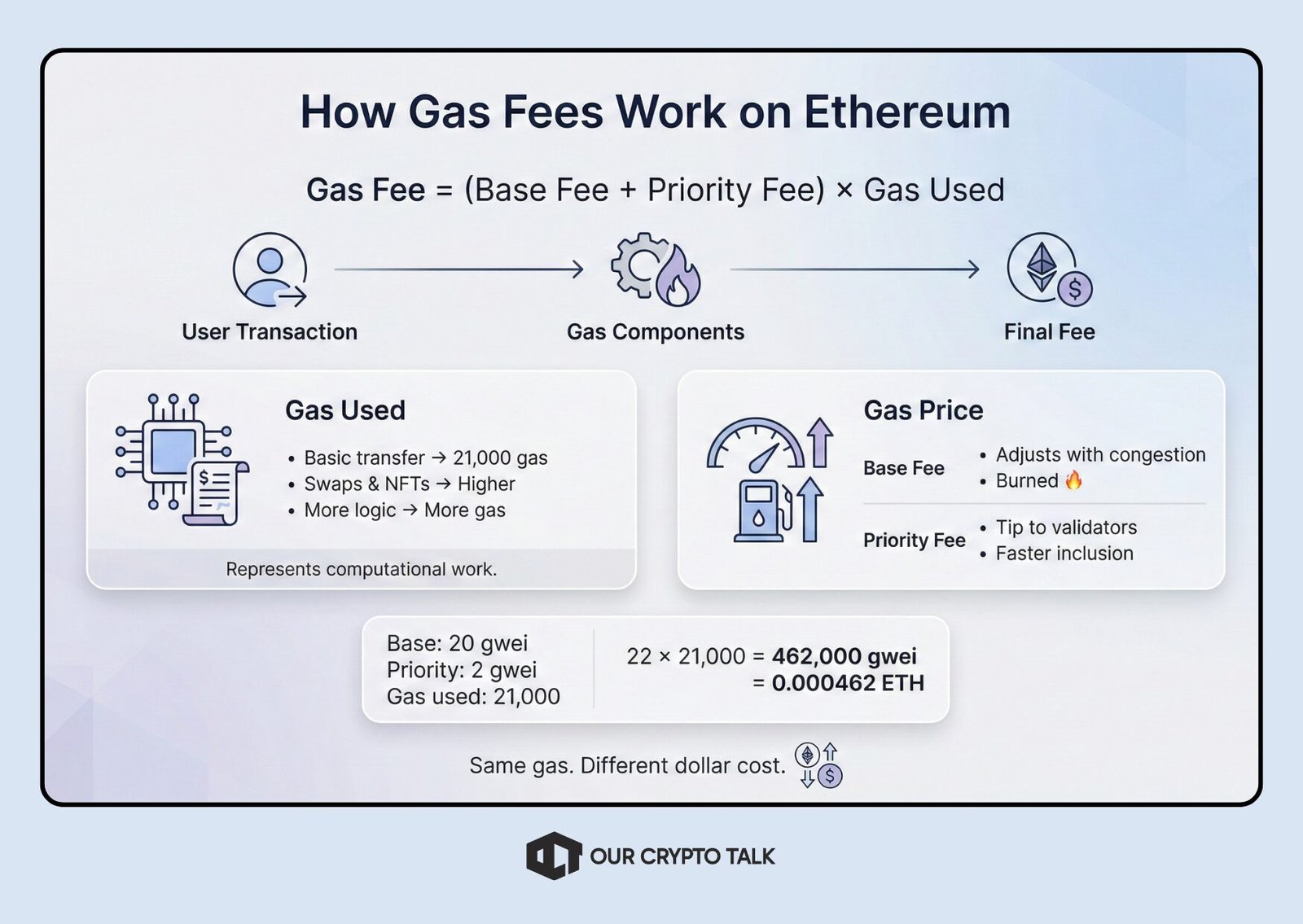
To truly understand the gas fee, you need to break it into components. On Ethereum, a gas fee equals: Gas used × Gas price But that simple formula hides important nuance.
Gas Used
Gas used refers to the amount of computational work required. Different actions consume different gas amounts:
- A basic ETH transfer: 21,000 gas units
- Token swaps: significantly higher
- NFT minting: even higher
- Complex DeFi interactions: variable
Smart contracts execute multiple steps. Each step consumes gas. The more logic executed, the more gas required.
Gas Price
The gas price is what you pay per unit of gas. Since Ethereum’s EIP-1559 upgrade, gas pricing consists of two parts:
- Base fee
- Priority fee (tip)
The base fee adjusts automatically depending on network congestion. When demand increases and blocks fill up, the base fee rises. When demand decreases, it falls. Importantly, the base fee is burned. It is permanently removed from circulation, reducing ETH supply. The priority fee is a tip paid directly to validators. It incentivizes them to include your transaction sooner rather than later.
So your total gas fee equals:
(Base fee + Priority fee) × Gas used
Here is a simplified example:
- Base fee: 20 gwei
- Priority fee: 2 gwei
- Gas used: 21,000
Total fee = 22 gwei × 21,000 = 462,000 gwei
Converted to ETH = 0.000462 ETH
The dollar cost depends entirely on ETH’s price at that moment. When ETH rises in value, the same gas usage becomes more expensive in USD terms. This is why gas fee costs can feel unpredictable.
Why Gas Fee in Crypto Feels So Expensive
The frustration around gas fee spikes often stems from demand dynamics. Blockchains have limited capacity. Ethereum blocks have a target gas limit. When user demand exceeds that limit, competition for inclusion increases.
During high-activity periods, such as:
- Major NFT launches
- Large market crashes
- Token airdrops
- Meme coin mania
- Sudden DeFi liquidations
users compete aggressively for block space. The base fee rises automatically. This is not arbitrary. It is supply and demand applied to computational bandwidth.
Time also plays a role. Network usage often peaks during:
- North American business hours
- Major trading sessions
- High-volatility market periods
Submitting transactions during off-peak hours can significantly reduce gas fee costs.
Why Gas Fee Is Fundamental to Crypto Economics
It is easy to view gas fee purely as a cost. In reality, it is part of the economic design of decentralized systems.
Gas fees:
- Secure the network
- Prevent abuse
- Allocate scarce block space
- Create token burn dynamics (in Ethereum’s case)
- Influence validator revenue
In Ethereum’s post-EIP-1559 model, base fee burning has even introduced deflationary pressure under high demand conditions. In other words, the gas fee is not just a transaction cost. It is an economic lever that shapes supply, demand, and network health. Understanding it at this level changes how you interpret blockchain design.
Why Gas Fee Fluctuates So Much
Few things frustrate crypto users more than watching a gas fee suddenly jump fivefold within minutes. You open your wallet. The transaction looks reasonable. Then you refresh the page, and the cost has doubled. This volatility is not random. It is built into how blockchains allocate limited block space.
Every blockchain processes a fixed amount of computational work per block. On Ethereum, blocks have a target gas limit. When demand stays below that limit, the base fee gradually decreases. When demand exceeds it, the base fee rises automatically.
This creates a dynamic fee market. Gas fee fluctuations are primarily driven by three forces:
1. Transaction Demand
When more users compete for block space, fees increase. This happens during:
- Market crashes, when traders rush to close positions
- Bull market rallies, when traders open leverage
- Major NFT mints
- Token airdrops and farming events
Block space is scarce. During peak moments, users bid against each other through priority fees to secure faster inclusion. The higher the urgency, the higher the tip.
2. Network Activity Concentration
Crypto is global, but activity clusters around certain hours. Historically, Ethereum gas fee spikes align with:
- U.S. trading hours
- Major macro announcements
- High-volatility weekends
Submitting non-urgent transactions during off-peak hours often reduces costs significantly. Many users overlook this simple timing advantage.
3. Smart Contract Complexity
Not all transactions are equal. A simple token transfer consumes predictable gas. A DeFi transaction, however, may:
- Interact with multiple contracts
- Execute complex swaps
- Trigger internal state updates
Even if the gas price stays constant, the gas used increases. This means your gas fee rises simply because your transaction does more computational work. Gas fee volatility therefore reflects both market psychology and technical architecture.
Gas Fee Across Different Blockchains
Ethereum is often criticized for high gas fees, but comparing chains requires understanding trade-offs. Each network balances three variables:
- Security
- Decentralization
- Throughput
Changing one affects the others.
Ethereum Mainnet
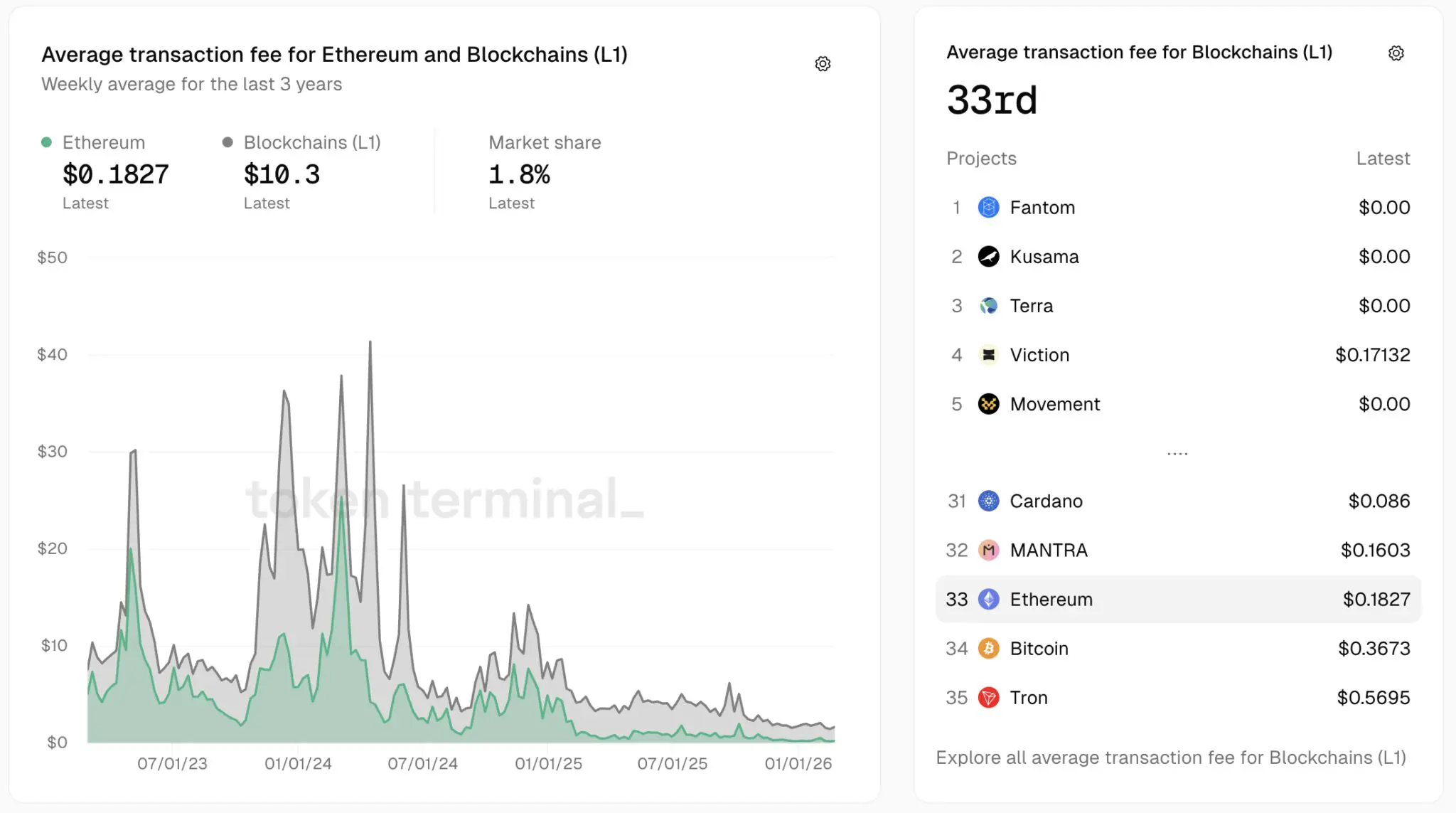
Ethereum prioritizes decentralization and security. Thousands of nodes verify transactions globally. The cost of that security is limited throughput. When demand surges, gas fees rise. However, Ethereum’s fee burning mechanism adds another layer of economic design. High activity increases ETH burn, reducing supply. This creates a feedback loop where high gas fee periods contribute to token deflation.
Source : Token Terminal
Layer 2 Networks
Layer 2 solutions dramatically change the gas fee experience. Networks like Arbitrum, Optimism, and Base process transactions off-chain and bundle them into batches. These batches settle on Ethereum mainnet.
This reduces per-user cost because:
- Many transactions share one mainnet fee
- Computation happens off-chain
- Throughput increases
For active DeFi users, operating on Layer 2 can reduce gas fee expenses by over 90 percent. Importantly, these networks inherit Ethereum’s security while improving scalability.
Solana
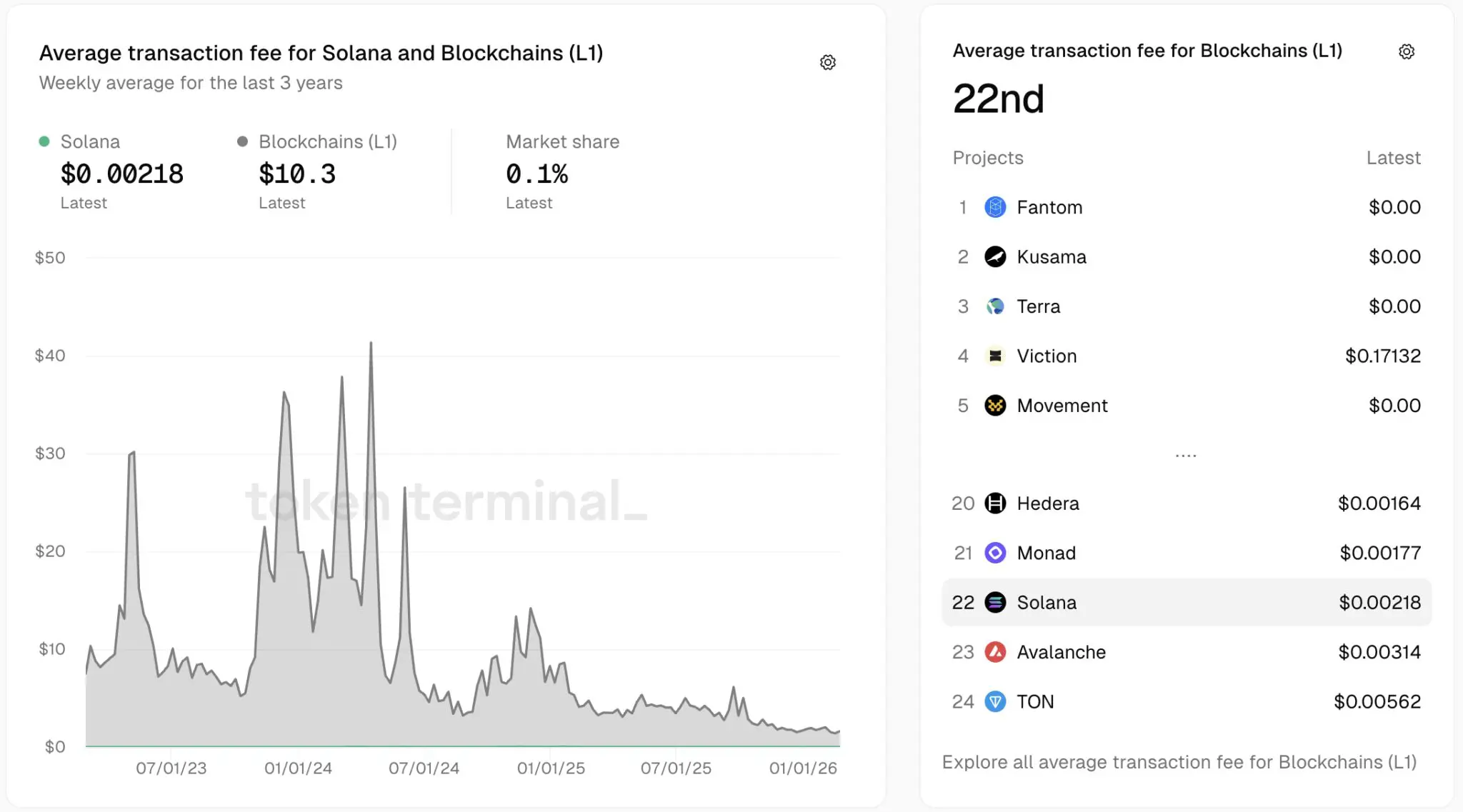
Solana uses a different architectural design combining proof-of-stake with proof-of-history. Its throughput is significantly higher than Ethereum’s. As a result, transaction fees are typically fractions of a cent. The trade-off historically involved network outages and centralization concerns. While reliability has improved, the design philosophy differs fundamentally from Ethereum’s conservative scaling approach.
Source : Token Terminal
BNB Chain and Polygon
BNB Chain reduces gas fee costs by operating with a smaller validator set. This increases efficiency but introduces centralization trade-offs. Polygon, initially built as a sidechain, offers low fees and high throughput. It has gained strong adoption in gaming and NFT ecosystems where user cost sensitivity matters more than maximal decentralization.
The key insight is this:
Lower gas fee environments often involve architectural compromises. Higher gas fee environments typically prioritize security and decentralization.
Understanding that trade-off changes how you evaluate fee levels.
Ethereum
Solana
BNB Chain
Common Mistakes Users Make Around Gas Fee
Most frustrations around a gas fee do not come from the system itself. They come from misunderstandings. Even experienced crypto users occasionally waste money due to small but costly mistakes. One of the most common errors is misunderstanding the gas limit. The gas limit is not the gas fee. It is the maximum amount of computational work your transaction is allowed to consume.
If you set the gas limit too low:
- The transaction begins execution.
- It consumes part of the allocated gas.
- It fails before completion.
- You still pay for the gas consumed.
This is painful because you lose money without receiving the intended result. For complex smart contract interactions, always rely on wallet-recommended gas limits and add a small safety buffer when interacting with unfamiliar contracts.Another mistake involves overpaying priority fees during congestion.
Many wallets offer presets like low, market, and aggressive. In high-demand periods, users panic and choose the highest option. In reality, validators do not need extremely high tips once the base fee requirement is met. Over-tipping often results in unnecessary spending with no real speed advantage.A third mistake appears frequently in DeFi strategies: ignoring gas cost in profitability calculations.Yield farming and liquidity provision often look attractive on paper. However, when you include:
- Entry transaction costs
- Harvesting costs
- Exit costs
The strategy may no longer outperform holding the asset. Gas fee awareness is part of honest performance measurement. Finally, many users simply do not monitor real-time fee conditions. Tools like gas trackers provide live and historical data. Submitting transactions blindly during peak congestion is avoidable.Gas fee literacy is not advanced knowledge. It is practical survival.
How to Reduce Gas Fee Costs Strategically
Reducing gas fee expenses does not require deep technical expertise. It requires behavioral adjustments and infrastructure choices.
Timing Matters More Than Most Realize
Network activity fluctuates predictably. Submitting non-urgent transactions during low-demand periods can reduce costs significantly. Late-night hours in Western time zones or quiet market days often offer lower base fees. If your transaction is not time-sensitive, patience alone can save money.
Embrace Layer 2 as Default Infrastructure
For active Ethereum users, Layer2 networks should not feel optional. Operating on Arbitrum, Optimism, or Base allows you to:
- Execute swaps at a fraction of mainnet cost
- Interact with DeFi protocols more frequently
- Experiment without fearing triple-digit fees
Bridging assets requires a one-time transaction. After that, the cost savings accumulate quickly.
Batch Actions When Possible
Some DeFi protocols and aggregators allow combining multiple steps into a single transaction.
For example:
- Approve token + swap
- Stake + claim rewards
Instead of executing each step separately and paying two gas fees, you pay once. This is underutilized efficiency.
Consider Wallet Innovations
Account abstraction, introduced through standards like EIP-4337, allows new possibilities:
- Paying gas fees in tokens other than ETH
- Sponsored transactions where third parties cover fees
- Smart contract wallets optimizing gas usage
As these tools mature, user experience improves. The gas fee becomes less visible and more manageable.
Optimization is cumulative. Small improvements compound over dozens or hundreds of transactions.
The Future of Gas Fee Economics
The evolution of gas fee mechanics is directly tied to scalability. Ethereum’s long-term roadmap focuses on rollups and data availability improvements. Rather than increasing mainnet throughput dramatically, the ecosystem shifts computation to Layer 2 networks.
This architecture changes gas fee economics in three major ways. First, mainnet becomes a settlement layer. High-value transactions anchor security, while everyday activity migrates off-chain. Gas fee on mainnet may remain valuable, but fewer users interact directly with it. Second, rollups compress transactions. Thousands of Layer 2 transactions share a single mainnet gas fee. This dramatically improves efficiency per user.
Third, competition between rollups creates a fee market across networks. Users can choose environments based on cost sensitivity. Beyond Ethereum, newer blockchains approach the gas fee problem differently. Parallel execution engines, modular blockchain designs, and improved consensus algorithms aim to reduce congestion structurally.
However, there is a deeper philosophical layer. Gas fee is not merely a cost problem. It is an economic coordination mechanism. Blockchains allocate scarce block space using price signals. As long as block space remains finite and demand fluctuates, some version of gas fee will exist.
The question is not whether gas fee disappears. It is how intelligently networks manage it.
Over time, the user-facing friction will likely decrease. Wallets will abstract complexity. Layer 2 adoption will normalize. Sponsored transactions may become common in consumer applications.
But the underlying mechanic of paying for computational work, remains foundational to decentralized systems.
Conclusion
A gas fee is often viewed as an annoyance. In reality, it is one of the most elegant components of blockchain design. It:
- Incentivizes validators
- Prevents spam
- Allocates scarce resources
- Reflects demand pressure
- Influences token economics
Understanding gas fee mechanics changes how you interact with crypto. You stop reacting emotionally to spikes. You begin thinking structurally about congestion, timing, and architecture.
As blockchain infrastructure matures, gas fee volatility will likely decrease for everyday users. But it will never vanish entirely, because it represents the cost of decentralized coordination.
The more fluent you become in navigating gas fee dynamics, the more efficiently you can operate across the crypto ecosystem.
TL;DR — Gas Fees Explained
- A gas fee is the cost paid to process a blockchain transaction.
- It compensates validators and helps prevent network spam.
- On Ethereum, gas fee = gas used × (base fee + priority fee).
- Fees fluctuate with network demand and congestion.
- NFT mints, DeFi events, and volatility commonly trigger spikes.
- Layer 2 networks significantly reduce gas costs for users.
- Solana and BNB Chain offer structurally lower fees in many scenarios.
- Mistakes like low gas limits can cause failed transactions and wasted fees.
- Timing and batching transactions can lower total expenses.
- Gas is a core economic mechanism, not just a cost.
In this article
How Gas Fee in Crypto WorksWhy Gas Fee in Crypto Feels So ExpensiveWhy Gas Fee Is Fundamental to Crypto EconomicsWhy Gas Fee Fluctuates So MuchGas Fee Across Different BlockchainsCommon Mistakes Users Make Around Gas FeeHow to Reduce Gas Fee Costs StrategicallyThe Future of Gas Fee EconomicsConclusion