DA Layer in Crypto: Data Availability Explained
Discover how DA Layer technology boosts blockchain scalability, security, and efficiency in the modular crypto ecosystem.


Author: Chirag Sharma
The blockchain world is evolving fast, but scalability still limits how far the technology can go. As more users, transactions, and decentralized apps pile into networks like Ethereum, blockchains face the challenge of staying fast, affordable, and secure at the same time. This is where Data Availability Layers (DA Layers) step in as a breakthrough solution.
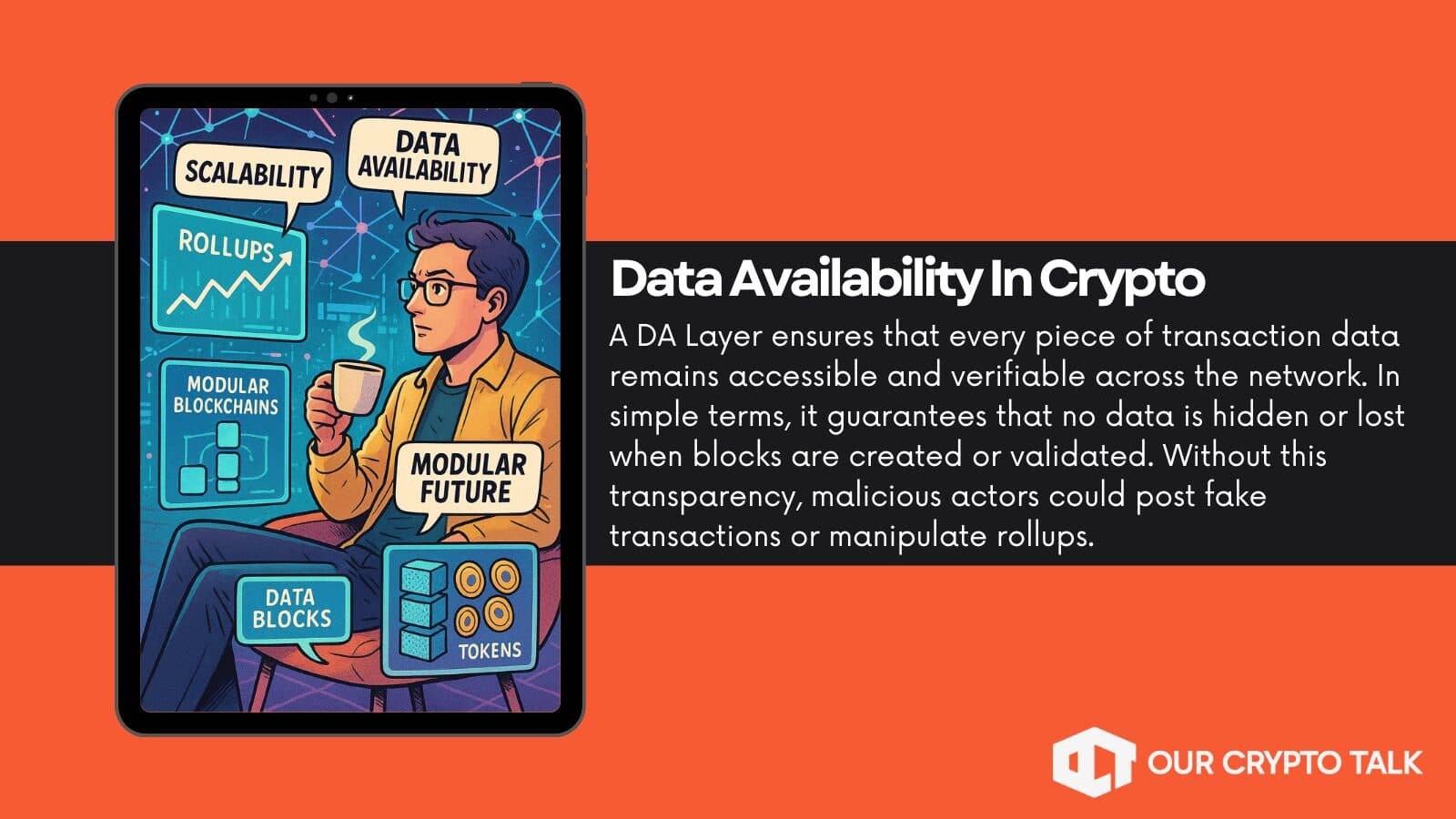
A DA Layer ensures that every piece of transaction data remains accessible and verifiable across the network. In simple terms, it guarantees that no data is hidden or lost when blocks are created or validated. Without this transparency, malicious actors could post fake transactions or manipulate rollups.
This function might sound basic, but it is one of the hardest problems to solve in scaling blockchains. As modular architectures gain traction, the DA Layer has become a critical part of the “modular stack,” sitting alongside execution, settlement, and consensus layers.
In this article, we’ll break down what a DA Layer is, why it matters, which projects are leading the space, and what risks or investment opportunities exist. Whether you’re a crypto enthusiast, a builder, or a long-term investor, understanding DA is vital for grasping how the next generation of blockchain networks will scale.
What is a DA Layer?
A Data Availability Layer is a dedicated blockchain protocol that ensures transaction data is always retrievable and verifiable by anyone. It separates data storage from computation and consensus, enabling faster performance and lighter node participation.
In traditional blockchains like Bitcoin or early Ethereum, every node must download and store all transaction data to validate the network. This model becomes inefficient as activity grows. DA Layers fix this bottleneck by handling data storage separately, freeing the main chain to focus on consensus and security.
To understand their importance, consider the “data availability problem.” Layer-2 solutions like optimistic and zero-knowledge rollups process transactions off-chain and only post summaries or proofs on the main chain. If the detailed data behind those proofs becomes inaccessible, validators cannot confirm whether the batch is valid. This could lead to fraud or lost funds.
DA Layers solve this with Data Availability Sampling (DAS). Instead of downloading entire datasets, light nodes can verify data existence by sampling small, random pieces. If enough pieces are accessible, it proves the entire dataset is available. This method, often combined with erasure coding, boosts efficiency while maintaining security.
This modular approach allows thousands of rollups and app-specific chains to share one DA Layer, each storing their data safely and cheaply. In short, the DA Layer is the data backbone of modular blockchains, enabling massive scalability without sacrificing decentralization.
Why DA Layers Matter in Blockchain Scalability
The DA Layer plays a key role in solving blockchain’s biggest challenge — scaling securely. Traditional monolithic chains struggle with the blockchain trilemma: balancing decentralization, scalability, and security. DA Layers help break this trade-off.
By offloading data storage, they allow the main chain to focus on consensus and settlement. This design makes rollups faster and more reliable. For example, Ethereum rollups like Arbitrum and Optimism can reach higher throughput when integrated with efficient DA solutions, as validators can instantly verify batch data without storing everything themselves.
Another benefit is cost reduction. On-chain data storage is expensive. Ethereum gas fees can spike unpredictably, but DA networks store data at a fraction of that cost. For developers, this means launching affordable and accessible decentralized apps (dApps). For users, it means cheaper transactions and faster confirmation times.
DA Layers also enhance interoperability. In a multi-chain world, they can serve multiple blockchains simultaneously, acting as a shared data infrastructure. This setup promotes transparency and connectivity between ecosystems like Ethereum, Cosmos, and Near.
Finally, they support decentralization. With light nodes verifying data through sampling, anyone can help secure the network without needing expensive hardware. This keeps control distributed and prevents centralization around a few validators.
In short, DA Layers make scaling practical, affordable, and fair — turning blockchains from isolated systems into open, modular networks ready for global adoption.
Top Projects Leading the DA Layer Revolution
- 1. NEAR Protocol ($2.74B)
NEAR has evolved into a powerful DA provider using sharding. Its Near DA service lets rollups and appchains post large data blobs efficiently. With low fees and high throughput, NEAR is becoming a preferred backend for scalable apps and real-time use cases like gaming and DePIN. - 2. Celestia ($829M)
Celestia pioneered modular blockchain architecture and remains the poster child for DA. Using Data Availability Sampling, it allows thousands of rollups to verify data without storing full blocks. Its TIA token is used for staking and paying data fees. - 3. EigenCloud (formerly EigenLayer, $428M)
Built on Ethereum’s restaking model, EigenCloud extends security to DA services. It enables staked ETH to protect multiple networks, creating a high-trust environment for data validation. EigenCloud is gaining momentum with projects like AltLayer and Mantle - 4. Unibase ($124M)
Unibase focuses on interoperability, providing a lightweight DA solution for smaller rollups and chains. Its cross-chain bridge ensures that data flows smoothly between different ecosystems. - 5. BSquared Network ($72M)
One of the fastest-rising names in the DA sector, BSquared has gained 143% in recent weeks. It specializes in combining DA with execution layers, giving developers a plug-and-play infrastructure for launching new blockchains. - 6. Avail ($34M)
Originally incubated by Polygon, Avail’s “unified DA” model supports both optimistic and ZK rollups. Its light-client verification and modular PoS design make it ideal for appchains seeking independence without sacrificing interoperability. - 7. Syscoin ($23M)
Syscoin’s Rollux architecture blends DA with optimistic rollups for enhanced throughput. It supports smart contracts, NFTs, and Bitcoin-based interoperability. Despite its smaller cap, Syscoin’s hybrid model positions it as an experimental yet valuable piece of the DA puzzle.
DA Layer Project Comparison
Investment Outlook: Retail Opportunities in DA Layer Tokens
For retail investors, DA Layers are one of the most promising frontiers of blockchain infrastructure. Unlike speculative memecoins, these projects serve a clear technical purpose — they make blockchain data accessible and scalable.
Each leading DA project issues a native token for staking, governance, and fee payments. Examples include TIA (Celestia) and AVAIL (Avail). By staking or restaking tokens, holders can earn network rewards while supporting decentralization.
Investment strategies here rely on diversification. A balanced portfolio could include established names like NEAR and Celestia, growth-oriented picks like EigenCloud, and speculative plays such as BSquared or Unibase. This spread balances risk and upside potential.
The valuation metrics also matter. Comparing total value locked (TVL) to market cap helps identify undervalued DA ecosystems. For instance, a high TVL-to-market-cap ratio suggests real usage that the market hasn’t priced in yet.
Challenges and Risks in DA Layer Adoption
Despite their promise, DA Layers face multiple hurdles before achieving mainstream adoption. The first challenge is technical reliability. Data Availability Sampling, while efficient, must stay resistant to manipulation. If sampling nodes go offline or data chunks are withheld, it can stall entire rollups.
Another issue is validator centralization. Some DA providers rely on a small set of validators, creating potential single points of failure. If those validators collude or get compromised, it can lead to censorship or data tampering. Projects like Celestia counter this with incentive mechanisms, but risks persist.
Economic sustainability is another concern. To attract validators, networks often issue high staking rewards, leading to inflation. Balancing low data fees with healthy tokenomics remains a tricky challenge.
Interoperability is also complex. DA Layers need to integrate smoothly with multiple blockchains, but standards are still evolving. Without consistent frameworks, smaller rollups may struggle to connect across ecosystems.
Then comes regulation. As DA projects handle vast amounts of data, they may attract scrutiny over security classifications or privacy concerns. Governments could impose restrictions similar to those on cloud providers.
Lastly, user experience remains a barrier. Setting up DA-integrated wallets or nodes requires technical expertise. Mass adoption will need simpler, plug-and-play tools.
Still, the ongoing research in cryptography, validator incentives, and open protocols gives hope that these challenges will be solved in time.
The Future of DA Layers and Modular Blockchain Architecture
The future of DA Layers looks incredibly bright. As Ethereum transitions to proto-danksharding and later full danksharding, demand for efficient data availability will skyrocket. Projects like EigenCloud and Celestia are already positioning themselves to power this evolution.
Expect a move toward hybrid models, blending privacy with scalability. DA Layers integrated with zero-knowledge proofs could allow sensitive data storage without compromising transparency.
Cross-chain DA services will also rise. We may see DA-as-a-Service platforms that provide data availability to multiple ecosystems — similar to how cloud storage works in Web2. Avail and BSquared are already building toward that future.
Artificial intelligence, IoT, and DePIN projects will rely heavily on these layers to store and verify machine-generated data securely. By 2030, DA Layers could underpin not only blockchain systems but also decentralized cloud and compute networks.
Regulatory clarity will also shape the market. Regions like Asia and Europe are expected to embrace modular infrastructure faster, providing tailwinds for DA adoption.
In the big picture, DA Layers are not just a technical upgrade. They represent the invisible infrastructure that will make Web3 scalable, secure, and user-friendly for billions of people.
Conclusion
The rise of DA Layers marks a turning point in blockchain development. They solve one of the hardest challenges in crypto — ensuring every piece of data remains accessible, verifiable, and secure. From Celestia’s modular design to NEAR’s sharded architecture and EigenCloud’s restaking model, the innovation here is shaping the backbone of Web3 scalability.
For investors and builders alike, this is not a passing trend but a long-term shift. DA Layers will define how rollups, appchains, and even decentralized AI networks function in the coming decade.
As the modular era unfolds, understanding DA is not optional — it’s essential for navigating the next phase of blockchain’s evolution.
Frequently Asked Questions on DA Layers
What does DA Layer mean in crypto?
Why is data availability important?
How does a DA Layer work?
Which are the top DA projects?
What makes DA Layers scalable?
Can retail investors buy DA tokens?
What risks do DA Layers face?
How does DA benefit Ethereum?
Are DA Layers energy-efficient?
What’s next for DA Layers?
In this article
What is a DA Layer?Why DA Layers Matter in Blockchain ScalabilityTop Projects Leading the DA Layer RevolutionDA Layer Project ComparisonInvestment Outlook: Retail Opportunities in DA Layer TokensChallenges and Risks in DA Layer AdoptionThe Future of DA Layers and Modular Blockchain ArchitectureConclusionFrequently Asked Questions on DA Layers