Walrus Protocol Review
Walrus Protocol: A modular data availability layer built on Cosmos and Celestia to offer fast finality and low-cost DA for rollups and L2s.


Author: Akshat Thakur
Introduction
Walrus Protocol is a modular data availability (DA) layer that aims to solve one of the most critical bottlenecks in blockchain scalability: reliable and cost-efficient data availability. Built with the Cosmos SDK and leveraging Celestia’s blobstream technology, Walrus focuses on serving both general-purpose chains and app-specific rollups by offering faster finality and reduced costs compared to existing DA layers.
Positioned as a core infrastructure piece for the modular blockchain future, Walrus brings innovation through its built-in staking mechanisms, flexible validator incentives, and a robust ecosystem model. Its strategic design aims to align with the needs of L2s, L3s, and sidechains that require highly performant, secure, and economically sustainable data availability.
Problem Statement
- High Cost of Data Availability
Most rollups and modular chains depend on Ethereum or similar base layers for data availability, which comes at a high cost. Ethereum’s calldata is expensive, limiting the economic feasibility of on-chain apps and layer-2 solutions. - Finality Delays and Latency
Rollups relying on Ethereum inherit its relatively slow finality times. This limits real-time applications, cross-chain bridging, and user experience in sectors like DeFi and gaming. - Validator Misalignment and Centralization
Current DA solutions suffer from weak validator incentive structures. Without strong economic alignment, the network becomes prone to centralization and poor liveness guarantees. - Fragmented Ecosystem Support
Many DA solutions are either too general or highly specialized, lacking flexibility. This leads to limited integration support across diverse rollup architectures and toolchains. - Lack of Sustainable Revenue Models
DA platforms struggle with long-term economic sustainability, especially when transaction fees fail to cover operational and security costs.
Solutions Provided by Walrus Protocol
- Low-Cost DA Layer via Celestia Blobstream
Walrus leverages blobstream from Celestia to reduce the cost of posting data. By offloading expensive calldata to Celestia while still verifying data roots on Ethereum or Cosmos, Walrus dramatically reduces the cost for rollups. - Fast Finality with Cosmos SDK and Optimistic Confirmations
Walrus is built on the Cosmos SDK, enabling it to offer near-instant finality using Tendermint consensus. Optimistic confirmation layers further reduce perceived finality delays, improving UX and bridging. - Validator Alignment Through Dual Staking
The protocol supports dual staking models (native WAL token + external chains), incentivizing validators to act honestly across the network while remaining financially invested in ecosystem security. - Flexible Modular Architecture
Walrus supports both general-purpose and specialized rollups, allowing easy integration via standard APIs. Its support for IBC further expands interoperability, making it suitable for Cosmos-native and EVM chains alike. - Built-in Fee Redistribution and Sustainability Mechanisms
Walrus incorporates protocol-level fee splits and inflationary rewards, redistributing a portion to validators and DA clients. This ensures long-term economic alignment between users, rollups, and infrastructure providers.
Problem-Solution Chart
Problems
High Cost of Data Availability: Most rollups rely on Ethereum for data availability, making calldata prohibitively expensive for scalable application use.
Finality Delays and Latency: Ethereum’s slow finality time hampers real-time dApps, cross-chain bridging, and user experience in fast-paced sectors.
Validator Misalignment and Centralization: Weak incentive models lead to poor validator participation and network centralization risks.
Fragmented Ecosystem Support: Existing DA platforms lack the flexibility to support diverse rollup needs and architectures efficiently.
Lack of Sustainable Revenue Models: Many DA solutions struggle to cover operating costs, threatening long-term viability.
Solutions
Low-Cost DA Layer via Celestia Blobstream: Walrus reduces data costs by offloading calldata to Celestia while verifying data roots on Ethereum or Cosmos.
Fast Finality with Cosmos SDK and Optimistic Confirmations: Near-instant finality via Tendermint and optimistic confirmations enhances bridging and app responsiveness.
Validator Alignment Through Dual Staking: Dual staking with native and external tokens promotes validator honesty and ecosystem security.
Flexible Modular Architecture: Walrus supports both general and specialized rollups via APIs and IBC, offering cross-ecosystem interoperability.
Built-in Fee Redistribution and Sustainability: Protocol-level fee sharing and rewards ensure long-term viability for validators and DA clients alike.
Technology and Architecture
- Peer-to-Peer Storage Marketplace: Storage providers and clients interact directly without intermediaries.
- Zero-Knowledge Storage Proofs: Proof-of-Access mechanisms ensure data integrity with lower overhead.
- Bandwidth Optimized: Focus on content addressing and deterministic data routing.
- Incentivized Participation: Token-based rewards align interests between storage nodes and data consumers.
Technology & Architecture
Peer-to-Peer Storage Marketplace: Storage providers and clients interact directly without intermediaries.
Zero-Knowledge Storage Proofs: Proof-of-Access mechanisms ensure data integrity with lower overhead.
Bandwidth Optimized: Focus on content addressing and deterministic data routing.
Incentivized Participation: Token-based rewards align interests between storage nodes and data consumers.
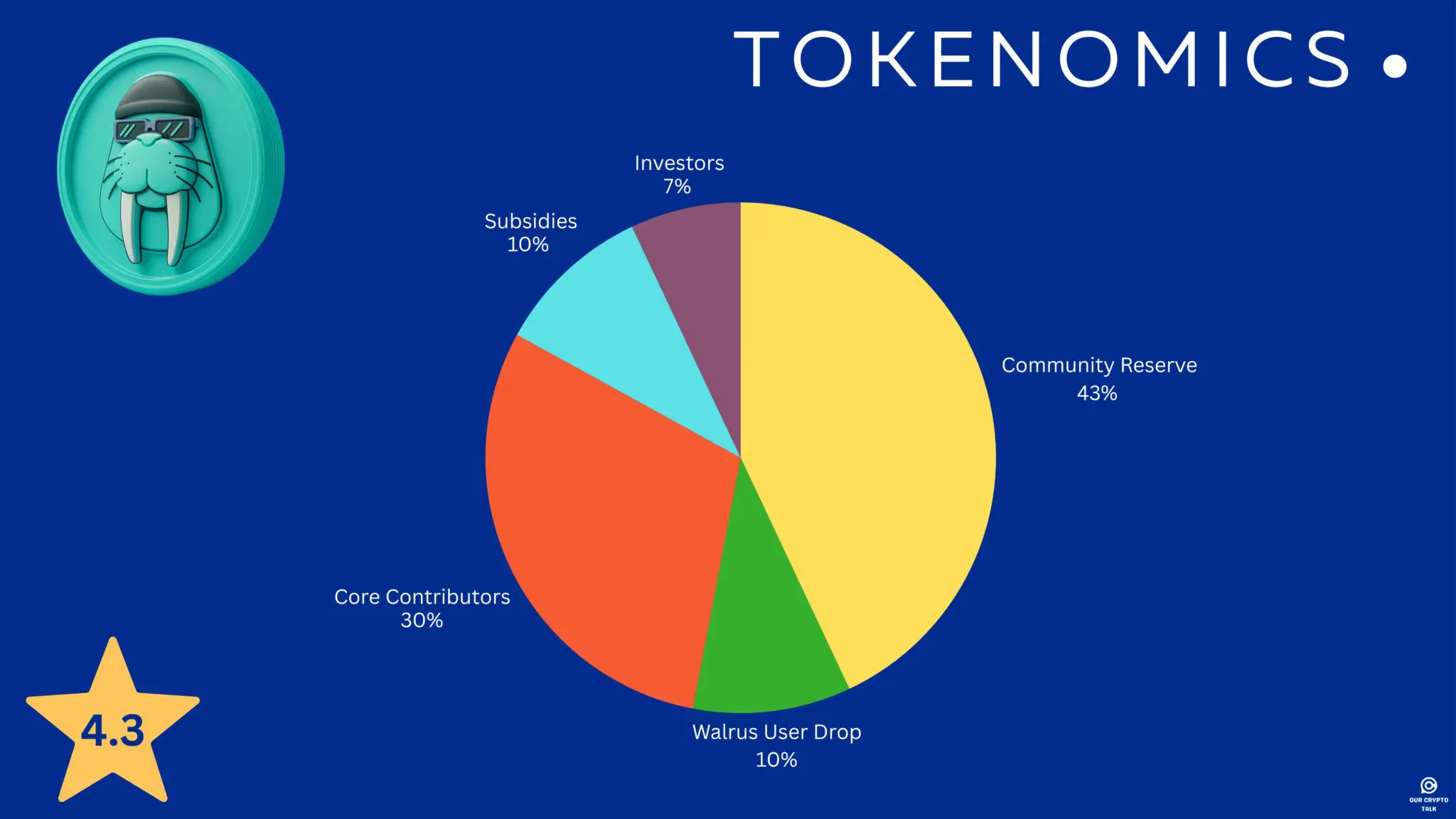
Tokenomics
The native token of the Walrus Protocol is $WAL. It plays a core role in staking, governance, and validator incentivization.
- Maximum Supply: 5 billion
- Use Cases:
- Staking and slashing
- Governance proposals
- Fee payments for DA services
- Incentives for validators and relayers
Allocation:
- 43% – Community reserve
- 30% – Core contributors
- 10% – Walrus user drop
- 10% – Subsidies
- 7% – Investors
Market Performance
📊 Market Performance
Team
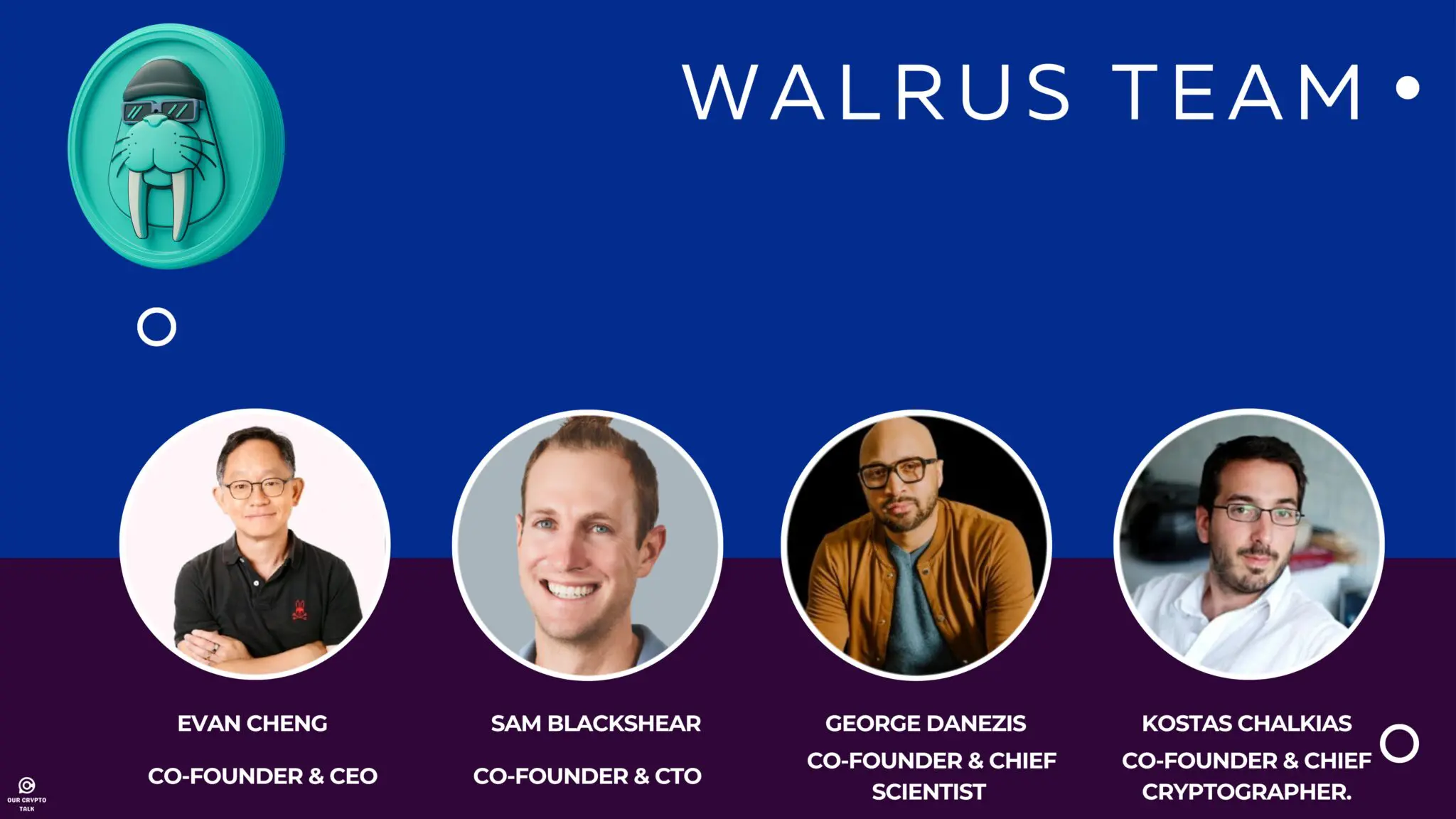
- Evan Cheng: Co-founder & CEO.
- Sam Blackshear: Co-founder & CTO.
- Adeniyi Abiodun: Co-founder & CPO.
- George Danezis: Co-founder & Chief Scientist.
- Kostas Chalkias: Co-founder & Chief Cryptographer.
The Walrus team comprises experienced professionals from leading blockchain ecosystems such as Cosmos, Celestia, and Ethereum.
Several contributors have previous experience building DA layers, staking frameworks, and smart contract tooling, making Walrus a technically competent project.
Project Analysis
Comparative Overview
- Celestia: The first modular DA chain, offering high throughput and data availability. Walrus builds on Celestia via blobstream, providing cheaper DA with faster finality.
- Avail by Polygon: Focuses on Ethereum compatibility and zkRollup scaling. Walrus is more Cosmos-native but achieves lower latency.
- EigenDA: A hyperscale DA solution for Ethereum. Walrus competes on decentralization and economic alignment but is lighter in cryptographic guarantees.
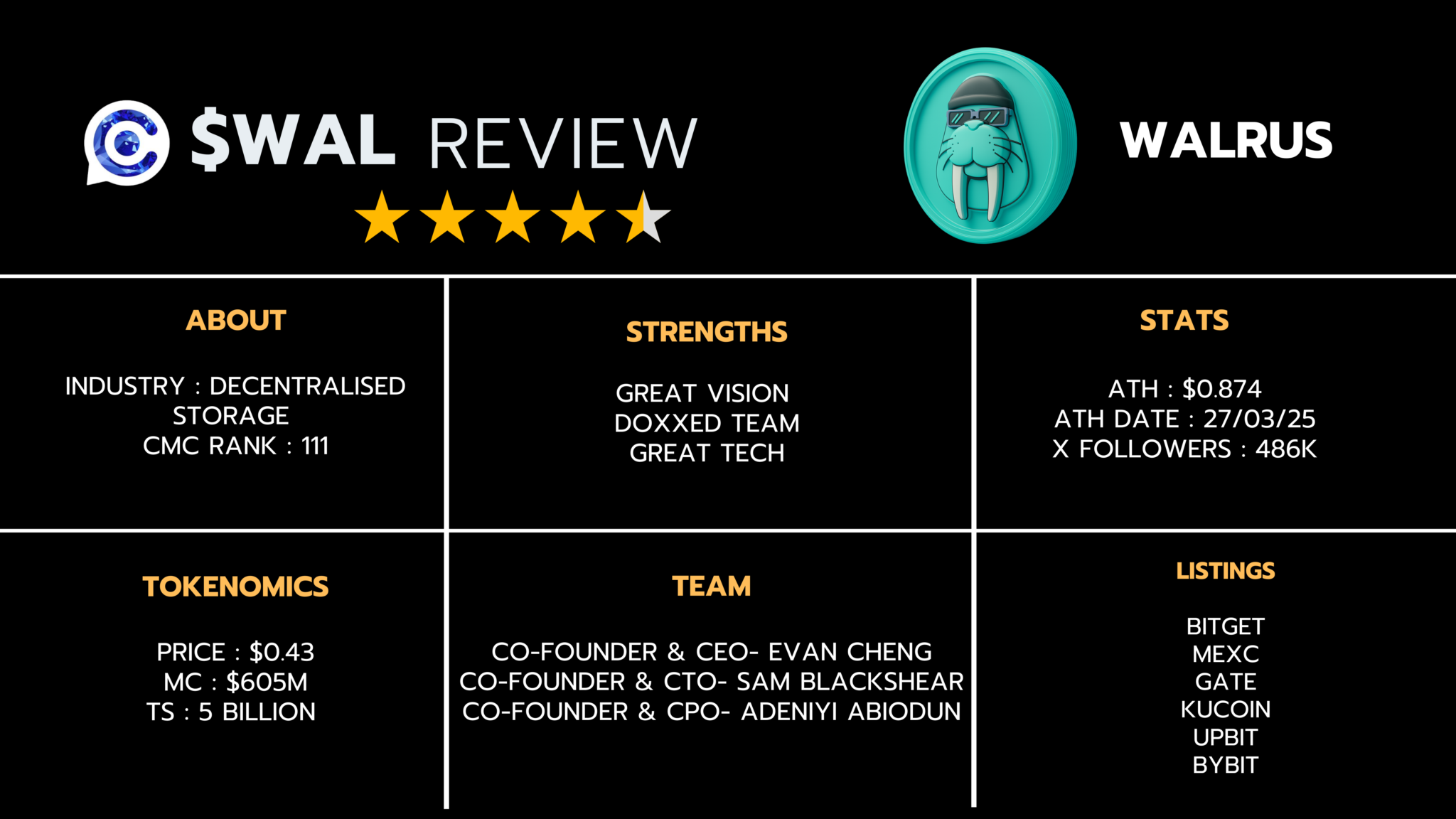
Strengths
- Deep integration with Cosmos and Celestia ecosystems
- Flexible architecture for general and specific rollups
- Fast finality and low-latency bridging
- Strong validator incentive structure via dual staking
Challenges
- Lack of public team identity may reduce institutional trust
- Unproven tokenomics and fee model
- Competing in a rapidly growing and technically dense DA space
Walrus vs Competing Decentralized Storage Protocol
| Project | Core Focus | Compliance/Identity | Performance |
|---|---|---|---|
|
| Decentralized storage network emphasizing user control, file versioning, and cryptographic proofs | Privacy-preserving identity tools; compliance optional/customizable | Efficient for small, medium and large files; supports file versioning and tamper-proof proofs |
|
| Decentralized cloud storage & compute marketplace leveraging blockchain + AI; secure storage, compute, Agora public file system, hosting, identity apps | Active compliance stance (AML/CFT policy), GDPR-ready tools, optional KYC on Agora | Storage nodes require ≥ 900 GB & 20 Mbps; compute/testnet: performance‑tiered nodes, benchmarking, sub-second metrics. Scale depends on node network |
|
| Decentralized storage marketplace | Compliance depends on integrations; no native identity | High throughput for archiving; slower retrieval |
|
| Permanent data storage | No built‑in compliance/KYC | Optimized for permanent writes; moderate access speeds |
|
| Decentralized cloud storage | Offers optional KYC/compliance for enterprise | Good performance worldwide but depends on node distribution |
|
| Decentralized file storage | No native compliance | Performance varies by host location; less optimized than Iagon |
Walrus Protocol differentiates itself by combining ultra-efficient, high-throughput blob storage infrastructure with programmable, on-chain identity and encryption — ideal for bridging traditional data-heavy applications into Web3.
Conclusion
Walrus Protocol enters the data availability arena with a focused mission: provide modular, fast, and cost-effective DA infrastructure. Compared to peers like Celestia and EigenDA, Walrus trades off some cryptographic guarantees for performance, lower fees, and faster finality.
Its unique validator incentive structure, blobstream-based architecture, and Cosmos-native design offer it an edge in onboarding early rollup ecosystems. While it still faces competition from better-capitalized players and has yet to fully launch, Walrus has the design fundamentals and integration strategy to stand out.
As data availability becomes the backbone of modular blockchain infrastructure, Walrus could evolve into a critical component of the next-generation rollup stack especially for ecosystems looking beyond Ethereum’s constraints.
Explore More Reviews to Level Up Your DYOR Game.
Frequently Asked Questions — Walrus Protocol
What is Walrus Protocol?
What problems does Walrus address?
How does Walrus solve these problems?
- Low-cost DA: Uses Celestia blobstream to cut calldata costs.
- Fast finality: Cosmos SDK + Tendermint consensus with optimistic confirmations.
- Dual staking: Native WAL + external tokens align validator incentives.
- Flexible modular architecture: APIs + IBC support for both EVM and Cosmos-native rollups.
- Sustainable revenue: Built-in fee redistribution and inflationary rewards.
What are the core technologies behind Walrus?
What is the WAL token and how is it used?
How has WAL performed in the market?
Who is behind Walrus Protocol?
How does Walrus compare to competitors?
What are Walrus’ main strengths and challenges?
What is the long-term outlook for Walrus?