Iagon ($IAG) Review
Explore Iagon crypto – a dual-chain platform combining decentralized storage and computing to challenge Web2 cloud giants.


Author: Akshat Thakur
Introduction
Iagon is a decentralized storage and computing platform built to challenge centralized cloud monopolies. By combining blockchain, AI, and a marketplace for unused storage and computing power, Iagon offers a Web3-native infrastructure designed to rival traditional giants like AWS and Google Cloud. It operates across Ethereum and Cardano networks, making it one of the few dual-chain projects tackling decentralized infrastructure at scale.
Iagon is not just a decentralized storage network. It’s building a decentralized cloud ecosystem (dCloud) for enterprises, Web3 apps, and developers to store and compute data securely and cost-effectively. With data privacy becoming a growing concern and Web3 services demanding scalable backend solutions, Iagon has carved a niche as an infrastructure Layer that aligns with regulatory and user sovereignty values.
Problem Statement
- Cloud Centralization and Data Monopoly
The cloud infrastructure market is dominated by a few tech giants such as Amazon, Google, and Microsoft. This centralization creates risks like single points of failure, pricing control, censorship potential, and disproportionate data access power. Enterprises and users are left with limited alternatives for hosting their critical services and data. - Loss of Data Privacy and Sovereignty
Centralized cloud providers often collect and store vast amounts of personal and business data. This compromises user privacy and exposes sensitive information to potential breaches, surveillance, or unauthorized use, leaving users with minimal control over their data. - High Infrastructure Costs and Limited Access
Traditional cloud services are expensive and mostly cater to large enterprises. The lack of affordable, pay-as-you-go decentralized solutions excludes many startups, developers, and users in emerging economies from accessing scalable compute and storage services. - Fragmentation in Decentralized Storage and Compute Networks
Existing decentralized storage or compute platforms often operate independently and lack interoperability. This fragmentation forces developers to juggle multiple networks, creating friction in integrating services like data storage, computation, and payments into a single pipeline.
Solutions Provided by Iagon
- Decentralized Storage Marketplace to Break Cloud Monopolies
Iagon enables individuals and businesses to share unused storage resources on a decentralized marketplace. This breaks the grip of central cloud providers by democratizing access to storage infrastructure and driving cost efficiency. - Encrypted Data with Full User Control
Iagon ensures that all data processed or stored is encrypted end-to-end. This guarantees user sovereignty over their data, giving them full control over access permissions while eliminating third-party surveillance and censorship risks. - Affordable Cloud Access via Token-Based Economy
By leveraging a decentralized, token-powered model, Iagon offers compute and storage at reduced rates compared to centralized alternatives. This opens up cloud infrastructure to developers and startups who previously found such services financially inaccessible. - Interoperable and Scalable Dual-Chain Architecture
Operating on both Ethereum and Cardano, Iagon ensures broader compatibility and reach. This dual-chain design enhances interoperability, allowing users and developers to operate across two of the largest blockchain ecosystems seamlessly. - Integrated Compute Services for Unified Web3 Infrastructure
Iagon doesn’t just stop at storage. Its decentralized compute layer enables users to run backend processes, data analytics, or AI training on distributed infrastructure, merging storage and computation into a holistic Web3-native cloud service.
Problem-Solution Chart
Problems
Cloud Centralization and Data Monopoly: The cloud infrastructure market is dominated by a few tech giants such as Amazon, Google, and Microsoft. This centralization creates risks like single points of failure, pricing control, censorship potential, and disproportionate data access power.
Loss of Data Privacy and Sovereignty: Centralized cloud providers collect and store vast amounts of data, compromising user privacy and exposing sensitive information to breaches and surveillance.
High Infrastructure Costs and Limited Access: Traditional cloud services are expensive and inaccessible for many startups and developers, especially in emerging economies.
Fragmentation in Decentralized Networks: Decentralized storage and compute platforms often lack interoperability, forcing developers to manage multiple systems manually.
Solutions
Decentralized Storage Marketplace: Iagon allows sharing of unused storage resources via a decentralized marketplace, reducing reliance on centralized cloud providers.
Encrypted Data with Full User Control: All data is end-to-end encrypted, ensuring user sovereignty and eliminating surveillance or unauthorized access.
Affordable Access via Token Economy: Iagon provides compute and storage services at reduced rates through a decentralized, token-powered model.
Interoperable Dual-Chain Architecture: By running on both Ethereum and Cardano, Iagon offers cross-chain compatibility and broader network reach.
Integrated Compute Services: Iagon combines decentralized storage with compute capabilities, supporting backend processes, data analytics, and AI workloads within a unified Web3 framework.
Technology and Architecture
Iagon uses a dual-chain infrastructure leveraging both Ethereum and Cardano networks, which provides flexibility, cost optimization, and broader adoption. It employs distributed node architecture where individuals contribute unused resources and receive IAG tokens in return.
The platform integrates encryption protocols for data confidentiality and security, supporting high availability and redundancy. The architecture is modular, allowing seamless integration of additional services like AI processing and privacy-focused computing.
Iagon’s architecture includes:
- Decentralized Storage Nodes
- Compute Nodes with AI Optimization
- Cross-chain Token Utilities
- Developer SDKs for integration
Technology & Architecture
Dual-chain Infrastructure: Iagon uses a dual-chain infrastructure leveraging both Ethereum and Cardano networks, providing flexibility, cost optimization, and broader adoption.
Distributed Node Architecture: Individuals contribute unused resources and receive IAG tokens in return.
Security & Redundancy: Integrates encryption protocols for data confidentiality and security, supporting high availability and redundancy.
Modular Design: Allows seamless integration of additional services like AI processing and privacy-focused computing.
Architecture Components: Decentralized Storage Nodes; Compute Nodes with AI Optimization; Cross-chain Token Utilities; Developer SDKs for integration.
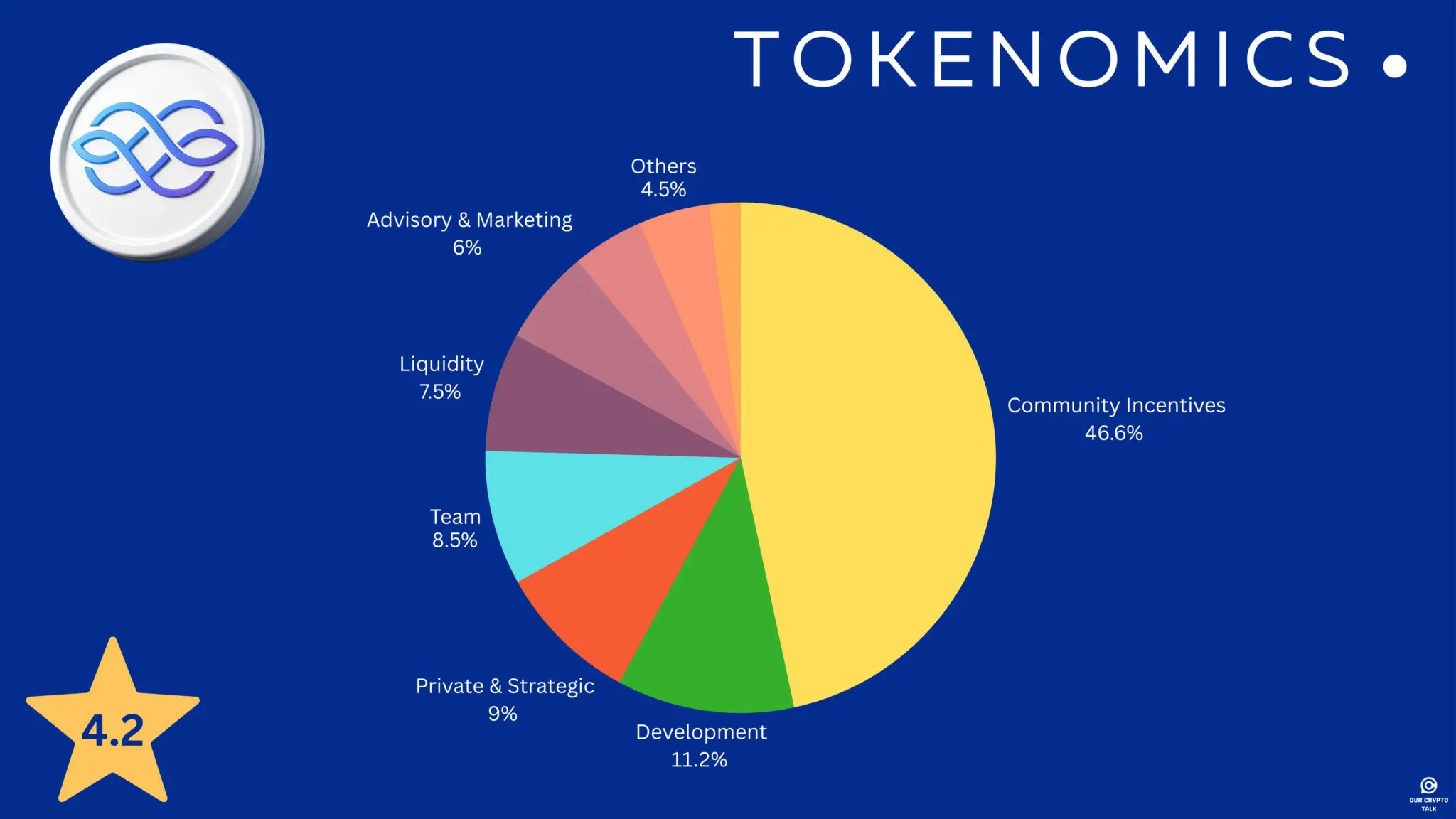
Tokenomics
- Token Name: Iagon ($IAG)
- Total Supply: 1,000,000,000 IAG
- Token Utility:
- Payments for storage and compute services
- Rewards for providers
- Staking and governance
Allocation:
- 46.5% – Community incentives
- 11.2% – Development
- 9% – Private and Strategic
- 8.5% – Team
- 7.5% – Liquidity
- 6% – Advisory & Marketing
- 4.5% – Seed Round
- 4.5% – Others
- 0.5% – IDO Round
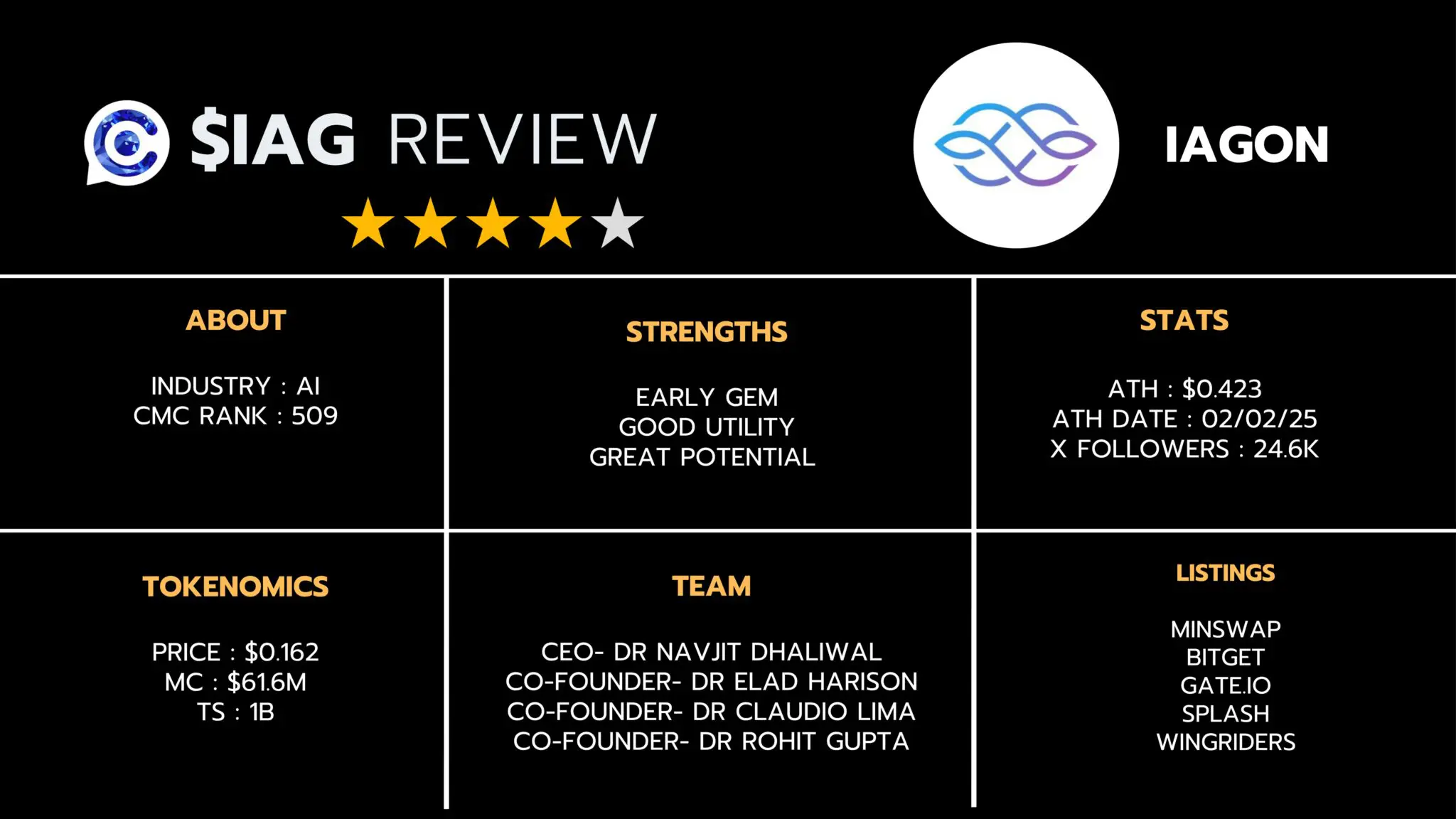
Market Performance:
📊 Market Performance
All-Time High: $0.424 (Feb 02, 2025)
All-Time Low: $0.000795 (Aug 02, 2022)
Exchange Listings:
Bitget, Gate, Bitrue, Minswap, Sundaeswap
Liquidity:
High on CEXs; High on DEXs (Minswap, Sundaeswap)
Trading Volume Trends:
962k 24h avg.
Team
- Dr Navjit Dhaliwal: Co-founder & CEO.
- Dr Elad Harison: Co-founder & COO.
- Dr Claudio Lima: Co-founder.
- Dr Rohit Gupta: Co-founder.
The Iagon team comprises experienced professionals from cloud computing, cybersecurity, and blockchain domains.
Advisors include experts from Cardano ecosystem partners and AI data privacy sectors, strengthening Iagon’s position in the Web3 infrastructure space.

Project Analysis
Comparative Overview
- vs. Filecoin ($FIL): Filecoin focuses purely on decentralized storage, whereas Iagon offers both storage and decentralized compute. Iagon’s cross-chain support gives it an interoperability edge.
- vs. Akash Network ($AKT): Akash targets decentralized compute but lacks a strong storage component. Iagon merges both compute and storage into one cohesive platform.
- vs. Arweave ($AR): Arweave focuses on permanent data storage, mainly for archival. Iagon is designed for active, scalable, and secure file storage and compute.
Strengths
- Dual-chain architecture for broader interoperability
- Combined compute and storage services in one platform
- Strong focus on privacy, encryption, and data control
- Accessible cost model for small developers and enterprises
Challenges
- Competing with well-funded incumbents like Filecoin and Arweave
- Scaling storage capacity while ensuring quality and redundancy
- Driving adoption across two distinct blockchain ecosystems
Iagon vs Competing De-Pins
| Project | Core Focus | Compliance/Identity | Performance |
|---|---|---|---|
|
| Decentralized cloud storage & compute marketplace leveraging blockchain + AI; secure storage, compute, Agora public file system, hosting, identity apps | Active compliance stance (AML/CFT policy), GDPR-ready tools, optional KYC on Agora, enterprise-grade identity via Statur | Storage nodes require ≥ 900 GB & 20 Mbps; compute/testnet: performance-tiered nodes, benchmarking, sub-second metrics. Scale depends on node network; currently enterprise testnet, mainnet storage live |
 Filecoin
| Decentralized storage marketplace | Compliance depends on integrations; no native identity | High throughput for archiving; slower retrieval |
|
| Permanent data storage | No built-in compliance/KYC | Optimized for permanent writes; moderate access speeds |
|
| Decentralized cloud storage | Offers optional KYC/compliance for enterprise | Good performance worldwide but depends on node distribution |
|
| Decentralized file storage | No native compliance | Performance varies by host location; less optimized than Iagon |
Iagon differentiates itself by combining decentralized storage infrastructure with enterprise-grade security and compliance—ideal for bridging traditional enterprises into Web3.
Conclusion
Iagon stands out in the decentralized infrastructure landscape by combining both decentralized storage and computing into one interoperable, user-controlled cloud system. While Filecoin and Akash dominate their respective verticals, Iagon’s unified platform approach positions it as a powerful Web3-native alternative.
As demand for censorship-resistant, private, and scalable backend services grows, Iagon offers a viable infrastructure backbone for dApps, enterprises, and Web3 platforms. Its dual-chain strategy and tokenized economy enhance usability and adoption potential, especially in an era where data sovereignty and cost-effective computing are in demand.
If Iagon can continue executing on its roadmap and attract enterprise partners, it may emerge as one of the key players in the race to decentralize the cloud.
Explore More Reviews to Level Up Your DYOR Game.
Frequently Asked Questions
What is Iagon in one line?
What problem does Iagon solve?
How does Iagon ensure data privacy?
What makes Iagon different from Filecoin, Akash, or Arweave?
What is Iagon’s architecture?
What is the IAG token used for?
How is the IAG token allocated?
What is IAG’s market performance?
Who is behind Iagon?
What are Iagon’s biggest strengths and challenges?