Aptos ($APT) Review:
Aptos blockchain review: A fast, compliant, AI-integrated Layer-1 leading in stablecoins and real-world assets with sub-second finality.


Author: Akshat Thakur
Introduction
Aptos is a Layer-1 blockchain engineered for speed, security, and real-world adoption. Created by former Meta engineers behind the Diem blockchain, Aptos is built on the Move programming language, which ensures safe and parallelized execution. Its unique Block-STM engine and AptosBFT consensus enable sub-second finality and ultra-low fees, allowing Aptos to process millions of transactions per second under high demand.
In 2025, Aptos has emerged as one of the most versatile ecosystems in Web3, powering the convergence of artificial intelligence (AI), stablecoins, and real-world assets (RWAs). Through collaborations with Microsoft and Aptos Labs’ FIND OUT AI Q&A app, Aptos is making blockchain more intuitive through AI-powered interfaces. Simultaneously, it has become the Chain of Choice for Stablecoins, surpassing $1 billion in stablecoin market cap, with native support for USDT, USDC, USDe, PYUSD0, and USDY.
Now, Aptos is also leading the Real-World Asset (RWA) revolution, with over $540 million in tokenized assets and a Top 3 global ranking among chains for RWAs. Tokenized credit portfolios, real estate, and money-market funds are moving on-chain, leveraging Aptos’ compliance-ready infrastructure and sub-second settlement. Aptos’ combination of institutional-grade security and user-friendly innovation demonstrates its mission: to bridge traditional finance, AI, and decentralized technology into one interoperable ecosystem.
Problem Statement
- Performance Bottlenecks in Legacy Blockchains: Most existing blockchains execute transactions sequentially, causing congestion, slow confirmations, and high fees. This limits their ability to handle large-scale financial and AI applications.
- Security and Compliance Limitations: EVM-based chains face recurring vulnerabilities like re-entrancy attacks and lack standardized compliance modules. This creates barriers for institutions that need secure, regulated environments.
- Fragmented Stablecoin and RWA Ecosystems: Liquidity across stablecoins and RWAs is scattered across multiple chains. The lack of a unified framework restricts composability, settlement efficiency, and global asset mobility.
- Centralization in AI and Data Systems: Most AI systems are controlled by centralized entities, creating risks of bias, data manipulation, and opaque decision-making. This undermines user trust and transparency.
- Poor Accessibility for New Users: Web3 interfaces remain too complex for mainstream audiences. Wallet management, gas fees, and technical jargon discourage onboarding and slow down global adoption.
Solutions Provided by Aptos
- Block-STM Parallel Execution: Aptos’ Block-STM engine executes multiple transactions simultaneously, enabling sub-second finality and up to one million TPS. It eliminates congestion and supports institutional-scale workloads.
- Move Language and Compliance Standards: The Move language ensures resource safety and prevents vulnerabilities. Combined with the Fungible Asset Token Standard, it provides built-in tools for compliance, auditing, and regulated asset issuance.
- Unified Asset Infrastructure: Aptos integrates USDT, USDC, USDe, PYUSD0, and USDY into one composable framework. This unified infrastructure connects stablecoins, RWAs, and DeFi protocols under a single liquid ecosystem.
- Transparent AI Integration: Partnerships with Microsoft and tools like Aptos Assistant enable verifiable, on-chain AI operations. Users can interact with transparent AI systems that prioritize trust and accountability.
- AI-Driven User Experience: Aptos simplifies blockchain access through intuitive AI tools like FIND OUT, offering guidance and education. This approach removes barriers for newcomers and improves mass usability.
Problem–Solution Overview
Technology and Architecture
- Consensus: AptosBFT (based on DiemBFTv4) – rapid finality and Byzantine fault tolerance.
- Execution Layer: Block-STM parallel engine for concurrent transaction processing.
- Move VM: Resource-oriented programming for security and composability.
- Compliance Layer: Fungible Asset Token Standard enabling KYC and AML compatibility.
- AI Layer Integration: On-chain verifiable AI execution with Aptos Assistant and FIND OUT.
- Performance Metrics: Sub-1 second finality and up to 1 million TPS.
Technology & Architecture
Tokenomics
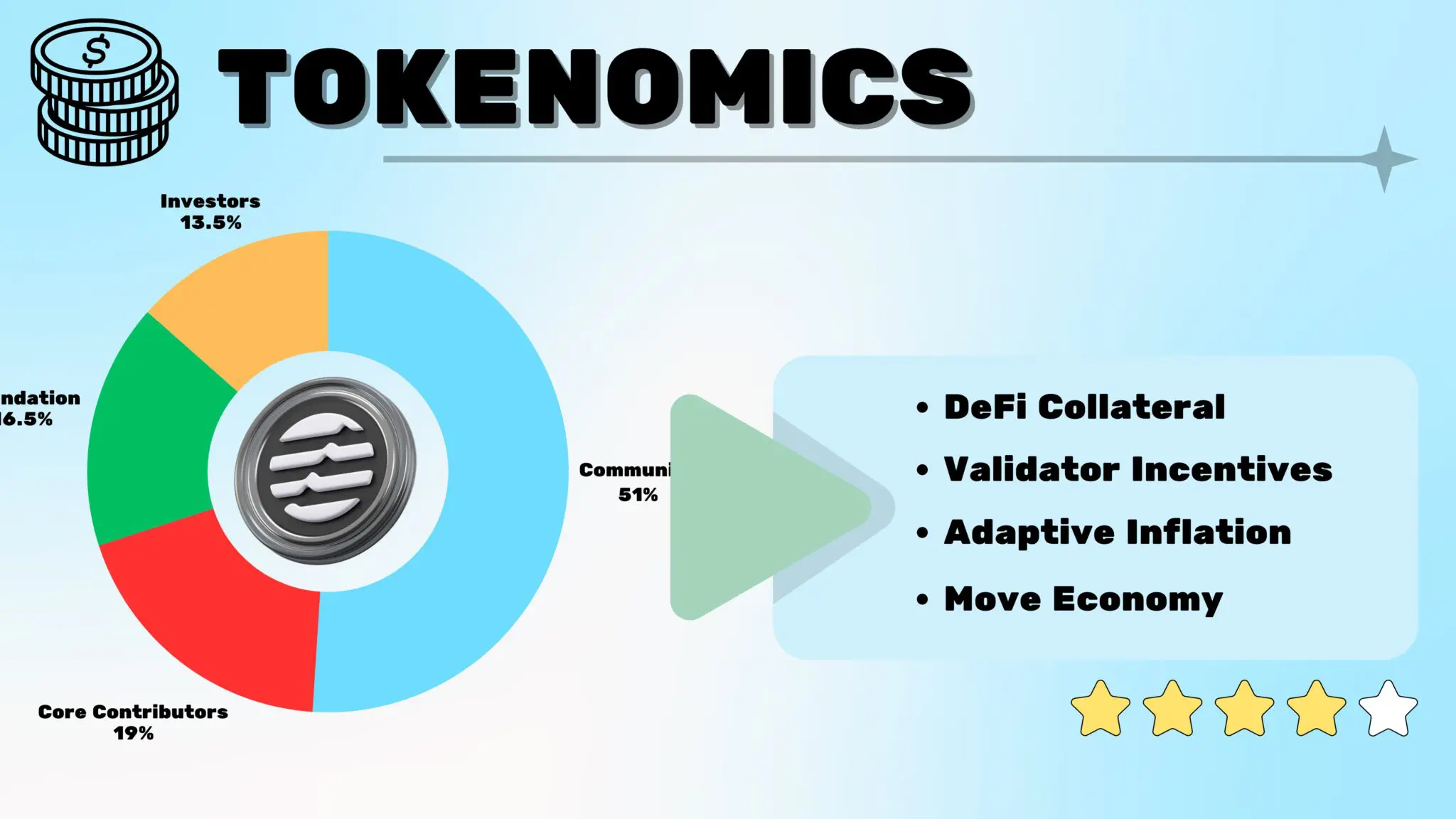
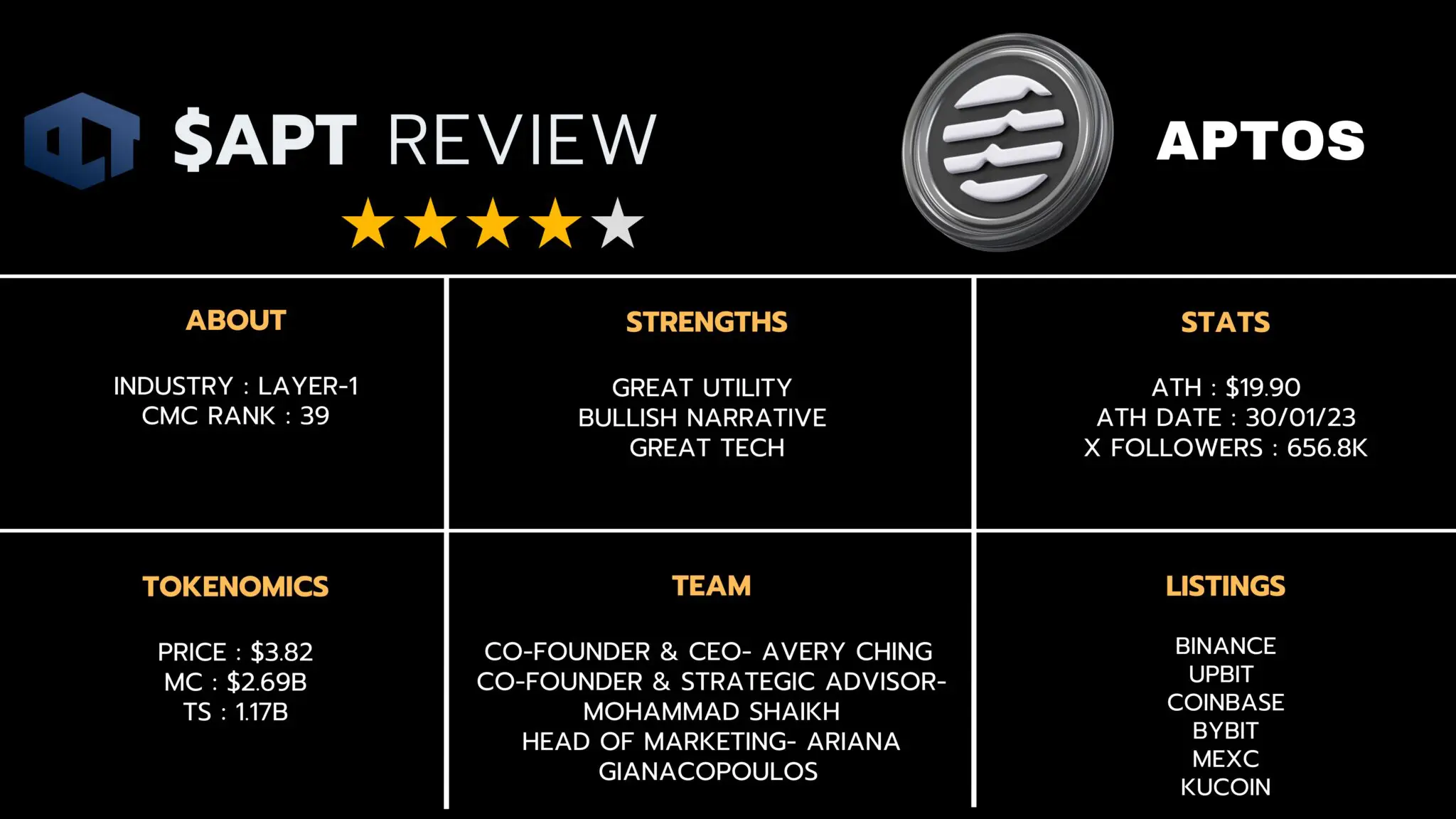
- Token Symbol: APT
- Total Supply: 1.17B APT
- Utility: Transaction fees, staking, governance, collateral in DeFi, and validator incentives.
- Inflation: Adaptive model balancing validator rewards and long-term token value.
Initial Supply
Mainnet was launched on October 12, 2022. The initial total supply of Aptos tokens (APT) at mainnet was 1 billion tokens. APT will have 8 digits of precision as part of the fraction where the minimal unit is called an Octa.
| Category | % of Initial Token Distribution | Initial Tokens |
|---|---|---|
| Community | 51.02% | 510,217,359.767 |
| Core Contributors | 19.00% | 190,000,000.000 |
| Foundation | 16.50% | 165,000,000.000 |
| Investors | 13.48% | 134,782,640.233 |
Market Performance
📊 Market Performance
Team
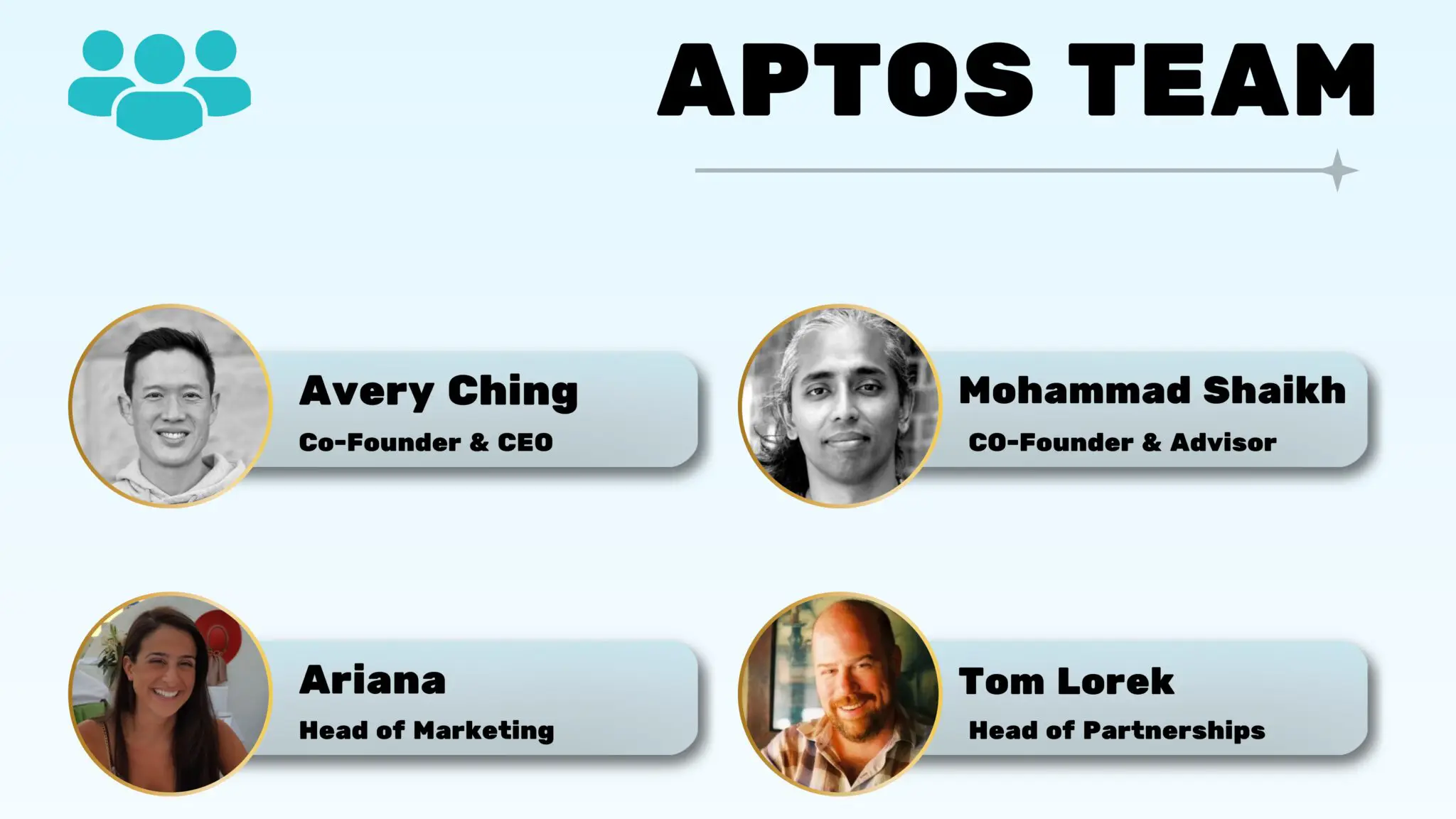
- Avery Ching: Co-Founder & CEO.
- Mohammad Shaikh: Co-Founder & Strategic Advisor.
- Ariana Gianacopoulos: Head of Marketing.
- Tom Lorek: Head of Partnerships.
Project Analysis
Comparative Overview
- Vs. Avalanche: Aptos offers faster execution and compliance features tailored for RWAs.
- Vs. Polygon: Aptos delivers stronger parallelization and institutional integration.
- Vs. Stellar: While Stellar focuses on payments, Aptos extends to programmable RWAs and AI integration.
Strengths
- High-speed, low-cost execution for financial-grade workloads.
- Deep liquidity through stablecoins and RWAs.
- Partnerships with Microsoft, BlackRock, Franklin Templeton, and Securitize.
- Move language and token standards ensuring safety and compliance.
- Mature DeFi composability with AI-powered accessibility.
Challenges
- Competing with established chains in institutional adoption.
- Requires continuous ecosystem development and dApp expansion.
- Long-term reliance on sustained TradFi partnerships for RWA scaling.
Aptos vs. Competing Layer-1 Blockchains
SOL) –> Sui (SUI) –> AVAX) –> POL) –> Sei (SEI) –> NEAR (NEAR) –>| Project | Core Focus & Innovation | Compliance / Identity | Performance & Notes |
|---|---|---|---|
|
| Parallel-execution Layer-1 for AI, stablecoins, and RWAs using the Move language and Block-STM engine. | Built-in KYC/AML compatibility via the Fungible Asset Token Standard. | Sub-second finality, ~1M TPS theoretical, strong institutional traction. |
|
| High-performance monolithic chain for DeFi, NFTs, and consumer apps using Sealevel runtime. | Fully permissionless; compliance handled at app level. | Extremely fast but faces occasional congestion; deep DeFi liquidity. |
|
| Object-centric Layer-1 focused on asset composability and gaming UX. | Permissionless; compliance frameworks still emerging. | Parallel object execution; optimized for digital assets and gaming. |
|
| Subnet-based Layer-1 allowing institutional or permissioned networks. | Supports KYC/KYB on custom subnets. | Fast finality (~2s); strong enterprise appeal for regulated RWAs. |
|
| Multi-chain EVM ecosystem (PoS, zk, app-chains) bridging Ethereum scale. | Compliance via enterprise partners and zk frameworks. | Mature liquidity; settlement secured by Ethereum; strong BD traction. |
|
| Payments-focused Layer-1 for cross-border transfers and fiat-token issuance. | Issuer-level compliance via trustlines and anchors. | Highly reliable settlement layer; limited programmability. |
|
| Trading-optimized L1 designed for order-book and exchange-grade latency. | Permissionless; compliance optional at app layer. | Low-latency consensus; strong for DeFi trading use cases. |
|
| Sharded Layer-1 emphasizing scalability and simple onboarding. | Permissionless; identity via human-readable accounts. | Fast finality (Doomslug); great developer and user experience. |
Conclusion
Aptos has evolved into a true multi-dimensional blockchain combining AI accessibility, stablecoin dominance, and real-world asset tokenization. Its robust technical foundation, institutional partnerships, and compliance-driven design have propelled it into the top tier of blockchains driving the next wave of on-chain finance.
From Microsoft’s AI integrations to over $1 billion in stablecoins and $540 million in tokenized assets, Aptos demonstrates how high performance and regulatory trust can coexist. Its success in bridging TradFi and DeFi through verifiable, secure infrastructure sets a precedent for what the future of blockchain can achieve.
If Aptos continues executing its roadmap and scaling its ecosystem, it could emerge as the global infrastructure backbone for tokenized assets and AI-driven finance a network where money, data, and intelligence move seamlessly across the digital economy.
Frequently Asked Questions
What makes Aptos different from other blockchains?
How does Aptos integrate AI into its ecosystem?
Why is Aptos considered the “Chain of Choice” for stablecoins?
What role do Real-World Assets (RWAs) play on Aptos?
How does Aptos ensure regulatory compliance?
What is the Move language, and why is it important?
What are Aptos’ main advantages for developers?
What are the key growth drivers for Aptos in 2025 and beyond?
In this article
Technology & Architecture 📊 Market PerformanceAptos vs. Competing Layer-1 Blockchains