
Why The Last Automatic Bidder is leaving MSTR as MSCI removes Strategy from its indexes, impacting passive demand and financing.
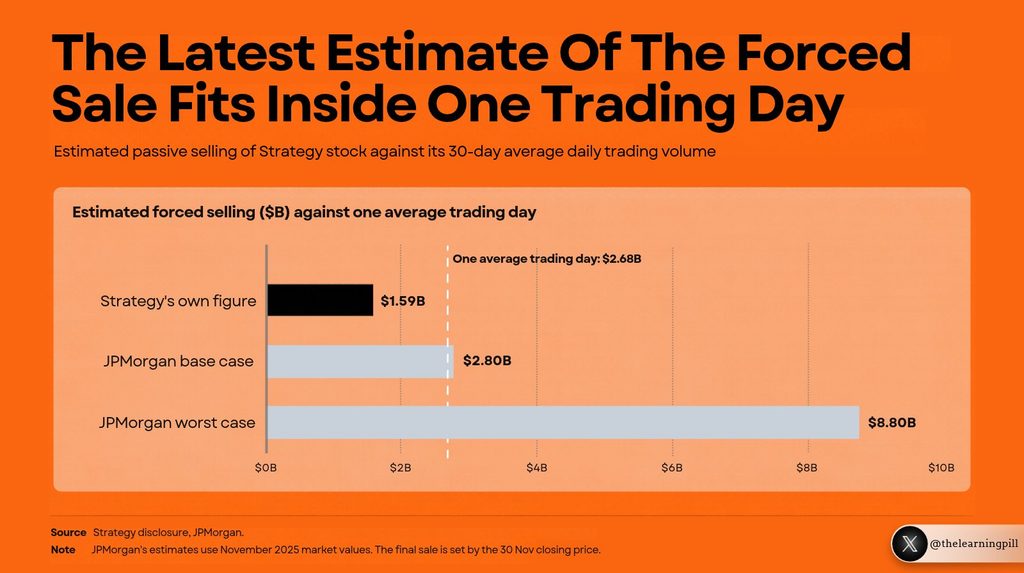
Why The Last Automatic Bidder is leaving MSTR matters more than the forced selling itself. The 13 million shares index funds must sell would fit inside one ordinary trading session.
Index funds tracking MSCI benchmarks hold roughly 13 million shares of the company they now have to exit, about 3.1% of its basic share count. At Wednesday’s close of $122.35 that’s around $1.59 billion of stock, while the same stock has averaged roughly $2.68 billion of trading volume a day over the past month. A seller that size gets absorbed inside a single session of normal flow.
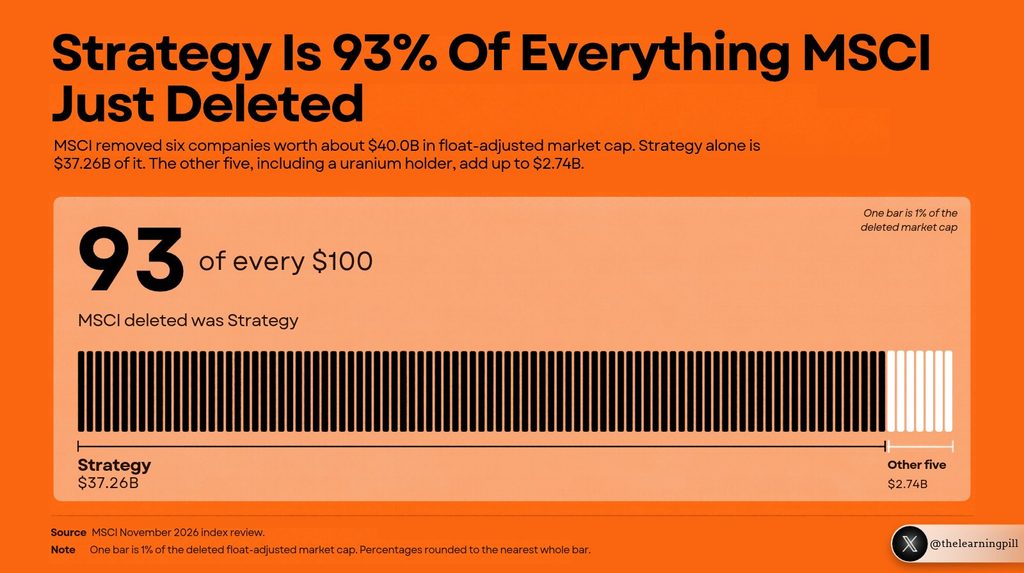
So why did a company worth about $40 billion by MSCI’s own count spend a year writing letters and lobbying to stay in?
The fight was over the definition MSCI used to reach its decision, and that definition lands at the worst possible point in Strategy’s financing cycle.
On Wednesday evening, MSCI published its November review.
MSCI will remove Strategy’s Class A shares from its Global Investable Market Indexes after the market closes on 30 November. Metaplanet and Upexi will also leave the indexes.
Strategy represents roughly 93% of the float-adjusted market capitalisation affected by the new rules. Its share amounts to about $37.26 billion of the $40 billion total.
The outflow figures circulating this morning come from three places, and only one of them is current:
Passive money had also been capped for more than a year before this vote. In October 2025 MSCI froze index weight increases for companies holding more than half their assets in digital assets, so every share Strategy issued since then entered the market without a matching passive bid.
The new screen runs in two stages. A company first has to show that operating assets make up more than half its total assets. Strategy, whose balance sheet is overwhelmingly bitcoin, fails that core screen, which sends it to five industry-neutral ratios, and failing four or more of them removes eligibility:
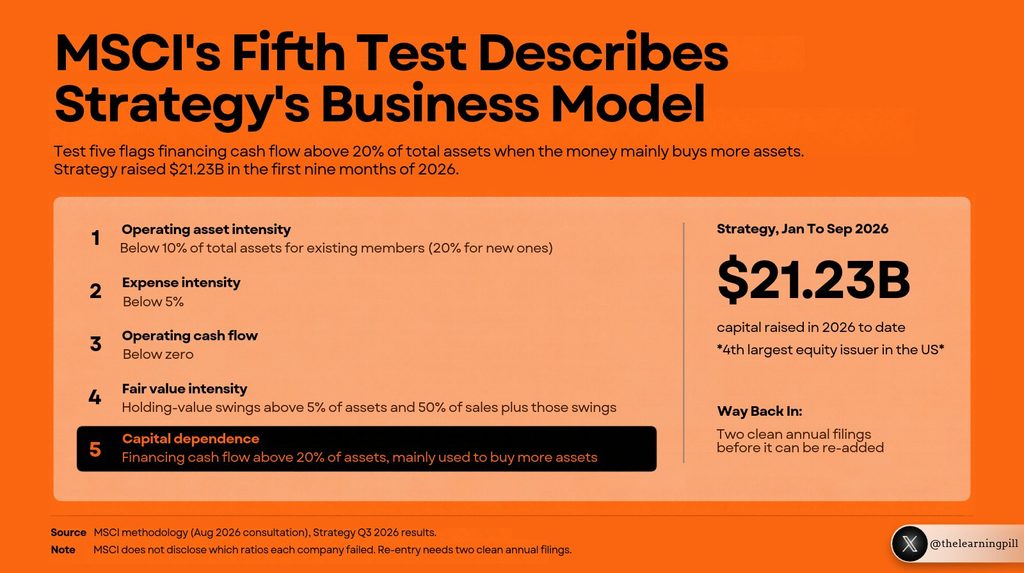
MSCI doesn’t publish which ratios caught which company. Ratio five, though, reads like a description of the business model written in index-committee language. Strategy raised $21.23 billion of capital in the first nine months of 2026 and calls itself the fourth largest equity issuer in the US. The figure it presents to investors as its edge is the same activity MSCI now treats as evidence that a company isn’t operating.
The screen is deliberately asset-neutral, and the deletion list proves it. Yellow Cake, a UK company whose business is holding a stockpile of uranium, was removed in the same review. For index purposes, 850,364 BTC now sits in the same category as warehoused uranium, classed as a pile of assets with a listing attached.
Getting back in won’t be quick. MSCI removes existing members only after they fail two consecutive annual filing periods. Strategy has now met that condition.
New applicants face a similar hurdle. MSCI won’t admit a company if it failed either of its two most recent annual filings.
Re-entry needs two clean years, which means a different-looking business. Michael Saylor’s response was that “index classification does not define us.” For the passive share of the shareholder base it now does, at least until 2028.
Losing the index bid would matter less if the company still had strong demand for new shares. It doesn’t, and its own Q3 release shows how quickly that demand faded:
That’s the arithmetic of issuing at or below net asset value, which I walked through in July using Europe’s treasury cohort: below 1x, every share sold dilutes bitcoin per share faster than the proceeds add to it.
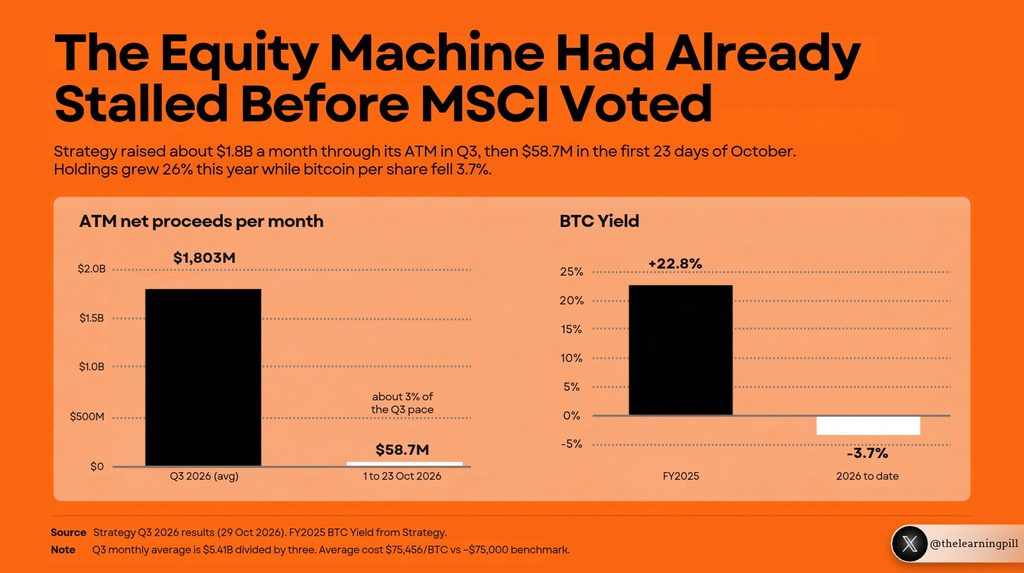
The index removal takes away a structural buyer of the common stock at exactly the moment Strategy needs a premium on that stock to restart the flywheel.
Index funds sell once. The preferred stack keeps billing every month.
The size of that bill, from the Q3 release:
That bill can be paid from four places, and each one now has a constraint:
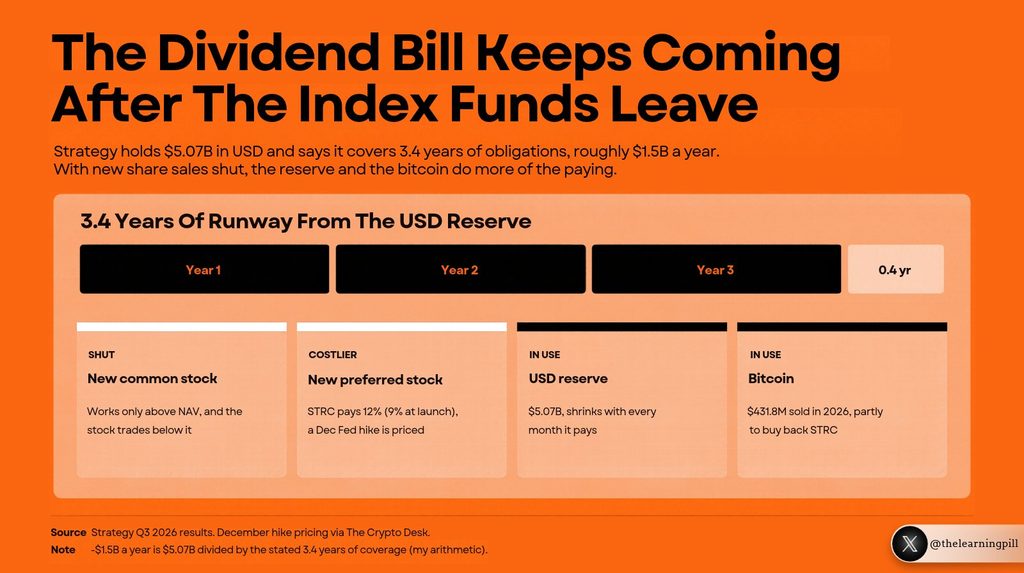
The buybacks deserve their own line. Strategy has repurchased 20,980,508 STRC shares this year for about $2.04 billion, at an average of $97.39 against a $100 stated value. A company built to convert dollars into bitcoin has spent part of 2026 converting bitcoin into support for the price of its own credit.
However, none of this points to a forced liquidation that may spook the markets. Having a reserve worth 3.4 years of obligations gives management room, and a bitcoin rally would refill the equity premium faster than any policy change could.
What has changed is the direction of travel: for every month the common stock trades below NAV without an index bid, the reserve and the bitcoin stack carry more of the dividend bill.
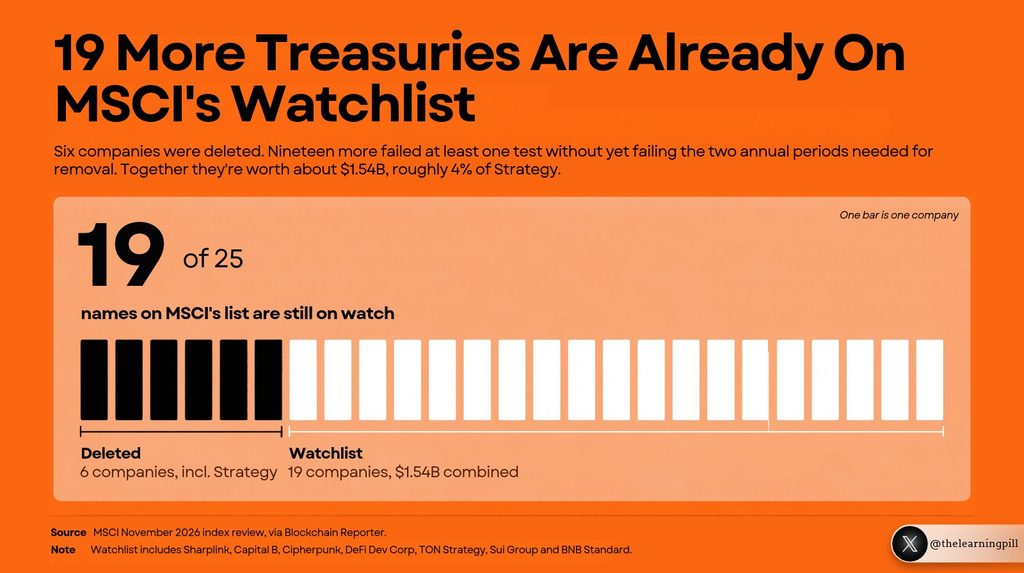
The deletion list gets the headlines, but the watchlist matters more for the rest of the sector.
Nineteen companies have failed at least one test without yet failing the two annual periods needed for removal: Sharplink, Capital B, Cipherpunk Technologies, DeFi Dev Corp, TON Strategy, Sui Group, BNB Standard and others. Their combined float-adjusted cap is about $1.54 billion, roughly 4% of Strategy’s.
For them the capital dependence ratio works as a ceiling on how they grow.
Ratio five measures whether a treasury raises capital to buy its core asset. Smaller operators copying Strategy’s model face greater removal risks. Their reliance on financing could put them outside passive benchmarks.
Capital B is already on the watchlist. The French operator has links to Blockstream and TOBAM. This shows that Europe’s discount-regime cohort is not exempt.
Metaplanet’s chief executive said the change doesn’t alter its accumulation plans. The plans will still have to fit inside a ratio from now on.
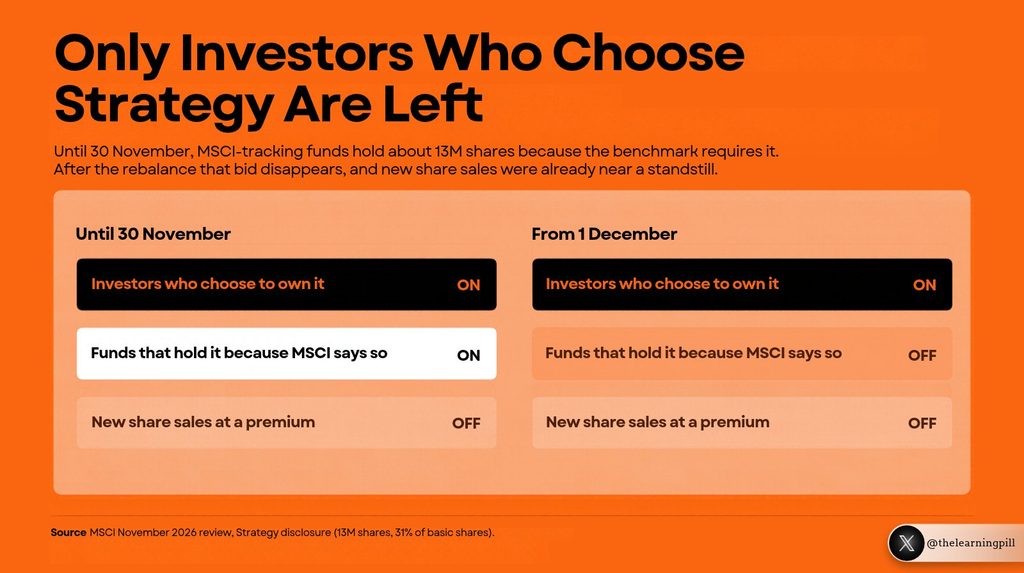
Strategy built its model on a market willing to pay extra for bitcoin inside a stock. Part of that extra came from investors who chose it, and part came from funds that held the shares because a benchmark told them to. From 1st December, only the first group remains.
Public markets have long priced listed wrappers at a discount. Investors can buy the underlying asset directly. Buybacks or a genuine operating business are usually needed to close that gap.
Strategy now faces a choice. It can build a business that passes four of MSCI’s five ratios. That would require a different operating model. Alternatively, it can follow the playbook of vehicles trading below their holdings.
This second approach uses tenders, buybacks and share-for-share consolidation. European operators were already using these tools in May. Strategy has begun taking this route with STRC.
The 13 million shares will clear in a day. But the rulebook behind their removal will shape how Bitcoin treasuries raise capital for at least the next two years.
This article is purely for informational purposes only and does not construe any buy/sell advice. Always DYOR.

Weekly 7 Gud Reads + Yield Collective Deep analysis on DeFi mechanics, RWA, yields and capital flows Storyteller at @glasscade_xyz
https://t.co/rEGyx0kthn


Why The Last Automatic Bidder Of MSTR Is Bidding Goodbye
Pump.fun: Good or Bad for the Crypto Industry?
Top 7 Highest Revenue Per Market Cap Projects in Crypto
Stablecoin Payments Are Growing. Can Zoth Capture the Market?
Why The Last Automatic Bidder Of MSTR Is Bidding Goodbye
Pump.fun: Good or Bad for the Crypto Industry?
Top 7 Highest Revenue Per Market Cap Projects in Crypto
Stablecoin Payments Are Growing. Can Zoth Capture the Market?