Pump.fun earned nearly $1B while 60% of traders lost money. We break down the case for and against, the PUMP buyback model, and what the lawsuit changes.

Author: Kritika Gupta
Pump.fun has generated nearly $1 billion in revenue and helped users launch more than 12 million tokens. Yet Solidus Labs flagged 98.6% of the Pump.fun tokens it examined for signs of pump-and-dump schemes or rug pulls. More than 60% of traders lose money. So what did Pump.fun build? A genuine innovation that makes crypto more accessible, or a more efficient way to extract money from retail traders?
The case for innovation starts with what it used to take to launch a token. Creators had to deploy a smart contract, supply liquidity, and find somewhere for people to trade. Pump.fun handles those steps through a simple interface. Anyone with a Solana wallet can launch a token in seconds, and traders can buy or sell immediately through a bonding curve that adjusts the price with each trade. That is a real change in who gets to create a market on-chain.
But the same design also makes it easy to launch a token, attract buyers, and sell into the rush. Most tokens never “graduate” from the bonding curve to a liquidity pool. Still, Pump.fun collects fees when traders buy and again when they sell, even if the token collapses within hours. The platform can grow its revenue without increasing the share of tokens that survive.
That is what makes Pump.fun so divisive. It lowered the cost of creating a market, but it also built a business that can thrive while most traders lose. For crypto, the question is whether wider access creates enough lasting value to justify the cost to the people who use it.
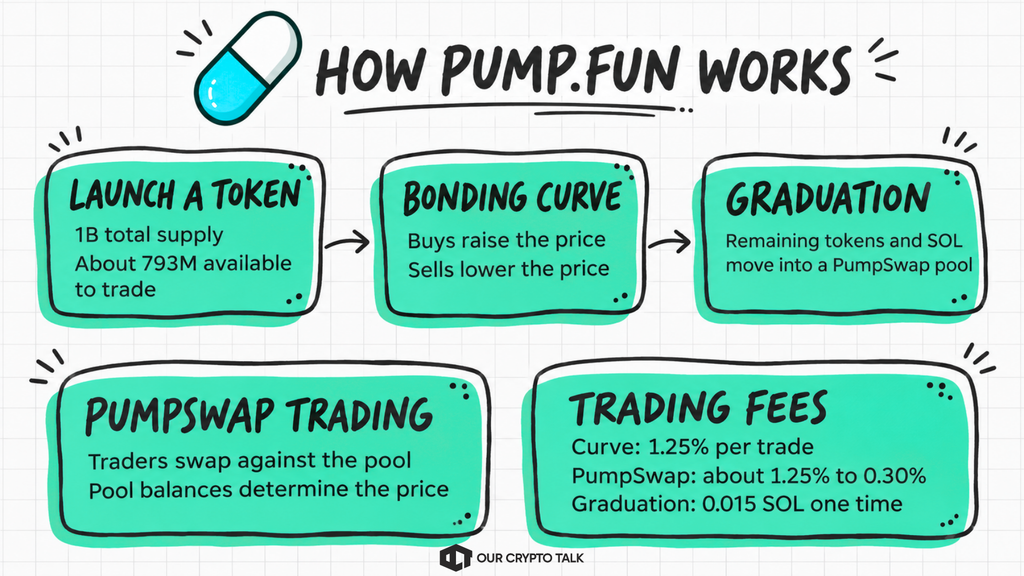
Pump.fun lets anyone with a Solana wallet launch a token in seconds. The creator picks a name, adds an image and description, and submits the launch. A smart contract creates one billion tokens and makes roughly 793 million available for initial trading. The creator can skip writing code, supplying upfront liquidity, and applying for an exchange listing.
At launch, traders buy and sell through a bonding curve, a formula that sets the token’s price. Each buy moves the price up the curve, and each sell moves it down. For example, if several buyers enter in a row, the next buyer pays a higher price. Traders interact directly with the smart contract, which handles pricing without an order book or a market maker quoting prices.
Next comes graduation. Once trading pushes the token to the curve’s threshold, the contract moves the remaining tokens and the SOL it collected into a PumpSwap pool in one transaction. PumpSwap is Pump.fun’s decentralized exchange. From that point, traders swap against the pool, and the balance of tokens and SOL in it determines the price. Graduation gives the token a new place to trade, but buyers still determine whether activity lasts. Most tokens never reach this stage.
Fees apply at both stages. On the bonding curve, every buy or sell carries a 1.25% fee. The protocol typically takes 0.95% of the trade amount, and the creator receives 0.30%. Pump.fun also charges a one-time graduation fee of 0.015 SOL. After graduation, fees in the token’s main PumpSwap pool start near 1.25% for tokens with small market caps and fall toward 0.30% as the market cap grows.
For traders, the main distinction is where the trade happens. Before graduation, they trade against the bonding curve. After graduation, they trade against the PumpSwap pool. Either way, they pay a fee when they enter and again when they exit, even if they sell at a loss.
PUMP trades at roughly 1x annualized revenue at the low end of its estimated price-to-sales range. In late November 2026, the token traded near $0.0024, about 40% below its $0.004 ICO price. Its circulating market cap ranged from roughly $800 million to $1.1 billion. At recent revenue run rates, that implies a multiple of about 1–2x.
Pump.fun raised roughly $1.3 billion across public and private sales in July 2025. Those tranches accounted for about 33% of PUMP’s maximum supply of one trillion tokens. The remaining allocations include the team, the community and ecosystem, and earlier investors. As team and investor tokens unlock, more PUMP can enter circulation even as buybacks reduce total supply.
Pump.fun uses a share of protocol revenue to buy PUMP on the open market and permanently burn it. Estimates put that share at 25–50%, depending on the period. Estimates also put cumulative buybacks at roughly $475–500 million and total burns at around 15–18% of the original supply. Higher trading activity can fund more buybacks, while a slowdown can reduce them.
That makes the revenue behind the roughly 1x multiple worth examining. The ratio compares PUMP’s circulating market cap with the platform’s annualized revenue, while holders benefit indirectly through the share Pump.fun spends on buybacks. If trading slows, both the revenue behind the multiple and the cash available for buybacks can shrink.
This is analysis, not financial advice. The ~1x revenue multiple could be a value signal or a value trap.
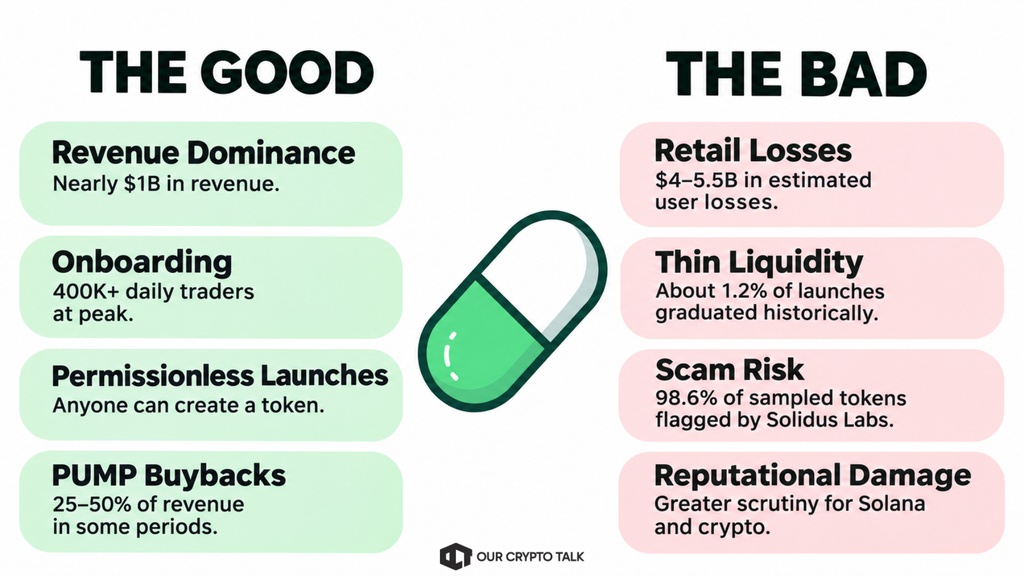
Pump.fun has built one of crypto’s highest-revenue applications by charging for an activity users already wanted to do. Its cumulative revenue approaches $1 billion, with hundreds of millions coming in through September 2026 alone. That puts it near the top of protocol fee rankings, alongside names such as Hyperliquid. Each new launch gives traders another market to enter, and Pump.fun earns fees when they buy or sell. Even if yesterday’s most popular token fades, today’s launches can bring traders back.
That ability to generate fees matters for PUMP’s valuation. At the low end of its estimated price-to-sales range, the token’s circulating market cap sits near one year of annualized platform revenue. The bull case is that Pump.fun can maintain enough trading activity to make that roughly 1x multiple look cheap, especially if it keeps directing a meaningful share of revenue toward buybacks.
Pump.fun reached more than 400,000 daily active traders at its peak. About 80% traded $100 or less, and 40% traded under $10. Those figures show how far the product reached into smaller accounts. For a few dollars and about 30 seconds, a user could launch a token. Buyers could then trade it directly from a Solana wallet.
That simple first transaction gives newcomers a practical introduction to wallets, network fees, liquidity, and on-chain markets. Some of that activity has translated into measurable demand for Solana blockspace. Pump.fun contributed more than $50 million in validator fees and accounted for 36.4% of all Solana fees in Q1 2026. The platform also helped draw memecoin liquidity to Solana, giving traders more reasons to fund wallets on the chain and use other applications there.
Before platforms like Pump.fun, a creator typically needed to deploy a contract, arrange initial liquidity, and find a venue where people could trade. Pump.fun handles those steps through one interface. A creator can launch without venture funding, a traditional presale, or approval from an exchange. Buyers can participate as soon as the token goes live.
The bonding curve also gives traders a clear view of how the market works. Its formula determines how each trade moves the price, and anyone can inspect transactions and wallet holdings on-chain. If a token meets the graduation threshold, its liquidity moves into PumpSwap automatically. Together, those features make it easier for small communities to test whether people want to trade a token without negotiating a listing or raising capital upfront.
Pump.fun uses part of its revenue to buy PUMP on the open market and burn it. Estimates put that share at 25–50%, depending on the period. When trading activity rises, the platform can collect more fees and use part of the proceeds to buy back more tokens. Every burn permanently removes those tokens from total supply.
For holders, the mechanism creates a link between platform usage and demand for PUMP. That link matters when evaluating the roughly 1x revenue multiple. If Pump.fun sustains trading volume and keeps allocating a meaningful share of revenue to buybacks, holders can point to an ongoing source of open-market demand at today’s valuation. The other figure to watch is circulating supply. Team and investor unlocks can add tokens to the market even as burns reduce total supply, so both flows matter to the investment case.
Solidus Labs found that 98.6% of the Pump.fun tokens it examined showed signs of pump-and-dump schemes or rug pulls. Separately, CoinGecko data showed that roughly 69% of tokens died on launch day and only about 5% survived past 90 days. More than 60% of traders lose money, and estimates put aggregate user losses at $4–5.5 billion, several times the roughly $935 million or more that the platform collected in fees.
Historically, only about 1.2% of launches graduated to a liquidity pool, and the rate fell as low as 0.26% during some periods in 2026. Yet Pump.fun earns fees whether a token graduates or collapses on its first day. If a trader buys into a launch and then sells at a loss, the platform earns a fee on both trades. That asymmetry sits at the center of the bear case.
Creators have launched more than 12.4 million tokens through Pump.fun, with as many as 42,000 launches in a single day. Every new batch competes for the same pool of speculative capital and trader attention. When demand fades, thin liquidity can leave traders with few buyers and force them to accept a much lower price to exit.
The effects may extend beyond the launchpad. Analysts such as Miles Deutscher argue that short-lived memecoins pulled speculative capital away from top-200 altcoins and helped delay a broader rally. That is one explanation for weaker altcoin demand. On the platform itself, the pattern is easier to see. Traders can move to the next launch in seconds, while anyone still holding yesterday’s token depends on buyers returning.
Pump.fun’s low barriers also make repeat scams cheap to run. A creator can launch a token, accumulate a position early, and sell into the demand that follows. Traders can inspect wallet holdings on-chain, but a list of holders rarely tells them who controls each wallet or which accounts might act together. Pump.fun advises users to check holder concentration. Buyers still have to make that judgment while prices move and new launches compete for their attention.
The class action Aguilar v. Baton Corporation et al. puts the insider question in sharper focus. Plaintiffs allege that co-founders and insiders bought newly launched tokens at low prices, pushed prices up along the bonding curve, and sold into retail demand. They cite more than 5,000 internal messages in support of their allegations. Those claims raise a question that matters to traders even before the case concludes. How much can a buyer infer from public on-chain data about who has an advantage at launch?
Pump.fun’s scale makes it one of the most visible examples of what crypto lets people do. For newcomers who first use Solana to buy a token that collapses within hours, that trade can shape how they view the entire ecosystem. Curve founder Michael Egorov called Pump.fun a “casino of scams,” and some Solana founders have also criticized the platform.
The consequences can reach other projects. Solana wants to attract businesses building payments, DeFi, and tokenized assets, yet those teams share an ecosystem with one of crypto’s most visible centers of memecoin speculation. Meanwhile, the Pump.fun lawsuit could influence how regulators and courts treat token launchpads more broadly. Pump.fun collects fees from the trading activity, while other builders may have to contend with the scrutiny it attracts.
Nearly $1 billion in revenue puts Pump.fun among crypto’s highest-earning applications. Alongside an estimated $4–5.5 billion in user losses, that figure tells a less flattering story. The two numbers measure different things. Pump.fun earns fees on trades, while users can lose money through fees, falling prices, and slippage when they exit thin markets. Much of a trader’s loss can end up with someone who sold earlier rather than with the platform itself.
Revenue per user adds another layer. Pump.fun charges on both buys and sells, so a trader can generate fees several times by recycling the same $100 across launches. A high revenue-per-user figure can therefore reflect frequent turnover even when users commit little fresh capital. Much of the platform’s fee revenue comes from tokens that still trade on their bonding curves or have market caps below roughly $250,000. A large share arrives in the first hour after launch, when traders rush into new markets.
Hyperliquid offers a useful comparison. It earns fees mainly from perpetual futures trading. Speculators use perps, but traders can also use them to hedge existing exposure or take a position in an established market. Pump.fun earns much of its revenue from traders betting on whether a newly launched token can attract the next wave of buyers. Both platforms monetize activity, but the trades serve different purposes.
Pump.fun creates value by making tokens easier to launch and trade. Its fee revenue shows how much users pay for that access. Whether the platform creates lasting value depends on what traders and creators get from it after the initial rush fades.
Private investors brought Aguilar v. Baton Corporation in federal court in New York. Their initial complaint alleged that Pump.fun collected nearly $500 million in trading fees while offering tokens the plaintiffs considered unregistered securities. The figure represents the plaintiffs’ estimate of platform fees at the time. The SEC did not bring the case.
The plaintiffs later told the court that a confidential informant provided nearly 5,000 internal messages involving Pump.fun personnel and others. They argued that the chats helped explain how participants coordinated the alleged scheme. In August 2026, the court dismissed the securities claims, citing deficiencies in the allegations for two tokens and a lack of standing for the other eighteen. It allowed civil racketeering claims against Pump.fun’s operator and three co-founders to proceed.
The exchange-registration question would matter in a separate ruling. If a court found that Pump.fun operated an unregistered securities exchange, other launchpads that facilitate similar trading for U.S. users could face closer scrutiny. Operators might need to register, qualify for an exemption, or change how they serve the U.S. market. An exemption can still carry obligations. For example, the SEC’s alternative trading system framework requires operators to register as broker-dealers. The implications would depend on which tokens qualify as securities and how much control each launchpad exercises over trading after launch.
Pump.fun helped make Solana the center of memecoin trading. In Q1 2026, activity tied to the launchpad accounted for 36.4% of all Solana fees. Every token launch, buy, and sell gave users a reason to keep SOL in their wallets and transact on the network. At peak activity, those trades generated substantial fee income for validators and drew more memecoin liquidity to Solana.
Yet Solana founders have publicly criticized Pump.fun. The tension comes down to what the network gains from that activity and what the activity signals to outsiders. A validator earns fees when traders rush into a new token.
A bank evaluating Solana for payments or tokenized assets may see those same trades as a reputational risk, especially when rug pulls dominate the coverage. The launchpad can boost network usage while making it harder for Solana to tell a broader story about what people use the chain for.
The 36.4% figure also raises a question about where future demand will come from. If memecoin trading cools, payments, DeFi, and tokenized assets could give users other reasons to transact on Solana. For now, Pump.fun remains both a major source of fee activity and an awkward association for an ecosystem trying to win institutional business.
Pump.fun made token creation easier, brought small traders on-chain, and built one of crypto’s highest-earning applications. Before Pump.fun, launching a tradable token took technical knowledge and upfront capital. Today, a creator with a Solana wallet can open a market in seconds. That is a genuine improvement in access. On balance, though, the costs outweigh the benefits for crypto.
The strongest argument against Pump.fun is how little its business depends on good outcomes for users. The platform earns fees when traders buy and again when they sell, even if a token collapses before the end of the day. Rug pulls and pump-and-dump schemes take advantage of that rapid turnover, and estimates put aggregate user losses in the billions. Meanwhile, every high-profile collapse gives people who have never used crypto a reason to associate the industry with scams.
Onboarding still counts, but the kind of activity people encounter first matters. A newcomer can learn how a Solana wallet works and still leave after one bad trade. Likewise, a creator can launch a token in seconds, but lasting liquidity still depends on people showing up after the first wave of speculation.
Pump.fun proved that anyone can launch a token and that millions of people will try trading them. So far, the platform has captured more lasting value from that experiment than the traders it brought on-chain.
On August 31, 2026, the court dismissed the securities claims against Pump.fun’s operator and let civil racketeering claims proceed. No date for the next ruling has surfaced in the public records reviewed. The next court order could clarify when the parties will begin exchanging evidence.
For PUMP holders, the July 2026 unlock is already behind them. Tokenomics.com lists December 12 as the next release, with about 9.2 billion PUMP due to unlock for insiders and private investors. Watch how much of that supply reaches the market and how it compares with the pace of buybacks.
Meanwhile, track whether a larger share of new tokens graduate and how many still have meaningful liquidity a month later. Compare those figures with rivals such as Bonk.fun and Bags to see whether competitors can attract traders and retain liquidity.
In Europe, watch how national regulators enforce MiCA’s licensing rules now that the transition period has ended. DAC8 adds a separate test for crypto platforms serving EU users. Its first tax-reporting cycle falls in 2027 and covers reportable transactions from 2026.


Pump.fun: Good or Bad for the Crypto Industry?
Top 7 Highest Revenue Per Market Cap Projects in Crypto
Stablecoin Payments Are Growing. Can Zoth Capture the Market?
Top 7 Crypto Tokens with the Highest Token Unlocks Left
Pump.fun: Good or Bad for the Crypto Industry?
Top 7 Highest Revenue Per Market Cap Projects in Crypto
Stablecoin Payments Are Growing. Can Zoth Capture the Market?
Top 7 Crypto Tokens with the Highest Token Unlocks Left