Top 10 countries leading crypto adoption in 2026, ranked by Chainalysis data, ownership rates, and on-chain volume. See who leads real usage.

Author: Akshat Thakur
We ranked countries by crypto adoption using a composite index built from five data sets as of March 2026. We focused only on usage and ownership. Looking at the top 10 countries leading crypto adoption, the pattern is clear: real utility is driving global growth, not speculation. This distinction matters, especially when compared to regulatory-focused rankings like our guide to the Top 10 Crypto-Friendly Countries in 2025, which evaluates policy rather than actual usage.
Chainalysis provides the Global Crypto Adoption Index, updated through Q4 2025, with strong weighting toward stablecoin activity. DefiLlama and Dune Analytics track on-chain transaction volume.
Binance Research and peer-to-peer platform reports capture P2P flows. The BVNK–YouGov survey, covering 4,658 holders across 15 countries, along with Cambridge Centre for Alternative Finance data, shows ownership levels. SimilarWeb tracks traffic to major wallets and exchanges.
Each metric carries equal weight. On-chain volume shows how much value moves through dollar-pegged tokens. P2P data highlights usage in markets with limited banking access. Ownership data shows how many people actually hold cryptocurrencies . Web traffic reflects daily engagement with wallets and exchanges.
We applied the same framework across 180 countries and territories. This ranking measures adoption through real usage. We exclude regulation, licensing, and policy signals. A country ranks higher only if people actively use and hold crypto at scale.
We cross-check every data point against at least two sources. The goal is simple. Show where cryptocurrencies actually move money in 2026.
More than ~559 million people worldwide now own cryptocurrency. That equals a global adoption rate of 9.9 percent as of early 2026. The data comes from the Chainalysis 2025 Global Crypto Adoption Index. The data not only ranks crypto adoption but also reveals the countries with most crypto users, with India, the United States, and Pakistan leading in absolute ownership while emerging markets dominate in usage intensity.
It measures actual on-chain and off-chain activity across retail centralized services, centralized services overall, DeFi, and institutional flows. The index adjusts for population and purchasing power parity to focus on real usage and ownership. It covers the 12 months ending June 2025 and shows sustained momentum into 2026.
These rankings highlight the top 10 countries leading crypto adoption, based on real usage rather than speculation.
Here is a closer look at each country, what drives adoption, and what changed in 2025-2026.
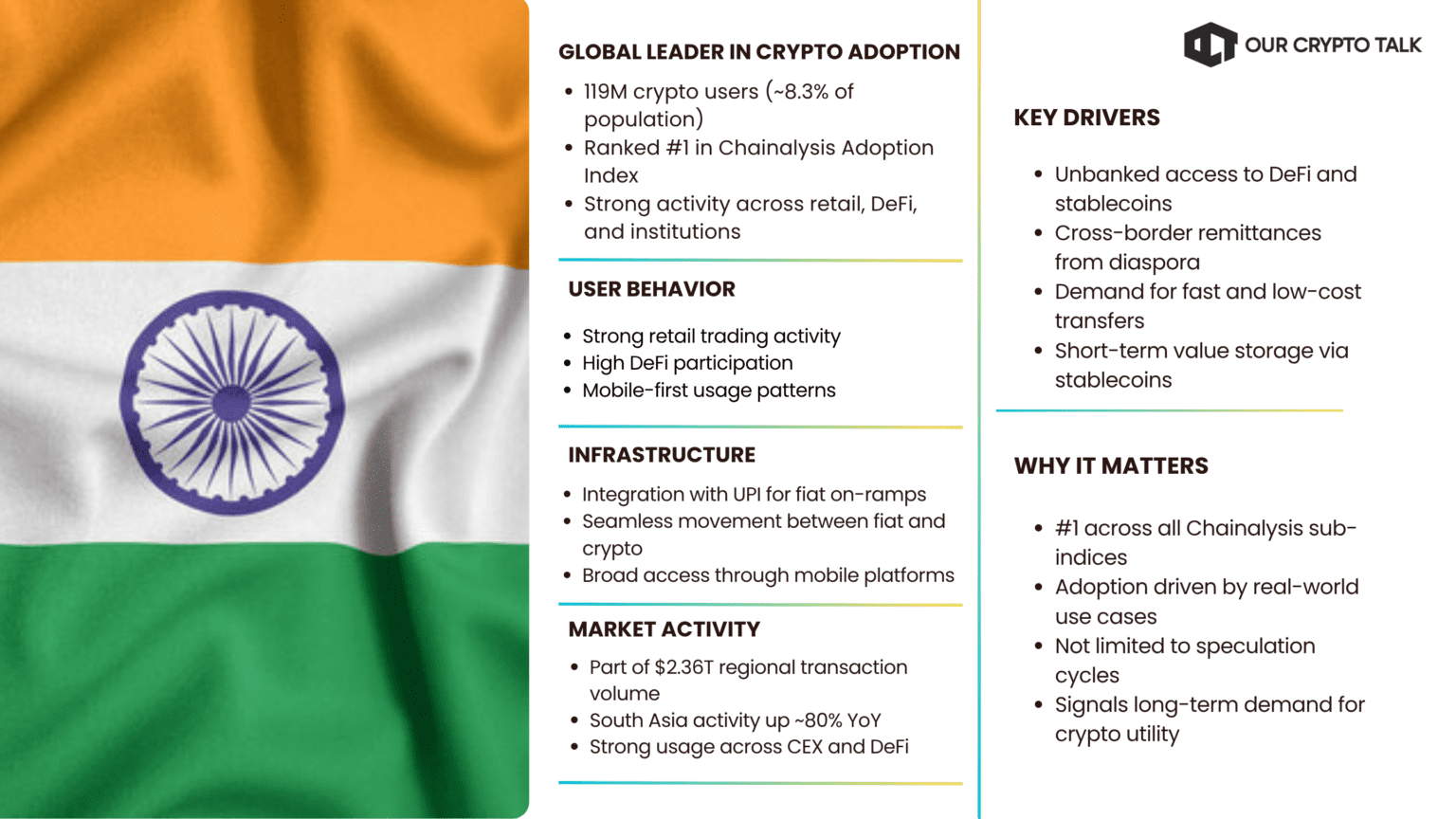
India reports around 119 million crypto users in early 2026, equal to roughly 8.3% of the population. Chainalysis ranks India first in the 2025 Global Crypto Adoption Index for the third year in a row, leading across every sub-index measured.
Usage remains broad and consistent. A large mobile-first population drives activity through retail trading and DeFi participation. Dollar-pegged tokens play a central role in cross-border remittances from the global Indian diaspora. Users also rely on them for short-term value storage and fast transfers. Integration with domestic payment systems like UPI supports seamless on-ramps between fiat and crypto.
Recent data confirms continued growth. South Asia recorded an 80% increase in crypto activity, pushing total on-chain transaction volume to $2.36 trillion in the 12 months ending June 2025. India accounts for a significant share of that volume, with both centralized exchanges and decentralized protocols seeing sustained usage.
One data point stands out. India ranks first globally across all Chainalysis categories, including retail centralized service activity, institutional flows, and DeFi usage. This reflects not just high participation, but consistent usage across every segment of the market.
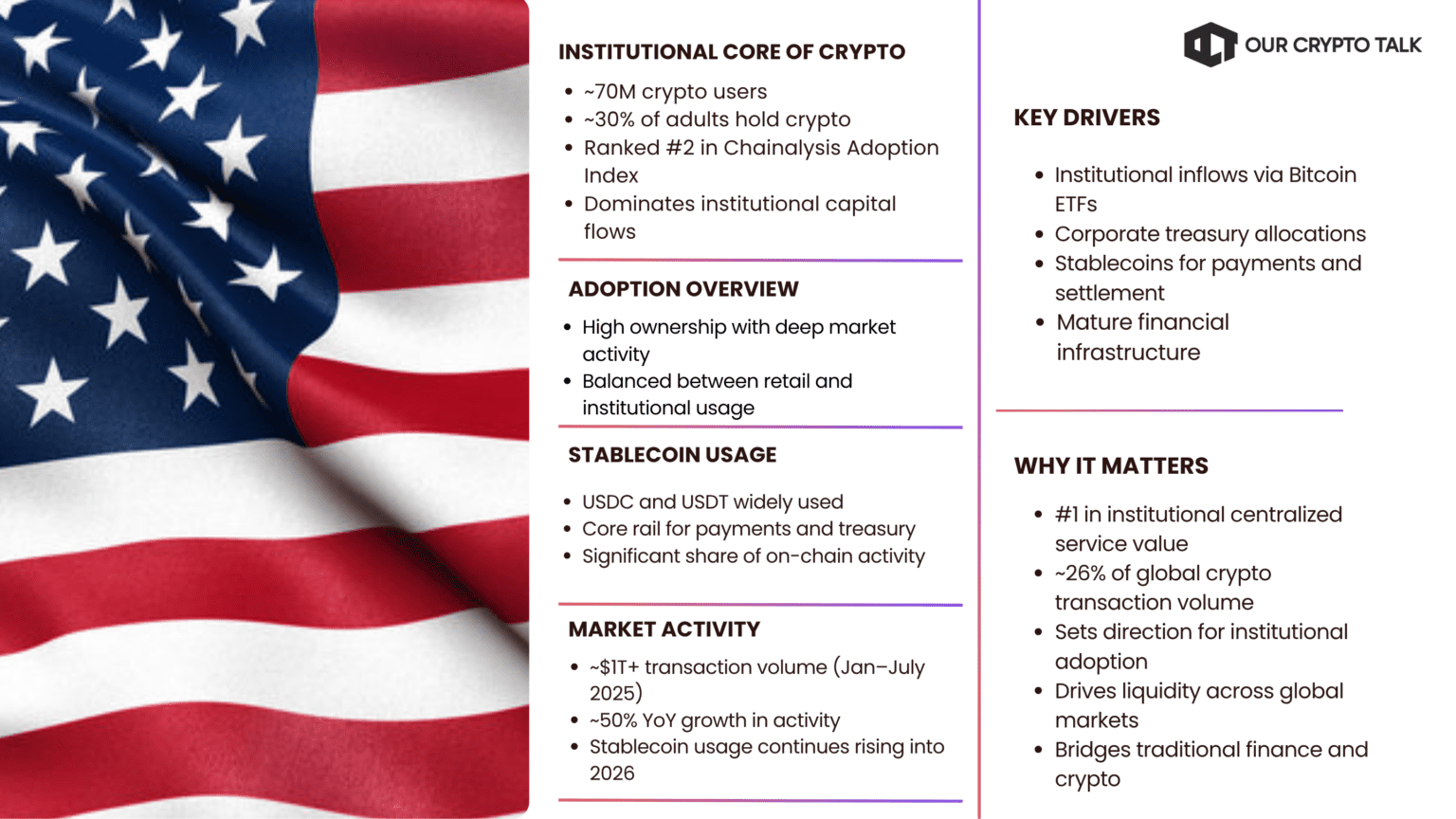
The United States has around 70.4 million crypto owners in early 2026, representing roughly 30% of adults. Chainalysis ranks the country second in the 2025 Global Crypto Adoption Index, reflecting both high ownership and sustained transaction activity at scale.
Adoption in the U.S. is defined by depth rather than just reach. Institutional participation drives a large share of total volume. Spot Bitcoin ETFs and corporate treasury allocations have increased capital flowing through centralized services. At the same time, stablecoins have become a core payment rail for both businesses and consumers. Companies use them for faster settlement, cross-border payments, and treasury management. Retail users continue to engage through exchanges, DeFi platforms, and peer-to-peer transfers, though growth has stabilized compared to earlier cycles.
Stablecoin usage stands out as a key driver. Businesses increasingly rely on USDC and USDT for predictable settlement and lower transaction costs. This shift shows up clearly in transaction data, where stablecoin transfers now represent a significant share of on-chain activity. The combination of institutional flows and everyday usage creates a balanced adoption profile.
Recent data confirms this trend. Crypto transaction volume in the United States increased by around 50% between January and July 2025 compared with the same period in 2024. Total volume exceeded $1 trillion in the first seven months alone. Stablecoin transfers continued to grow into 2026, reaching sustained highs as more payment flows moved on-chain.
One data point captures the scale. The United States accounts for 26% of global crypto transaction activity and ranks first in institutional centralized service value received. This reflects a market where both ownership and high-value usage contribute to adoption at a global level.
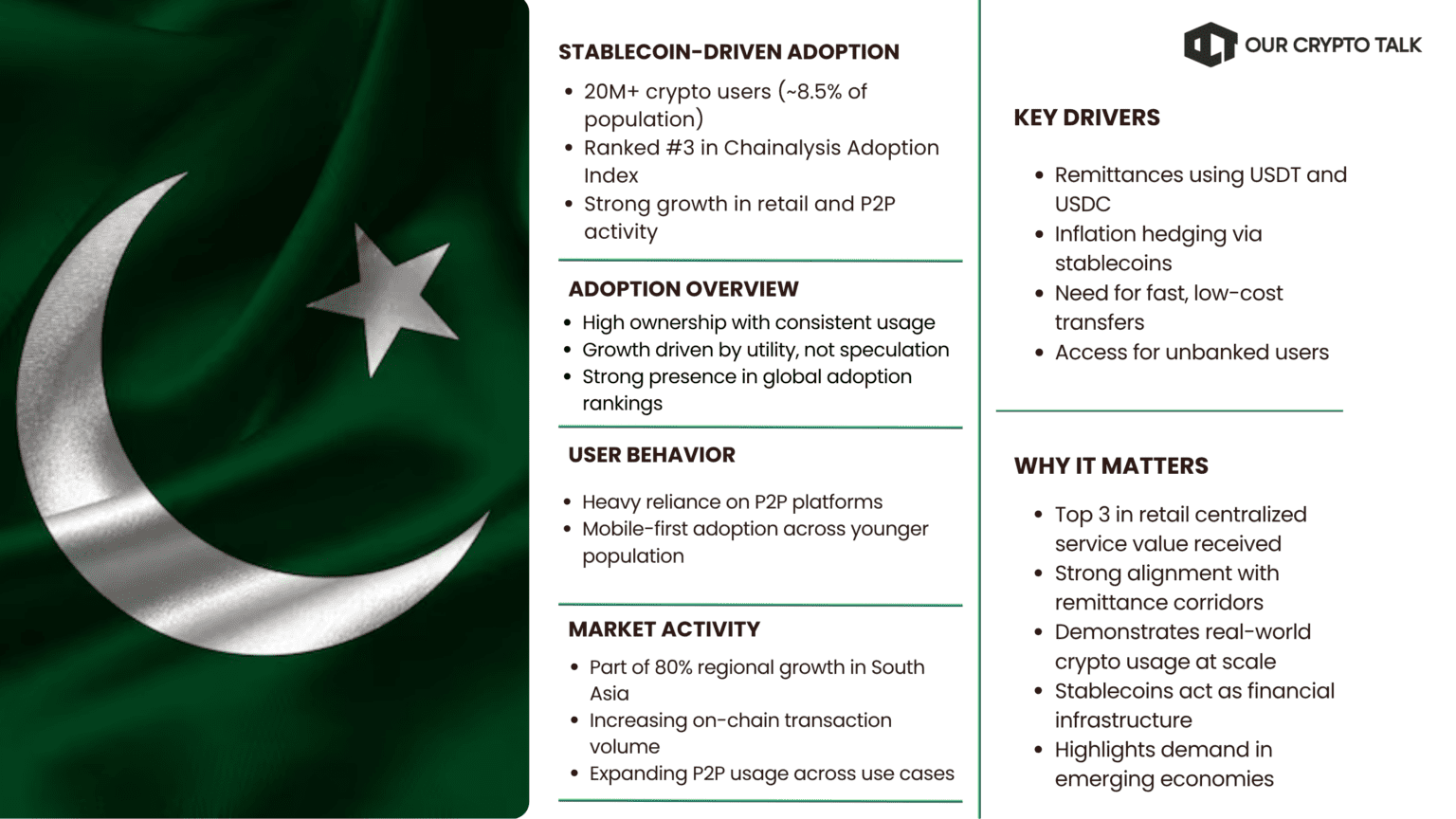
Pakistan has more than 20 million crypto users in early 2026, representing roughly 8.5% of its population. Chainalysis ranks the country third in the 2025 Global Crypto Adoption Index, placing it among the highest in both ownership and transaction activity.
Stablecoin usage drives most of this adoption. Remittances remain the primary use case. Workers sending money from abroad rely on USDT and USDC to bypass slow banking channels and high fees. Inflation also plays a role. Users turn to stablecoins to preserve value during periods of currency volatility. P2P platforms support freelancers, small businesses, and unbanked users who need fast and accessible payment rails. A young, mobile-first population accelerates this shift, with stablecoins used for both savings and everyday transfers.
Recent data shows strong growth. South Asia recorded an 80% increase in crypto activity, which pushed Pakistan’s on-chain flows higher through 2025. P2P volumes continue to expand as more users move away from traditional remittance channels. Stablecoin transfers remain consistent across both retail and small business use cases, especially in cross-border payments.
One data point highlights the structure of adoption. Pakistan ranks among the global top three in retail centralized service value received. At the same time, stablecoin transaction volume continues to grow year over year, closely tied to remittance corridors. This shows adoption built on real usage rather than speculative trading, with stablecoins acting as a core financial tool for daily transactions and income flows.
Vietnam has around 21 million crypto users in early 2026, representing roughly 21% of its population. Chainalysis ranks the country fourth in the 2025 Global Crypto Adoption Index, reflecting strong participation across both ownership and transaction activity.
Stablecoins play a central role in everyday usage. Remittances from overseas workers flow through USDT and USDC, offering faster settlement and lower costs than traditional channels. Users also rely on stablecoins for savings, especially in a market where access to global financial tools remains limited. Gaming and digital economies add another layer of activity, with stablecoins used for in-game payments and asset transfers. High smartphone penetration supports this shift, with mobile wallets and fintech apps integrating crypto into daily financial routines.
DeFi and P2P activity reinforce adoption. Retail users actively move funds across decentralized platforms, while peer-to-peer transfers remain common for small business payments and informal commerce. This creates a steady base of on-chain activity beyond speculative trading.
Recent data confirms continued growth. APAC crypto transaction volume increased by 69% year over year in the 12 months ending June 2025. Vietnam contributed to this trend through higher stablecoin usage in cross-border payments and domestic financial flows. Local platforms report rising daily active users as stablecoins become a standard tool for both transactions and value storage.
One data point highlights the breadth of adoption. Vietnam ranks consistently in the global top four across multiple Chainalysis sub-indices, including retail centralized service value received and DeFi activity. This reflects a market where usage extends across payments, savings, and digital economies at scale. This is a key reason the country remains part of the top 10 countries leading crypto adoption in 2026.
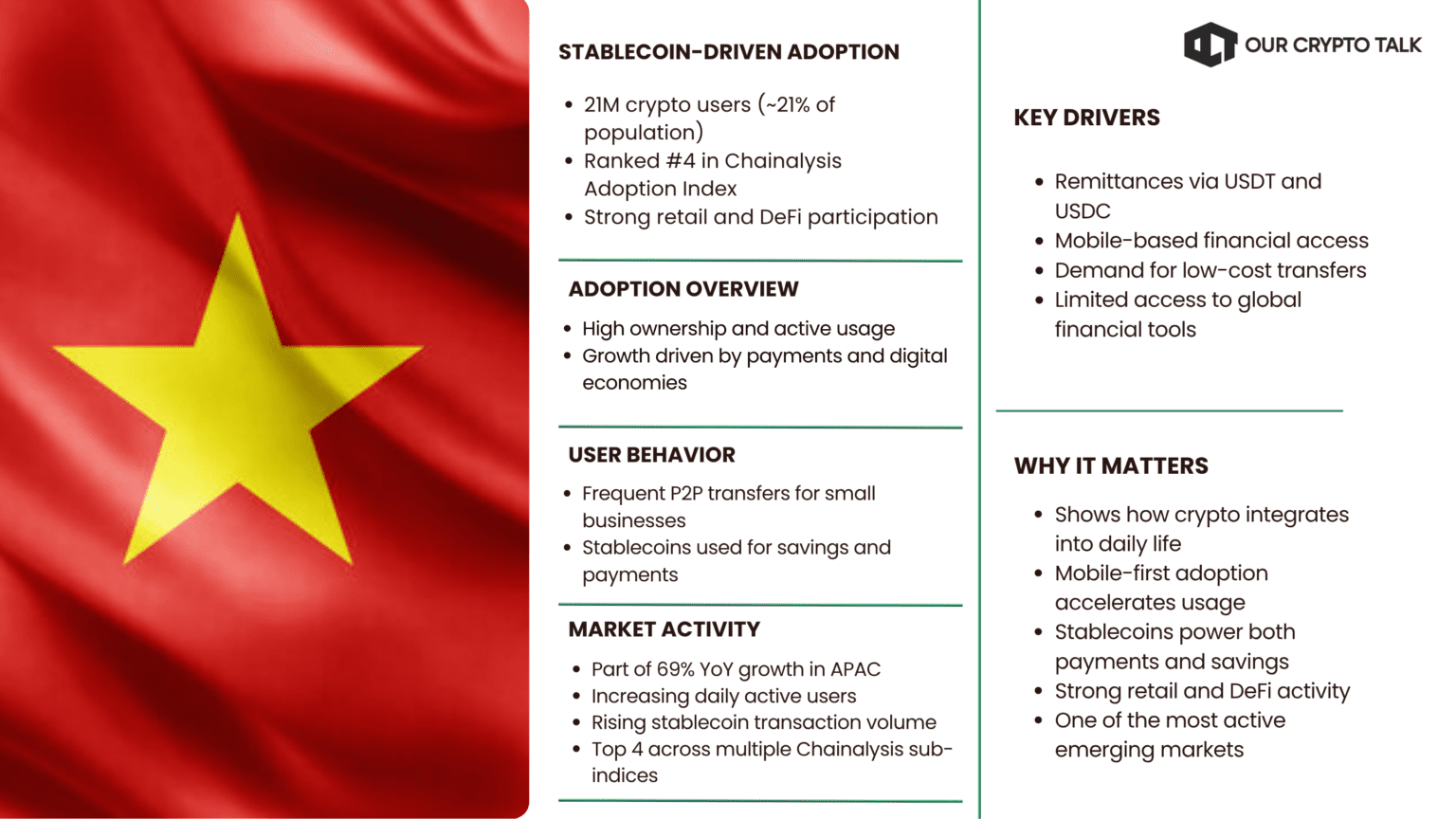
Brazil has around 26 million crypto users in early 2026, representing roughly 12% of its population. Chainalysis ranks the country fifth in the 2025 Global Crypto Adoption Index, placing it among the largest crypto markets by both ownership and transaction volume.
Stablecoins drive a large share of usage. Retail users rely on them to hedge against inflation and protect purchasing power. Businesses use USDT and USDC for cross-border trade, supplier payments, and faster settlement. A significant unbanked and underbanked population supports adoption through mobile wallets, where stablecoins offer easier access than traditional banking services. On-chain activity remains high across both centralized exchanges and decentralized platforms.
Regional data shows strong growth. Latin America recorded a 110% increase in on-chain value received year over year, with Brazil contributing over $318 billion in volume during that period. Stablecoin transfers make up a large portion of this activity, especially in cross-border transactions and business payments. Peer-to-peer platforms and DeFi applications continue to expand, adding consistent usage beyond trading.
One data point highlights Brazil’s position. The country ranks fifth across all major Chainalysis categories, including retail activity, institutional flows, and DeFi engagement. It also leads Latin America in total crypto transaction volume. This reflects balanced adoption, where both individual users and businesses actively use stablecoins for payments, savings, and transfers at scale.
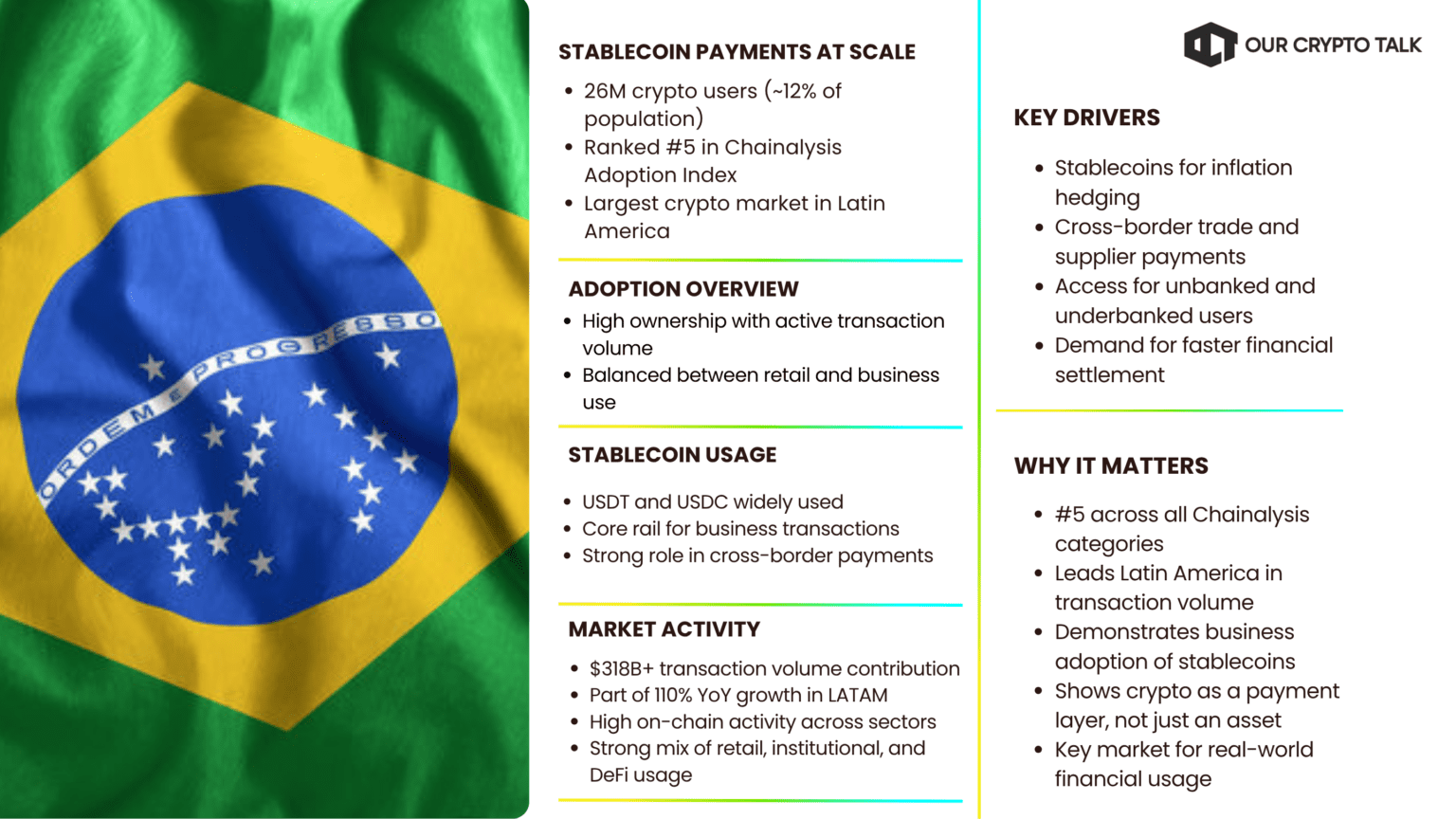
Nigeria has more than 20 million crypto users in early 2026, representing roughly 8.5% of its population. Chainalysis ranks the country sixth in the 2025 Global Crypto Adoption Index, reflecting strong participation in both ownership and transaction activity.
Stablecoins drive most of this usage. Remittances remain a primary use case, with USDT and USDC used to bypass high fees and delays in traditional channels. Inflation also plays a key role. Users turn to stablecoins to preserve value as the local currency faces volatility. Peer-to-peer platforms support freelancers and small businesses that rely on cross-border payments and flexible settlement. A young, mobile-first population accelerates adoption, with crypto used for both savings and everyday transfers.
Recent data shows continued expansion. Broader African crypto activity increased sharply through 2025, which pushed Nigeria’s on-chain flows higher. P2P transaction volumes continue to grow as users shift away from banking constraints. Stablecoin transfers tied to remittance corridors show consistent month-over-month growth, reinforcing their role in daily financial activity.
One data point highlights the structure of adoption. Nigeria ranks among the global top three in retail centralized service value received. At the same time, stablecoin usage continues to grow year over year, driven by real transaction demand rather than speculative trading. This confirms Nigeria’s position as one of the most active grassroots crypto markets globally.
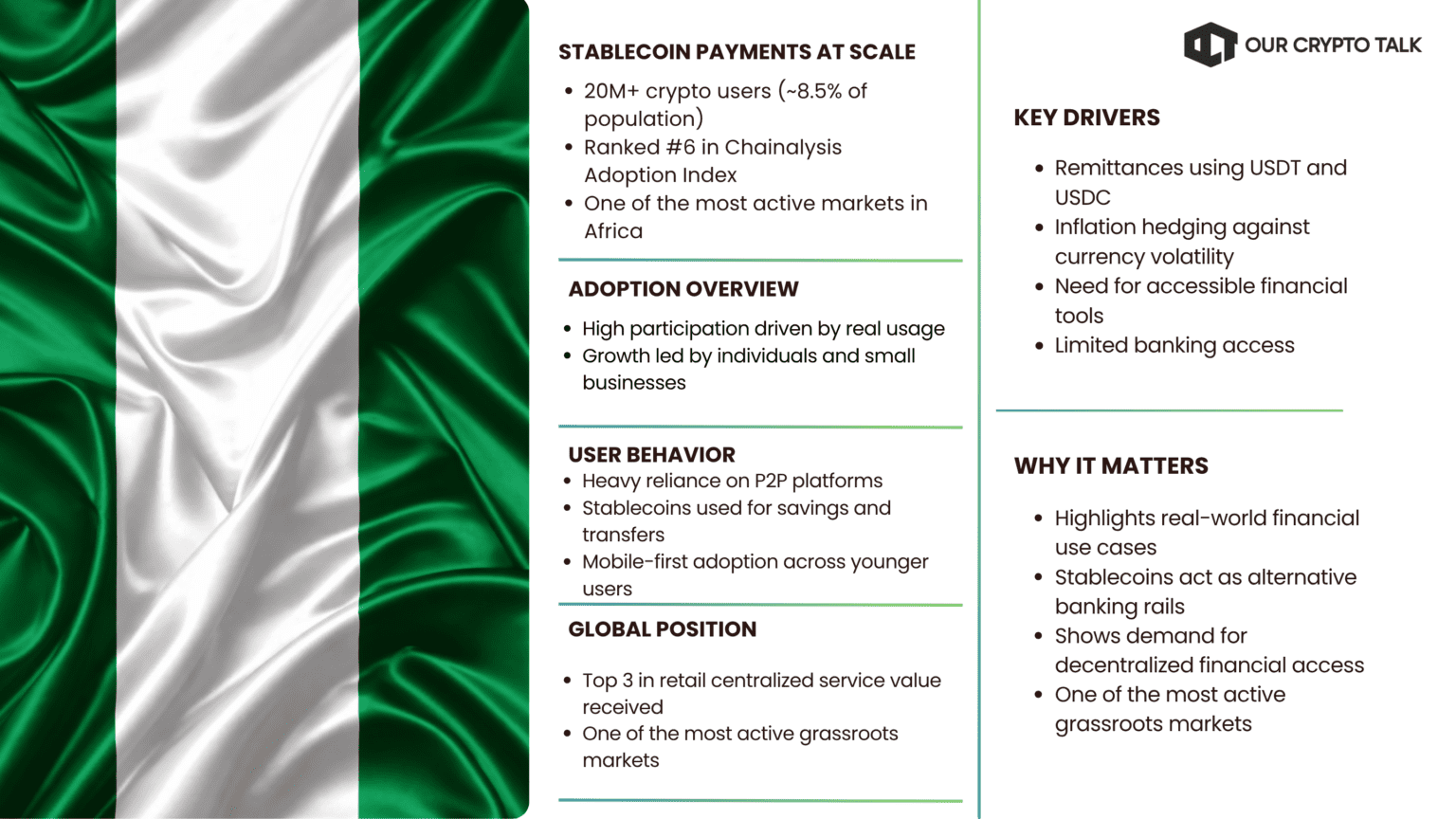
Indonesia has around 15 million crypto users in early 2026, representing roughly 5.5% of its population. Chainalysis ranks the country seventh in the 2025 Global Crypto Adoption Index, reflecting steady growth in both ownership and transaction activity.
Remittances from overseas workers rely on USDT and USDC for faster and lower-cost transfers. Users also hold stablecoins for savings, especially during periods of local currency volatility. DeFi participation adds another layer of activity, with retail users moving funds across lending, trading, and staking platforms. High mobile internet penetration and integration with local payment apps make access straightforward for everyday users.
Recent data shows consistent expansion. APAC recorded a 69% year-over-year increase in on-chain value received in the 12 months ending June 2025, with Indonesia contributing through higher retail activity and stablecoin usage. Local exchanges and wallet providers report rising daily active users as stablecoins become part of freelance payments and small business transactions. P2P and DeFi volumes continue to grow alongside this trend.
One data point highlights Indonesia’s position. The country ranks among the global top seven across multiple Chainalysis sub-indices, with strong performance in retail DeFi value received. This shows adoption driven by active usage, where crypto connect local users to global financial systems and decentralized applications.
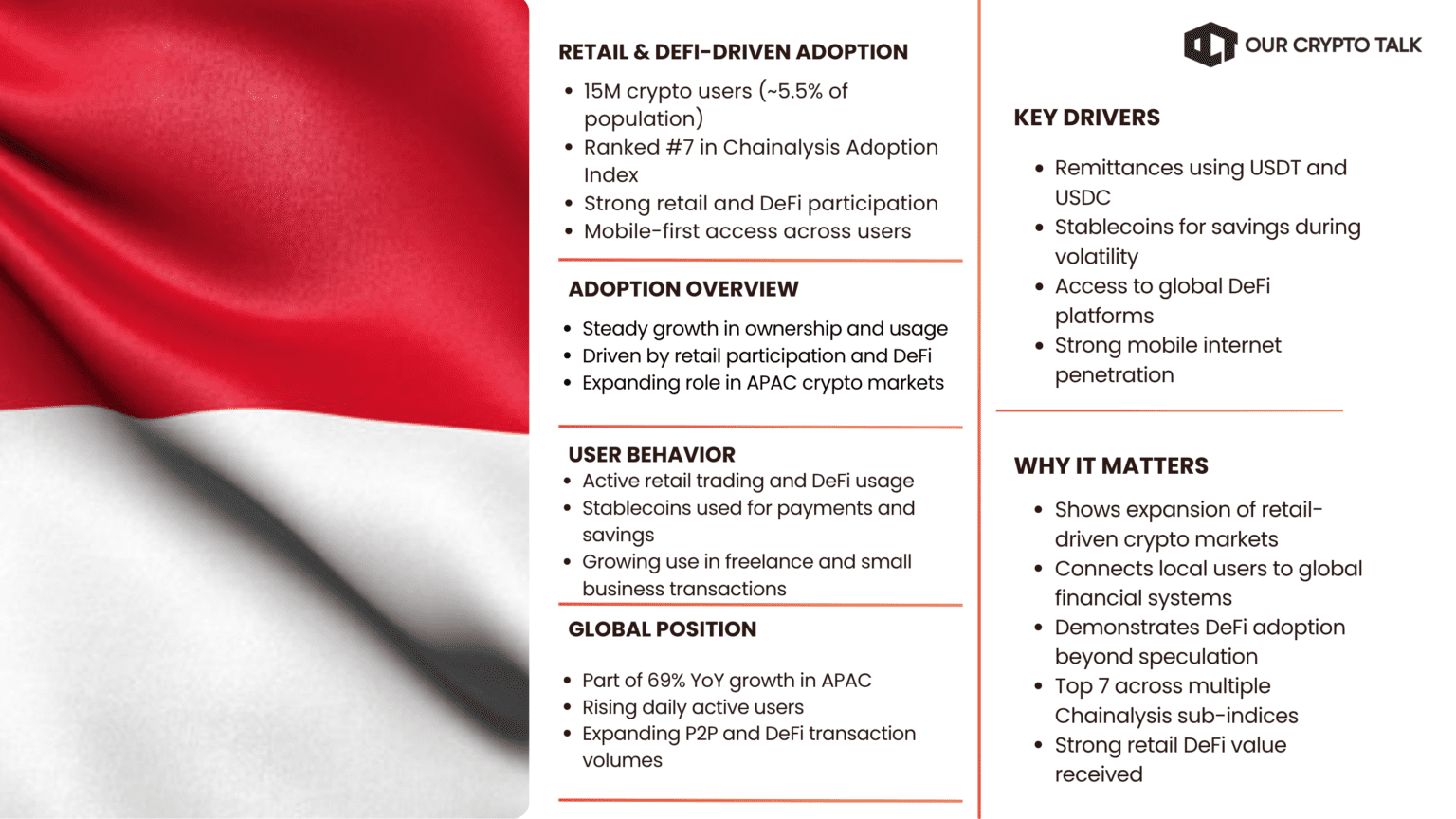
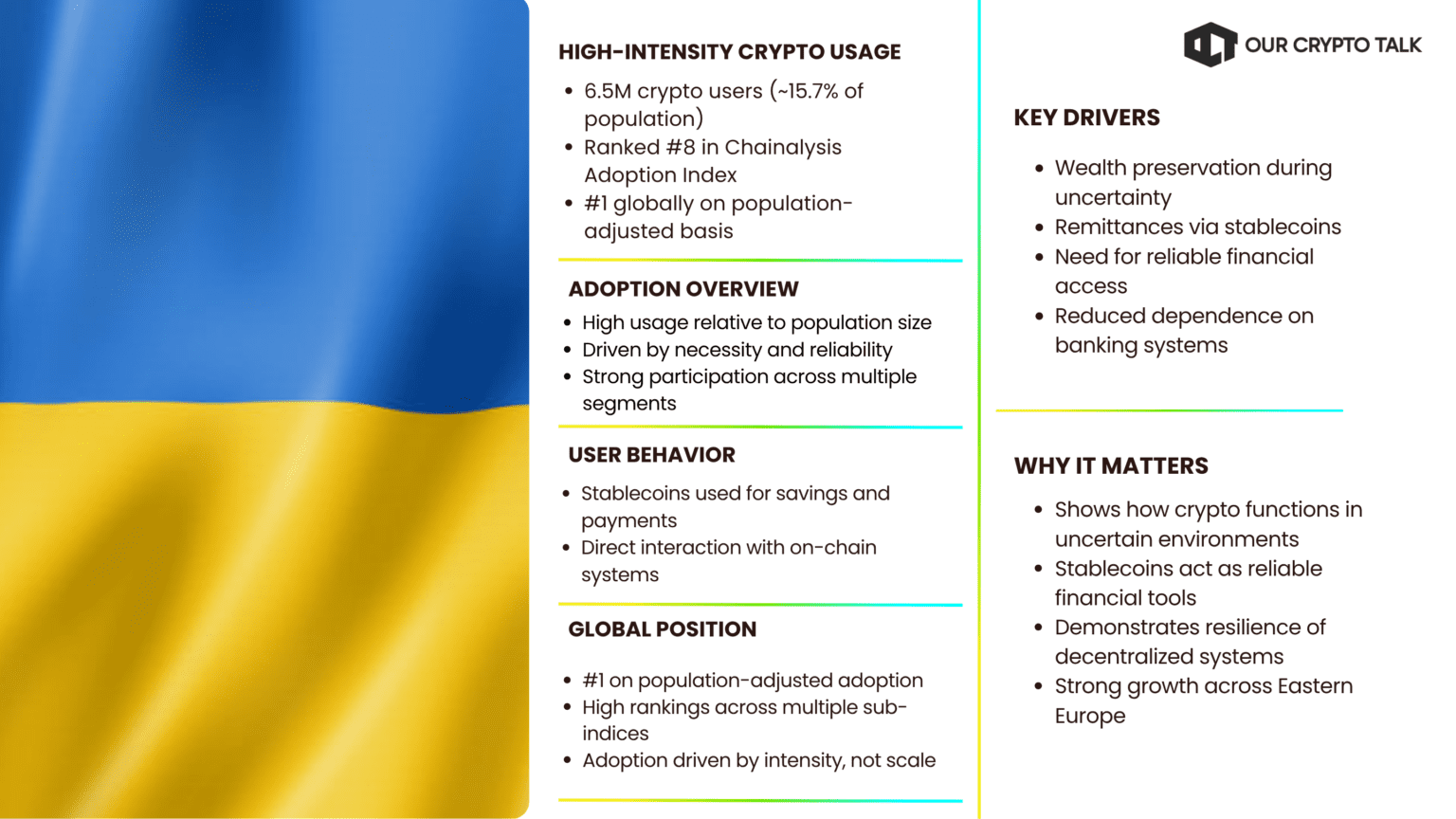
Ukraine has around 6.5 million crypto users in early 2026, representing roughly 15.7% of its population. Chainalysis ranks the country eighth in the 2025 Global Crypto Adoption Index and first when adjusted for population size, showing high usage relative to its total population.
Cryptocurrencies play a central role in daily financial activity. Users rely on them for remittances, especially during periods of disrupted banking access. They also use Dollar-pegged tokens for savings and payments, where speed and reliability matter. Peer-to-peer platforms and DeFi protocols support this usage, allowing users to move funds without relying on traditional financial infrastructure. A digitally native population drives adoption through mobile wallets and direct on-chain interaction.
Recent data shows sustained activity. Eastern Europe recorded strong growth in crypto flows through 2025, with Ukraine leading on a per-capita basis. Local exchanges and wallet providers report steady increases in daily active users. Stablecoin transfers remain consistent across both domestic transactions and cross-border payments, reflecting continued reliance on these tools in everyday use.
One data point highlights Ukraine’s position. The country ranks first globally on a population-adjusted basis across multiple Chainalysis sub-indices, including retail centralized service value received and institutional flows. This confirms adoption driven by intensive usage rather than scale alone, with cryptocurrencies embedded in both personal and transactional finance.
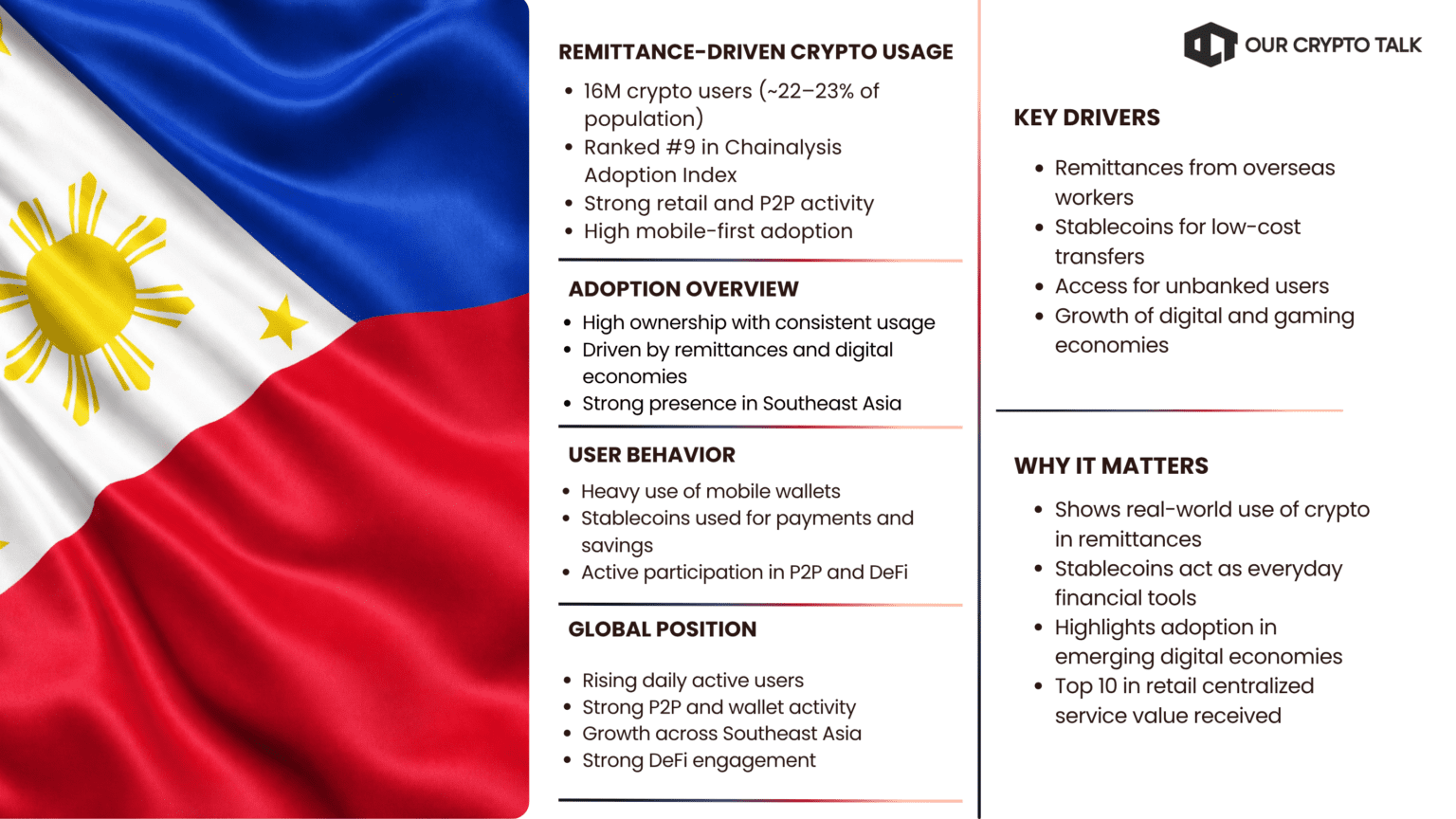
The Philippines has around 16 million crypto users in early 2026, representing roughly 22% to 23% of its population. Chainalysis ranks the country ninth in the 2025 Global Crypto Adoption Index, reflecting strong participation across both ownership and transaction activity.
Remittances drive a large share of usage. Overseas Filipino workers send funds home using cryptocurrencies to reduce fees and settlement time. Gaming ecosystems also play a role, with play-to-earn platforms introducing users to crypto wallets and on-chain transactions. Mobile-first adoption supports both trends. Many users access cryptocurrencies through wallets that serve unbanked and underbanked communities, making them a practical tool for savings and daily payments.
Recent data shows continued growth. Southeast Asia recorded strong increases in on-chain volume through 2025, with the Philippines contributing through higher P2P activity and wallet usage. Local platforms report rising daily active users as stablecoins integrate into payment apps and digital income streams.
One data point highlights the structure of adoption. The Philippines ranks in the global top ten for retail centralized service value received and shows strong DeFi engagement. This reflects adoption driven by everyday usage, where stablecoins support remittances, commerce, and digital economies at scale.
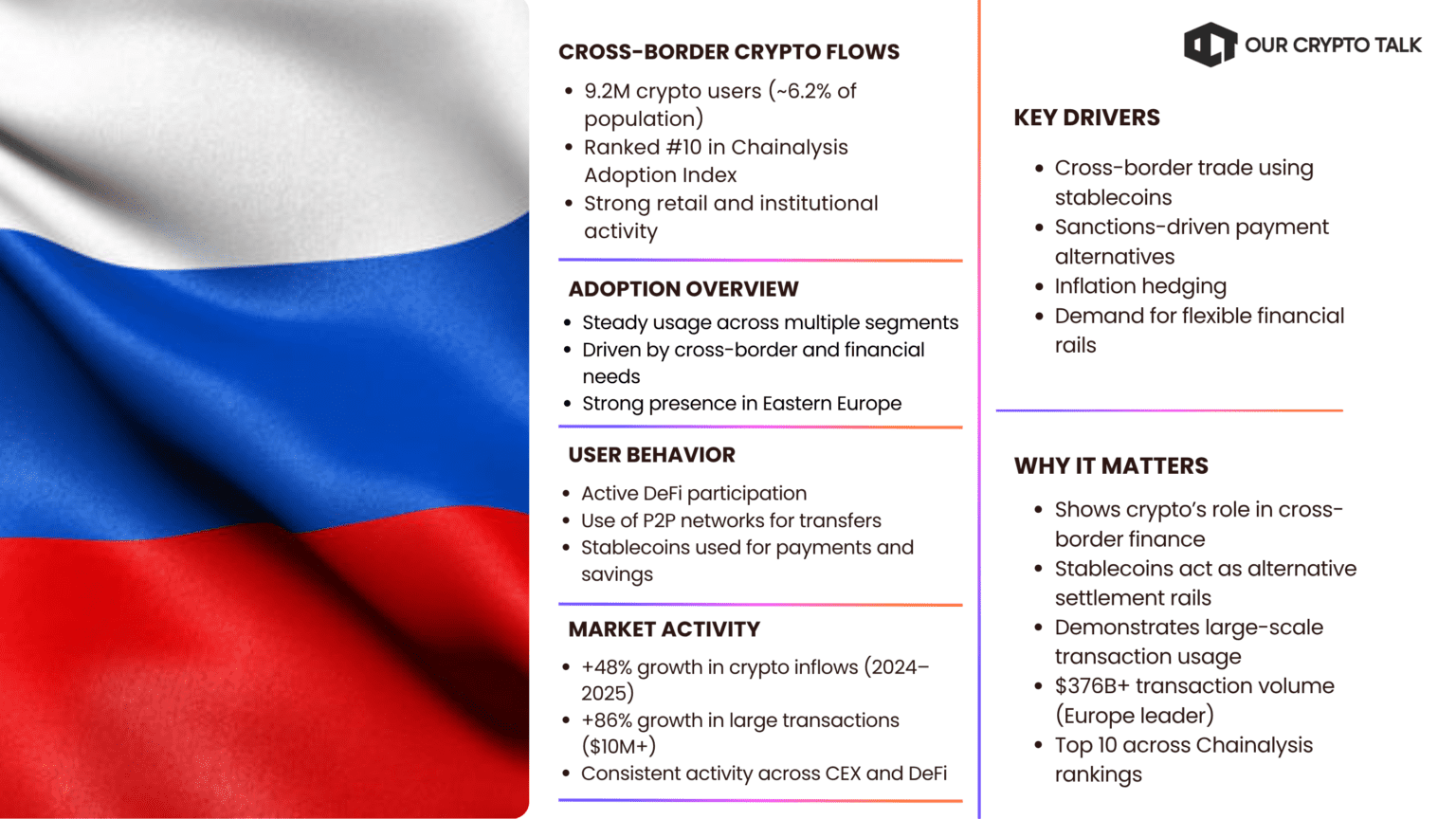
The Russian Federation has around 9.2 million crypto users in early 2026, representing roughly 6.2% of its population. Chainalysis ranks the country tenth in the 2025 Global Crypto Adoption Index, reflecting steady usage across both retail and institutional segments.
Cryptocurrencies play a central role in cross-border activity. Businesses use them to settle international trade where traditional channels face friction. Inflation also drives demand, with users turning to USDT/USDC to preserve value in a volatile economic environment. DeFi participation continues to grow, with both retail users and larger entities moving funds through decentralized platforms. Peer-to-peer networks support these flows, especially for transfers that require speed and flexibility.
Recent data shows rising activity. Crypto inflows increased by 48% between 2024 and 2025. Large transfers above $10 million grew by 86%, indicating higher institutional and high-value participation. Domestic stablecoin usage also expanded, with ruble-pegged assets used for business settlements. On-chain activity remained consistent across both centralized and decentralized channels.
One data point highlights Russia’s scale. The country recorded $376.3 billion in received crypto transactions in the 12 months ending mid-2025, the highest in Europe. This reflects adoption driven by real transaction volume, where stablecoins and DeFi tools support both large-scale transfers and everyday financial activity.
Asia leads global crypto adoption in 2026. Five of the top ten countries come from the region: India, Pakistan, Vietnam, Indonesia, and the Philippines. Together, they account for 62% of the ranking by adoption score. This reflects scale and consistent usage. Large populations, high smartphone penetration, and strong remittance flows create steady demand for fast and low-cost financial tools.
Cryptocurrencies meet that demand directly. Users rely on them for cross-border payments, savings, and everyday transactions. DefiLlama data shows APAC stablecoin volume reached $2.36 trillion in the 12 months ending June 2025, more than double the previous year. P2P platforms and local fintech integrations support this activity, making stablecoins part of daily financial infrastructure rather than occasional use.
Africa shows a different pattern. Total volume is lower, but usage intensity remains high. Nigeria ranks sixth globally with over 20 million users and leads the region in both ownership and transaction activity. Inflation and currency volatility push users toward stablecoins as a store of value. Limited banking access increases reliance on peer-to-peer networks for payments and transfers. Chainalysis data shows Africa’s retail centralized service value received grew by 80% year over year, with Nigeria contributing the largest share.
Latin America follows a similar trend. Brazil ranks fifth and contributes more than $318 billion in on-chain value received. Stablecoins support both business payments and savings. The United States ranks second but reflects institutional activity rather than broad retail usage.
Europe appears through Ukraine and Russia, where demand for cross-border transfers drives adoption. Western Europe does not appear in the top ten. Efficient banking systems reduce the need for stablecoins in everyday transactions.
The data shows a clear pattern. Asia and Africa lead because stablecoins solve immediate financial needs at scale. Usage drives adoption.
Not every country in the top 10 countries leading crypto adoption followed a predictable path. Pakistan’s rise to third place stands out. The country moved from outside the top ten in earlier rankings to a top-three position in 2026. Chainalysis data shows an 80% increase in South Asia crypto activity, with strong growth in P2P volumes.
Dollar-pegged tokens now serve as a primary tool for remittances and income flows, especially for freelancers and small businesses. High mobile penetration and limited banking access support this shift. On-chain data shows consistent transaction activity, not short-term spikes.
Ukraine’s position at eighth shows a different pattern. The country ranks first globally when adjusted for population size. USDT and USDC support daily transactions, including remittances, payroll, and savings. Usage increased as users relied on faster and more accessible financial tools. Chainalysis data places Ukraine at the top of per-capita metrics for retail and DeFi activity, confirming sustained usage under pressure.
The Russian Federation ranks tenth with strong transaction volume. Crypto inflows increased by 48% between 2024 and 2025. Transfers above $10 million grew by 86%, indicating rising high-value activity. Total on-chain volume reached $376.3 billion over 12 months, the highest in Europe. Stablecoins support cross-border trade and value storage, especially where traditional channels face limits.
These three markets show the same pattern. Adoption increases when stablecoins solve immediate financial needs. Remittances, inflation, and access drive usage. The data points toward similar growth in other markets with the same conditions. South Asia and parts of Africa already show this trend. As mobile wallets and P2P networks improve, more countries will move up the rankings based on real usage and ownership.
We’ve broken this down further in our X post on crypto adoption in crisis economies, do share your thoughts.
The 2026 rankings show a clear pattern. Digital dollar assets adoption follows usage, not speculation. India, Pakistan, Vietnam, Nigeria, and the Philippines lead because users rely on USDT and USDC for everyday needs. Remittances settle faster. Savings hold value during currency swings. Payments work without banking friction. These markets dominate the top ten because transaction volume and wallet ownership stay consistently high. The top 10 countries leading crypto adoption reveal a clear direction for where the market is heading.
A gap has formed between usage and policy. Countries with limited or evolving frameworks still rank highest in on-chain activity and P2P volume. The United States and parts of Europe show strong institutional flows, but retail participation per capita remains lower. The data shows that adoption grows from actual use cases. Policy tends to follow, not lead.
Digital dollar assets now act as the main entry point for new users. One wallet and one asset provide access to global payments. Mobile access drives this shift. In every top-ranked market, smartphone usage supports daily transactions. Users start with dollar-pegged tokens for remittances, payments, and savings before moving into other crypto assets.
Recent data reinforces the trend. Transaction volume, wallet growth, and daily active usage continue to increase across emerging markets. P2P platforms and mobile wallets expand access without relying on traditional financial systems.
The direction is clear. Crypto growth follows real usage. Markets with strong remittance demand, currency pressure, and limited banking access continue to lead. Stablecoins sit at the center of this shift, acting as infrastructure for moving and storing value at scale. Overall, the crypto adoption by country 2026 landscape shows that growth is concentrated in regions where financial access, remittances, and inflation create real demand.
This article ranks countries by crypto adoption (actual usage and ownership), not by regulatory friendliness. For a regulatory-focused ranking, see our guide to the Top 10 Crypto-Friendly Countries. All data is sourced from publicly available reports and may not capture untracked P2P or informal crypto usage. This is not financial or investment advice.
All the opinions in this article are that of the author and in no way are financial advice. Our Crypto Talk and the author always suggest you do your own research in crypto and to never take anything as financial advice that you read on the internet. Check our Terms and conditions for more info.


RWA Needs Better Access. Can NUVA Deliver?
Tokenization of RWA yields onchain might be the biggest opportunity that no one has noticed
Cold Wallet Safety 2026: Are Hardware Wallets Still Safe?
One Token, Multiple Products. Can Zylo Deliver?
RWA Needs Better Access. Can NUVA Deliver?
Tokenization of RWA yields onchain might be the biggest opportunity that no one has noticed
Cold Wallet Safety 2026: Are Hardware Wallets Still Safe?
One Token, Multiple Products. Can Zylo Deliver?