The Index turns trading fees into tokenized stock rewards on Robinhood Chain. Explore $INDEX, traction, tokenomics, risks, and its future.

Author: Akshat Thakur
The Index is a live protocol on Robinhood Chain that turns trading activity into tokenized-stock distributions.
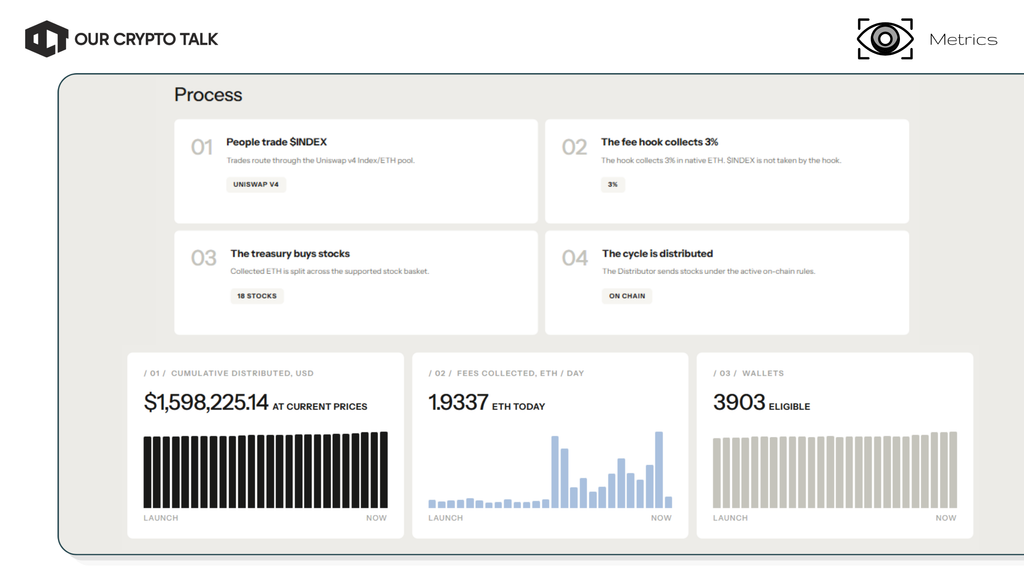
The mechanism is simple. Every $INDEX trade carries a 3% ETH fee. Fees from sibling products also feed the system. The protocol uses that ETH to buy a basket of tokenized equities, including AAPL, NVDA, TSLA and roughly 18 other names. It then sends those assets to eligible $INDEX holders every few minutes.
The threshold is 10,000 $INDEX. There is no claim page and no staking lock.
The timing matters. Robinhood Chain launched its public mainnet in July 2026 with tokenized stocks, Uniswap v4 hooks and ambitions to expand its stock-token universe. Robinhood has since pushed tokenized stocks as a core part of the chain’s ecosystem.
The Index launched into that early liquidity race. Its pitch is to turn speculative trading activity into exposure to real-world assets. That creates an unusual link between memecoin-style volume and tokenized equities.
The protocol dashboard showed around $1.60 million in stocks distributed, 762.93 ETH collected in fees and roughly 3,900 eligible wallets in early September. $INDEX traded around $0.058, with a market cap near $57 million and almost the entire 1 billion token supply circulating.
The core question is whether that flywheel can survive. Robinhood Chain is seeing meaningful activity, but much of the early flow has clustered around speculative assets. The Index needs enough volume to keep converting that activity into meaningful stock distributions.
That makes $INDEX less a traditional RWA token and more a bet on trading activity staying high.
The Index faces competition from both traditional tokenization platforms and other onchain fee mechanisms.
Robinhood itself is the biggest structural threat. It provides the underlying stock-token infrastructure and controls the distribution layer. If Robinhood eventually launches a native product that rewards users with equity exposure, The Index could become a wrapper around inventory it does not control.
Direct tokenized-stock platforms also let users access names such as Apple, Nvidia and Tesla without paying a 3% $INDEX trading fee. , Backed, Superstate-style products and other RWA rails already target the broader tokenized-asset market.
There is also competition inside crypto. Index Cooperative, Set and other onchain index products already occupy the index category. Meanwhile, reflection and tax tokens have used similar fee-recycling mechanics across meme-chain markets.
The Index’s differentiator is the combination of trading fees and continuous stock distributions. Hold one token, generate volume, and receive a basket of tokenized equities. Its Indices infrastructure extends that model to other tokens by allowing their fees to flow into a stock treasury, with a portion returning to $INDEX. The sibling rwa.wtf product adds another potential fee source.
The mechanic is real. The website shows ETH flowing in and stocks flowing out to eligible wallets. But the moat is thin.
Anyone can build a Uniswap v4 hook that collects fees and uses them to buy the same Robinhood stock tokens. The 3% fee also creates a reason for traders to avoid the pair.
The bigger issue is volume. If $INDEX, Indices and rwa.wtf activity falls, stock distributions fall with it.
The Index has real payouts and a working product. But the underlying design remains copyable and heavily dependent on Robinhood Chain liquidity.
The team is the weakest formal signal around The Index.
@TheIndexFi launched on July 2, 2026, shortly after Robinhood Chain mainnet went live. The project does not currently present a public founder page, named CEO, LinkedIn roster or disclosed history of previous products under the same entity.
Most communication comes through the organizational X account and theindex.finance dashboard.
That anonymity matters more here than it would for a typical meme-chain experiment. The Index deals with tokenized U.S. equities, even if it does not directly issue or custody the underlying stocks. Investors need to know who operates the protocol, what legal entity sits behind it and who can be held accountable when something goes wrong.
The project has demonstrated meaningful shipping velocity. It has a live fee-to-equity mechanism, an Indices factory, rwa.wtf fee routing and a Uniswap whitelist. It has also integrated with Pons, Rialto and Lighter.
That provides evidence of execution. It does not provide the same confidence as identifiable founders with relevant brokerage, transfer-agent or RWA experience.
There is also a blemish in the early history. A former member retained delegated access while the project was below a $200,000 market cap. The team acknowledged the incident as unprofessional.
The result is a mixed picture. The Index appears to be run by anonymous operators who managed to ship a functioning fee-to-equity router on a brand-new L2.
That is enough to prove the product exists. It is not enough to establish strong institutional credibility.
Until the people and legal entities behind the protocol become public, the team remains a material risk.
The Index has no publicly disclosed funding round, Tier-1 VC announcement, seed round, SAFT or treasury diversification deal.
Third-party trackers also do not list disclosed institutional investors. That makes the project’s backing story different from many RWA protocols that arrive with large venture rounds and recognizable names.
The token itself is already essentially fully floated. Maximum supply sits at 1 billion, with roughly 980 million circulating. There is also no published team lockup or vesting schedule.
That cuts both ways. There is little evidence of a future cliff unlocking a small circulating supply. But there is also no clear evidence that insiders have locked allocations for the long term.
Instead, the strongest signals come from ecosystem integrations.
The Index has a Uniswap whitelist and fee-routing relationships involving Pons and Rialto. Rialto can route fees toward The Index, while Lighter adds another connection to Robinhood Chain’s trading ecosystem. These relationships show distribution and integration potential, but they are not equivalent to institutional capital.
The survival question is therefore different from a typical pre-launch token. The Index does not need to fund a long development runway before TGE. The token is already live, and the protocol depends on its own trading activity.
That makes fee flow the real treasury signal.
The project has printed roughly $10 million in 24-hour volume alongside a market cap near $58 million. If that activity stays elevated, fees can keep the distribution engine running.
If $INDEX volume and Indices or rwa.wtf fees slow sharply, the flywheel weakens. Smaller fees mean fewer stock purchases, which means less visible value flowing back to holders.
For now, The Index looks more like a bootstrap-on-a-new-chain experiment than a heavily funded RWA project.
The Index is already live on Robinhood Chain. This is not a testnet or concept-stage project. Users can open theindex.finance, connect a wallet and trade $INDEX through its Uniswap v4 pool.
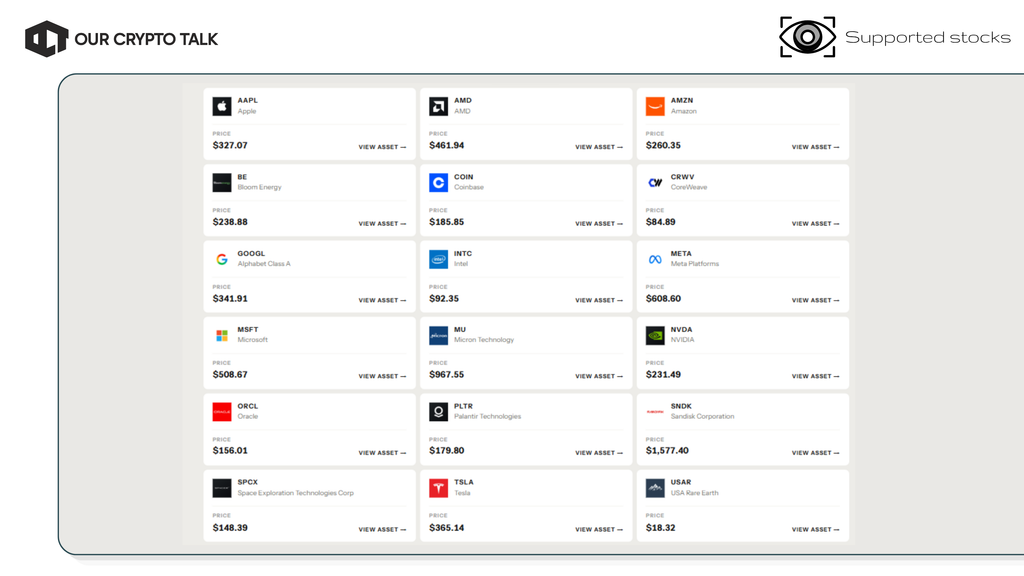
The core product is the fee engine. Buys and sells in the INDEX/ETH pool carry a 3% ETH fee. The protocol sends that ETH to a treasury, buys a basket of Robinhood Chain stock tokens and distributes them pro rata to eligible holders. The basket includes AAPL, NVDA, TSLA, AMD, AMZN, GOOGL, META, MSFT and other names.
The eligibility threshold is 10,000 INDEX. Distributions are designed around 15-minute cycles, although congestion can delay batching while the reward pot continues to accrue. No separate claim is required for the core loop.
The dashboard also exposes contract-level metrics. In early September 2026, it showed around $1.60 million in distributed stocks, 762.87 ETH in collected fees and roughly 3,900 wallets in the latest payout round.
The protocol has expanded beyond $INDEX. Indices lets other tokens route creator or tax fees into treasuries that buy selected stock baskets for their holders. It supports ready-made baskets and custom allocations of up to 20 names. rwa.wtf adds another fee stream through its RWA research and perps product.
The product is therefore tangible. Uniswap v4 hooks, keepers and distribution transactions provide stronger evidence than a GitHub repository alone.
The unfinished piece is the customizable onchain ETF layer, which the team says is under audit. Legal and product infrastructure also remain questions.
You can use The Index today. But it should not be treated as a licensed brokerage or conventional equity fund.
The useful traction signals are money spent on stocks and wallets that actually received them, not follower counts.
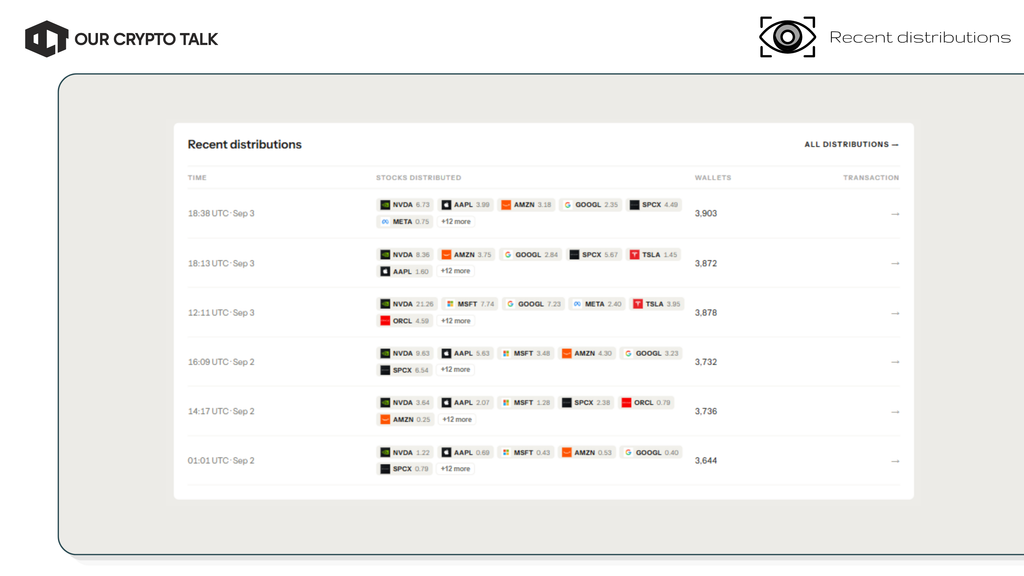
The Index has distributed around $1.60 million worth of tokenized stocks since launching in July 2026. Early team updates also cited a single 15-minute distribution above $155,000 and periods where the protocol ranked among the largest stock purchasers on Robinhood Chain.
The protocol has collected 762.87 ETH in cumulative fees. That represents meaningful economic activity rather than a free incentive program.
Trading volume provides another important signal. $INDEX has printed roughly $10 million to $11 million in 24-hour volume alongside a market cap around $55 million to $58 million. That high turnover matters because trading activity generates the ETH used to purchase stocks.
Around 3,918 wallets currently sit above the 10,000 INDEX eligibility threshold. That is more useful than raw holder numbers because these wallets can actually participate in distributions.
Indices adds a secondary source of activity. Team updates cited tens of thousands of dollars in RWA distributions to thousands of holders, followed by figures such as $355,000 in stock rewards and $5 million in RWA volume. That remains small relative to the main $INDEX fee engine, but it shows other tokens can feed the system.
Several integrations also required actual implementation or whitelisting, including Uniswap, Pons, Rialto and Lighter.
The caution is straightforward. Distributed stock value is real, but it is also a function of trading volume. High volume increases both the tax collected and the stocks purchased.
The $1.60 million payout ledger proves the mechanism works. It does not prove sticky AUM. If volume falls, distributions can compress quickly.
$INDEX is already live, so there is no future TGE structure to evaluate. The relevant question is the current float.
The maximum supply is 1 billion INDEX, while roughly 980.5 million tokens circulate. That puts approximately 98% of the supply in circulation, making the token functionally fully floated.
Recent figures place $INDEX around $0.058, with market cap and FDV both around $57 million. The token reached roughly $0.075 on September 4, 2026, while its mid-August low was near $0.0044.
This is therefore very different from a low-float token carrying a multibillion-dollar FDV. Most of the supply is already trading.
The problem is disclosure. There is no public allocation table, SAFT breakdown or disclosed team and investor vesting schedule. That means there is no scheduled cliff to track, but there is also no evidence showing that insiders cannot sell into the same large float.
The main reason to hold $INDEX is its stock distribution mechanism. The protocol uses the 3% ETH trading fee to fund stock purchases, while Indices and rwa.wtf can provide additional fee flow.
That creates a real transfer from trading activity toward eligible holders. But it does not create a permanent value sink independent of volume.
There is no protocol-owned stock NAV that gives $INDEX holders a legal claim on a ring-fenced equity fund. Holders receive distributed tokenized stocks instead. Those stock tokens also do not provide ordinary voting or cash-dividend rights.
The structure is therefore stronger than a low-float token facing a known unlock cliff, but weaker than a transparent, vested and fee-accruing equity product.
At around $58 million fully diluted, buyers are underwriting continued trading volume, anonymous treasury control and the risks of the tokenized-stock wrapper.
The early opportunity has already passed. The Index launched in early July 2026 at much smaller valuations, including prices around its eventual sub-cent lows.
What remains is participation in a live market.
Users can buy $INDEX on Robinhood Chain through the Uniswap v4 INDEX/ETH pool. The trade carries the 3% distribution fee in addition to the applicable LP fee. Holding at least 10,000 INDEX places a wallet inside the payout set, with distributions sent directly to the wallet.
Indices offers a different route for token issuers. Builders can select a stock basket, use the treasury address and route creator or tax fees toward it. This is infrastructure access rather than a retail farming strategy.
rwa.wtf provides another way to interact with the ecosystem through its RWA and perps venue. Its fees contribute to the broader flywheel rather than operating as an airdrop points program.
There is no points campaign, node sale or confirmed second airdrop that makes sense to farm. The core incentive is the product itself.
Users pay the tax through trading activity, while eligible holders receive tokenized stocks when enough fees accumulate. That makes the system economically tied to market activity rather than quest completion.
The distinction matters. Market makers and high-turnover traders can generate the ETH used for stock purchases, but they also face the 3% fee when they cross the pool.
For most users, the question is therefore not whether there is an early farming opportunity. There isn’t.
The relevant question is whether they already want exposure to Robinhood Chain’s tokenized-stock ecosystem and are comfortable holding a wrapper that can move far faster than the underlying stock basket.
The Index is no longer an early-stage quest. It is a live, high-float, high-tax market with visible payouts and an unnamed team.
There is no farm left. The real question is whether $INDEX at roughly $57 million fully circulating offers a good way to capture Robinhood Chain’s tokenized-stock activity.
There is no meaningful points opportunity. The product already delivers its incentive in tokenized stocks, funded by the 3% pool tax. Grinding Discord activity or Indices clicks for a hypothetical second airdrop does not justify the time.
The current entry is around $0.058, with roughly $57 million in market cap and FDV. Around 980 million of the 1 billion tokens already circulate. The token recently traded near its September 4 ATH of roughly $0.075.
Comparisons remain difficult. Licensed tokenized-stock platforms and onchain equity funds compete on issuance, AUM and legal structure. Meme-tax tokens compete on volume and speculation. The closest comparison is a high-turnover RWA wrapper built around a single-issuer chain.
At roughly $57 million, the market is already pricing two months of activity, around $1.6 million in stock distributions and roughly 763 ETH in fees. That looks cheap if $INDEX volume becomes a durable source of demand for Robinhood Chain equities. It looks expensive if the valuation mostly reflects recent speculation.
The risk-reward does not justify a core position. It only makes sense as a small satellite bet for someone who specifically wants Robinhood Chain exposure and accepts the possibility of losing the entire wrapper value.
The thesis requires Robinhood to keep expanding tokenized stocks, ecosystem volume to remain high and the anonymous operators to keep the system running.
The downside case is easier to understand. $INDEX is fully floated, distributions depend on speculative volume, tokenized stocks carry issuer and liquidity risk, and the team and cap table remain undisclosed.
Treat the stock stream as a rebate funded by other traders, not as a conventional investment income stream.
The Index does not need to fail because its technology stops working. Volume, competition, regulation and execution can all break the model.
Robinhood is the clearest competitive threat. Users may eventually be able to access tokenized stocks directly through Robinhood without touching a 3% tax token. Other RWA platforms already offer exposure to the same names. The fee-to-basket mechanism is also technically copyable through Uniswap v4 hooks.
The project is equally dependent on Robinhood Chain’s narrative. If attention moves elsewhere, or memecoin activity continues while stock-token liquidity stays thin, the fee engine can weaken quickly. RWA branding means little without RWA volume.
Regulation presents the most serious risk. The Index markets a system where trading fees fund distributions of U.S. stock tokens. That creates potential questions around the $INDEX token itself, the distributed securities and the structure used to package and distribute them.
An anonymous team operating this model faces an additional credibility problem. A change in policy from Robinhood Chain, a stock-token issuer or regulators could restrict programmatic purchases and stop the distribution loop.
There is also structural risk in the tokenized-stock wrapper. Holders do not receive ordinary voting or cash-dividend rights. They receive chain representations whose value depends on the issuer, liquidity and treasury routing. Without a published NAV, prospectus or named fiduciary, the basket ultimately depends on whoever controls the system.
The 10,000 INDEX threshold can also be split across multiple wallets, creating Sybil risk and diluting payouts.
Execution remains another weakness. Keepers can stall, batching can slow during congestion and thin stock-token liquidity can make treasury purchases expensive. The 3% tax can also push serious traders toward competing pools.
Mechanically, the system is not especially novel. Its differentiation comes from the Robinhood stock basket and the chain it operates on. If either disappears, much of the moat disappears with it.
The Index has no upcoming TGE catalyst. The token is already live.
The strongest catalysts would come from sustained growth in stock-token activity and $INDEX fee generation. Rising stock-token TVL combined with growing ETH fees would provide stronger evidence than another short-term move in the token itself.
Indices could become another important driver if other tokens begin routing meaningful creator or tax fees into stock treasuries. That would diversify the fee engine beyond $INDEX trading.
A named team, disclosed legal entity or audit tied to identifiable operators would also change the project’s risk profile. It would address one of the largest credibility gaps surrounding the protocol.
Robinhood expanding its stock-token universe, improving liquidity or directly integrating with The Index would provide another major catalyst. Such developments would strengthen the underlying ecosystem rather than simply increase speculation around $INDEX.
The opposite developments could move the thesis in the other direction. A pause in distributions, changes to fee routing or restrictions on programmatic stock purchases would directly challenge the model.
There is no reason to rush for early access. That opportunity ended with the July launch.
The better approach is to watch whether distributions remain meaningful after trading volume normalizes. If the system can maintain payouts through organic stock-token activity and fees from Indices or rwa.wtf, the thesis becomes stronger.
Until then, $INDEX is better viewed as a tactical Robinhood Chain RWA-beta trade than a long-term stock accumulation vehicle.
WATCH
The Index has something many new RWA projects lack: a working product with measurable output.
Around $1.6 million in tokenized stocks has already reached holders, while the protocol has collected roughly 763 ETH in fees. The Uniswap v4 hook is live, and Indices gives other tokens a way to feed fees into the same stock-distribution engine.
That makes the product real. It is not just a deck or a future roadmap.
The weaknesses are equally clear. $INDEX is an anonymous, fully floated token carrying a 3% trading tax. Its stock distributions depend on other traders continuing to generate volume. The underlying assets are tokenized stock representations rather than ordinary listed equity, and the protocol does not provide holders with a legal claim on a ring-fenced equity fund.
The entire model also depends on Robinhood Chain and on regulators, issuers and ecosystem partners continuing to allow the mechanism to operate.
At roughly $57 million FDV, that makes $INDEX a speculative RWA satellite, not an index fund.
The milestone that could change the rating is simple: a named legal entity followed by two consecutive months of material stock distributions after $INDEX volume normalizes.
If those payouts increasingly come from Indices, rwa.wtf and organic stock-token activity rather than another speculative volume spike, the thesis becomes much stronger.
Until then, The Index is usable, measurable and interesting. It is also easy to copy, dependent on one chain and exposed to serious regulatory risk.
WATCH.
All the opinions in this article are that of the author and in no way are financial advice. Our Crypto Talk and the author always suggest you do your own research in crypto and to never take anything as financial advice that you read on the internet. Check our Terms and conditions for more info.


Tokenization of RWA yields onchain might be the biggest opportunity that no one has noticed
Cold Wallet Safety 2026: Are Hardware Wallets Still Safe?
One Token, Multiple Products. Can Zylo Deliver?
The Rise of NEAR Protocol 2026: Inside the 530% Rally and the ETF
Tokenization of RWA yields onchain might be the biggest opportunity that no one has noticed
Cold Wallet Safety 2026: Are Hardware Wallets Still Safe?
One Token, Multiple Products. Can Zylo Deliver?
The Rise of NEAR Protocol 2026: Inside the 530% Rally and the ETF