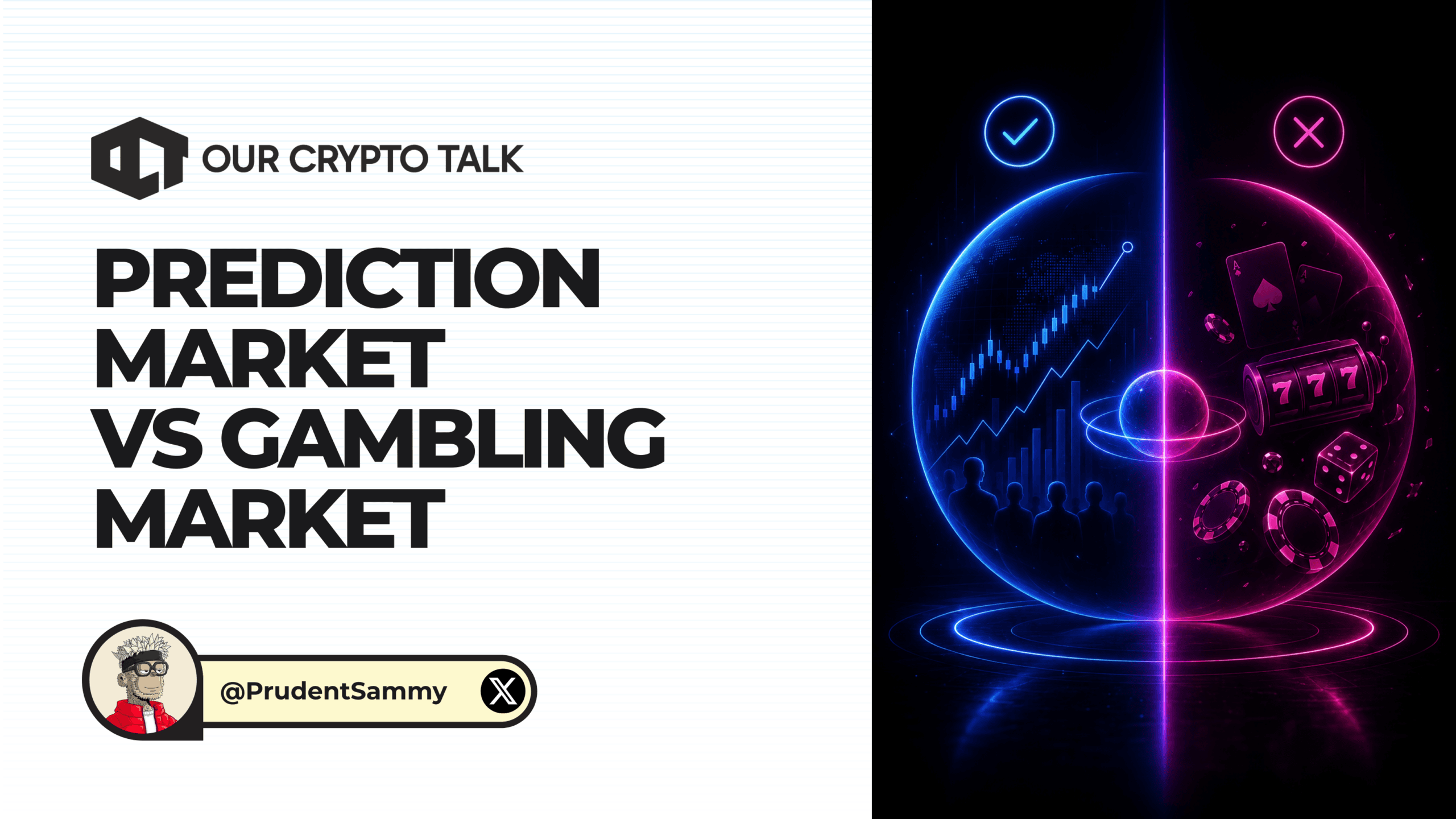
Prediction market vs gambling explained. Learn how Polymarket compares to betting platforms, key differences, risks, TVL, and DeFi growth.
Back to when it all started – prediction market vs gambling.
Starting it out with 2 questions.
1. If I say Polymarket is not the biggest prediction market right now, would you believe me?
before you argue with me,… 2. can you navigate the gambling sector without burning your entire portfolio?
If you can, then let`s talk…
A market runs $3.7 billion in a single 30-day period this late 2025, outpacing entire chains like @Polygon in activity.
Cumulative volumes crossed tens of billions, driven by diverse events (politics, crypto prices, culture, sports).
The decentralized prediction markets sector has a TVL around $320–350 million.
Polymarket accounts for the vast majority of it. So, when I said “If I say Polymarket is not the biggest prediction market right now, would you believe me?” You better not believe me as it is currently the largest decentralized (crypto/DeFi) prediction market by far.
Lets go further in other competitors
@azuroprotocol – A sports-betting focused protocol with shared liquidity across apps; its TVL is in the single-digit to low tens of millions (e.g., ~$5–10M earlier in 2025).
@AugurProject, @gnosis_, @overtime, etc., Legacy or niche platforms with TVL often under $5–10M each.
Newer ones like @opinion or @trylimitless – Growing fast.
Now, before comparing prediction markets to gambling, I believe it’s worth being clear about what a prediction market actually is in DeFi.
Here is my way of seeing the prediction market… 📷
It is a smart-contract system that lets people trade on the outcome of real-world events.
Each market creates two outcomes, usually YES and NO, backed by stablecoins.
At settlement, one side pays out $1, the other goes to $0. The price during trading reflects the market’s current view.
If YES trades at $0.70, the market is saying there’s roughly a 70% chance the event happens. No opinion polls, no house setting odds, just capital expressing belief.
That structure is why prediction markets behave very differently from casinos.
There’s no built-in edge. You don’t lose because the protocol wins, you lose because the market moved against you.
Not long ago, I want to believe 2025, demand for this kind of product increased sharply.
Elections, interest rate decisions, geopolitical tension, and crypto volatility all pushed traders toward tools that could express uncertainty in a simple way.
Prediction markets also started linking more closely to real-world assets, letting users hedge exposure to inflation or supply disruptions without touching traditional derivatives.
The basic tech became much more reliable than in earlier cycles. Smart contracts handle market creation, trading, and settlement. Liquidity is provided by automated pools that allow YES and NO tokens to trade continuously.
Oracles, most commonly @chainlink, only step in at the end to resolve outcomes using verified data. They don’t control prices.
Lower fees on Layer-2 networks made active trading viable, while better oracle systems reduced disputes and delayed settlements.
Privacy tools also improved, letting larger players trade without revealing positions immediately.
𝜶. Data reflects this shift.
By this December 2025, prediction markets held roughly $370–400 million in TVL, with over $2 billion in weekly trading volume during active periods.
More importantly, the amount of cumulative trading volume across these markets has grown dramatically year over year, tens of billions. I see that as a sign of trust.
𝜷. Polymarket dominates this category.
With close to $280 million in TVL on @Polygon, it accounts for most decentralized prediction market liquidity.
The focus on simple yes/no markets, USDC settlement, and low fees made it easy for people to understand probabilities without needing a finance background.
During major events, weekly volume often exceeded $400 million.
Opinion took a different approach, focusing on culture- and sentiment-driven markets.
The fast growth and higher short-term volume show strong demand, though liquidity depth is still catching up.
@azuroprotocol operates mainly in sports betting, sharing liquidity across apps, but remains much smaller in size.
Older platforms like @AugurProject and @gnosis_ proved the model early on, but complex interfaces and fragmented liquidity kept adoption low.
They are important historically, but they no longer set the pace.
𝜸. Now compare this to gambling.
Onchain gambling platforms also run on smart contracts, but outcomes are based on randomness, not real-world events.
Games like slots, dice, poker, and roulette all include a built-in house edge. Over time, the platform always wins.
Blockchain improves transparency here, as these can be done:
𝒶. Randomness can be verified.
𝒷. Payouts are automatic.
Access is global, and in 2025, many gambling platforms added NFTs, leaderboards, and rewards to keep every user engaged.
𝜹. Capital behaves differently in this sector.
In gambling liquidity moves fast. Users deposit, play, and withdraw. The TVL is unstable, and the performance is measured in revenue rather than long-term capital.
Most gambling data is grouped under “gaming,” but estimates put casino-focused TVL in the hundreds of millions, mainly on low-fee chains like @base and @arbitrum.
@rollbit, @DecentralGames, @betfury_gaming, and @MetaWin all grew in 2025 by focusing on speed, variety, and incentives. Some added metaverse features. Others leaned into high-multiplier games. All rely on volume, not accuracy.
𝝴. The key difference.
Prediction markets exist to price uncertainty. Gambling exists to sell entertainment.
Both use similar tools: oracles, liquidity pools, wallets, and Layer-2 networks. Both benefited from better audits and fewer hacks in 2025.
However, the incentives are not the same.
Prediction markets reward good judgment. Gambling rewards activity.
This difference also explains regulation. In 2025, prediction markets drew attention from regulators because they resemble financial contracts.
Gambling platforms faced consumer protection and access restrictions instead.
Coming to the end of the year, the line between the two is clearer.
Prediction markets has turned into an actual layer for forecasting and hedging in DeFi.
Gambling on the other end, remained profitable and popular, but limited by design.
Same technology. Different purpose.
And if you don’t know which one you are using, you are probably taking the wrong kind of risk.

https://t.co/jk1T05ZT70


Tokenization of RWA yields onchain might be the biggest opportunity that no one has noticed
Cold Wallet Safety 2026: Are Hardware Wallets Still Safe?
One Token, Multiple Products. Can Zylo Deliver?
The Rise of NEAR Protocol 2026: Inside the 530% Rally and the ETF
Tokenization of RWA yields onchain might be the biggest opportunity that no one has noticed
Cold Wallet Safety 2026: Are Hardware Wallets Still Safe?
One Token, Multiple Products. Can Zylo Deliver?
The Rise of NEAR Protocol 2026: Inside the 530% Rally and the ETF