Ondo Finance ($ONDO) Review 2026: Worth It After 87% Drop?
Ondo Finance review 2026: $3.52B TVL, 87% crash, unlock risks, Binance & Franklin deals, can ONDO rebound or stay under pressure?


Author: Akshat Thakur
What Is Ondo Finance?
Ondo Finance is a DeFi platform focused on bringing real-world financial assets onchain. If you’re wondering what is Ondo crypto, the simplest way to understand it is as a bridge between traditional finance and blockchain infrastructure. Instead of relying on purely crypto-native assets, Ondo tokenizes instruments like U.S. Treasuries, stocks, and ETFs, making them accessible with the speed and transparency of blockchain.
Nathan Allman founded Ondo in 2021, who previously worked on Goldman Sachs’ digital assets team. Since then, Ondo has grown rapidly, reaching over $3.52 billion in total value locked as of early 2026. That level of capital places it among the more established players in the real-world asset (RWA) segment.
Its product suite is built around three core offerings that target different types of users.
USDY is a yield-bearing dollar token backed by short-term U.S. Treasuries and bank deposits. It behaves similarly to a stablecoin but distributes daily interest, making it attractive for users looking to earn passive yield on dollar exposure.
OUSG targets accredited investors and provides tokenized access to short-term U.S. government securities and money market funds, including allocations managed by institutions such as BlackRock, Fidelity Investments, and Franklin Templeton.
It offers daily yield accrual along with flexible subscriptions and redemptions. Ondo Global Markets expands the scope further by enabling tokenized access to stocks and ETFs, particularly for non-U.S. investors who want exposure to public equities without relying on traditional brokerage infrastructure.
From an Ondo Finance review perspective, the project stands out because it leans heavily into regulated financial products rather than speculative crypto primitives. This positioning allows Ondo to combine institutional-grade assets with onchain liquidity and accessibility. As the RWA narrative gains traction, Ondo Finance is steadily establishing itself as a key layer connecting traditional markets with blockchain-based capital.
What Has Changed Since Our Last Review
Ondo Finance has executed on most of what it outlined since August 2025. The platform expanded across products, partnerships, and distribution. At the same time, the ONDO token moved in the opposite direction.
The shift started in July 2025 when 21Shares filed for a spot ONDO ETF. The filing did not move price immediately, but it showed early institutional interest in packaging the token for broader markets. If approved, it could unlock a new demand layer.
In September 2025, Ondo Global Markets went live. This marked a key delivery moment. The platform launched with over 250 tokenized stocks and ETFs. By early 2026, it scaled to more than $700 million in TVL and over $13 billion in trading volume, capturing a dominant share of the tokenized equities market.
Regulatory pressure also eased. By late 2025, the U.S. Securities and Exchange Commission closed its two-year investigation into Ondo without filing charges. That outcome removed a major risk factor and strengthened the project’s position in the RWA sector.
Token Impact vs Platform Growth
January 2026 changed the token dynamics. On January 18, Ondo unlocked 1.94 billion ONDO tokens, increasing circulating supply by roughly 60 percent. The market reacted quickly. Selling pressure increased and the price dropped, creating a clear disconnect between adoption and token performance.
Meanwhile, the platform continued to scale. Ondo crossed $3.52 billion in TVL, becoming the largest provider of tokenized Treasuries and stocks. Around the same period, Binance partnered with Ondo to introduce tokenized equities under a regulated framework in ADGM, marking the return of this product category on a major exchange.
Infrastructure development also progressed. Ondo continued building Ondo Chain, a dedicated Layer 1 for institutional RWAs, with mainnet targeted for 2026. In March 2026, Franklin Templeton expanded its collaboration by bringing five ETFs onchain through Ondo Global Markets, adding credibility from a $1.7 trillion asset manager.
Distribution improved at the same time. MetaMask integrated over 200 tokenized stocks and ETFs, giving non-U.S. users direct access inside the wallet. Ondo also launched Ondo Perps, enabling perpetual futures trading on tokenized equities with leverage up to 20x.
The contrast is hard to ignore. Ondo delivered on product expansion, partnerships, and regulatory clarity. Yet the ONDO token lagged behind, driven more by supply expansion and market structure than by platform fundamentals.
Ondo Tokenomics and Vesting Schedule
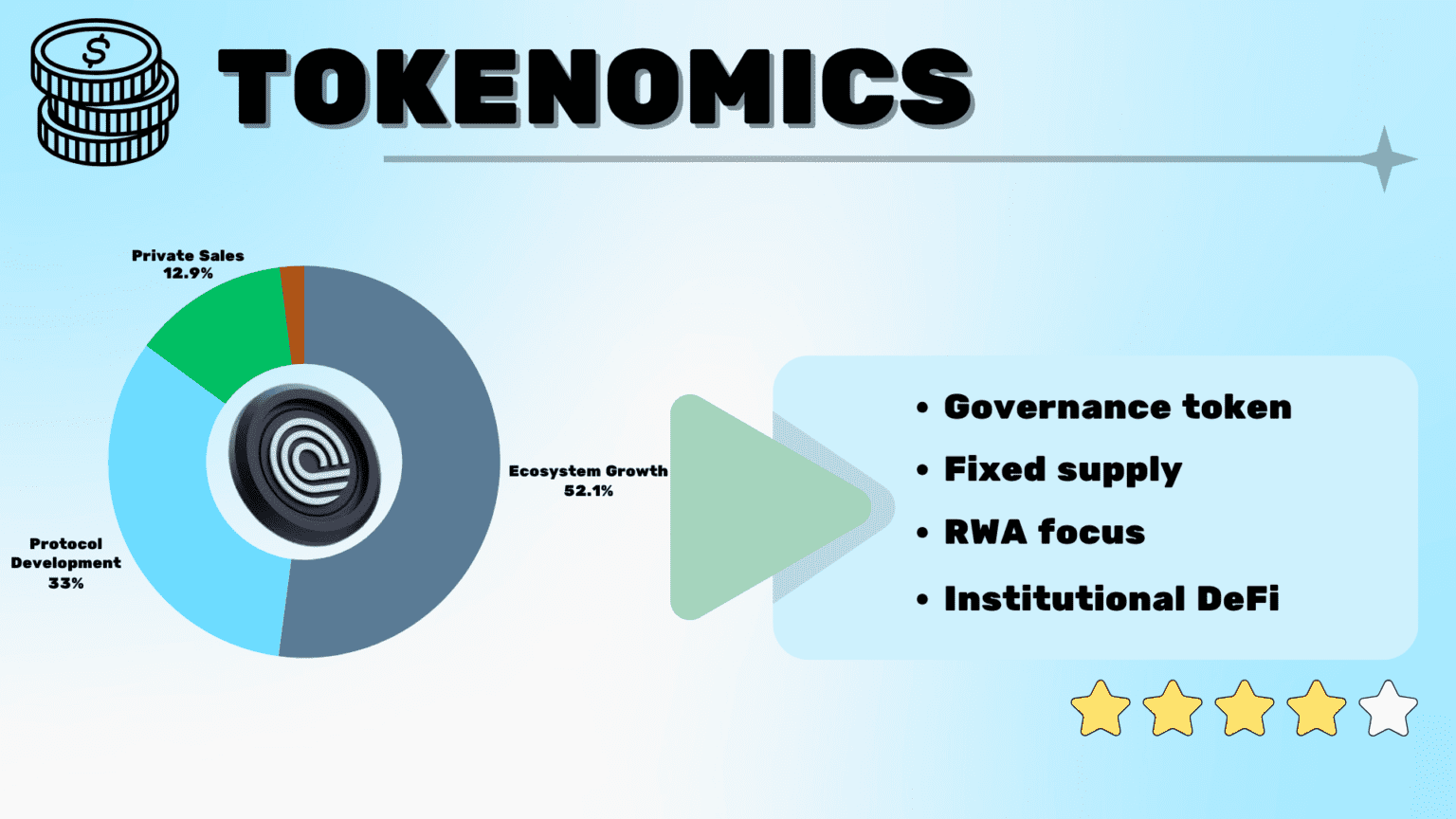
Ondo Finance launched ONDO with a fixed total supply of 10 billion tokens. At TGE in January 2024, only around 21 percent of the supply was unlocked. The rest was locked under multi-year vesting schedules with cliffs and gradual releases. This structure aimed to support long-term alignment, but in practice it introduced large supply shocks.
As of April 2026, circulating supply sits near 4.87 billion tokens, or 48.7 percent of total supply. That means roughly 5.13 billion ONDO is still locked. The biggest shift came from two identical cliff unlocks of 1.94 billion tokens each in January 2025 and January 2026. These events sharply increased supply in short periods and became key drivers of price pressure.
The allocation breakdown looks balanced on paper, but the unlock behavior tells a different story. Ecosystem Growth holds the largest share at 52.1 percent, followed by Protocol Development at 33 percent, Private Sales at 12.9 percent, and Community Sale at 2 percent. Most of these allocations follow a mix of cliff unlocks and linear vesting, which concentrates supply releases into specific windows.
Jan 18, 2024
(TGE)
Jan 18, 2025
Jan 18, 2026
Jan 18, 2027
Jan 18, 2028
Jan 18, 2029
The problem is not the allocation. It is the timing. The January 2026 unlock alone increased circulating supply by roughly 60 percent. On-chain data showed large batches of ONDO moving from early investor wallets to exchanges soon after. This created immediate sell pressure and pushed the price lower, even as platform usage continued to grow.
The next major event is already defined. On January 18, 2027, another 1.94 billion ONDO will unlock under a similar structure. This keeps dilution risk in focus for the next cycle.
From an Ondo tokenomics vesting perspective, the model is predictable but heavy. It prioritizes distribution over time, but does not smooth supply effectively. In this ONDO token unlock schedule, the pattern is clear. Platform growth has been strong, but repeated unlocks and limited direct value capture for the token have kept performance under pressure.
Ondo Price Performance: Why It Dropped 87%
Ondo Finance saw its token peak early, then trend down despite strong platform growth. $ONDO reached an all-time high of $2.14 on December 16, 2024. As of early 2026, it trades near $0.27. That is an 87 percent decline.
If you are asking why did Ondo price drop, the answer is clear. Two large token unlocks reset the market structure.
In January 2025, Ondo unlocked 1.94 billion tokens. Price closed that month around $1.49, then dropped to $0.99 by February. The trend continued through 2025, with ONDO falling to around $0.36 by year-end.
January 2026 repeated the same pattern. Another 1.94 billion tokens entered circulation. Price fell again, finding support near $0.20 in February 2026. Each unlock increased supply faster than demand could absorb.
On-chain data showed large transfers from early investor wallets to exchanges after both events. This created sustained sell pressure, not just short-term volatility. Distribution drove the ONDO price crash, not just sentiment.
Market conditions made it worse. The altcoin market cooled after the 2024 to 2025 cycle. Liquidity moved elsewhere, and many TGE-era tokens saw similar declines.
The key issue is the disconnect between usage and value capture. Ondo’s TVL hit $3.52 billion, making it a leader in tokenized Treasuries and stocks. But ONDO is mainly a governance token. It does not offer direct yield or fee sharing.
So demand stayed limited while supply kept rising. What was built is working. What happened to the token is different.
Ondo vs Maple Finance vs Centrifuge vs BlackRock BUIDL
Ondo Finance operates as a full-stack RWA platform. It combines tokenized Treasuries, equities, derivatives, and its own chain. In contrast, Maple Finance, Centrifuge, and BlackRock’s BUIDL fund each focus on narrower segments.
Focus
Products
TVL
Token
Key Backers
Price From ATH
From an Ondo vs Maple Finance perspective, the difference is focus. Maple built around institutional credit and underwriting. It goes deeper in one vertical. Ondo spreads across multiple products and asset classes.
The same applies when looking at Ondo vs BlackRock BUIDL. BlackRock focuses only on tokenized Treasuries but brings unmatched distribution and trust. Ondo competes by offering more than just yield. It adds equities, trading, and infrastructure.
This creates a clear trade-off. Ondo’s breadth is its biggest advantage. It captures liquidity across multiple RWA segments and builds network effects. At the same time, it risks spreading execution too thin while competitors specialize and dominate their niches.
Is Ondo Finance a Good Investment in 2026?
The bull case is straightforward. Ondo Finance has become one of the largest RWA platforms with $3.52 billion in TVL. Ondo Global Markets scaled to 250+ tokenized stocks, over $700 million in TVL, and more than 60 percent market share.
Partnerships with Franklin Templeton, Binance, and MetaMask improved distribution. The U.S. Securities and Exchange Commission closed its investigation without charges. 21Shares filed for a spot ETF. Ondo Chain is expected in 2026. The broader RWA market is projected to reach trillions by 2030.
The bear case is harder to ignore. ONDO is down about 87 percent from its peak. Around 5.13 billion tokens are still locked, with the next major unlock scheduled for January 2027. The token has no direct yield or fee sharing. It functions mainly as governance.
That limits demand even as the platform grows. U.S. users face restrictions, and competition from BlackRock’s BUIDL adds pressure in the Treasury segment. Market conditions for altcoins also remain weak.
The core issue is the disconnect. The platform is growing fast. The token is not capturing that growth. Supply keeps increasing while utility stays limited.
This is the key question behind is Ondo a good investment 2026. If the platform continues to scale and token design evolves, the gap could close. If not, dilution and weak value capture may continue to weigh on price.
This is not financial advice. The setup is clear. Strong fundamentals on the platform side. Structural challenges on the token side. The decision depends on how you weigh those two forces.
How to Buy and Stake ONDO
Ondo Finance token ONDO is available across major exchanges, making access straightforward. If you are searching where to buy Ondo, the most common platforms include Coinbase, Kraken, Bybit, Gate.io, and Bitget. Most offer USDT or fiat pairs, with standard onboarding and KYC requirements.
ONDO is an ERC-20 token, so it works with widely used wallets like MetaMask, Ledger, and Trust Wallet. After buying on an exchange, users can withdraw tokens to self-custody for better control and security.
In terms of how to stake ONDO, options are limited. The token does not offer native staking with protocol-level yield. Its primary function is governance within the Ondo ecosystem. Some exchanges provide flexible staking or earn programs, but these are custodial and depend on platform-specific incentives rather than Ondo’s revenue.
This means holding ONDO is closer to holding a governance asset than a yield-bearing token. Buyers are effectively betting on ecosystem growth rather than earning passive income directly from the protocol.
Final Verdict: Should You Buy Ondo in 2026?
An Ondo crypto review 2026 comes down to one tension. The platform is scaling fast, but the token is not reflecting that growth.
Ondo Finance built one of the largest RWA ecosystems with $3.52 billion in TVL, strong partnerships, and expanding product lines. It delivered on what it set out to build. The infrastructure side is working.
The token tells a different story. ONDO is still down heavily from its peak. Large vesting unlocks continue to add supply, and another major release is scheduled for January 2027. The token has no direct claim on revenue or yield, which limits demand even as usage grows.
Consider ONDO if you have a long time horizon, believe in the RWA thesis, and can handle continued dilution and volatility. Avoid it if you want short-term returns or expect price to track platform growth closely.
Verdict. Strong platform. Weak token design, for now.
Frequently Asked Questions
What is Ondo Finance?
Why did ONDO price drop?
Does ONDO token generate yield?
Where can I buy ONDO?
What is the ONDO token unlock schedule?
How is Ondo different from competitors?
Is Ondo a good investment in 2026?
In this article
What Is Ondo Finance?What Has Changed Since Our Last ReviewOndo Tokenomics and Vesting ScheduleOndo Price Performance: Why It Dropped 87%Ondo vs Maple Finance vs Centrifuge vs BlackRock BUIDLIs Ondo Finance a Good Investment in 2026?How to Buy and Stake ONDOFinal Verdict: Should You Buy Ondo in 2026?