Justin Sun WLFI saga explained. Explore how blacklist controversy, backdoor claims, and public conflict contributed to WLFI crash in 2026.

Author: Chirag Sharma
The crypto market has seen countless controversies, but very few have combined politics, DeFi, and billionaire clashes like the Justin Sun WLFI saga. What started as a high-profile partnership between a major crypto founder and a politically backed DeFi project has now turned into one of the most talked-about conflicts of 2026. At the center of this story is the key question: how did Justin Sun go from being WLFI’s biggest supporter to one of its harshest critics, and how did that conflict contribute to the project’s collapse?
The answer lies in a complex chain of events involving investment, governance control, token freezes, and eventually public accusations that shook investor confidence.
World Liberty Financial, widely known as WLFI, entered the market in late 2024 with significant hype and political backing.
The project positioned itself as a DeFi platform aligned with pro-crypto narratives in the United States, promising a governance token, stablecoin infrastructure, and yield-generating opportunities. Despite the strong branding, the early momentum did not translate into sustained capital inflows. The presale phase struggled to maintain traction, and the project needed a major catalyst to survive. This is where Justin Sun entered the picture.
In November 2024, Sun committed $30 million to WLFI, instantly becoming the largest external investor. Within a few months, he increased his exposure to nearly $75 million, signaling strong confidence in the project’s long-term potential.
At that stage, the Justin Sun WLFI narrative was overwhelmingly positive. His involvement brought credibility, liquidity, and renewed attention to the project. He actively promoted WLFI on social media, aligning it with broader crypto adoption narratives and even hinting at integrating WLFI’s stablecoin ecosystem with TRON’s infrastructure.
For WLFI, this investment was not just capital. It was survival.
Justin Sun’s investment in WLFI was one of the largest single commitments to a DeFi project during that period. In return, he received a massive allocation of WLFI tokens, including a significant portion that was unlocked and tradable at launch. At peak valuation levels, his holdings were worth hundreds of millions on paper. This positioned him not only as an investor but also as a key stakeholder with considerable influence over the ecosystem.
However, the structure of WLFI’s smart contracts introduced a critical element that would later become controversial. The protocol included a function that allowed the team to blacklist wallets and restrict token movement under certain conditions.
This detail was not widely discussed during the early promotional phase. When WLFI officially launched in September 2025, market volatility was expected, but what followed was not. Sun performed what he described as routine operational transfers, moving a portion of his tokens to exchanges for testing deposit functionality.
These transactions triggered internal alarms within WLFI. Instead of treating them as standard operations, the team flagged the activity as suspicious. This marked the beginning of a breakdown in trust between the two sides.
The defining moment in the Justin Sun WLFI saga came just days after the token became publicly tradable. WLFI activated its blacklist function on Sun’s primary wallet, effectively freezing a massive portion of his holdings. The address reportedly contained hundreds of millions of unlocked tokens along with additional locked allocations, representing a significant share of the circulating supply.
At prevailing market prices, the frozen tokens were worth well over $100 million. WLFI justified the action by citing security concerns and suspicious exchange-related activity. The team argued that blacklisting was necessary to protect the ecosystem from potential manipulation and fraudulent behavior.
Justin Sun strongly disagreed. He publicly stated that no selling activity had taken place and that the transfers were purely operational. He emphasized that blockchain assets should remain inviolable and that unilateral freezes contradicted the core principles of decentralization.
The situation escalated quickly, with both sides refusing to back down. Sun demanded the immediate unfreezing of his assets and even offered additional investment to demonstrate his commitment. However, WLFI maintained its stance and kept the wallet locked. This event fundamentally changed the Justin Sun WLFI relationship.
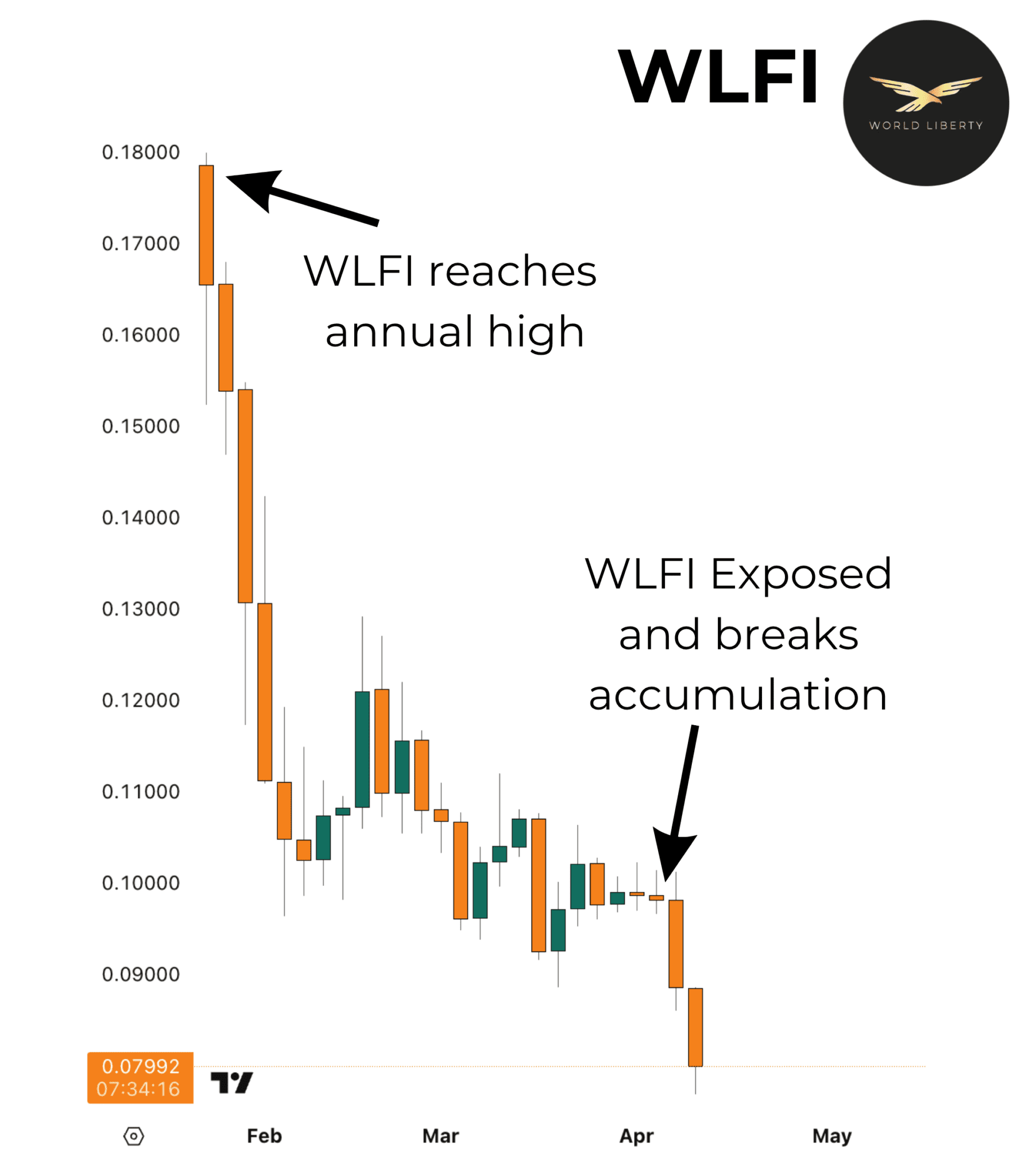
Following the blacklist incident, WLFI’s price began to decline steadily, driven by uncertainty and declining investor confidence. For Justin Sun, the consequences were severe. As one of the largest holders, he was unable to access or liquidate his tokens, even as their value continued to drop. Reports estimated that his losses quickly reached tens of millions of dollars, eventually crossing the $70 million mark as the token approached new lows.
The broader market reaction was equally important.
The blacklist event raised serious concerns about WLFI’s decentralization claims. Investors began questioning whether the project truly operated as a decentralized protocol or if it retained centralized control mechanisms that could override user ownership.
Several key issues emerged:
These concerns created a feedback loop where declining trust led to selling pressure, which further weakened the token’s price. Meanwhile, WLFI continued developing its ecosystem, including its stablecoin and DeFi offerings, but the damage to its reputation was already visible. The Justin Sun WLFI conflict became a recurring topic in crypto discussions, highlighting deeper structural issues within the project.
The situation reached a new level in April 2026 when fresh controversies emerged around WLFI’s financial operations. Reports revealed that the project had used a significant portion of its own token supply as collateral on a DeFi platform, borrowing large amounts of stablecoins in the process. This move raised concerns about liquidity risks and potential self-dealing practices.
Market sentiment deteriorated rapidly. WLFI’s price dropped sharply, falling to new all-time lows and wiping out a majority of its earlier gains. The crash intensified scrutiny on the project’s governance and financial decisions.
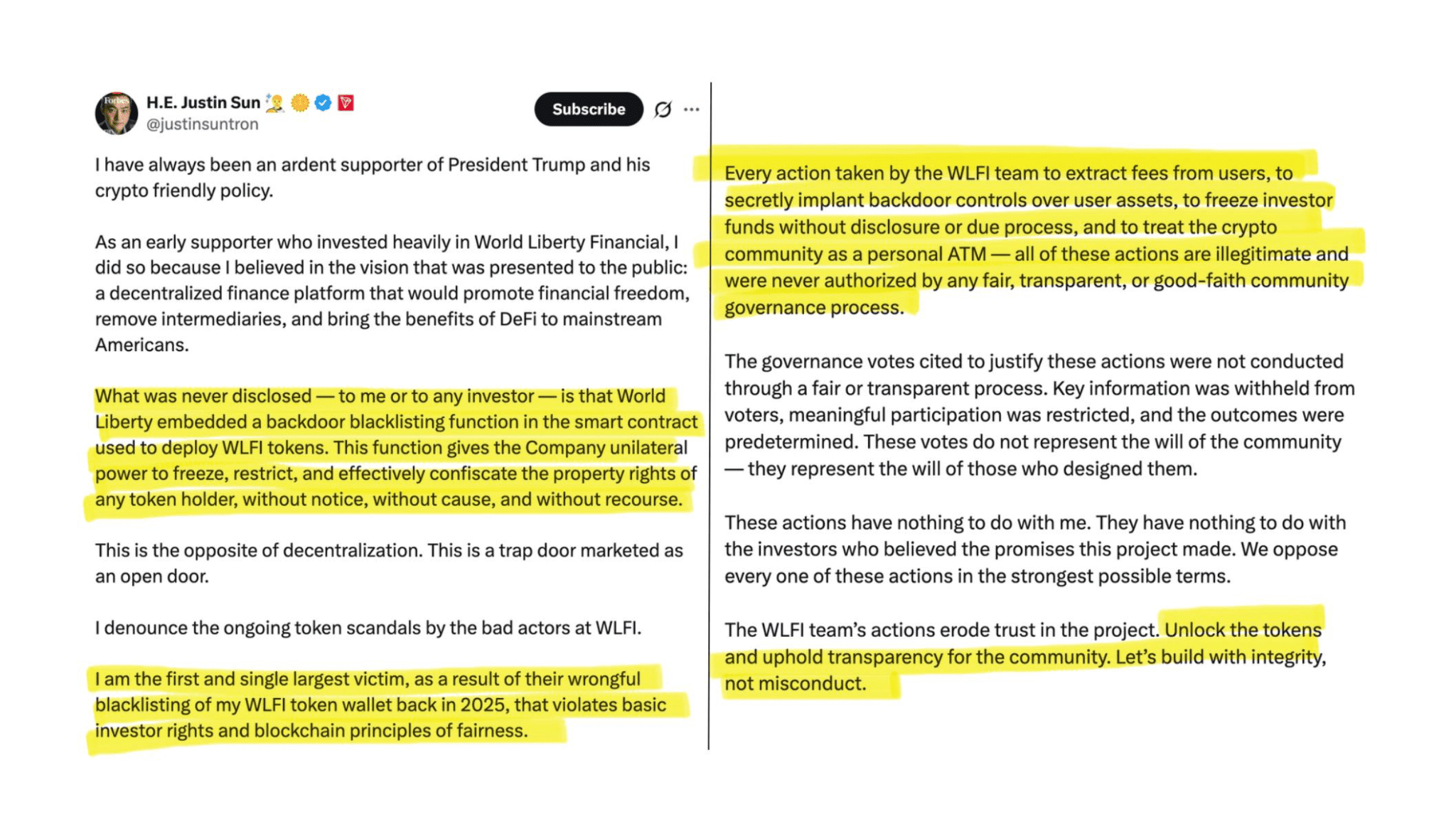
At this point, Justin Sun made his most aggressive move. He publicly accused WLFI of embedding an undisclosed backdoor mechanism in its smart contracts, which allowed the team to freeze or restrict tokens without prior notice. He claimed that this feature had never been disclosed during his initial investment discussions.
Sun described the system as fundamentally incompatible with decentralization and positioned himself as one of its primary victims. These allegations had a massive impact on market perception. Investors began reassessing the risks associated with WLFI, and the narrative shifted from a promising DeFi project to a case study in governance failure.
The Justin Sun WLFI saga was no longer just a disagreement. It had become a full-scale public confrontation.
WLFI did not remain silent in the face of these accusations. The project’s official communication channels responded aggressively, denying Sun’s claims and accusing him of spreading misinformation. The team suggested that his actions were intended to deflect attention from his own activities. This public exchange quickly went viral across crypto platforms.
The combination of accusations, counter-accusations, and legal threats created a highly negative sentiment environment. Even investors who were previously neutral began to exit positions due to uncertainty. At the same time, the project attempted to stabilize its financial position by repaying portions of its outstanding loans. While this provided some short-term relief, it did little to restore confidence.
The damage had already been done. WLFI’s price remained near its lows, and trading volumes reflected ongoing selling pressure. The Justin Sun WLFI conflict had effectively become a major factor influencing market behavior.
From a broader perspective, this saga exposed several critical lessons for the crypto industry:
These lessons extend far beyond WLFI.
The Justin Sun WLFI saga is more than just a dispute between an investor and a project. It is a reflection of the growing pains within the crypto industry as it transitions from hype-driven growth to institutional maturity. What began as a strategic partnership evolved into a conflict that exposed fundamental weaknesses in governance, transparency, and decentralization. The blacklist incident, combined with subsequent allegations and market reactions, created a perfect storm that contributed to WLFI’s decline.
For Justin Sun, the episode represents both a financial loss and a public battle over principles. For WLFI, it has become a defining moment that will shape its future trajectory. The key takeaway is clear.
In crypto, trust is everything. Once that trust is broken, even the strongest narratives can collapse. The Justin Sun WLFI story serves as a reminder that behind every token is a system of decisions, controls, and incentives that ultimately determine its success or failure.
All the opinions in this article are that of the author and in no way are financial advice. Our Crypto Talk and the author always suggest you do your own research in crypto and to never take anything as financial advice that you read on the internet. Check our Terms and conditions for more info.