Discover how many Bitcoin are lost forever, why it matters, and how 2.3–3.7 million BTC could reshape supply, scarcity, and long-term value.

Author: Arushi Garg
As of March 2026, miners have already produced more than 20 million Bitcoin. But here’s the catch. Not all of them actually circulate. A significant portion is gone. Not stolen. Not temporarily locked. Gone forever.
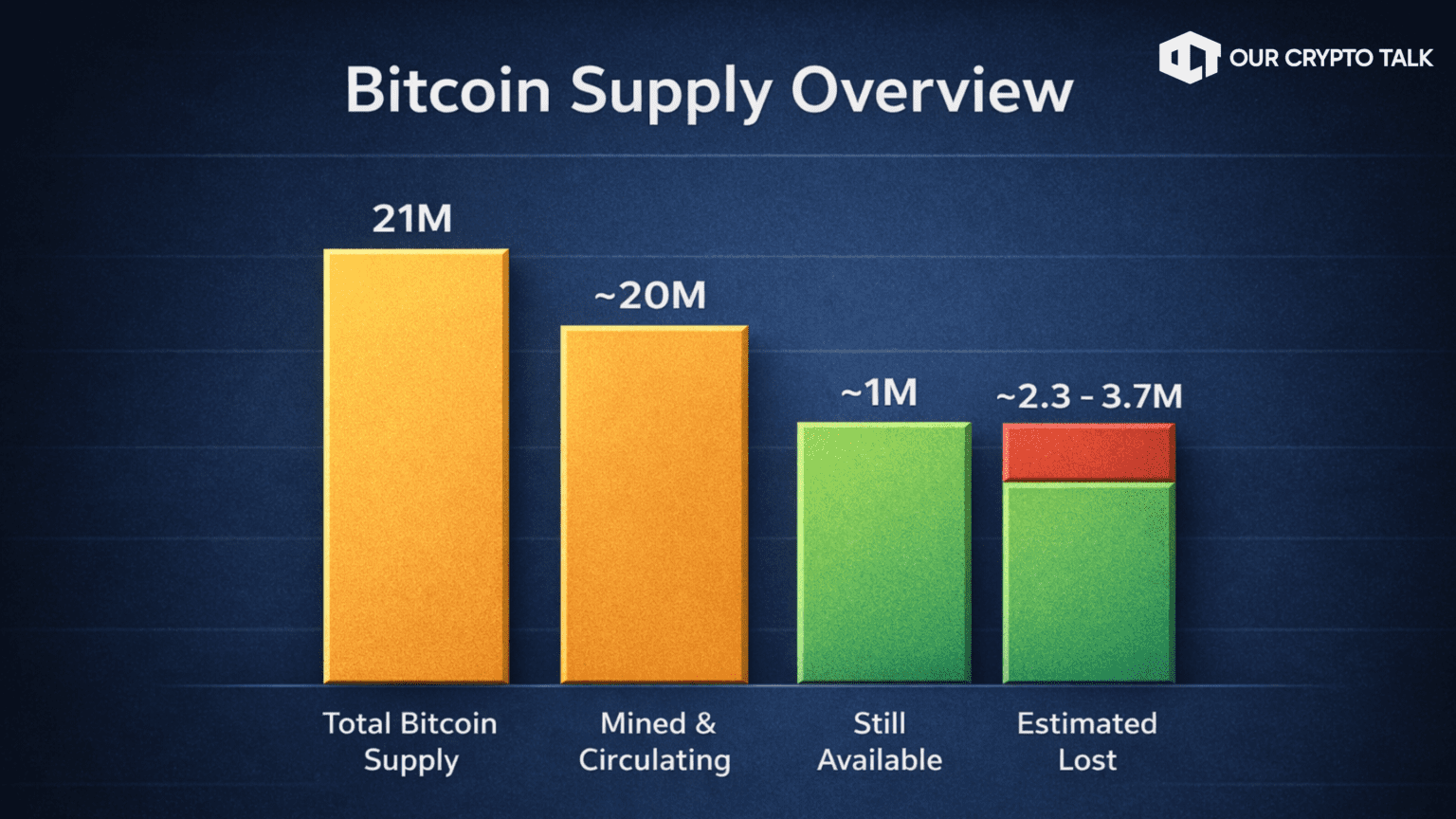
On-chain analysts estimate that users have permanently lost between 2.3 and 3.7 million Bitcoin. At recent prices hovering around $60,000 to $70,000 per BTC, this amounts to roughly $140 billion to $250 billion in value that will never re-enter the market. This fact changes how investors should think about Bitcoin’s supply.
It is not 20 million. It is closer to 17 million. And it will never reach the full 21 million in any meaningful, usable sense.
Most articles stop at a headline figure. But the reality is more nuanced. Research from firms like Chainalysis, Glassnode, and Coin Metrics consistently lands in the same range:
Why the range? Because analysts cannot always prove coin loss. Some coins are definitively gone. Others appear statistically likely lost, but analysts cannot guarantee it.
What we can say with confidence:
This has a direct implication for scarcity.
Even though miners have produced more than 20 million BTC, the effective circulating supply sits closer to 16.3 to 17.7 million BTC.
This is where most explanations fall short. Analysts do not rely on guesswork. They build these estimates on observable blockchain data.
Here are the four primary methods analysts use.
Bitcoin tracks ownership through something called Unspent Transaction Outputs (UTXOs). Think of each UTXO as a coin sitting in a wallet. If it has not moved in a long time, it raises a question: is it being held, or is it lost? Researchers analyze the age distribution of all UTXOs on the network.
If a wallet from 2010 has never made a transaction, the owner likely lost the private keys. It is not certain, but the probability remains very high.
Closely related to UTXO analysis is the study of inactive Bitcoin addresses. These are addresses that received BTC, often between 2009 and 2011, and have never sent a transaction since.
Analysts look at patterns like:
If coins have not moved despite Bitcoin rising from near-zero to tens of thousands of dollars, the likelihood that the owner still has access drops significantly. That said, dormancy is not proof. Some early holders may simply be long-term “HODLers.” But at scale, researchers treat long-inactive addresses as probably lost, not definitively lost.
Some Bitcoin is not just likely lost. It is provably gone. Users send these coins to burn addresses, which are valid addresses with no known private key.
A well-known example is:
Coins sent there can never be accessed or spent.
Other examples include:
Unlike dormant coins, these are 100% unrecoverable and form the “definitely lost” portion of Bitcoin supply.
In Bitcoin’s early years, some users created transactions with scripts that later proved unspendable. These scripts define the conditions required to spend a coin, but in some cases, users wrote them incorrectly or relied on an incomplete understanding of the system. As a result, certain coins remain locked behind conditions that no one can fulfill. Bugs, experimental usage, or simple construction errors often caused these issues. Unlike lost passwords or discarded wallets, the protocol itself prevents anyone from accessing these coins.
They make up a small portion of total lost Bitcoin, but they matter because they fall into the “definitely lost” category. Analysts can identify these outputs on the blockchain and confirm that no one can ever spend them.
Not all lost Bitcoin is equal, and this distinction plays a key role in understanding the estimates. Some coins are definitely lost, such as those sent to burn addresses or locked in unspendable scripts. Anyone can verify these coins as unrecoverable on-chain.
Others likely fall into the “probably lost” category, including coins sitting in dormant wallets or untouched UTXOs from Bitcoin’s early years. Analysts rely on statistical methods rather than certainty to classify these coins. Most of the widely cited 2.3 to 3.7 million BTC sits in this category. There is always a small chance that an old wallet suddenly becomes active, and this has happened on rare occasions. However, the longer coins remain untouched, the lower the chance of recovery.
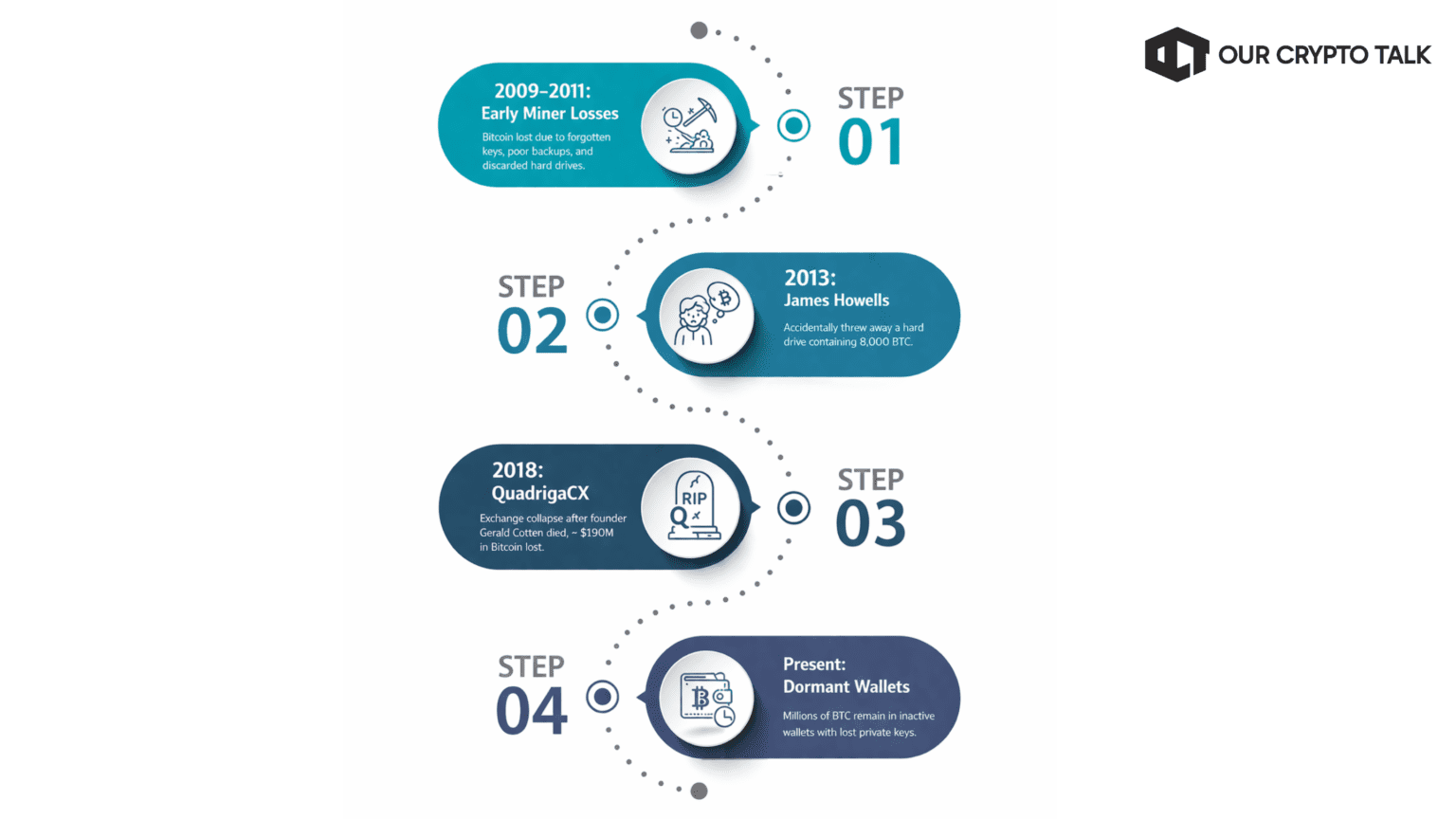
Behind the estimates are real stories that illustrate how Bitcoin gets lost. Some are accidental, some are mysterious, and some remain unresolved.
The largest single share belongs to Satoshi Nakamoto, who likely controls around 1.1 million BTC. He mined these coins in Bitcoin’s earliest days and has never moved them. Researchers identified this stash using the “Patoshi pattern,” a distinct signature in early mining activity. At current prices, it’s worth tens of billions of dollars. No one knows whether Nakamoto lost these coins, chose to leave them untouched, or can no longer access them, but most analysts treat them as effectively out of circulation.
Another well-known case is James Howells, who accidentally threw away a hard drive in 2013 containing 7,500 BTC. The device ended up in a landfill in Newport, Wales. For years, Howells has attempted to recover it, proposing excavation plans and funding efforts, but local authorities have not granted permission. The lost Bitcoin is now worth hundreds of millions of dollars, buried and likely unrecoverable.
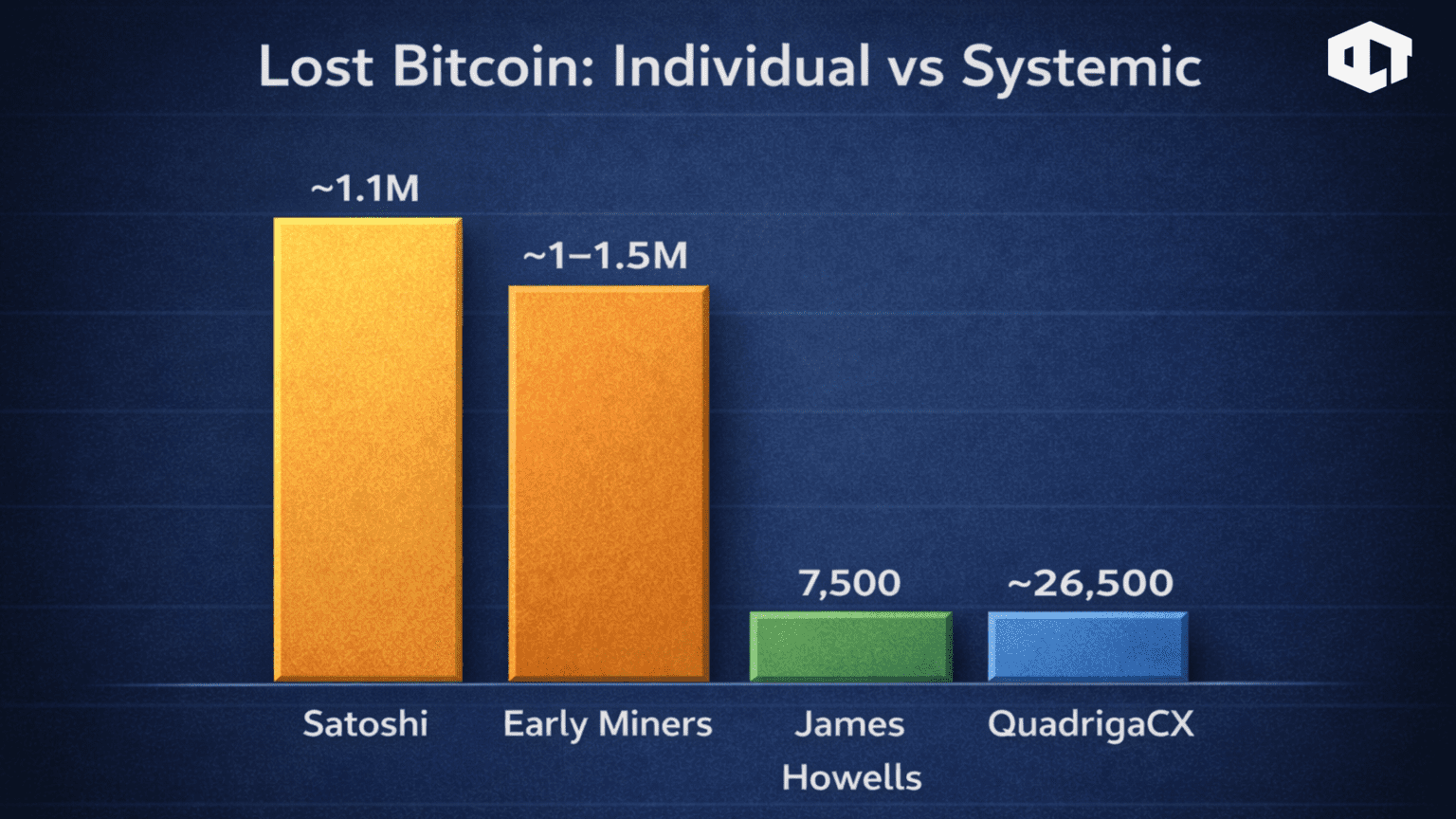
The collapse of QuadrigaCX presents a more complex case. In 2018, CEO Gerald Cotten reportedly died, allegedly taking sole access to the exchange’s cold wallets with him. Early reports suggested that the exchange lost around 26,500 BTC. However, later investigations revealed that Cotten had already moved or misused much of the crypto before his death. Some funds may still be inaccessible, but analysts continue to dispute the situation rather than classify it as clearly “lost.”
A major portion of lost Bitcoin comes from early miners between 2009 and 2011. Back then, Bitcoin had little value, and many users mined coins on personal computers without thinking much about long-term storage. Over time, wallets were deleted, hard drives were formatted, and private keys were lost. These coins now sit untouched on the blockchain, with estimates suggesting 1 to 1.5 million BTC may fall into this category alone.
Finally, users sometimes send Bitcoin to the wrong address. Bitcoin’s design makes transactions irreversible. If someone sends coins to an incorrect or non-existent address, no one can recover them. No system allows users to reverse a transaction. Even small mistakes like a mistyped character or a faulty copy-paste can permanently remove coins from circulation.
This is where the implications become meaningful. Lost Bitcoin is not just an interesting statistic. It directly reshapes how investors should understand the asset’s supply.
Bitcoin’s headline numbers look simple. The supply cap sits at 21 million, and miners have already produced more than 20 million BTC. On paper, that suggests most of the supply already circulates.
In reality, a significant portion of those coins is gone. Once you account for the estimated 2.3 to 3.7 million BTC that investors have lost, the effective circulating supply falls to roughly 16 to 17.7 million BTC. This shift is not minor. It structurally changes the supply picture. Any model, valuation, or narrative that assumes 20 or 21 million usable coins overstates the amount actually available to the market.
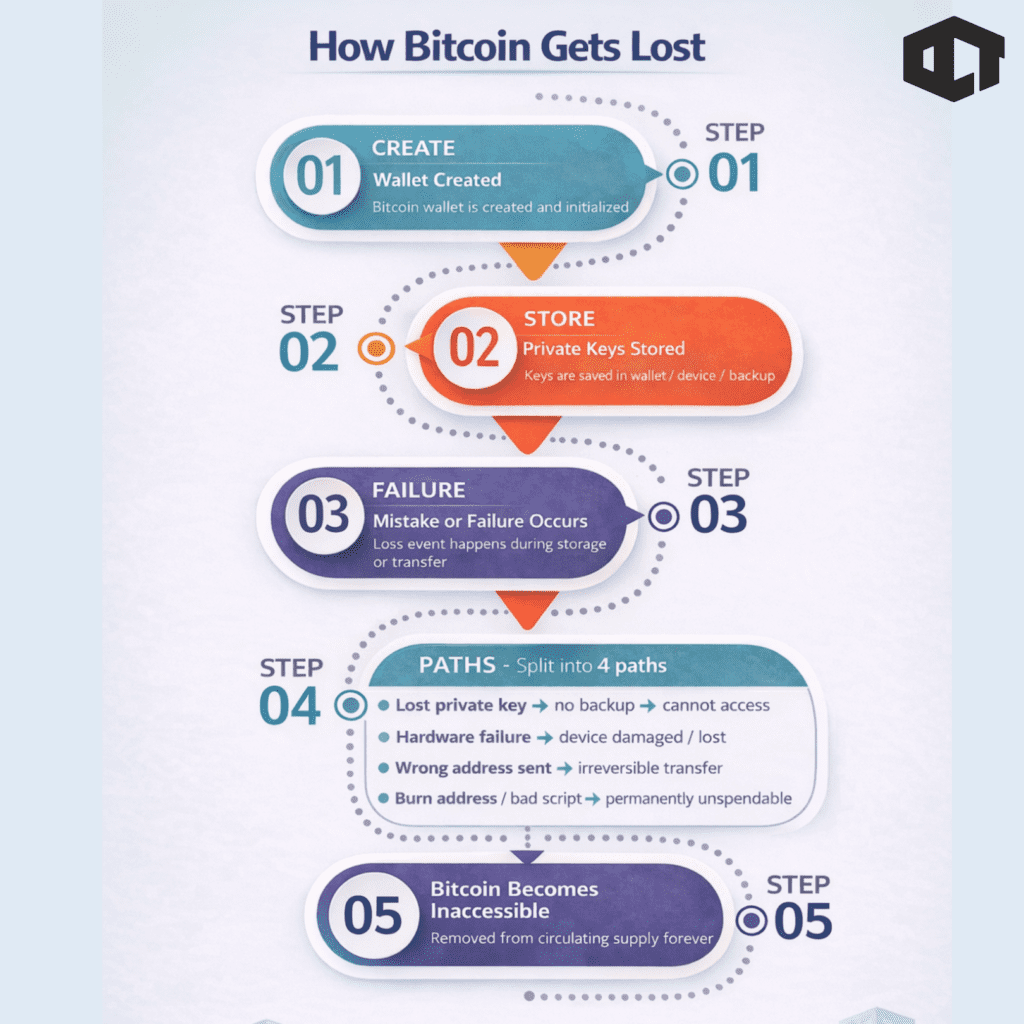
Bitcoin’s scarcity usually centers on halvings, which reduce the rate at which new supply enters the system. Every four years, the protocol cuts the block reward in half, slowing issuance. Lost coins introduce a second, less discussed force. They reduce the existing supply, not just the future supply.
These two mechanisms work together. Halvings limit how much new Bitcoin enters circulation, while lost coins quietly shrink the existing supply. As a result, fewer coins remain available over time, increasing competition for those that still exist.
The stock-to-flow model compares existing supply (stock) to annual new production (flow). Analysts often use it to frame Bitcoin’s scarcity relative to assets like gold. If the true circulating supply is closer to 17 million instead of 20 million, then the “stock” side of that equation is smaller than commonly assumed. At the same time, the “flow” continues to decline due to halvings.
This effectively tightens the ratio, reinforcing the idea that Bitcoin is becoming harder to acquire over time, even without any change to its underlying protocol.
Gold is scarce, but it is not fixed. Companies can still discover new deposits, and miners continue extracting it as long as it remains economically viable. Bitcoin works differently. Its supply cap stays absolute, and no one can replace lost coins.
When users lose Bitcoin, they do not just remove it temporarily, they eliminate it from the usable supply forever. This dynamic means the theoretical cap remains 21 million, but the practical supply keeps shrinking over time. In that sense, Bitcoin is not just finite, it becomes deflationary in practice as usable supply declines.
Scarcity alone does not determine price. Multiple factors influence Bitcoin’s value, including demand, regulation, market sentiment, and broader macroeconomic conditions. Lost coins strengthen the scarcity narrative, but they represent only one piece of a much larger puzzle.
In most cases, lost Bitcoin is gone for good. The system relies on private key ownership, and without the key, users cannot access their funds. Coins sent to burn addresses fall into the simplest category. No one holds the private keys to these addresses, which means no one can ever spend the Bitcoin sent to them.
Lost private keys present a different scenario. In theory, it is possible to guess a private key through brute force. In practice, it is not realistic. The number of possible Bitcoin private keys is around 10^77, an astronomically large number. For comparison, there are roughly 10^80 atoms in the observable universe. The odds of randomly discovering the correct key are effectively zero.
A few rare edge cases involve physical recovery. The story of James Howells shows that recovery becomes technically possible if someone retrieves a storage device and the data remains intact. However, hardware decay, data corruption, and environmental damage make success highly uncertain, even under ideal conditions.
Some people point to quantum computing as a potential solution. A sufficiently advanced system could theoretically break modern cryptography, including Bitcoin’s key system. However, this scenario remains speculative and likely decades away. More importantly, it would affect all digital security systems, not just Bitcoin. For practical purposes, investors should treat lost Bitcoin as permanently removed from circulation.
Bitcoin’s supply cap is often described as 21 million. In reality, the usable supply will likely never exceed 17 million. Users have lost millions of coins forever. They lost access through misplaced keys, discarded hardware, or irreversible transaction errors that send coins into digital voids with no way back.
That is not a bug in the system. It is a defining feature. Bitcoin is not just scarce by design. It becomes more scarce over time.


RWA Needs Better Access. Can NUVA Deliver?
Tokenization of RWA yields onchain might be the biggest opportunity that no one has noticed
Cold Wallet Safety 2026: Are Hardware Wallets Still Safe?
One Token, Multiple Products. Can Zylo Deliver?
RWA Needs Better Access. Can NUVA Deliver?
Tokenization of RWA yields onchain might be the biggest opportunity that no one has noticed
Cold Wallet Safety 2026: Are Hardware Wallets Still Safe?
One Token, Multiple Products. Can Zylo Deliver?