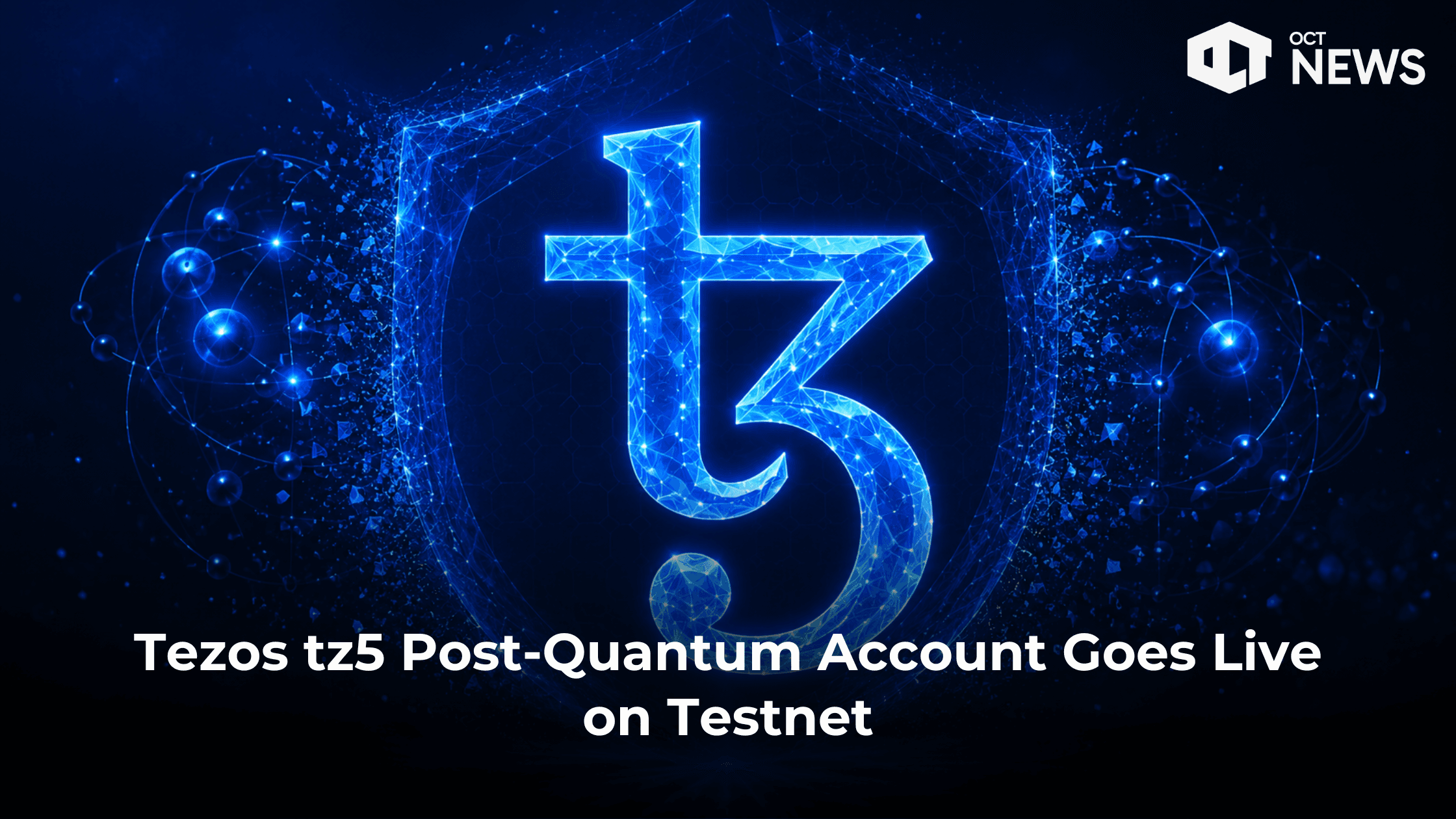
Tezos post-quantum accounts debut on Ushuaianet with tz5 and ML-DSA-44, preparing the network for a future quantum-resistant migration.

Author: Kritika Gupta
16th July 2026- Tezos has switched on tz5, a new post-quantum account type, for public testing on its Ushuaianet testnet. The official Tezos account announced the move on July 16, 2026. So developers can now create accounts that sign with quantum-resistant cryptography.
High Signal Summary For A Quick Glance

Crypto Daily™
@cryptodailyuk

Tezos Ushuaia Upgrade: Can 15x Data Availability and Liquid Staking Revive tezos:native? Tezos Ushuaia upgrade raised DAL bandwidth to 10 MB/s and cut confirmations to ~12–18s. sTEZ testing starts as enshrined staking targets Protocol V for mainnet. https://t.co/dDtRGkiBKU
05:38 AM·Jul 16, 2026
Steady attention without excessive speculation.
The tz5 address uses ML-DSA-44, a lattice-based signature scheme that NIST standardized in FIPS 204. It shipped with Ushuaia, the 21st Tezos protocol upgrade, which activated on mainnet on June 30. For now, the tz5 post-quantum account sits behind a feature flag and runs on testnets only.
Every Tezos address today leans on elliptic-curve cryptography. That includes tz1, tz2, tz3, and the newer tz4 accounts. A powerful quantum computer could, in theory, break those curves using Shor’s algorithm.
tz5 answers that risk directly. Instead of an elliptic curve, it signs with ML-DSA-44, a lattice-based scheme. Because no known quantum algorithm cracks lattices efficiently, the keys should hold up far longer.
Nomadic Labs, Trilitech, and Functori built the feature together. According to the Nomadic Labs announcement, the code passed through on-chain governance without a fork. The protocol hash is PsUshuai9QapM5TGj1JpuVGkdxz5GykdnEvS6Rh8SUVrARvZLCY.
ML-DSA-44 was once known as CRYSTALS-Dilithium. NIST finalized it in FIPS 204 in August 2024. It is the lowest parameter set in the ML-DSA family, rated at roughly 128-bit security.
The scheme rests on the hardness of finding short vectors in high-dimensional lattices. Shor’s algorithm does not apply to that problem. As a result, lattice signatures stay secure even against a large quantum machine.
Still, the safety comes with a size cost. An ML-DSA-44 public key runs about 1.3 KB, and a signature about 2.4 KB. By contrast, an Ed25519 key is 32 bytes and its signature 64 bytes. So every tz5 operation carries more data, which raises storage and gas costs on chain.
Tezos leans on a formally verified Rust library called libcrux-ml-dsa for the math. According to core developers on the Tezos Agora forum, performance stays close to a normal tz1 account for everyday operations.
How the new tz5 post-quantum account compares with existing Tezos account types
On testnets where the flag is on, a tz5 post-quantum account works like a regular wallet. It can send transfers, call smart contracts, delegate, and stake. In other words, ordinary user operations already function.
Yet there are firm limits for now. A tz5 account cannot register as a delegate. It also cannot serve as a consensus key. So baking and validation stay off-limits until later work lands.
Existing accounts feel no impact at all. tz1, tz2, tz3, and tz4 keys keep working exactly as before, per the Octez account documentation. Above all, nobody has to migrate, and no funds move automatically.
Key milestones behind Tezos’ rollout of tz5 post-quantum accounts
NIST standardizes ML-DSA, the lattice-based post-quantum signature scheme previously known as CRYSTALS-Dilithium.
Earlier protocol upgrades introduced new cryptographic account types, including tz4 accounts using aggregatable BLS signatures.
Tezos contributors propose introducing ML-DSA-44 accounts behind a feature flag before developing stateful addresses and key rotation.
The proposal for Tezos’ 21st protocol upgrade enters the formal governance process after its stabilization and development phase.
The upgrade moves through the Proposal, Exploration, Cooldown, Promotion and Adoption periods without causing a network fork.
The upgrade activates at block 13,857,889. tz5 support enters the protocol code but remains disabled by default on mainnet.
Developers and users can test ML-DSA-44 accounts for transfers, contract calls, delegation and staking on the dedicated testnet.
Wallets, custodians and developer tools must complete testing first. Enabling tz5 on mainnet would require a future protocol proposal and another Tezos governance vote.
Tezos upgrades itself through on-chain governance in roughly two-month cycles. Ushuaia is the 21st such upgrade. It activated at block 13,857,889 on June 30, 2026, at 00:31:52 UTC.
Beyond tz5, the upgrade raised data availability bandwidth by about 15 times. That change feeds the wider Tezos X plan for high-throughput rollups. Meanwhile, tz5 adds forward-looking cryptography to the same release.
The plan is deliberately phased. First, ML-DSA-44 arrives behind a flag. Next come stateful addresses for key attachment and rotation. Finally, older schemes would retire only if a quantum threat actually appears.
“With Ushuaia, Tezos Layer 1 does exactly what a modern settlement layer should do: increase data availability for the applications arriving with Tezos X, while preparing the cryptographic migration path long before quantum risk becomes urgent.”
That framing came from Yann Régis-Gianas, Head of Engineering at Nomadic Labs, in Tezos media coverage of the launch.
The testnet news did not move the market much. Around July 16, XTZ traded near $0.22 to $0.23, according to aggregator data from CoinGecko and CoinMarketCap. Daily volume stayed in the low millions of dollars.
That calm makes sense. Markets had already absorbed the June 30 mainnet activation, which centered on data availability. So the July tweet read as a developer update rather than a price catalyst.
Community sentiment looked positive but quiet. The official post drew modest engagement, with likes and reposts in the low dozens within hours. On the Agora forum, contributors framed the work as prudent groundwork rather than hype.
None of this is financial advice. Readers should do their own research before acting on any price or investment view.
For now, the tz5 post-quantum account stays testnet-only, and Tezos has set no firm mainnet date. Instead, the team wants wallets, custodians, and tooling to adapt first. Developers can already generate tz5 accounts on Ushuaianet through Octez.
Baking support, key rotation, and native multisig with tz5 keys all remain planned rather than shipped. So the next milestones will show whether the phased migration holds up in practice. Until then, Tezos sits among the first major chains to test a production-grade post-quantum account.
Our Crypto Talk is committed to unbiased, transparent, and true reporting to the best of our knowledge. This news article aims to provide accurate information in a timely manner. However, we advise the readers to verify facts independently and consult a professional before making any decisions based on the content since our sources could be wrong too. Check our Terms and conditions for more info.


ASTRA 2.0 Migration: Snapshot Nov 7, Trading Nov 10
Starknet Weighs Leaving Ethereum to Become Post-Quantum L1
Vitalik Backs ZKsync Airbender Prime & Eyes zkEVM Security
StandX Cancels Token Launch and Winds Down Perps
ASTRA 2.0 Migration: Snapshot Nov 7, Trading Nov 10
Starknet Weighs Leaving Ethereum to Become Post-Quantum L1
Vitalik Backs ZKsync Airbender Prime & Eyes zkEVM Security
StandX Cancels Token Launch and Winds Down Perps

Tezos