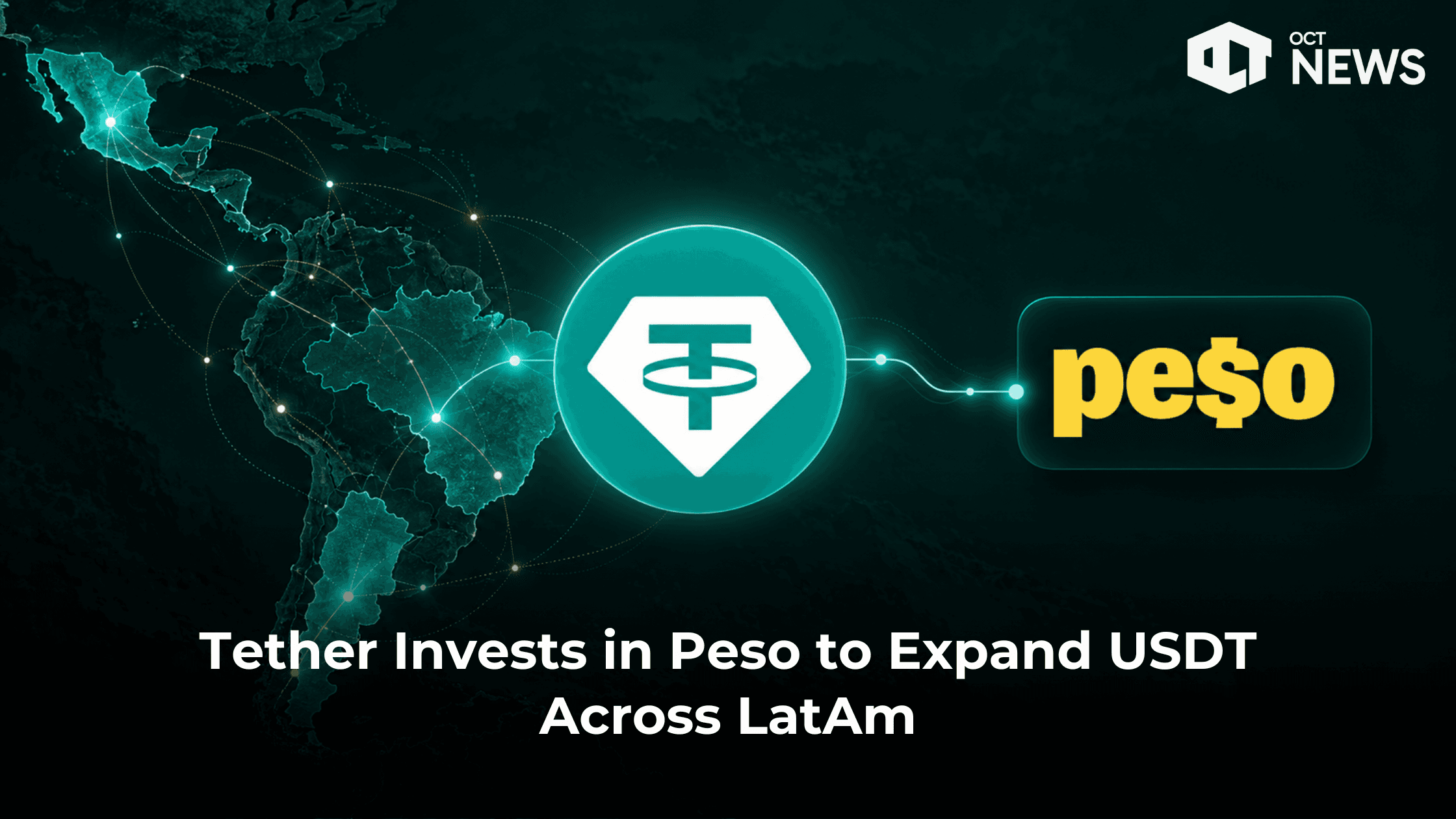
Tether invests in Peso to expand USDT payments across Latin America, supporting local banking connections and everyday stablecoin spending.

Author: Kritika Gupta
High attention and emotional sentiment detected.
21st October 2026– Tether invests in Peso, a Bolivian fintech, leading an undisclosed pre-seed round announced. The deal aims to expand fast, low-cost USD₮ payments across Latin America.
High Signal Summary For A Quick Glance
Peso offers a single app for saving, spending, and sending digital dollars. According to Tether’s announcement, the funding supports local on-ramps, merchant acceptance, and account infrastructure in the region.
The round is small and early. Tether led it, but the two companies did not disclose the amount, the valuation, or any co-investors.
So the headline here is strategic, not financial. A major global stablecoin issuer chose a startup from Bolivia, a market that bigger players often overlook.
Peso has operated since at least mid-2025. It first focused on named USD accounts and cards for Bolivians facing physical dollar shortages.
Now the company wants to widen that base. According to Tether, the money will grow local on-ramps, the merchant point-of-sale network, and virtual-account infrastructure.
Peso provides a global USD₮ account that users open with local ID. The app connects digital dollars to local banking through QR and ACH rails.
Because of that link, a user can move between USD₮ and local currency without heavy friction. For example, Peso integrates USD₮ into Yango, a food delivery service in Bolivia.
Merchants can also accept payments through point-of-sale tools and QR codes. Meanwhile, virtual accounts in the user’s name tie the stablecoin to the banking system.
The digital dollar here is USD₮, the stablecoin issued by Tether. Peso supports it across several chains, including Tron, Ethereum, Polygon, Solana, BNB, and Arbitrum.
The app also issues Visa debit cards and virtual US accounts opened with a local ID. So users can hold digital dollars, then spend them online or in stores through familiar rails.
“Latin Americans are already using USD₮; what was missing was the infrastructure to spend it in everyday life without friction,” said Alejandro Terán, CEO and Co-Founder of Peso.
Tether’s Latin America expansion leading to the Peso investment
The policy change creates room for stablecoin services and local payment infrastructure.
Peso begins offering dollar accounts and payment services for Bolivian users.
Tether backs institutional digital-asset infrastructure in Latin America.
Tether leads the Argentine payments wallet’s $14 million funding round.
Tether invests $20 million each in Brazil’s Mercado Bitcoin and Argentine neobank Ualá.
Tether leads a $3 million seed round for the Colombian fintech.
The investment supports institutional stablecoin payments and settlement infrastructure.
Tether announces it led Peso’s pre-seed round to expand everyday USDT payments. The funding amount remains undisclosed.
Expansion focuses on Bolivia, Brazil, Colombia, and Argentina. The supplied research provides no country-specific rollout or regulatory approval dates.
Bolivia makes an unusual but logical launchpad. The country has faced dollar shortages and parallel-market premiums for cash dollars.
In mid-2024, Bolivia lifted its crypto ban. After that shift, crypto volumes surged, reaching roughly $14.8 billion by some estimates.
Stablecoins dominate activity across much of the region. USD₮ accounts for the vast majority of stablecoin transactions in several LatAm markets, according to industry summaries.
Still, risks remain. Bolivia sits on the FATF grey list, so any formal stablecoin role in national payments would require stronger anti-money-laundering controls.
The trend also feeds a wider debate. Critics warn that heavy USD₮ use amounts to de facto dollarization, which can reduce a government’s control over its own currency.
This deal is not a one-off. Over the past year, Tether has backed a string of LatAm fintechs to push USD₮ into daily use.
The streak started back in November 2025 with an undisclosed investment in Parfin, which builds institutional digital-asset infrastructure. The pace then picked up through 2026.
In April 2026, Tether led a $14 million round in the Argentine wallet Belo. In July, it put $20 million into Brazil’s Mercado Bitcoin and $20 million into Argentine neobank Ualá.
Then in September, it led a $3 million seed round in Colombia’s Plenti. On 13 October, it joined a seed round for EFY Finance, which builds institutional stablecoin rails.
So when Tether invests in Peso, it extends a clear pattern. The firm wants USD₮ to work as a payments channel, not only a savings tool.
“Peso is building the kind of everyday-spend infrastructure that turns USD₮ from a savings tool into a payments channel people rely on daily,” said Paolo Ardoino, CEO of Tether. He added that the firm aims to “create a new standard for stablecoin-powered solutions.”
The deal is small, so it produced no visible price or supply move. USD₮ market cap sits near $182.73 billion, according to DefiLlama.
That figure gives USD₮ roughly a 60.7% share of the stablecoin market. The Peso round does not change those numbers in any measurable way.
Independent outlets covered the news quickly. Both The Block and CoinDesk reported the undisclosed pre-seed and the target markets.
For now, Peso plans to deepen its rails in Bolivia, Brazil, Colombia, and Argentina. The company has not shared a rollout timeline or a first-priority market.
The broader question is whether stablecoin payments can move from savings into daily spending at scale. This deal is a small but direct bet on that outcome.
As Tether invests in Peso, the next signals to watch are merchant adoption, new country launches, and any regulatory green lights. Those steps could show whether the model works beyond early users.
This article is for informational purposes only and is not financial advice. Always do your own research before making any decision involving crypto assets.
Our Crypto Talk is committed to unbiased, transparent, and true reporting to the best of our knowledge. This news article aims to provide accurate information in a timely manner. However, we advise the readers to verify facts independently and consult a professional before making any decisions based on the content since our sources could be wrong too. Check our Terms and conditions for more info.


CoinDesk
@CoinDesk

NEW: Tether has invested in Bolivian fintech Peso to expand USDT payments across Latin America. The funding will support everyday stablecoin payments and banking integration in Bolivia, Brazil, Colombia and Argentina. https://t.co/VCU0hkSwX5

01:44 PM·Oct 21, 2026

The Block
@TheBlockCo
THE BLOCK: Tether has led an undisclosed pre-seed funding round in Bolivian fintech startup Peso to expand USDT payment infrastructure across Latin America. Peso offers USDT accounts, cross-border transfers, point-of-sale payments and virtual accounts connected to Bolivia's https://t.co/XuV8zLqQZp
01:21 PM·Oct 21, 2026