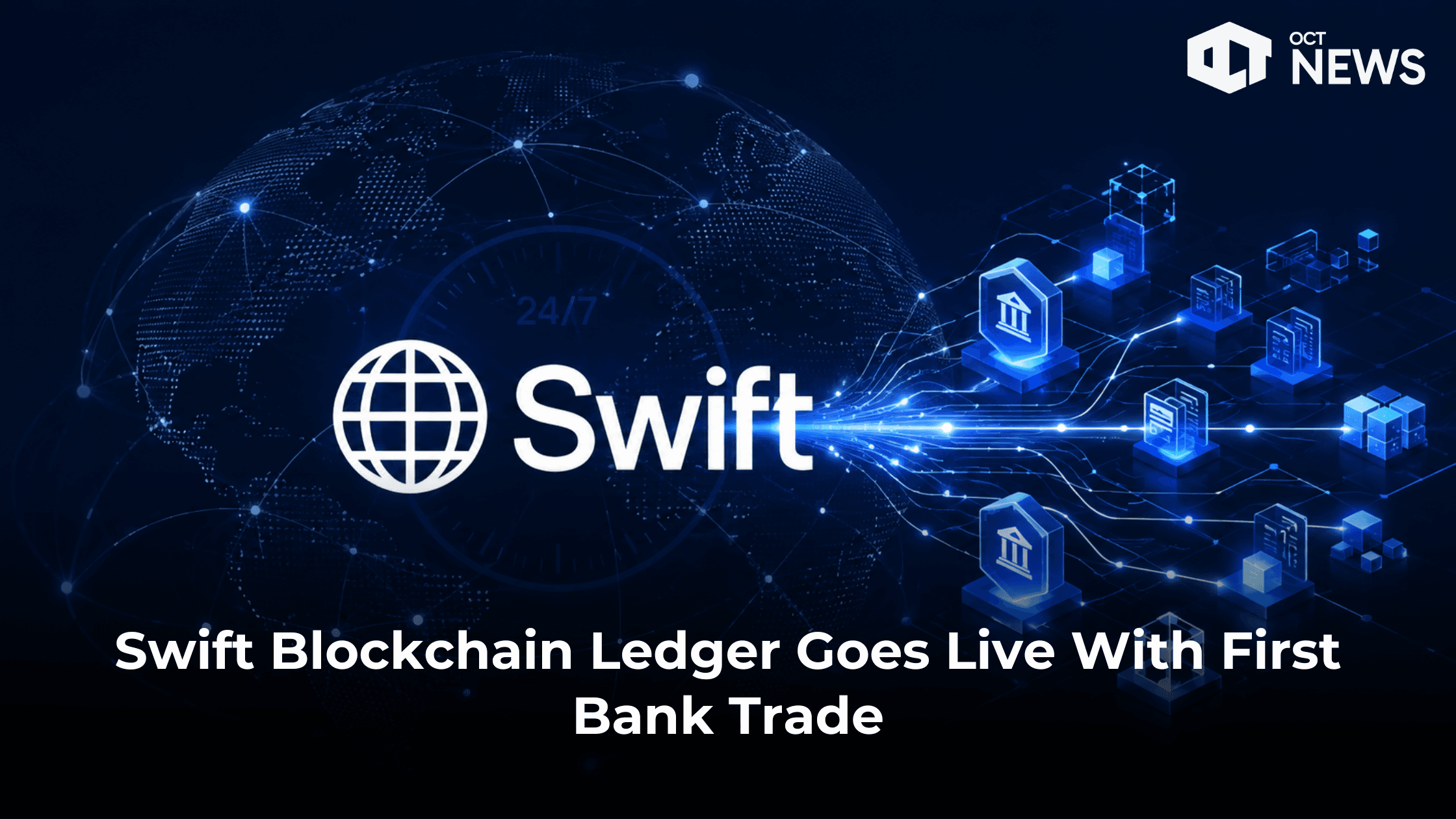
Swift Blockchain Ledger enables 24/7 tokenised deposit payments between banks while keeping final settlement on existing financial rails.

Author: Kritika Gupta
21st August 2026- Swift is taking a victory lap. The network posted a promotional message about its blockchain ledger. The timing was deliberate. Two days earlier, HSBC and Standard Chartered had run the first live transaction on the Swift blockchain ledger.
High Signal Summary For A Quick Glance

Copper Spike Transport
@copper_spike

@swiftcommunity U guys must really be scared with all the ads...u will be forgotten fast when you mimic the dinosaurs going extinct. You had many years to upgrade and chose not to. You will not be missed. Nobody will miss the bankers when they are gone...nobody.
Building on what already works. Extending it to support a tokenised future. We’re extending Swift’s infrastructure, standards, and expertise to enable a tokenised future, supporting real-time, 24/7 digital payments. This builds on the scale, reliability, and resilience that https://t.co/HI4hB6BoxS
11:56 AM·Aug 21, 2026

GEMINI
@Hasnankhan1Khan
@swiftcommunity Extending Swift’s trusted infrastructure to enable a tokenized future is a major step. To fully maximize cross-border efficiency and interoperability, integrating enterprise blockchain solutions like Ripple warrants serious consideration.
Building on what already works. Extending it to support a tokenised future. We’re extending Swift’s infrastructure, standards, and expertise to enable a tokenised future, supporting real-time, 24/7 digital payments. This builds on the scale, reliability, and resilience that https://t.co/HI4hB6BoxS
11:30 AM·Aug 21, 2026

insight.eth | Financial ENS broker
@insightens
@swiftcommunity “Building on what already works” may be the most important part. Institutional adoption probably doesn’t require throwing away existing financial infrastructure. It requires making it compatible with tokenised assets, 24/7 settlement and programmable payments. That’s how
Building on what already works. Extending it to support a tokenised future. We’re extending Swift’s infrastructure, standards, and expertise to enable a tokenised future, supporting real-time, 24/7 digital payments. This builds on the scale, reliability, and resilience that https://t.co/HI4hB6BoxS
10:40 AM·Aug 21, 2026
High attention and emotional sentiment detected.
The message was simple. Swift wants to build on what already works. Instead of chasing public blockchains, the network is extending its existing rails into tokenised deposits. So the shared ledger acts as an orchestration layer, not a replacement for settlement.
Today, Swift mostly moves messages, not money. Banks send standardised payment instructions, now largely on the ISO 20022 standard. Actual settlement happens elsewhere, through correspondent accounts or real-time gross settlement systems.
The Swift blockchain ledger adds a new layer on top. Banks post funding commitments as tokenised deposits, which are digital versions of commercial bank money. Then the ledger records, validates, matches, and nets those obligations in near real time. As a result, banks share a single view of who owes what, around the clock.
This means money can move on weekends and overnight. Corporate and treasury teams get a 24/7 experience for cross-border payments. Still, the ledger only coordinates commitments. It does not issue a common token or move value on a public chain.
On 19 August 2026, HSBC and Standard Chartered executed the first live interbank transaction on the ledger. HSBC used its Tokenised Deposit Service. Standard Chartered used its own tokenised-deposit infrastructure. The ledger then matched and netted the obligations between them.
According to the joint release, final settlement stayed on existing rails. The two banks did not disclose the transaction value, the currency, or any customer details. So the milestone proves the plumbing works, even if the scale stays unclear.
Lewis Sun, head of digital currencies at HSBC, called it a landmark moment for tokenised deposits. He said bank-issued digital money can now move between institutions while keeping regulatory oversight intact. Meanwhile, Mark Willis of Standard Chartered framed it as a step toward always-on financial services.
Key milestones related to this development
Swift starts testing CBDC interlinking and tokenised-asset interoperability across emerging digital-money networks.
Swift expands sandbox work around CBDCs, delivery-versus-payment, FX and connectivity between tokenised-asset environments.
Swift unveils its blockchain-based shared-ledger project, targeting 24/7 cross-border payments using bank-issued tokenised deposits.
The ledger design is completed, implementation begins on Hyperledger Besu, and 17 banks are named for initial use.
HSBC and Standard Chartered complete the first live tokenised-deposit transaction through Swift’s blockchain-based ledger.
Swift highlights 24/7 digital payments and tokenised finance as the next extension of its existing global financial infrastructure.
Swift is expected to expand beyond the controlled phase with more banks and functionality, while full production dates remain unconfirmed.
Here is the part critics keep circling. The Swift blockchain ledger does not settle payments. It orchestrates them. Final settlement still runs through RTGS systems, correspondent banking, or other agreed rails.
That design is deliberate. Banks keep control of their own assets, keys, funding, and compliance frameworks. Because of that, the ledger fits inside existing regulation rather than working around it. So Swift stays the trusted middle layer, not a new settlement network.
Thierry Chilosi, Swift’s chief business officer, put it plainly in July. “We are extending the trust and stability of established finance into the frontiers of digital money,” he said. In short, the pitch is coexistence, not disruption.
Swift today vs tokenised vision vs crypto-native rails
Under the hood, the ledger runs on Hyperledger Besu, a permissioned and EVM-compatible client. Swift operates the shared layer. The banks retain their keys and their funds. Swift first built a conceptual prototype with Consensys, which it announced back in September 2025.
The project moved quickly after that. Design work finished by March 2026, and MVP implementation began soon after. Then, on 9 July 2026, Swift declared the ledger ready for initial use. Seventeen banks across six continents signed on for the controlled pilot.
Those banks include Citi, UBS, BNP Paribas, Wells Fargo, MUFG, and DBS. Notably, the ledger is separate from Swift’s earlier Chainlink pilots. It also differs from its past CBDC connector trials. For now, no public-chain settlement component is named.
Reaction has split along familiar lines. Reuters and Bloomberg framed the launch as Swift’s answer to stablecoins. CoinDesk stressed that tokenised deposits and stablecoins can coexist. Meanwhile, TradFi voices see validation for regulated tokenisation at global scale.
Crypto-native skeptics are less impressed. Because settlement stays off-chain, many call the ledger a fancy messaging upgrade. On X, XRP supporters keep demanding public-chain integration instead. The official post drew roughly 110,000 views, yet the replies skewed critical.
Markets, for their part, barely blinked. Around the announcement, ETH still traded near $2,300 to $2,400 and LINK sat around $11. No clear move tied back to the Swift news. Analysts largely read the ledger as incremental infrastructure, not a catalyst for public-chain tokens. None of this is financial advice.
The controlled pilot is only the start. Swift says functionality and availability will expand after this phase. The network also points to programmable money and agentic commerce as longer-term goals. This effort maps neatly onto the G20 targets for faster, cheaper cross-border payments.
Context helps here too. Swift first floated the concept at Sibos in September 2025, with more than 30 institutions involved. Nine months later, the ledger went live for its controlled pilot. That pace is fast for an industry that usually moves slowly.
Still, big questions stay open. Swift has not shared transaction volumes, a full production timeline, or throughput and cost metrics. It is also unclear whether the ledger will ever support stablecoins, CBDCs, or public-chain connectivity. For now, the Swift blockchain ledger has cleared its first real test. The next proof will be scale.
Our Crypto Talk is committed to unbiased, transparent, and true reporting to the best of our knowledge. This news article aims to provide accurate information in a timely manner. However, we advise the readers to verify facts independently and consult a professional before making any decisions based on the content since our sources could be wrong too. Check our Terms and conditions for more info.


Robinhood Buys First $25M in Bitcoin for Corporate Treasury
Walrus Console Goes Live as Managed Layer for AI Data
Solana Goes Live With x402 Batch Payments for AI Agents
WLFI App Ready to Release, Folkman Says at Token2049
Robinhood Buys First $25M in Bitcoin for Corporate Treasury
Walrus Console Goes Live as Managed Layer for AI Data
Solana Goes Live With x402 Batch Payments for AI Agents
WLFI App Ready to Release, Folkman Says at Token2049