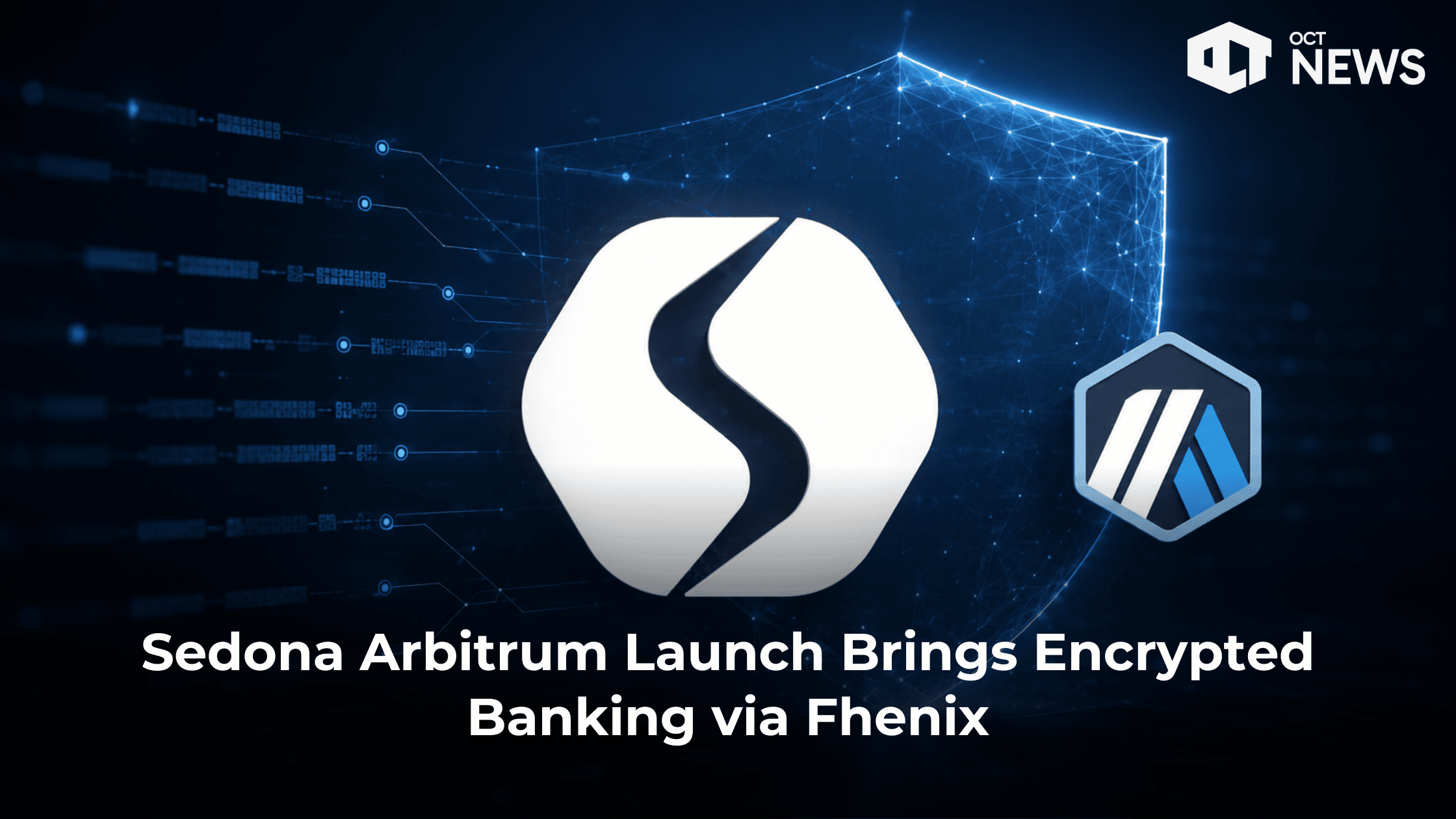
SedonaFi Arbitrum: Learn how Sedona plans to use Fhenix CoFHE for private, self-custodial trading and encrypted banking on Arbitrum.

Author: Kritika Gupta
23rd July 2026- Sedona announced recently that it is launching on Arbitrum. The privacy-focused neobank plans to bring encrypted banking to the layer-2 network through Fhenix’s encryption stack. According to the team, users get access to the “programmable economy” while their finances stay “completely private.”
High Signal Summary For A Quick Glance

Tilt Protocol
@tiltprotocol

@arbitrum Programmable economy finally scales without the surveillance tax. Game changer.
Private finance coming to Arbitrum 🔜 https://t.co/LxeCzMzqyK
11:49 AM·Jul 23, 2026

𝐕𝐑
@0xVeepul
@arbitrum arbitrum levels up with sedona’s private finance tech
Private finance coming to Arbitrum 🔜 https://t.co/LxeCzMzqyK
11:20 AM·Jul 23, 2026
The Sedona Arbitrum launch is an app deployment announcement, not a full public go-live. The official site at sedona.fi remains a waitlist. Several features are still marked “coming soon.” So the news marks a stack milestone rather than an open product.
Sedona describes itself as a trading-first neobank. The app aims to let users trade, earn yield, and later spend through a planned card. Meanwhile, balances, trades, transfers, and positions stay private by default.
The project also stresses that it stays self-custodial and EVM-compatible. In other words, users keep control of their own keys. Sedona pitches the result as a simple, Venmo-style experience on-chain. The goal is to hide financial activity from public view.
So far, one person is publicly tied to the build. Tyler, who posts as @zkteey and lists his location as Dubai, is the only individual consistently linked to Sedona. No formal team page or founders list has surfaced.
The privacy layer comes from Fhenix and its CoFHE coprocessor. CoFHE stands for Confidential Fully Homomorphic Encryption. In short, fully homomorphic encryption lets a system compute on encrypted data without ever decrypting it.
For Sedona users, that design keeps sensitive details hidden. Balances, portfolio positions, trade data, and even AI-agent spending limits stay encrypted. Meanwhile, the heavy math runs off-chain in the coprocessor. Results then get verified on-chain.
Fhenix laid out the plan in a partnership thread on 16 July. According to Fhenix, Sedona users get “encrypted balances,” “private portfolio positions,” and “self-custody from day one.” The firm added that “privacy is the default, literally.”
Sedona has pushed a similar message. In a 17 July post, the team wrote that traditional banks kept money private by policy. “Sedona encrypts it mathematically,” it said. “No one can see it, not us, not anyone.”
Sedona’s positioning within the existing on-chain privacy field
Sedona’s stack has shifted this year. The @SedonaFi account went live on 18 December 2025. Then, on 28 April 2026, the project introduced itself as a neobank built on SeismicSys. That network is a privacy L1 that uses secure hardware enclaves.
By mid-July, the messaging had moved to Arbitrum and Fhenix. Between 17 and 21 July, Sedona posted a stack diagram placing itself above Fhenix and Arbitrum. Instead of enclave-based encryption, the app now leans on FHE. The team has not published a detailed account of the migration. So the reason for the switch remains unclear.
For context, these approaches sit in a crowded privacy field. TEE-based systems like Seismic compete with ZK tools such as Railgun. FHE projects like Fhenix and Zama add a third camp. Fhenix has reportedly raised more than $22 million to build its coprocessor.
Key milestones in Sedona’s path to launch
Sedona’s official X account goes live. No confirmed founding date, funding round, or complete team disclosure is available.
Sedona presents itself as a trading-first private neobank built on Seismic and opens its public waitlist.
Sedona promotes private trading through the Seismic testnet while its yield and card features remain under development.
Sedona has not published confirmed smart-contract audits, contract addresses, deployment transactions, or security reports.
Fhenix reveals that Sedona will use CoFHE to support encrypted balances, private positions, and confidential spending controls on Arbitrum.
Sedona announces that it is launching on Arbitrum, although a full public mainnet release and live contracts remain unconfirmed.
The next milestone could include wider beta access, verified contracts, audits, and live product metrics. No token launch has been announced.
Several key details are still missing. No token exists, so there is no ticker, contract address, or supply. As a result, there is no price, market cap, or trading volume to track.
On-chain evidence is thin too. No verifiable Sedona contracts, deployment transactions, DefiLlama page, or Dune dashboards were found. The marketing site claims “every contract verified on-chain.” Yet it links no addresses.
Privacy claims also deserve caution. FHE remains computationally heavy, even with an off-chain coprocessor. Besides, the outer transaction shell still shows on a public L2. Compliance also tends to need selective-reveal tools that authorities can compel. No public audit of Sedona’s privacy layer has appeared.
Early reaction has been mild. The launch tweet drew roughly 14 likes and about 3,300 views at capture. That is a modest showing for a launch post.
Still, some Arbitrum voices engaged. The official Arbitrum account replied, “did somebody say programmable?” Another account said it loved the sound of the plan. Meanwhile, no tier-1 outlet such as CoinDesk or The Block has covered Sedona directly.
Sentiment among privacy watchers leans curious rather than hyped. For now, reactions largely echo the official “private and programmable” framing. No organized skepticism has appeared either.
The near-term test is a working product. Private beta access for waitlist users was referenced as imminent in early July. So users should watch for a live app, deployed contracts, and any audit reports.
The bigger questions stay open. Will Sedona ship a token? Will the Seismic integration continue? And how will the FHE layer hold up under real load? Until contracts appear on-chain, the Sedona Arbitrum launch remains a promise more than a finished product.
Readers can track updates through Sedona’s official channels and the Fhenix CoFHE docs. This article is informational only and not financial advice.
Our Crypto Talk is committed to unbiased, transparent, and true reporting to the best of our knowledge. This news article aims to provide accurate information in a timely manner. However, we advise the readers to verify facts independently and consult a professional before making any decisions based on the content since our sources could be wrong too. Check our Terms and conditions for more info.


Arbitrum