Robinhood Chain transactions crossed 100 million on or around July 22, just three weeks after the Ethereum Layer-2 went live.

Author: Sahil Thakur
Steady attention without excessive speculation.
25th July 2026 – Robinhood Chain transactions crossed 100 million on or around July 22, just three weeks after the Ethereum Layer-2 went live. CEO Vlad Tenev then called it the fastest EVM chain ever to reach that mark.
High Signal Summary For A Quick Glance

Chill
@ChillTRD

@vladtenev RH chain is goated 🔥
Robinhood Chain is the fastest EVM chain to hit 100M txns
03:20 AM·Jul 25, 2026

Artemis
@artemis
@vladtenev Can confirm @vladtenev! https://t.co/BJqpAeHOdo https://t.co/elWXCMlgN8

Robinhood Chain is the fastest EVM chain to hit 100M txns
02:53 AM·Jul 25, 2026

RobinHub
@RobinHub_xyz
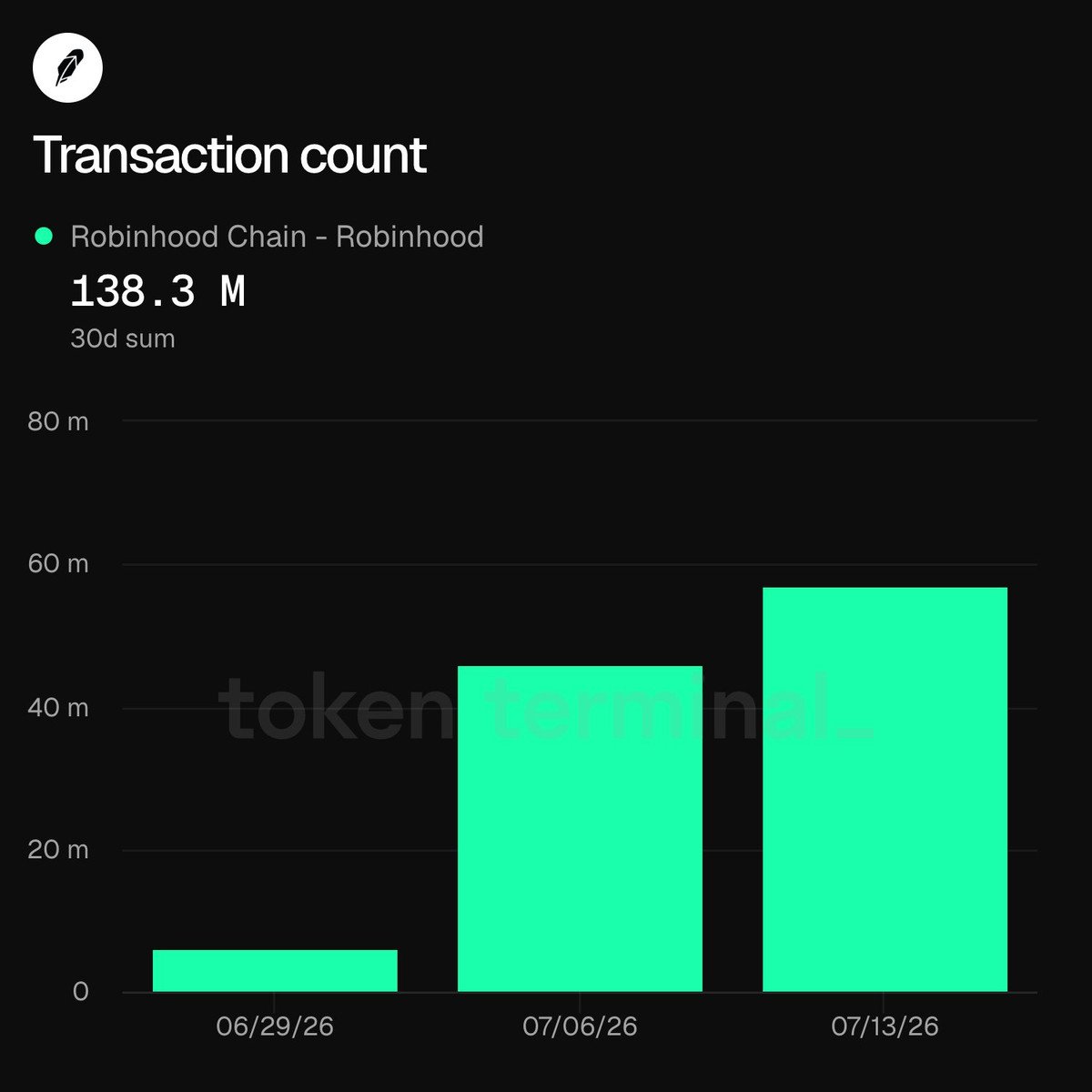
BREAKING: Robinhood Chain just crossed 100M+ cumulative transactions in 3 weeks. That makes it one of the fastest-growing dedicated blockchains. According to the good tech: @arbitrum And bullish on Robinhood Chain. https://t.co/oE3CKq3ZGf
05:00 AM·Jul 24, 2026
Tenev shared the claim on X on July 25, writing that “Robinhood Chain is the fastest EVM chain to hit 100M txns.” The network launched its public mainnet on July 1, so the milestone landed in roughly 21 to 22 days.
The counter has kept climbing since then. According to the chain’s Blockscout explorer, total transactions stood near 154.87 million by July 25, alongside about 4.08 million addresses.
Block times sit at roughly 0.1 seconds, so the network clears blocks almost instantly. Daily volume has also run in the millions, with about 7.37 million transactions logged on the partial day of the latest crawl.
For context, most EVM peers moved far slower. ZetaChain’s Universal EVM reached 100 million transactions in about 90 days, and Arbitrum One took years to build its much larger totals.
That gap is the heart of Tenev’s pitch. A three-week run to nine figures is unusual, and it signals both heavy demand and the low friction of a near-zero-fee chain.
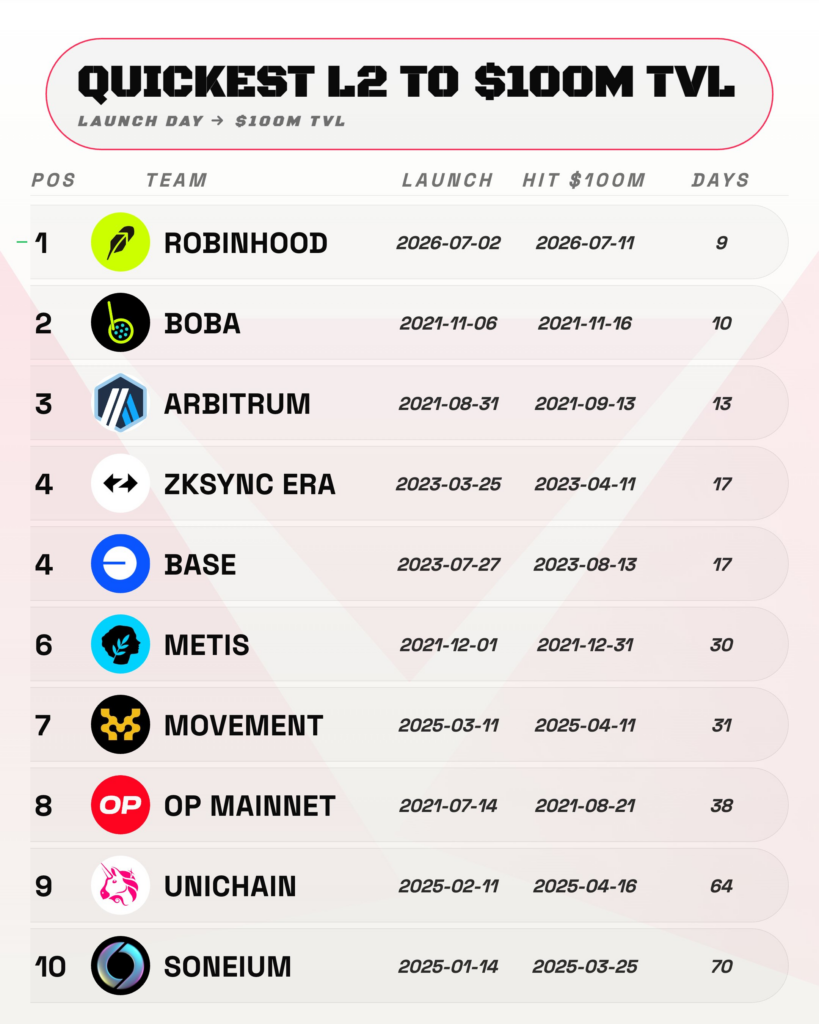
Robinhood was also the fastest blockchain to reach $100M TVL before this.
The three-week figure is real, and Arbitrum backed it publicly. On July 23, the Arbitrum account posted that Robinhood Chain “has hit 100M+ cumulative transactions in just three weeks.”
Still, the “fastest ever” label deserves a caveat. No public ranking independently verifies the claim against every minor or short-lived EVM chain, so it rests mainly on Tenev’s word.
Major chains do support the spirit of the claim, though. Base, for example, needed months to reach comparable cumulative volumes after its 2023 launch, and none of the big L2s matched a three-week pace.
The fast start did not come from nowhere. Robinhood opened a public testnet on February 10, 2026, and Tenev said it logged roughly 4 million transactions in its first week.
The company also spent 2025 building crypto infrastructure. Its Bitstamp acquisition closed around June 2025 for roughly $200 million, which added global licenses and institutional plumbing ahead of the chain.
By the July 1 mainnet, that groundwork was ready. As a result, Robinhood Chain transactions scaled quickly once retail users and DeFi apps arrived.
Robinhood built the chain for tokenized stocks and real-world assets. So far, though, memecoins have driven most of the early traffic.
The chain has briefly looked more like a memecoin venue than an RWA settlement layer.
The pattern matters because near-zero fees make raw counts easy to inflate. Bots, launchpads, and automated agents can each fire thousands of transactions for fractions of a cent, so the 100 million figure proves capacity more than sticky adoption.
Robinhood Chain is a permissionless Layer-2 built on Arbitrum’s Orbit stack, also called Dedicated Blockchains. It settles to Ethereum and uses ETH for gas.
The chain posts its data to Ethereum through blobs, so it inherits the base layer’s security while keeping fees low. Launch partners included Uniswap, Morpho, Chainlink, Alchemy, and BitGo, according to Robinhood’s newsroom.
The support article lists chain ID 4663 and a public RPC endpoint for developers. Because the stack mirrors Arbitrum’s tooling, existing EVM apps can deploy with little rework, which helps explain the fast ramp in usage.
Johann Kerbrat, Robinhood’s SVP and general manager of crypto, framed the July 1 launch as a bridge between traditional finance and DeFi. He said the goal is “expanding financial ownership to every corner of the globe.”
The activity has also rippled into token prices. Arbitrum’s ARB token jumped about 19% around July 9, when on-chain volume on the network spiked.
That move ties back to the Orbit model, since secondary reports describe a revenue-share arrangement of roughly 10% of net fees. Meanwhile, total value locked has been volatile, with DefiLlama pegging it near $324 million while some Dune dashboards show higher figures.
Robinhood’s own stock, HOOD, climbed roughly 8% around the launch before trading mixed. This article is not financial advice, and readers should treat early-stage metrics and hype-driven price moves with care.
The next test is durability. Raw Robinhood Chain transactions prove the network can scale, but sustained value depends on whether tokenized stocks and RWAs gain real traction.
For now, the chain sits at more than 154 million transactions and rising, with hype and memecoins fueling much of the pace. Watch the Blockscout explorer and DefiLlama in the coming weeks to see whether organic, product-driven usage follows the early numbers.
Our Crypto Talk is committed to unbiased, transparent, and true reporting to the best of our knowledge. This news article aims to provide accurate information in a timely manner. However, we advise the readers to verify facts independently and consult a professional before making any decisions based on the content since our sources could be wrong too. Check our Terms and conditions for more info.