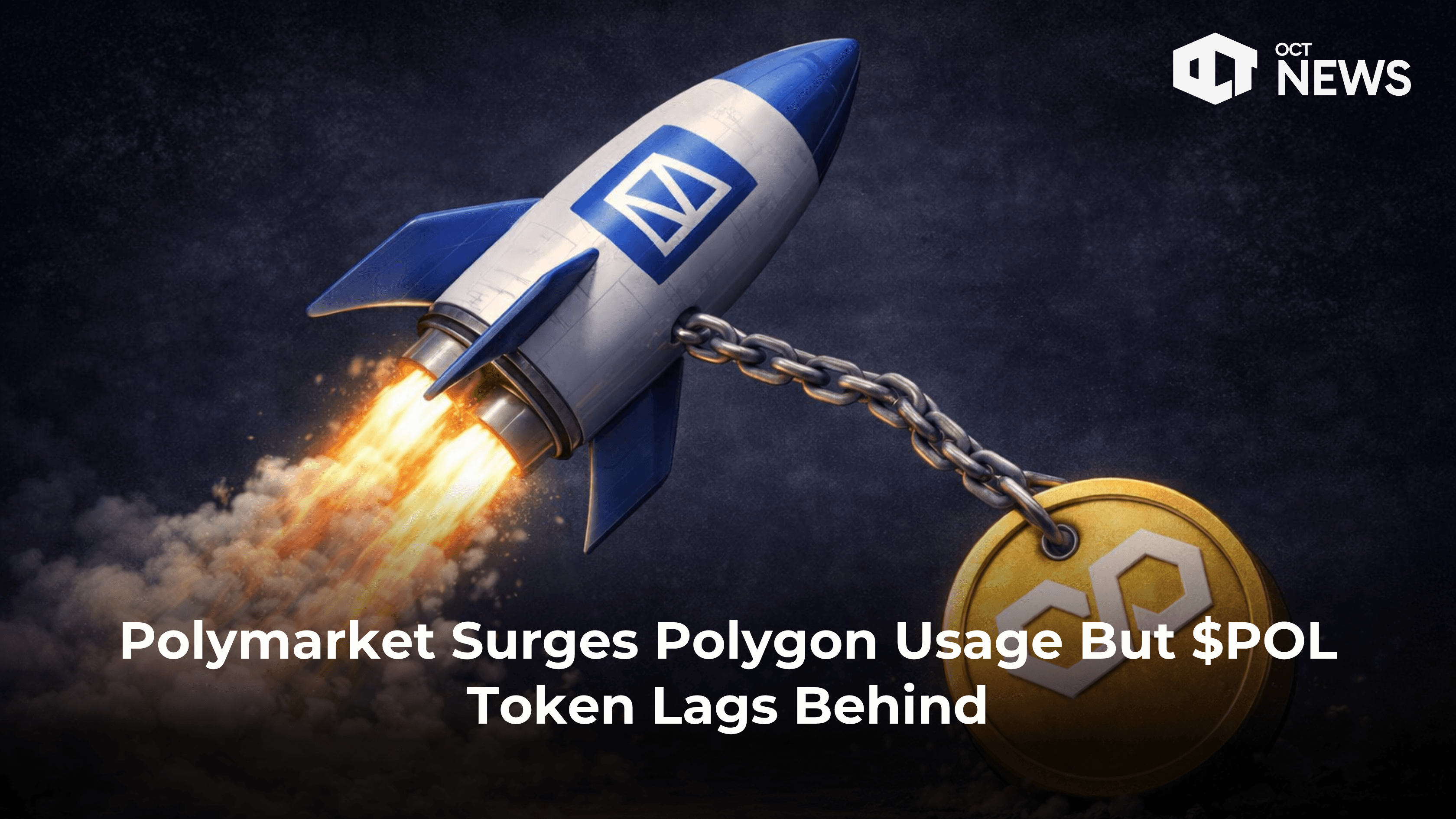
Polymarket surges Polygon usage, driving activity higher, but $POL lags behind, highlighting weak value capture and a growing disconnect.

Author: Akshay
Steady attention without excessive speculation.
March 31, 2026. Polymarket surges Polygon usage as new data shows the platform now accounts for over 77% of gas usage and more than 54% of transactions on the network. Despite this surge, which has generated over $1.7 million in protocol fees this year, the $POL token remains under pressure, trading near multi-month lows and failing to reflect rising on-chain demand.
High Signal Summary For A Quick Glance

Stacy Muur
@stacy_muur

Polymarket said back in December that they wanted to leave Polygon and build their own Ethereum L2. No chain has shipped yet, no date given, but the intent is out there. The dependency since then has only gotten worse. March 2026 numbers: → 77% of Polygon's gas consumption → https://t.co/Tb1UbbvTxu
seems a crazy chart to me that no one talks about - Polygon's recent usage is entirely surged by Polymarket, who has claimed to leave the chain in the future... is this a pivotal moment for Polygon to figure out a deal with Polymarket? (🎙️interview coming with JW on https://t.co/78akTxm18l https://t.co/KHZgd9f6Ln
07:28 AM·Mar 30, 2026

Simon Dedic
@sjdedic
Polymarket usage up 100x, Polygon price down -90% This tells us 3 things: 1) as long as you’re building sth with proper product market fit and abstracted UX, the ecosystem shouldn’t matter 2) underlying chains don’t accrue the value of the applications built on top 3) infra https://t.co/HEoE3fePxI

07:05 AM·Mar 30, 2026
Polymarket’s rapid growth continues to boost on-chain activity across Polygon. Prediction markets now drive millions of transactions and account for a significant share of network fees, highlighting the scale of this expansion. The platform gained momentum after the 2024 election cycle and introduced trading fees in early 2026, increasing revenue and token burns. This growth further demonstrates Polygon’s ability to support high-volume applications while showcasing the impact of Polymarket’s activity on the network.
Polymarket’s rapid growth has boosted Polygon’s on-chain activity. Prediction markets now drive millions of transactions and a large share of network fees. The platform expanded after the 2024 election cycle. It also introduced trading fees in early 2026. This increased revenue and token burns. It further reinforced Polygon’s ability to handle high-volume applications at scale.
This dynamic has occurred multiple times since 2024, particularly during Polymarket’s surge in the U.S. election cycle when billions in volume drove activity on Polygon but generated minimal fee capture. Similar patterns continued through 2025, including spikes in transactions and DeFi activity without meaningful upside for $POL, and again in December 2025 when network usage hit multi-year highs while the token remained near cycle lows.
Each cycle has followed a similar outcome, with short-term optimism and occasional price spikes followed by quick reversals. While on-chain metrics improved, structural factors such as low fees, value concentration at the app layer, and reliance on a single dominant application limited sustained token growth. This recurring pattern reinforces that increased usage alone has not translated into long-term price support for $POL.
Polymarket-driven usage vs $POL value capture across cycles and L2 peers
Previous episodes show a consistent pattern where strong on-chain activity led to short-term rallies in $POL, followed by quick reversals. In January–February 2026, fee spikes and token burns triggered gains of roughly 40–80%, supported by record activity and brief moments where Polygon outpaced Ethereum in daily fees. However, these rallies were short-lived, with prices drifting back toward lows by late February and March despite continued usage growth.
Sentiment followed a similar cycle, shifting from initial optimism around “real usage” to renewed skepticism about value capture. Discussions increasingly focused on structural issues such as app-layer dominance and dependency risks, especially after Polymarket signaled plans for its own Layer-2. While these cycles prompted tokenomics adjustments and ecosystem diversification efforts, the overall trend remained unchanged, reinforcing a recurring loop of hype, reversion, and incremental fixes.
Near-term focus will be on whether upcoming upgrades can improve value capture for $POL. The most immediate catalyst is the PIP-85 proposal, expected to move toward voting in the coming weeks, alongside planned updates such as fixed pricing and dynamic fee adjustments likely in April 2026. Broader developments under Polygon’s payments-focused roadmap and potential announcements at major April events will also be key signals for ecosystem expansion beyond Polymarket-driven activity.
However, risks remain around execution and dependency. If governance changes fail to increase staking yields or fee capture, the current disconnect may persist, especially given Polymarket’s dominant share of network activity. Additional concerns include potential regulatory pressure on prediction markets, uncertainty around Polymarket’s future on Polygon, and broader market sentiment. Strong delivery on upgrades and diversification could shift the narrative, while delays or continued reliance on a single app may reinforce the existing cycle of usage growth without token upside.
Our Crypto Talk is committed to unbiased, transparent, and true reporting to the best of our knowledge. This news article aims to provide accurate information in a timely manner. However, we advise the readers to verify facts independently and consult a professional before making any decisions based on the content since our sources could be wrong too. Check our Terms and conditions for more info.



POL (ex-MATIC)