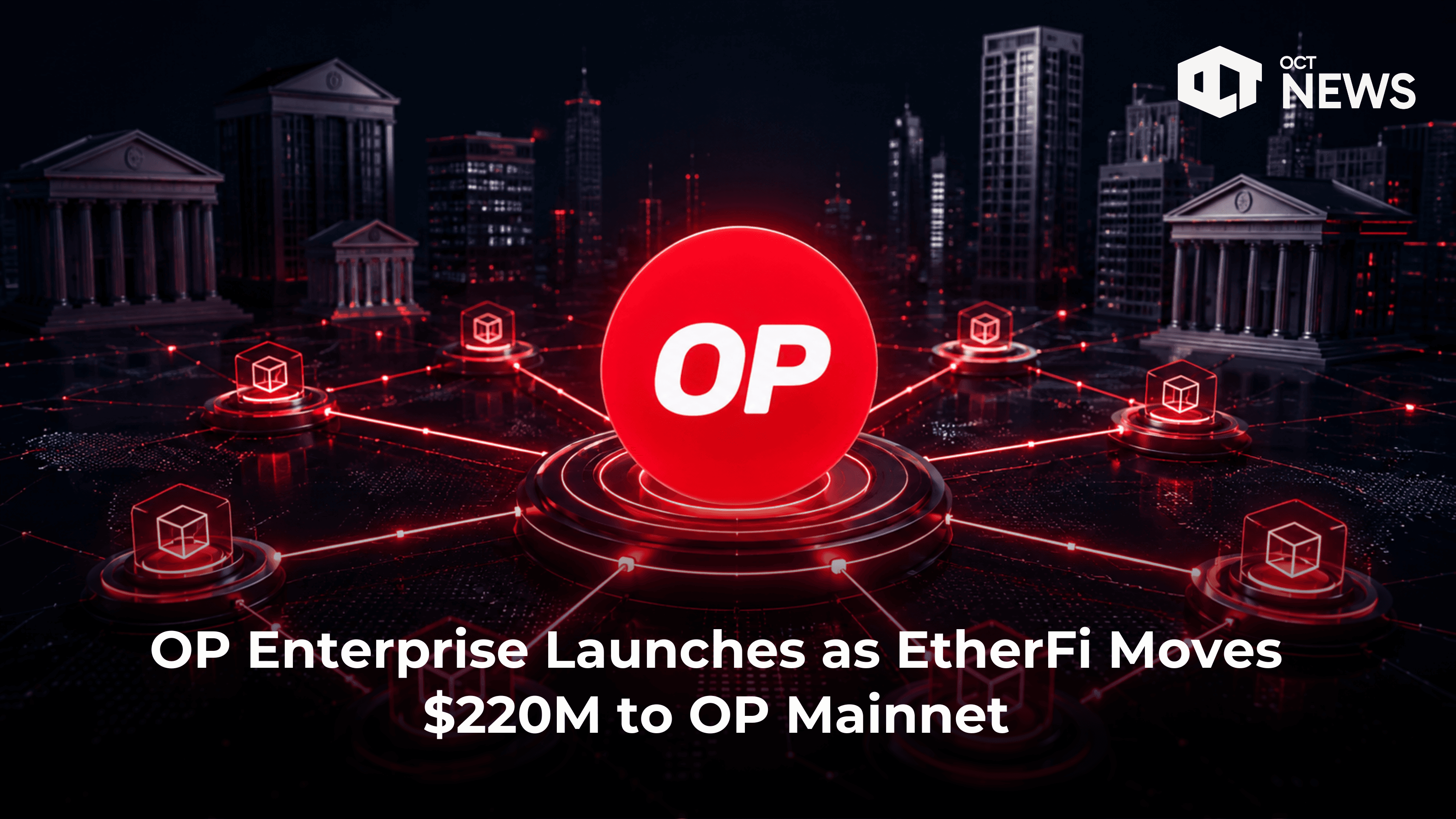
OP Enterprise launches as Optimism expands institutional blockchain infrastructure, while EtherFi migrates over $220M TVL to OP Mainnet.

Author: Akshay
13th May 2026. Optimism has launched OP Enterprise, a managed blockchain infrastructure product that lets institutions deploy and operate dedicated OP Stack chains. Meanwhile, EtherFi completed a $220M+ TVL migration from Scroll to OP Mainnet with zero downtime, marking one of the largest L2 migrations to date.
High Signal Summary For A Quick Glance

cexscan
@cexscan

@MessariCrypto @Optimism @EtherFi lol okay, so they're pushing the enterprise side hard. https://t.co/Gg4vBG63HM ditching LSTfi for their own chain on OP just means they're betting on that infra. gotta watch if this unlocks real volume or just more sideways chop before the next push. my eyes are still on the
State of the OP Stack Q1 2026 is live Key Update: @Optimism shifted toward institutional adoption with the launch of OP Enterprise, a managed infrastructure product for institutions to run dedicated chains without in-house ops. @EtherFi migrated its Cash product to OP Mainnet https://t.co/G8cvshrOCA
01:26 PM·May 13, 2026
OP Labs, the team behind the OP Stack, announced OP Enterprise on January 29, 2026. The product targets fintech companies, exchanges, and financial services firms seeking dedicated blockchain infrastructure without building an operations team from scratch.
Meanwhile, a new Messari “State of the OP Stack Q1 2026” report published today frames the launch as part of Optimism’s broader institutional pivot. The timing also aligns with rising enterprise demand for production-grade Layer 2 infrastructure.
The product comes in three tiers. All three include managed L1 bridge contracts, public RPC endpoints supporting up to 5 billion requests per month, a block explorer, a chain status page, priority security patches, and 15-minute P1 incident response.
The Fully Managed tier is the flagship. OP Labs hosts and operates the entire chain end-to-end. That includes 24/7 monitoring, upgrades, security operations, and a 99.99% uptime SLO. Fully Managed clients also receive 160 engineering hours in their first year.
The Self Managed tier targets institutions that want to run their own sequencer and infrastructure. They still get full protocol support, engineering access, and priority patches from OP Labs.
The third tier, OP Mainnet, lets enterprises start on the public OP Mainnet with enterprise-grade support. It includes a migration path to a dedicated chain when the business is ready.
According to The Defiant, most OP Enterprise customers reach testnet in 4 to 8 weeks. Production deployment follows in 8 to 12 weeks. Traditional blockchain launches typically take 6 to 12 months or longer.
Pricing has not been disclosed publicly. Instead, each enterprise negotiates custom SLAs and support hours directly with Optimism. Early OP Enterprise customers include Unichain, developed by Uniswap Labs, and Celo.
“OP Enterprise is a major focus for us in 2026,” said Jing Wang, Co-Founder of Optimism and CEO of OP Labs, in a PR Newswire statement. “We have active engagements across fintech, exchanges, payments, and financial services.”
Wang added that “the direction is clear: the OP Stack is becoming the standard for the next generation of financial systems.” He also posted on X, calling OP Enterprise “your blockchain, your revenue, enterprise guarantees.”
The strongest validation for OP Enterprise came from EtherFi. On February 18, 2026, the non-custodial crypto neobank announced plans to migrate its Cash product from Scroll to OP Mainnet.
The migration was completed on April 16, 2026, with zero downtime. As part of the move, EtherFi brought approximately 70,000 active debit cards, 300,000 accounts, and more than $220 million in TVL to the Optimism ecosystem.
EtherFi Cash is a digital cash account paired with a debit card. Users can deposit crypto, earn yield, and spend directly through the card, while all transactions settle onchain. According to EtherFi, the product selected OP Mainnet because of its sub-250ms finality through Flashblocks, median fees of $0.00001, 99.99% uptime, and access to established liquidity.
The OP Stack is an open-source, MIT-licensed toolkit for building Ethereum-compatible Layer 2 optimistic rollups. In practice, it functions as a forkable framework, similar to how Red Hat distributes Linux. As a result, institutions can customize and deploy their own dedicated chains while still maintaining compatibility with Ethereum infrastructure.
A “dedicated chain” runs its own sequencer, gas token, and fee revenue. As a result, the institution keeps operational control and captures the associated revenue. By contrast, deploying on a shared rollup like OP Mainnet means transaction fees flow to the public sequencer instead.
“Managed infrastructure” means OP Labs handles the hard parts: sequencer uptime, protocol upgrades, monitoring, security operations, and vendor integrations. Institutions get a production blockchain delivered like a SaaS product, according to Yahoo Finance.
The Superchain now includes over 30 OP Stack chains. Combined TVL across the ecosystem reaches several billion dollars, with OP Mainnet alone holding approximately $1.67 billion, according to DefiLlama.
By 2025, the Superchain had grown to more than 50 live chains and $6.1 billion in cumulative TVL. Several major upgrades helped drive that expansion. For example, Bedrock introduced a modular architecture in 2023, while Ecotone reduced costs in 2024 through EIP-4844 integration. Later, Fjord and subsequent 2025 upgrades further improved performance and scalability across the ecosystem.
OP Enterprise vs Arbitrum Orbit vs zkSync Elastic Chain vs Polygon CDK (Q1 2026)
OP Mainnet trails Base in some L2 metrics, but OP Enterprise targets a different market. The product competes with Arbitrum Orbit and zkSync managed offerings, though no public benchmarks exist for direct comparison.
The OP token saw modest volatility following the January 29 announcement. As of May 2026, OP trades at approximately $0.16 with a 24-hour trading volume near $72 million, according to CoinGecko data. Meanwhile, the token gained roughly 26% over the past seven days amid broader momentum across the Layer 2 sector.
The price movement may reflect wider sector trends rather than OP Enterprise specifically. Investors should conduct their own research before making any decisions. This is not financial advice.
Several key details are still missing. Optimism has not revealed pricing, revenue-share terms, or exclusivity arrangements. The number of enterprise customers beyond Unichain, Celo, and EtherFi is unknown.
No public benchmarks compare OP Enterprise directly to Arbitrum Orbit or zkSync managed services. The core OP Stack remains open-source under MIT license, so there is no vendor lock-in. Still, the managed service layer introduces a traditional business relationship on top of open-source infrastructure.
Some commentators on X and LinkedIn have raised questions about the shift from a “permissionless Superchain” vision to managed enterprise services. The dominant sentiment, though, frames this as pragmatic maturation rather than a retreat from decentralization principles.
The pipeline appears strong. In particular, Wang referenced active engagements across fintech, exchanges, payments, and financial services. Meanwhile, EtherFi’s successful migration now serves as a live case study for prospective enterprise customers.
Additionally, the Messari Q1 2026 report published by analyst Austin Weiler provides deeper quantitative context around OP Stack adoption trends. As a result, enterprises evaluating Layer 2 infrastructure now have a clear managed option from the team that originally built the stack.
For institutions seeking Ethereum security without the operational burden, OP Enterprise may represent one of the most direct paths to production deployment. However, the key question remains whether enterprise adoption can accelerate quickly enough to justify Optimism’s broader investment in managed services.
Our Crypto Talk is committed to unbiased, transparent, and true reporting to the best of our knowledge. This news article aims to provide accurate information in a timely manner. However, we advise the readers to verify facts independently and consult a professional before making any decisions based on the content since our sources could be wrong too. Check our Terms and conditions for more info.