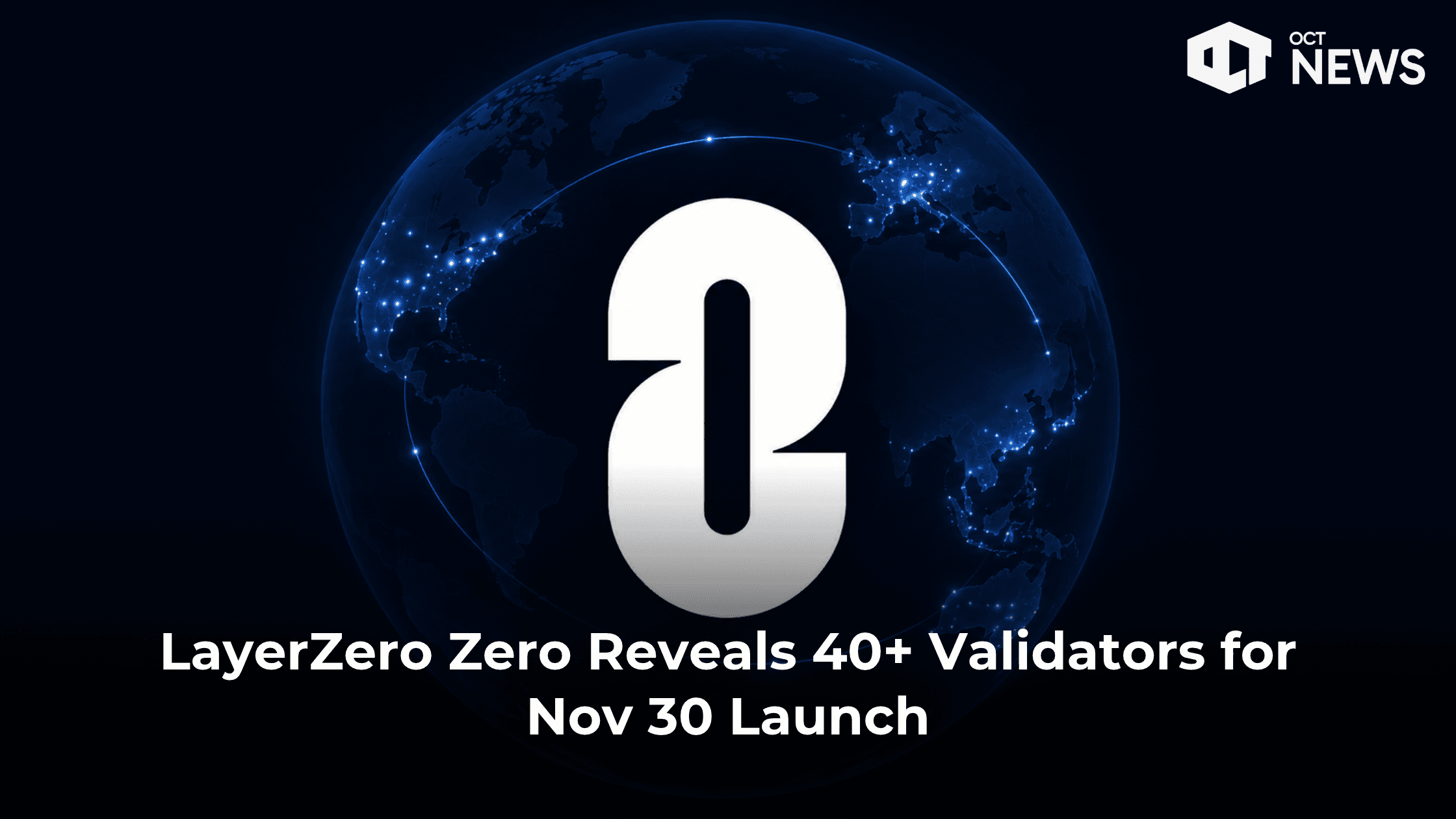
LayerZero Zero genesis validators include 40+ participants across Asia-Pacific, Europe and North America ahead of the Nov. 30 mainnet launch.

Author: Kritika Gupta
27th November 2026- LayerZero named the full set of 40+ genesis validators for its Zero blockchain, three days before the Monday, November 30 mainnet launch. The roster spans APAC, Europe, and North America, and the team frames it as proof that Zero is built for global markets.
High Signal Summary For A Quick Glance

X
@PumbaYumba0

@LayerZero_Core I’ve said it before, and I’ll keep saying it: ZRO has a bright future ahead. I hope everything works out for you guys. The price still has a long way to go - it’s going to the moon! 🚀
40+ validators across APAC, Europe and North America will validate Zero from launch on Nov 30. A globally distributed validator set makes Zero the foundation for global markets. https://t.co/qKV9hzWS4k
04:25 PM·Nov 27, 2026

Everstake
@everstake_pool
@LayerZero_Core Zero mainnet is almost here! Happy to be among 40+ validators supporting the network from the start 🤝
40+ validators across APAC, Europe and North America will validate Zero from launch on Nov 30. A globally distributed validator set makes Zero the foundation for global markets. https://t.co/qKV9hzWS4k
03:35 PM·Nov 27, 2026

Flare ☀️
@FlareNetworks
@LayerZero_Core One of the 40+ validators, and happy to be among them☀️ Flare will help verify Zero from day one, as LayerZero ATLAS goes live 🤝
40+ validators across APAC, Europe and North America will validate Zero from launch on Nov 30. A globally distributed validator set makes Zero the foundation for global markets. https://t.co/qKV9hzWS4k
03:31 PM·Nov 27, 2026
High attention and emotional sentiment detected.
The announcement landed around 15:25 UTC through a LayerZero Core post and a company blog. It caps a fast November, because pre-genesis staking only opened on Nov 23. Now the focus shifts to whether the LayerZero Zero network goes live on schedule.
Zero is LayerZero’s own Layer-1 blockchain. It is not an L2, an appchain, or a rebrand of the existing messaging protocol. The team describes it as the “first multi-core world computer” and a “heterogeneous blockchain.”
In practice, Zero launches with specialized “Atomicity Zones” for different jobs. There are zones for EVM apps, for privacy payments, and for trading and markets. Each zone runs its own execution environment, yet shares one validator set and one security model.
The pitch, according to LayerZero’s Zero site, is high-performance infrastructure for tokenized assets. So the chain targets institutions and venues rather than retail users. That focus shapes almost every design choice below.
LayerZero confirmed “40+” validators in its genesis validators blog. Earlier secondary reports had cited roughly 46 fixed validators. The company has not published an exact final number or every jurisdiction.
The names, however, are striking. The set includes Kakao Pay, Samsung Card through Four Pillars, and ZAN from Ant Digital across APAC. It also features Flare, ARK Invest, Gemini, Tether, and Broadridge.
Infrastructure operators round out the list. Hashed, Everstake, Kiln, Alchemy, Quicknode, and Nansen appear as well. As a result, the roster mixes financial institutions, enterprises, and native crypto players.
That spread is the whole point, according to LayerZero. “When validators cluster in one region, one type of organization or one stack, a single failure can reach many of them at once,” the team wrote. A more varied set, they argue, carries less concentration risk.
Zero separates execution from verification using ZK proofs. Block producers run on higher-spec hardware, execute transactions inside zones, and generate proofs. Block validators then only check those proofs rather than re-run every transaction.
This design removes a lot of redundant computation. Because validators verify instead of re-execute, hardware requirements stay lower. So the network can chase high throughput without forcing every operator onto expensive machines.
The Zero architecture docs target around 2 million transactions per second per zone. That figure is a design goal, not a measured mainnet result. Readers should treat it as a claim until live data appears.
LayerZero’s path to Zero mainnet
The interoperability protocol goes live across more than 20 chains, letting developers choose which networks verify their cross-chain messages.
The LayerZero Foundation launches ZRO, the protocol’s native token, and opens airdrop claims.
The new Layer 1 uses zero-knowledge proofs so validators can verify execution without re-running every transaction.
LayerZero announces more than 40 launch validators across Asia-Pacific, Europe, and North America.
Zero is set to go live alongside LayerZero ATLAS, its onchain trading engine.
LayerZero says more validators will join over time. Pre-genesis ZRO stake is scheduled to unlock on 31 March 2027.
Zero does not launch alone. It goes live beside LayerZero ATLAS, a headless onchain trading engine for venues. ATLAS handles matching, clearing, settlement, and risk in one system.
LayerZero claims ATLAS can support more than 250,000 transactions per second at launch. The team also reports internal tests near 1.5 million orders per second, at roughly 850 microseconds median latency. These numbers come from the company and are not yet independently verified.
The economics tie back to the token. After venue rebates, ATLAS directs much of its remaining fees toward ZRO buybacks and burns. So activity on the trading engine could feed demand for the native asset over time.
Pre-genesis ZRO staking opened on Nov 23 at staking.layerzero.network. The LayerZero Foundation staked 100 million ZRO itself. Staked tokens lock until March 31, 2027.
The validator set is fixed and permissioned at first. Stake is distributed equally, and early stakers cannot choose a validator or withdraw before that March date. After the lock, LayerZero plans a shift toward permissionless delegated proof-of-stake.
Critics read this as permissioned-at-launch. LayerZero has faced centralization questions before, including over 1-of-1 DVN setups tied to the roughly $292 million KelpDAO incident. Supporters counter that a vetted, distributed set suits institutional markets at the start.
Markets have stayed cool through the buildup. ZRO traded near $1.05 to $1.11 on Nov 27, with a market cap around $430 million. The token is down roughly 30% on the month and sits far below its $7.47 high from December 2024.
The immediate test is simple. Zero must go live on Monday and produce a genesis block, since no explorer or contract addresses exist yet. LayerZero has not published an exact launch time or timezone.
After that, watch real throughput against the ATLAS claims. Watch how many venues actually route orders through the engine. Watch whether the validator set widens on schedule after March 31, 2027.
For now, the LayerZero Zero launch stands as one of the most institution-heavy L1 debuts in recent memory. Whether that roster signals resilience or centralization will be the story once the network starts producing blocks. This article is not financial advice, and readers should do their own research before acting on any token.
Our Crypto Talk is committed to unbiased, transparent, and true reporting to the best of our knowledge. This news article aims to provide accurate information in a timely manner. However, we advise the readers to verify facts independently and consult a professional before making any decisions based on the content since our sources could be wrong too. Check our Terms and conditions for more info.


LayerZero