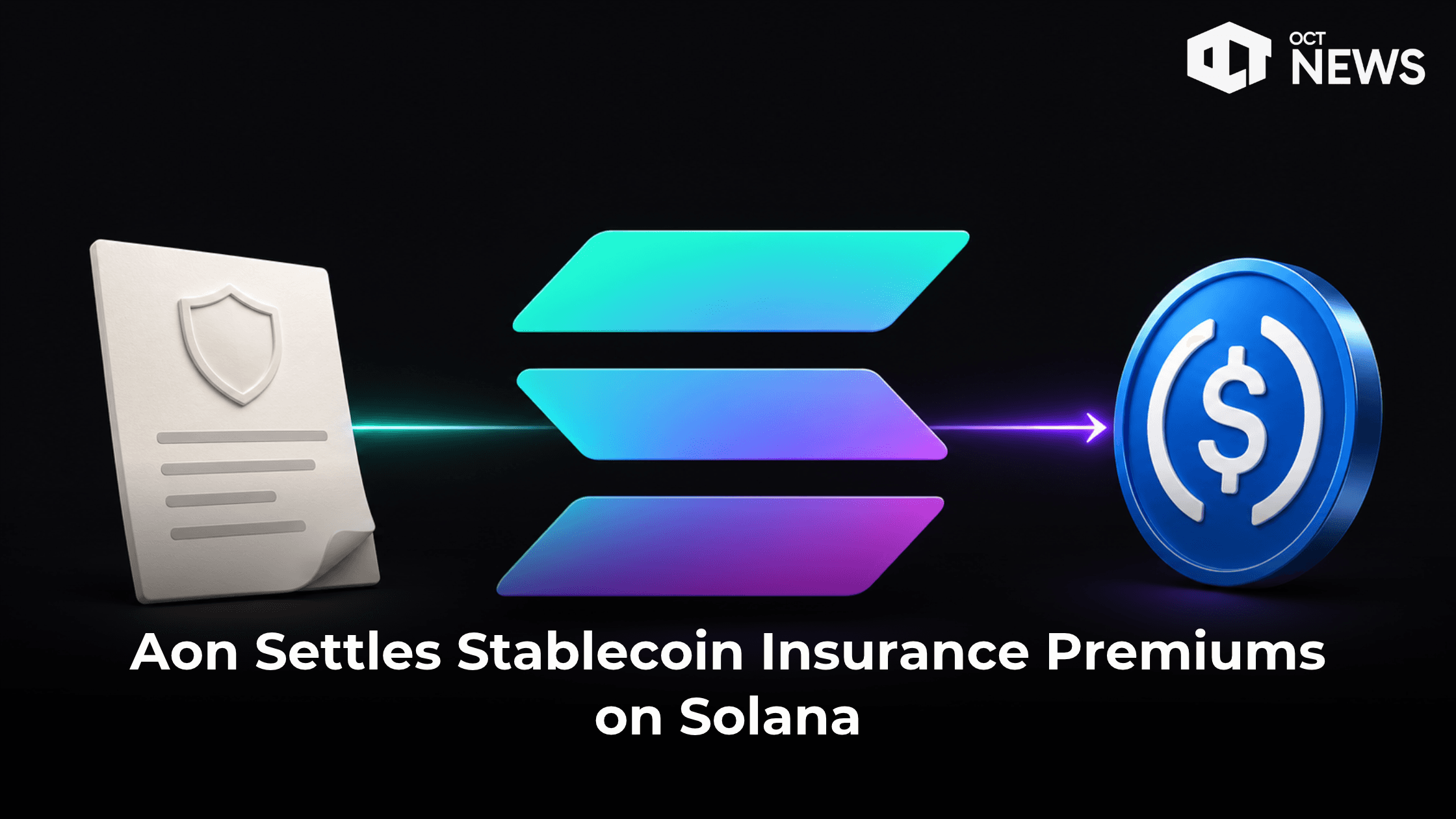
Aon stablecoin insurance premium payments pilot used PYUSD on Solana and USDC on Ethereum to settle premiums for Paxos and Coinbase.

Author: Kritika Gupta
27th November 2026- A viral clip from the official Aon Solana account landed on Thursday. It pushed Aon’s stablecoin experiment back into the spotlight. Plenty of viewers thought it was breaking news, yet it was not. The settlement actually happened when insurance broker Aon tested stablecoin insurance premiums in a controlled pilot.
High Signal Summary For A Quick Glance

HyDRAULIC
@HyDRAULIC_DeFi

@solana @Aon_plc Great to see you guys moving on chain @AON_plC . Finally we can carry on with the conversation regarding HyDRAULIC IP insurance needs.. exciting time ahead
One of the world's largest insurance brokers has settled its first stablecoin premiums on Solana https://t.co/H38CgIPQgA
11:13 AM·Nov 27, 2026

Sukesh Tedla
@sukeshtedla
@solana @Aon_plc Settling is the easy bit now. The broker still needs every premium in its books with a timestamp, a wallet and a fiat value at settlement, and that reconciliation is where a lot of stablecoin pilots stall.
One of the world's largest insurance brokers has settled its first stablecoin premiums on Solana https://t.co/H38CgIPQgA
09:45 AM·Nov 27, 2026

META STAR
@META_STARx
@solana @Aon_plc one of the worlds biggest insurance brokers settling stablecoin premiums on solana is lowkey huge. tradfi using it for real now
One of the world's largest insurance brokers has settled its first stablecoin premiums on Solana https://t.co/H38CgIPQgA
09:39 AM·Nov 27, 2026
High attention and emotional sentiment detected.
The @solana post on 27 November showed only the Solana side of the story. Behind that short video sits a bigger, dual-chain test that two major crypto firms helped run earlier this year.
Aon is one of the world’s largest insurance brokers, typically ranking second behind Marsh McLennan. In March 2026, Aon announced that it had become the first major broker to accept stablecoins for insurance premium payments. The Aon Solana pilot involved Paxos, which paid its own premium in PayPal USD (PYUSD). Coinbase paid its premium in USDC on Ethereum as part of the same test.
The November clip left out Aon, both clients and the Ethereum payment. That made the eight-month-old pilot look like a new, Solana-only settlement.
Traditional insurance premium payments typically move through bank wires, ACH or correspondent banks. Depending on the route, settlement can take one to three business days, and brokers must reconcile incoming payments against bank statements.
The Aon Solana pilot tested whether stablecoins could simplify that process. Each client paid its premium on-chain using a regulated stablecoin, while the terms of their insurance coverage stayed the same.
Paxos paid in PYUSD on Solana, and Coinbase paid in USDC on Ethereum. Using two networks let Aon test how its payment operations could handle different stablecoins and blockchains.
Solana’s institutional payments timeline
The integration lets Shopify merchants accept USDC on Solana.
Visa expands its stablecoin settlement pilot to Solana with merchant acquirers Worldpay and Nuvei.
Paxos is among the first providers to offer access to PYUSD on the network.
U.S. businesses can accept USDC from customers on Solana, Ethereum and Polygon.
Cross River Bank and Lead Bank begin settling with Visa in USDC on Solana.
In the pilot, Paxos pays its premium in PYUSD on Solana and Coinbase pays in USDC on Ethereum.
PYUSD launched on Solana in May 2024. The stablecoin, issued by Paxos under U.S. regulatory oversight, was already available on the network when Aon tested it for insurance premium payments.
The Aon Solana pilot follows other payments initiatives involving the network, including Visa’s USDC settlement pilot, Shopify’s Solana Pay integration and Solana’s participation in the Mastercard Crypto Partner Program.
For Aon, the pilot showed that a client could settle an insurance premium in PYUSD on Solana. Whether clients will use it for recurring payments remains open.
Timing matters here. The U.S. GENIUS Act of 2025 created a federal framework for stablecoins, and Aon cited that law as an enabling factor. Regulated rails gave the broker cover to move premiums on-chain.
Aon is not new to digital assets. The firm placed some of the first crypto-crime policies around 2013. It now fields more than 60 professionals in the space. So this pilot simply extended that practice into treasury operations.
The prize is large. Coverage of the test cited the roughly $375 billion in annual global insurance premiums. Faster settlement could eventually touch a meaningful slice of that flow.
Tim Fletcher, CEO of Aon’s financial services group, framed the move as a first-mover bet. The position “advances our commitment to innovating on behalf of clients,” he said in the release. Fletcher added that clients still need confidence that speed does not come at the expense of control.
Brett Tejpaul, Co-CEO of Coinbase Institutional, pointed to speed and infrastructure. He said settling premiums with stablecoins, including USDC, helps Aon scale its financial operations with transparency and institutional-grade rails.
Adam Ackermann, head of treasury and portfolio management at Paxos, focused on workflow. According to Ackermann, a regulated stablecoin like PYUSD can slot directly into treasury processes for more efficient capital management.
Not everyone treats this as a milestone. Critics note that Aon never disclosed the premium amounts. No public transaction hashes, wallet addresses, or verified on-chain flows exist for the settlement either.
That silence is normal for a private institutional pilot, yet it still limits independent verification. As a result, outside observers cannot confirm the size or frequency of any transfer.
There is also a timing question. Eight months later, no party has announced a second or third settlement. So some skeptics now ask whether the test ever became production. For now, it reads as a controlled demonstration rather than a daily workflow.
SOL traded roughly between $70 and $73 on 27 November, with some snapshots showing a gain above 3%. Still, no clean link ties that move to the recirculated Aon news.
The clip landed alongside other Solana developments that day, including tokenized equity volume and ETF flows. So any SOL price reaction likely reflects a mix of catalysts, not this single story. None of this is financial advice.
The honest read is simple. Aon ran a real, regulated, dual-chain test in March, and the November clip revived interest without adding new facts.
The next signal to watch is frequency. If Aon or its clients announce recurring settlements, stablecoin insurance premiums move from pilot to practice. Until then, treat the Solana video as a replay, not a premiere.
Our Crypto Talk is committed to unbiased, transparent, and true reporting to the best of our knowledge. This news article aims to provide accurate information in a timely manner. However, we advise the readers to verify facts independently and consult a professional before making any decisions based on the content since our sources could be wrong too. Check our Terms and conditions for more info.



Solana