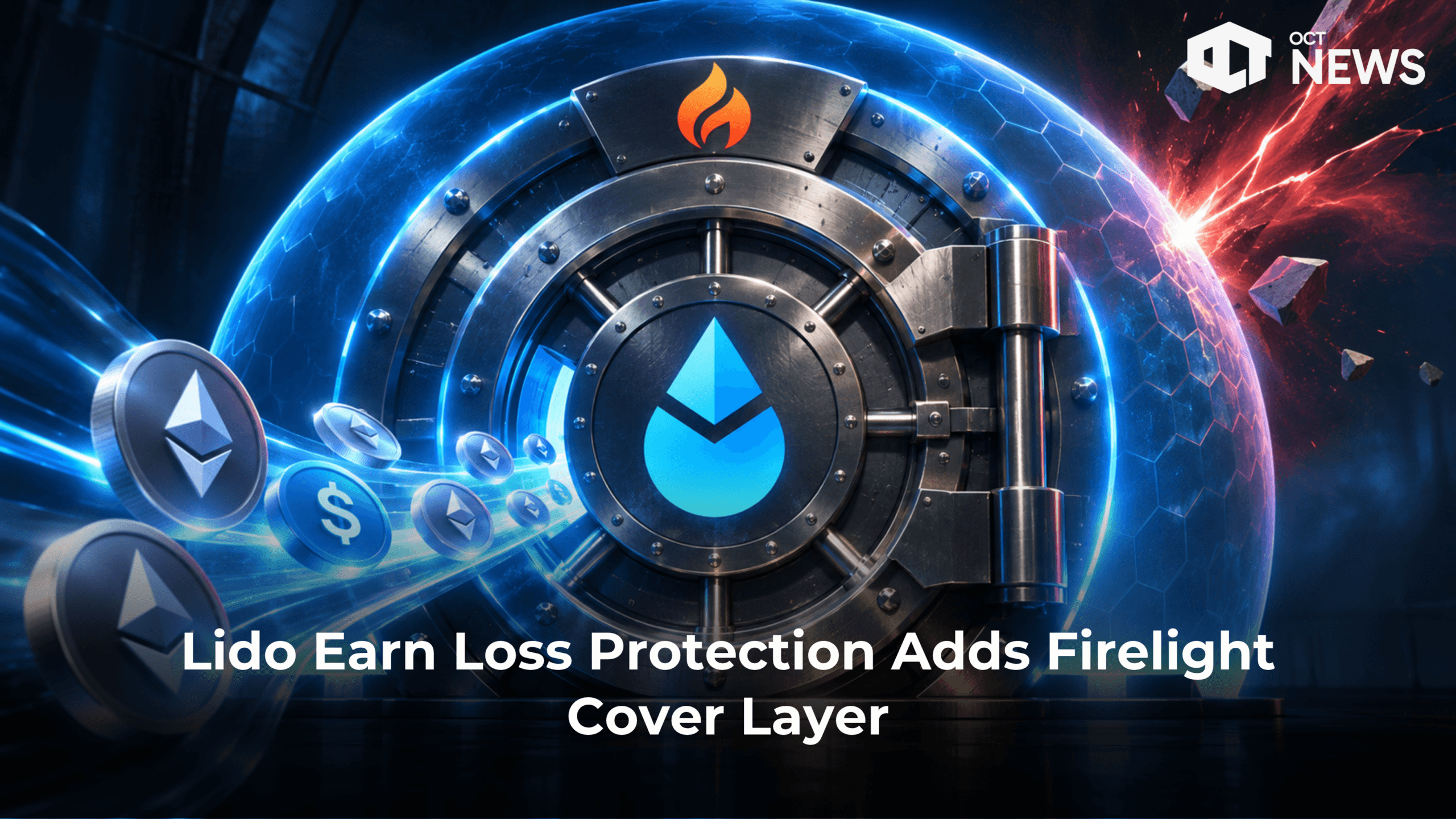
Lido Earn Loss Protection adds Firelight cover and a DAO buffer to shield EarnETH and EarnUSD depositors from eligible losses.

Author: Akshay
27th November 2026 – Lido Earn depositors now sit behind two layers of loss protection. On 5 November 2026, Lido added Firelight onchain cover as the first layer across its EarnETH and EarnUSD vaults. The Lido DAO buffer, live since March, becomes the second.
High Signal Summary For A Quick Glance

DiversiFi
@0xDiversiFi

@LidoFinance @Firelightfi @uvikdobro Solid risk management
Two-layer loss protection for all Lido Earn depositors 🛡️ In case you missed it: since November 5, Lido Earn has onchain cover from @Firelightfi, followed by the Lido DAO's loss protection. Applied to both EarnETH and EarnUSD. Here's Lido Earn's @uvikdobro explaining the https://t.co/9kSXZbC4Qq
12:26 PM·Nov 27, 2026
High attention and emotional sentiment detected.
The change is automatic. Firelight now covers every depositor at the vault level, so no one opts in or files a claim. According to Lido, Firelight pays eligible losses first, and the DAO layer then absorbs what remains.
Lido Earn runs two onchain vaults curated by Mellow. EarnETH takes ETH, WETH, and wstETH. EarnUSD takes USDC and USDT.
Both vaults route deposits into blue-chip DeFi strategies for auto-compounded yield. For example, EarnETH allocates across Aave, Morpho, Pendle, Gearbox, and Maple. Depositors then receive share tokens whose value tracks vault performance.
EarnUSD is notable on its own. It is Lido’s first major stablecoin vault, launched when the two-vault structure arrived in March. So the USD side is newer, and its cap sits higher than the ETH side.
On 5 November, EarnETH held $212.9M in TVL, while EarnUSD held $50.3M, according to Lido. Firelight now sits on top of that capital as the first line of defense.
Firelight is onchain cover, not insurance. So the protection applies only to defined failure modes. In total, it covers six of them.
The list includes smart-contract exploits, oracle failures, and governance exploits. It also covers bad debt from mechanism failure, depegs from mechanism failure, and redemption failures. In short, these are technical and economic breakdowns, not bad luck.
The exclusions matter just as much. Firelight does not cover normal market moves or liquidations at accurate prices. It also leaves out stolen keys, user error, offchain issues, and flaws that were public before the period began.
For the first 30-day period, Firelight caps payouts. First, the EarnETH limit reaches 5.7% of TVL, or about $12.1M. Then, for EarnUSD, the cap sits at 8% of TVL, near $4M.
Before 5 November, the Lido DAO buffer stood alone. Now it backs up Firelight instead of leading. The DAO funded this buffer in March with $3M in wstETH and $2M in USDC.
The second layer works by burning DAO-held vault shares. When a confirmed loss hits 1% of TVL, the Growth Committee can burn up to 100% of those shares. That burn then lifts the share value for remaining depositors.
The buffer has fired once already. In April, a Kelp DAO rsETH incident stressed EarnETH. The DAO later burned about 144 ETH of shares under a one-off vote. The residual loss had fallen below the usual 1% trigger.
Lido Earn evolved from curated DeFi yield vaults into a two-layer loss-protection structure, combining independent onchain cover from Firelight with Lido DAO’s first-loss capital to protect eligible deposits across EarnETH and EarnUSD.
Lido introduced Earn, a product built around curated DeFi strategy vaults, giving users access to yield opportunities across decentralised finance protocols.
Lido simplified and expanded Earn into two products: EarnETH, supporting ETH, WETH and stETH strategies across established DeFi protocols such as Aave, Morpho and Uniswap; and EarnUSD, its first stablecoin vault supporting USDC and USDT strategies. The DAO committed approximately $5 million in first-loss capital, including $3 million in wstETH for EarnETH and $2 million in USDC for EarnUSD. DAO shares absorb eligible losses before regular depositor capital.
Firelight, an onchain protection protocol on Flare incubated by Sentora, became the first protection layer for Lido Earn. Coverage addresses defined technical and economic failure modes, including smart-contract exploits, oracle failures, governance exploits, mechanism-related bad debt and depegs, and certain redemption failures. Protection applies automatically to all depositors, with terms and limits recalculated every 30 days based on vault composition. Claims are assessed by an independent Risk Consortium comprising Hypernative, Cyfrin, Credora, GFX Labs and Native. Premiums are funded by the Current Meta Treasury rather than vault returns.
The DAO’s existing first-loss capital sits behind Firelight as a second protection layer. If a confirmed loss reaches at least 1% of a vault’s TVL, the Growth Committee can burn up to 100% of the DAO’s shares in that vault to absorb residual losses. Unlike Firelight, this mechanism is not restricted to its specified failure categories. The DAO capital is funded through its own deposits under the same terms as other depositors.
Based on the supplied early-November TVL figures, EarnETH held approximately $213 million, with up to $12.1 million in Firelight cover and $3.2 million in DAO protection, creating a combined ceiling of approximately $15.3-$15.4 million. EarnUSD held approximately $50 million, with up to $4 million in Firelight cover and $2.1 million in DAO protection, creating a combined ceiling of approximately $6.1 million. These are capacity limits for eligible losses, not guaranteed repayments.
Lido shared an explainer video featuring Earn contributor @uvikdobro (NF404), outlining how Firelight serves as the first protection layer and DAO capital as the second across EarnETH and EarnUSD. The post also highlighted that the next Firelight coverage period is scheduled to begin on December 5, 2026.
The next 30-day Firelight protection period is scheduled to start, with coverage terms and limits determined by the live composition of the Earn vaults.
Firelight did not start with Lido. It went live in early October on other vaults first, including Sentora vaults and Kraken Protected Strategies. Then Lido became its marquee customer on 5 November.
Firelight is young, too. Sentora incubated it, and Sentinel Labs built it. Gumi Cryptos Capital led an $8M seed that funded its start, while Maven 11, Metalayer, and Tribe Capital also joined.
Firelight itself runs on Flare and draws its capital from staked FXRP. Behind it sits a Risk Consortium of five firms: Hypernative, Cyfrin, Credora, GFX Labs, and Native. These firms first validate whether a named failure actually occurred.
Crucially, the premiums do not come out of depositor yield. Instead, Lido’s Current Meta Treasury funds them. So Lido Earn loss protection arrives without a visible drag on returns.
The protection is real, but it is not a guarantee. Both Lido and Firelight say so plainly. Payouts still depend on eligibility, consortium validation, available capital, and the caps.
CryptoSlate flagged this point on 13 November. The outlet pegged the combined cushions near 7.2% of EarnETH TVL and 12.1% of EarnUSD TVL. Yet those figures are ceilings, not promised repayment.
No Firelight claim has ever paid out on Lido Earn. So the stack stays untested on these vaults. For now, depositors should treat the caps as upper bounds, not a safety net for every loss.
The next Firelight period starts 5 December, when the caps reset. On 27 November, Lido also pushed an explainer video featuring Marin Tvrdic, who leads Strategy and Partnerships for Lido Earn.
In his 5 November post, Tvrdic framed the model simply. Depositors benefit from two layers at the vault level, he said, with no opt-in required. For now, Lido Earn loss protection reaches both vaults automatically. Still, its real test will come only if an eligible loss ever lands.
None of this is financial advice. DeFi yield still carries risk, and loss protection narrows that risk without erasing it. So readers weighing a deposit should check the live caps, the covered events, and the exclusions first.
Our Crypto Talk is committed to unbiased, transparent, and true reporting to the best of our knowledge. This news article aims to provide accurate information in a timely manner. However, we advise the readers to verify facts independently and consult a professional before making any decisions based on the content since our sources could be wrong too. Check our Terms and conditions for more info.


Lido DAO