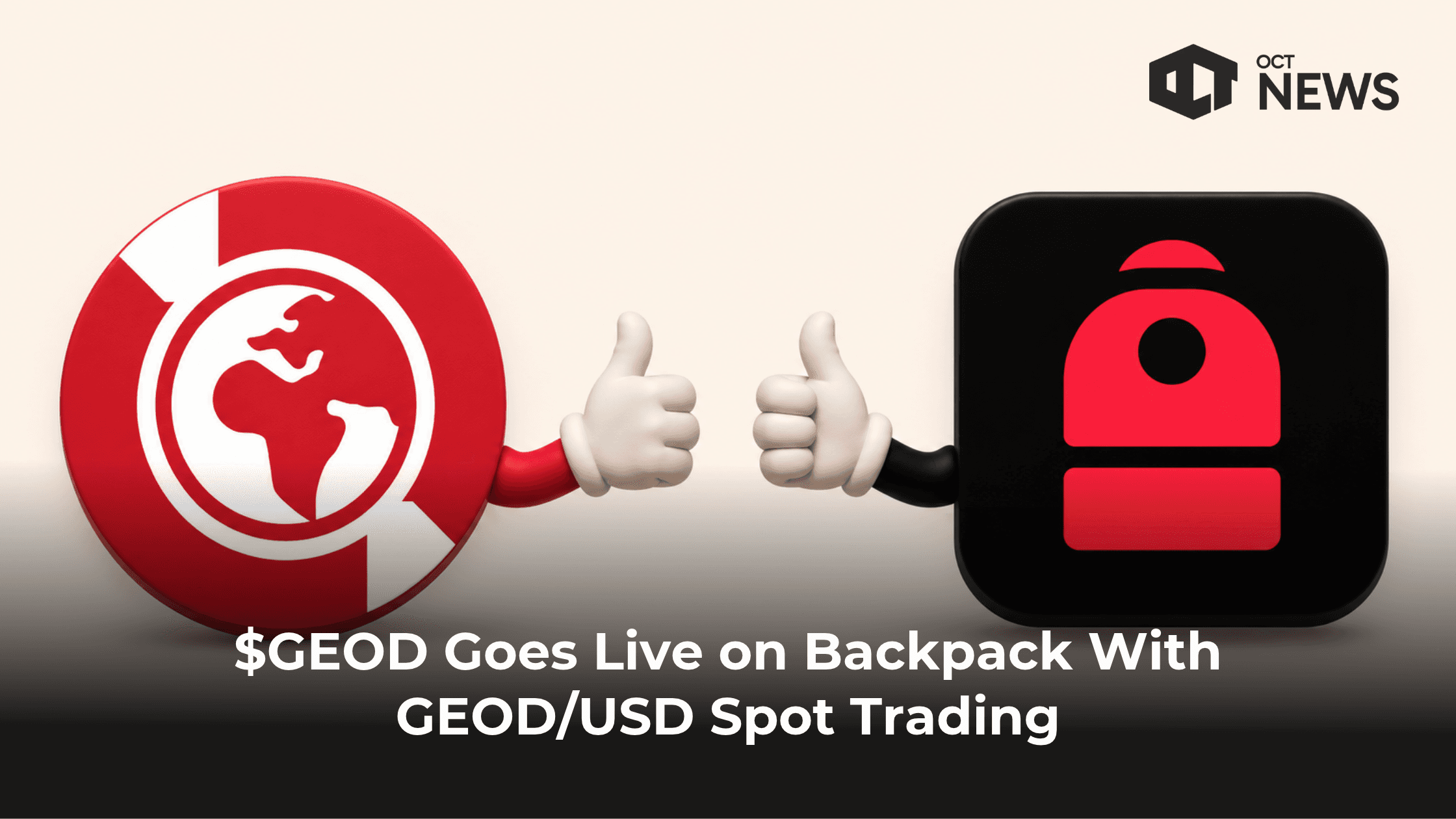
The GEOD Backpack listing opens GEOD/USD spot trading. See what it means for liquidity and the network behind the token.

Author: Kritika Gupta
26th November 2026- Backpack Exchange opened GEOD/USD spot trading in November 2026, giving Solana users another venue to trade GEODNET’s native token against the U.S. dollar around the clock. GEODNET operates more than 22,000 base stations across 177 countries. Those stations supply satellite correction data that helps drones, robots, and other machines pinpoint their location to within centimeters.
High Signal Summary For A Quick Glance

JardinFi ⚡
@JardinFi

GEODNET's $GEOD token is now live on Backpack — and behind the ticker sits a 22,000-plus station positioning grid. What the listing actually exposes: → More than 22,000 community-run base stations across 177 countries → RTK Fixed accuracy of roughly 1 to 2 centimeters → Each https://t.co/RUfSj8IP4S

10:32 AM·Nov 25, 2026

Krypto Insider 💫
@KryptoInsider1
solana:7JA5eZdCzztSfQbJvS8aVVxMFfd81Rs9VvwnocV1mKHu spot trading is now live on @Backpack . Backpack brings crypto, US stocks and dollars into one account and serves users in 150+ countries. GEOD was already listed on Coinbase, Upbit and Bithumb. Now @GEODNET adds another https://t.co/lF8rUG0lr6

07:23 PM·Nov 24, 2026
Backpack announced the listing on November 24–25. The exchange supports the Solana version of GEOD, which uses the mint address 7JA5eZdCzztSfQbJvS8aVVxMFfd81Rs9VvwnocV1mKHu.
The listing adds to GEOD’s existing markets on centralized exchanges such as Coinbase, MEXC, Gate, Upbit, and Bithumb, as well as Solana-based decentralized exchanges Raydium and Orca. GEODNET also supports transfers between Polygon and Solana through Wormhole’s Native Token Transfers framework following a governance vote.
For traders, the immediate change is a new USD spot market on a Solana-focused exchange. Its contribution to liquidity will depend on trading volume and order book depth. GEODNET founder Mike Horton framed the listing as a step forward for the project’s role in physical AI.
GEODNET crowdsources fixed reference stations that receive signals from global navigation satellite systems, or GNSS. Operators typically install the hardware on rooftops or other sites with a clear view of the sky. Each station uses its known location to measure errors in satellite signals and sends that data to the network.
Nearby devices then apply those corrections through real-time kinematic positioning, or RTK. Under suitable conditions, RTK can bring positioning error down to roughly 1–2 centimeters. Standard satellite positioning can miss by several meters. That difference matters when a surveyor measures a boundary, a drone maps a site, or a tractor follows a planting row.
GEODNET uses token rewards to encourage independent operators to install and maintain stations. As the network expands, the location and reliability of those stations matter alongside the headline count. A new station can extend coverage in an underserved area or add redundancy where customers already use the service.
Key milestones in the GEOD Backpack listing
GEODNET expands its ecosystem to Solana.
GEODNET governance approves GEOD transfers between Polygon and Solana through Wormhole.
Backpack announces that its GEOD/USD spot market is live.
Trading volume, bid-ask spreads, and order book depth will show how much liquidity Backpack adds.
GEODNET pays station operators in GEOD for contributing data, while customers pay for access to RTK corrections. According to the project, it allocates roughly 80% of data-service revenue to buying GEOD on the open market and burning it. The remainder supports foundation operations.
That gives paid usage a direct link to open-market demand for GEOD. As data-service revenue rises, the allocation can fund larger buybacks. Meanwhile, the network continues to distribute tokens to station operators. The effect on supply depends on how much GEOD the project burns and how much enters circulation through rewards and other distributions.
Robots and autonomous systems use precise location data to repeat routes, map terrain, and operate equipment within tight tolerances. For example, a farm robot needs to follow the same row on successive passes, while a surveying team needs measurements it can reproduce. GEODNET aims to serve those customers by using independently operated stations to expand coverage.
For crypto readers, the Backpack listing and GEODNET’s commercial growth show up in different metrics. Trading volume, spreads, and order book depth will show how much liquidity Backpack adds. Data-service revenue and repeat customer usage will show whether businesses increasingly rely on the network. The buyback and burn figures then show how much of that revenue flows back into GEOD purchases.
On Backpack, the first figures to watch are GEOD/USD trading volume, spreads, and order book depth after the initial listing activity settles. Over a longer period, station coverage, data-service revenue, and burns relative to token distributions can help readers assess whether GEODNET is turning broader coverage into paid demand.
Digital asset prices can move sharply. This article provides information only. Readers should conduct their own research before trading.
Our Crypto Talk is committed to unbiased, transparent, and true reporting to the best of our knowledge. This news article aims to provide accurate information in a timely manner. However, we advise the readers to verify facts independently and consult a professional before making any decisions based on the content since our sources could be wrong too. Check our Terms and conditions for more info.