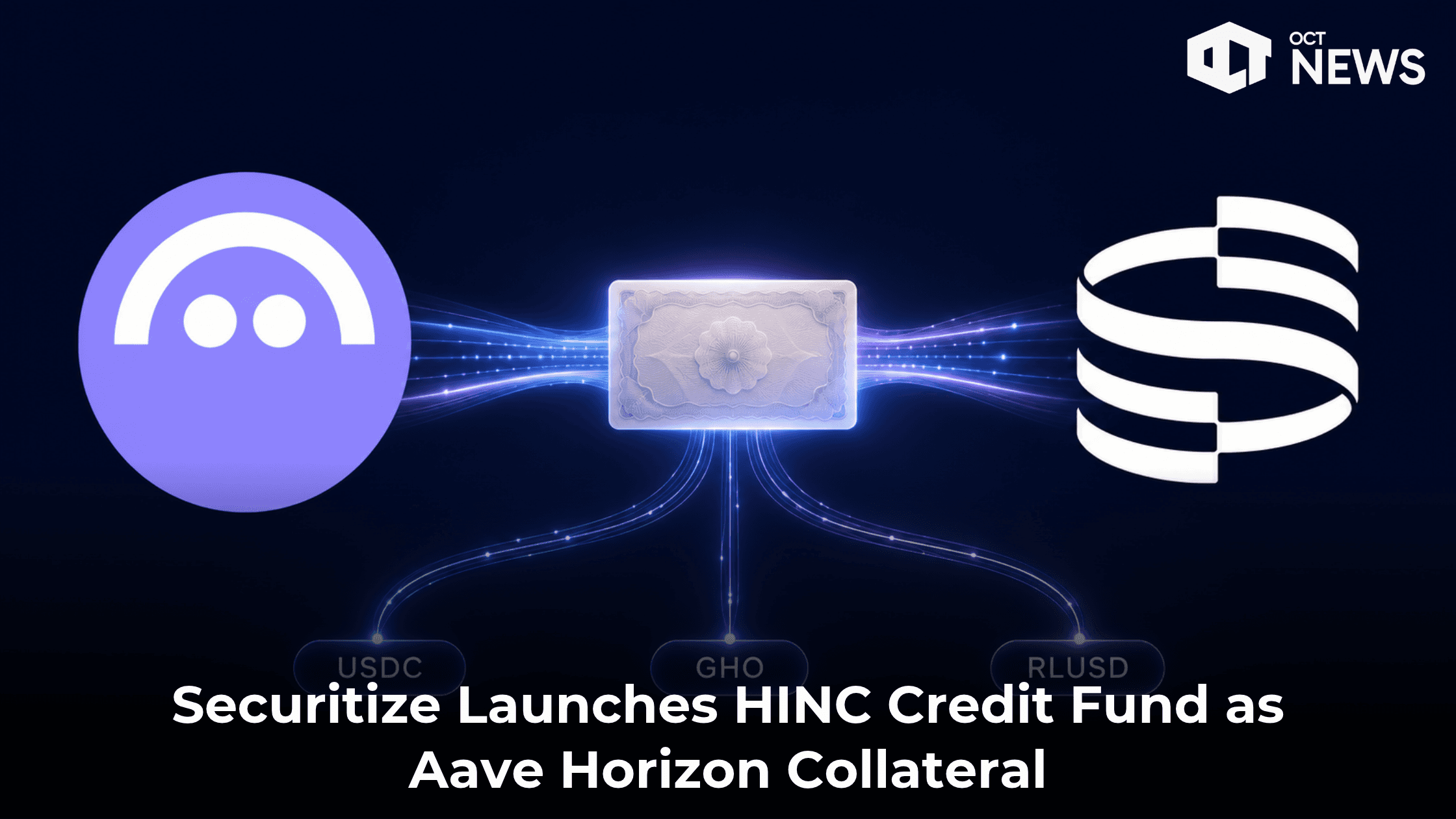
HINC on Aave Horizon lets eligible investors use the tokenized credit fund as collateral to borrow USDC, GHO, and RLUSD.

Author: Kritika Gupta
24th November 2026- Securitize has listed the Neuberger Securitize High Income Tokenized Fund, or HINC, as collateral on Aave Horizon. The token went live on the Ethereum market.
High Signal Summary For A Quick Glance

An1 Bao
@an1_bao55887

🚨 JUST IN: a junk-rated fund as collateral on aave… that's the kind of news that makes you stop scrolling the fund holds high-yield bonds and CLO tranches, and you can borrow $USDC, GHO or RLUSD against it at a 55% LTV one credit sell-off and that 67% liquidation threshold https://t.co/CDfEdjfgls
02:33 PM·Nov 24, 2026

Stani
@StaniKulechov
Neuberger Berman, founded in 1939 and one of America's oldest independent investment management firms, is bringing its investment expertise onchain. Neuberger’s HINC fund, tokenized in partnership with Securitize, is now available as collateral on Aave Horizon, enabling eligible https://t.co/HiLRSrENH4
Today, the Neuberger Securitize High Income Tokenized Fund (HINC) is live on @aave Horizon. Eligible investors can use HINC as collateral to borrow USDC, GHO and RLUSD. HINC adds actively managed high yield credit, bringing a new risk and return profile to Horizon. https://t.co/IbBrbQba8Y
02:07 PM·Nov 24, 2026
High attention and emotional sentiment detected.
Eligible, KYC-approved investors can now supply HINC and borrow USDC, GHO, and RLUSD against it. So the listing brings the first actively managed high-yield credit fund to the permissioned lending market.
Aave Horizon is a permissioned version of the Aave lending protocol. It launched in August 2025 for institutions and qualified users.
Until now, the market leaned on tokenized Treasuries and money market funds. HINC on Aave Horizon changes that mix. So it adds credit risk, spread duration, and real price swings for the first time.
Stani Kulechov, the Aave founder, welcomed the move on X. He noted that Neuberger Berman dates back to 1939 and now brings its credit expertise on-chain.
Horizon has grown into a sizable institutional market. Its total value locked sat near $250 million in late November, down from a January peak above $420 million. So the HINC listing widens the collateral menu beyond safe, near-cash assets.
HINC is a British Virgin Islands professional fund. Its tokenized shares track an actively managed high-yield credit strategy.
The fund holds mostly high-yield corporate bonds. It also holds CLO tranches, bank loans, and other higher-yielding fixed income, plus a liquidity sleeve. Notably, it uses no fund-level leverage.
The fund targets accredited investors and qualified purchasers. It sets a $100,000 minimum and charges a 0.50% management fee, with a total expense ratio near 0.60%. Anil Abraham of Neuberger said the firm wants to extend its process-driven approach on-chain.
Securitize Capital LLC acts as the investment adviser. Neuberger Berman Investment Advisers serves as sub-adviser with discretionary control. For scale, Neuberger manages about $613 billion in assets, with more than $230 billion on its fixed-income platform.
The fund launched on August 18 across Ethereum, Avalanche, Solana, and Sui. Carlos Domingo, the Securitize CEO, said the fund brings Neuberger’s fixed income capabilities to public blockchains.
Income accrues inside the token, which stays non-rebasing. Illustrative historical blend data, which is not actual fund performance, pointed to about a 7.21% annual return. Still, real results could land higher or lower.
Aave Horizon collateral timeline
The Ethereum lending market lets eligible institutions borrow stablecoins against tokenized real-world assets.
BlackRock’s BUIDL provides exposure to U.S. Treasuries and cash equivalents. Apollo’s ACRED adds private credit exposure.
Eligible investors can use the actively managed high-yield credit fund as collateral to borrow USDC, GHO, or RLUSD.
LlamaRisk proposed an initial supply cap of 10,000 HINC and a 55% loan-to-value ratio. The live market settings determine how much HINC users can supply and how much they can borrow against it.
The mechanics stay simple on the surface. First, investors supply HINC and receive a non-transferable aToken. Then they can borrow USDC, GHO, or RLUSD up to a set limit.
The borrowable assets include familiar stablecoins. USDC comes from Circle, while GHO is Aave’s own overcollateralized dollar. RLUSD is Ripple’s regulated dollar stablecoin.
Pricing comes from the fund’s daily NAV, not a live market price. RedStone delivers that NAV on-chain through its Trusted Single Source Oracle. Because HINC trades only among approved wallets, its secondary volume stays near zero.
Risk firm LlamaRisk recommended conservative settings for the listing. Its governance proposal suggested a 55% loan-to-value ratio, a 67% liquidation threshold, and an 8% liquidation bonus. It also recommended an initial supply cap near 10,000 HINC, worth about $10 million at recent NAV.
Liquidations also work differently here than on open markets. Only pre-approved, eligible holders can act as liquidators. Furthermore, they must navigate the fund’s T+1 redemption process to unwind seized collateral.
Active high-yield credit behaves very differently from near-cash Treasuries. As a result, it carries default risk, spread risk, and mark-to-market swings.
Critics in the Aave governance forum flagged several concerns. The fund prices once a day, so the oracle may lag fast market moves. Redemptions target T+1, yet they could slow or pause during stress.
Permissioned transfers also shrink the pool of eligible liquidators. Reviewers warned that freeze and seize compliance powers could strand a position and leave bad debt. Some skeptics simply called the idea junk bonds on-chain.
Early usage stays tiny for now. On-chain trackers show deposits of less than one HINC token so far. So the listing marks a milestone more than a liquidity event.
HINC already works as collateral elsewhere in DeFi. Earlier, the token integrated with Solana-based Loopscale for borrowing. The Aave Horizon listing now extends that reach to Ethereum’s largest lending venue.
The AAVE token itself traded in the mid-$90s on November 24. It slipped several percent on the day, though that move tracked a broader market dip, not the listing.
The governance process moved from an August proposal to a September vote and then to a live market. Still, final on-chain parameters may differ from the recommended figures.
Watch three things next: the real supply cap, the first liquidations, and whether eligible borrowers actually use the market. For now, HINC on Aave Horizon gives institutional credit a new home in DeFi.
This article is informational and not financial advice. Always research tokenized funds and their risks before investing.
Our Crypto Talk is committed to unbiased, transparent, and true reporting to the best of our knowledge. This news article aims to provide accurate information in a timely manner. However, we advise the readers to verify facts independently and consult a professional before making any decisions based on the content since our sources could be wrong too. Check our Terms and conditions for more info.


Securitize Launches HINC Credit Fund as Aave Horizon Collateral
Backpack RFQ for Stocks Opens Quoting to Market Makers
Backpack Tokenized Securities Hit $10B Onchain Volume
Derive RWA Options Launch With Nvidia and Anthropic
Securitize Launches HINC Credit Fund as Aave Horizon Collateral
Backpack RFQ for Stocks Opens Quoting to Market Makers
Backpack Tokenized Securities Hit $10B Onchain Volume
Derive RWA Options Launch With Nvidia and Anthropic

Securitize