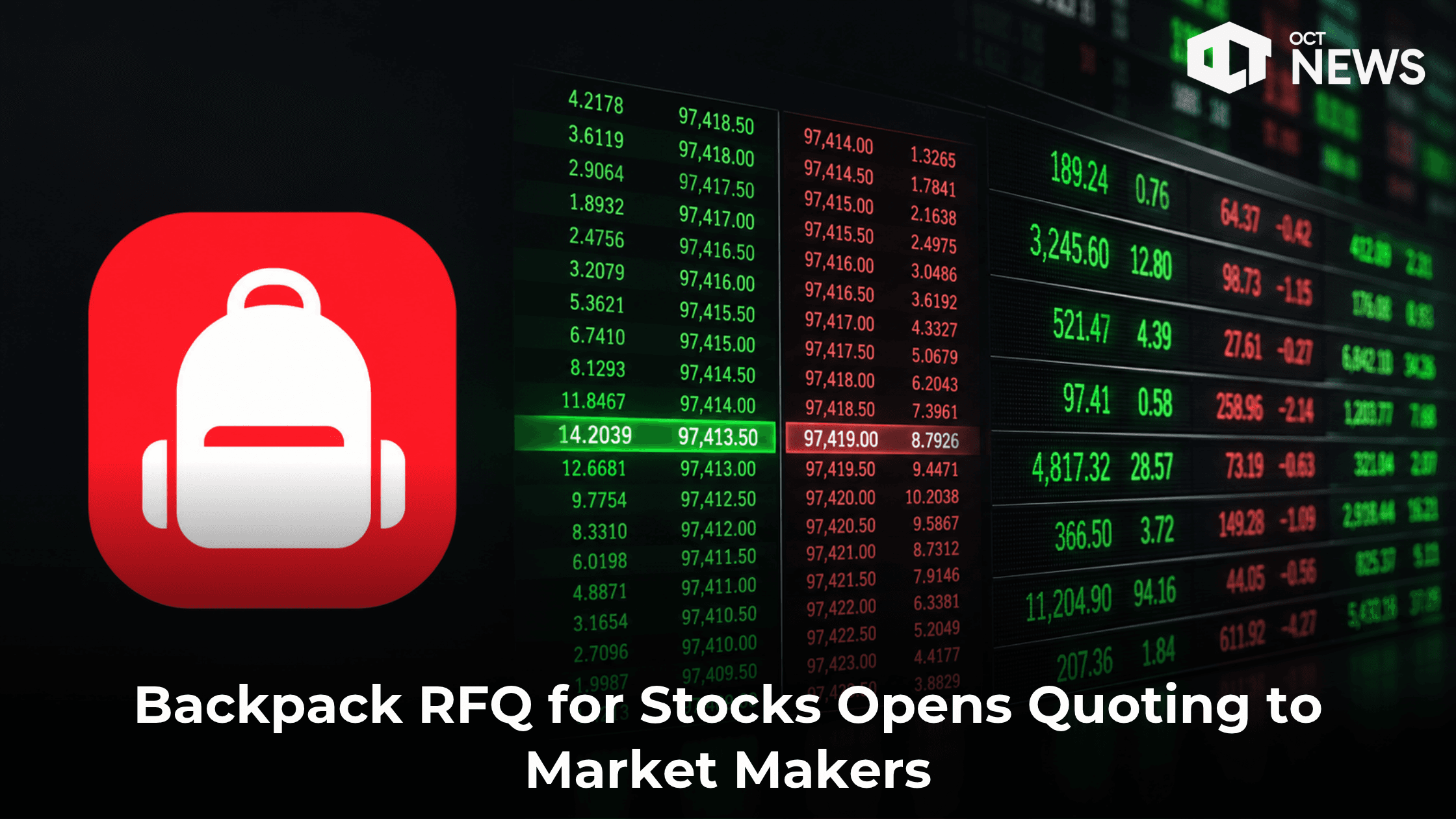
Backpack RFQ for stocks lets market makers compete with its broker to offer better prices on U.S. stocks and ETFs.

Author: Kritika Gupta
24th November 2026- Backpack has launched an RFQ system for stocks. The new feature lets outside traders and market makers quote directly against the exchange’s own executing broker.
High Signal Summary For A Quick Glance

yonniko.x
@yonnikox

The stock side of Backpack is getting interesting. More traders can compete for orders, and users benefit from better quotes. Can see myself doing a lot more there if they keep building like this. https://t.co/yAmWVZVfGg
Introducing Backpack RFQ for stocks. Traders can now compete directly with our executing broker by providing two-sided quotes for all stock order flow. By combining native liquidity on Backpack with liquidity in traditional finance, users get better fills and better prices in https://t.co/UeMDy05nU3
01:38 PM·Nov 24, 2026

MAD Vincent 🎒
@MadVincent666
Wall Street used to shout prices across the trading floor. On @Backpack, that conversation happens in code. RFQ (Request for Quote) for stocks. How does it work? ▸ Choose a stock, direction and quantity. ▸ Receive a price quote from the broker. ▸ Accept the quote. ▸ If https://t.co/PrRS1RQwTs https://t.co/67oApddWtt

Introducing Backpack RFQ for stocks. Traders can now compete directly with our executing broker by providing two-sided quotes for all stock order flow. By combining native liquidity on Backpack with liquidity in traditional finance, users get better fills and better prices in https://t.co/UeMDy05nU3
01:27 PM·Nov 24, 2026

DinhTien🎒
@DinhtienSol
Why Backpack Stock RFQ Changes Everything (And Why I'm Excited About It) Most platforms? They connect you to the same old liquidity pools (Nasdaq, NYSE). That's it. But Backpack is doing something bigger—Backpack creating a real marketplace where market makers, trading firms, https://t.co/O0YYdFbNtt
Introducing Backpack RFQ for stocks. Traders can now compete directly with our executing broker by providing two-sided quotes for all stock order flow. By combining native liquidity on Backpack with liquidity in traditional finance, users get better fills and better prices in https://t.co/UeMDy05nU3
01:26 PM·Nov 24, 2026
High attention and emotional sentiment detected.
The idea is simple. More quoters competing for the same order should tighten spreads. As a result, users should get better fills and better prices. According to Backpack, the system also blends native exchange liquidity with liquidity from traditional finance in one open marketplace.
Stock orders on Backpack already ran through a quote-based flow during market sessions. Until now, though, the executing broker acted as the default quoter on that flow.
The new feature opens the quoting side to everyone. External traders and market makers can now submit two-sided quotes for stock order flow. A two-sided quote means both a bid and an ask. The system then compares the broker’s quote against the outside quotes. Finally, it routes the user to the better price.
Backpack framed the launch directly on X. “Traders can now compete directly with our executing broker by providing two-sided quotes for all stock order flow,” the company wrote. It called the result an open-access liquidity marketplace that anyone can plug into.
An RFQ, or request for quote, works differently from a public order book. First, an order requests a price for a set quantity of a stock. Then liquidity providers reply with firm quotes. Finally, the best quote wins the order.
On Backpack, these RFQ markets use symbols like AAPL.US_USDC_RFQ. Some stocks also keep a spot order book, such as MU.US_USDC, for use outside regular sessions. Limit orders work as resting RFQs instead. Each one carries an expiry and a price bound that quoters try to fill.
Market makers reach this flow through the Backpack API. So the quoting is programmatic rather than manual. Developers can find the RFQ lifecycle and settlement rules in the official Backpack documentation. Deferred settlement also applies to broker quotes. That setup locks funds on acceptance, then settles once the offsetting trade completes.
The early signs looked promising even before this full opening. In mid-November, founder Armani Ferrante said one market maker was already testing the venue. He also claimed that roughly 25% of RFQ orders beat the traditional broker route. Still, Backpack has not published launch-day fill data.
The quotes sit on top of real securities, not synthetic exposure. Users hold security entitlements to actual U.S.-listed shares under New York UCC Article 8. In other words, this is genuine ownership rather than a CFD or a price wrapper.
A regulated brokerage chain handles execution, clearing, and custody. Atomic Vault Securities acts as the intermediary broker. RQD Clearing serves as the clearing broker. Both are SEC-registered and belong to FINRA and SIPC. Backpack Securities Global Limited, based in New Zealand, is the introducing entity.
Backpack also issues 1:1 redeemable tokenized versions of these equities on Solana. Traders can mint or redeem them against the underlying brokerage holdings. Still, on-chain liquidity for those tokens remains thinner than the brokerage flow. So most volume still runs through the broker side.
Backpack Securities product pages list more than 1,200 U.S. stocks and ETFs. Earlier tokenized counts ranged lower, though, depending on the source and date. Trading follows U.S. Eastern Time sessions. Select names like SPCX, MU, and SNDK also trade on weekends.
The fee pitch is straightforward. There is no separate commission or platform fee on stock trades. So the confirmed price is the final price, although spreads may still apply. The minimum order value sits at just $1, and fractional shares are available during regular hours.
Region limits access, however. The product requires a KYC-verified Backpack account. It is also explicitly unavailable in the United States, the United Kingdom, the United Arab Emirates, Japan, and on Backpack EU.
Backpack is not alone in chasing crypto-native stock trading. Robinhood offers extended hours, yet not full 24/7 access to real shares. Kraken’s xStocks and similar platforms lean on tokenized equities instead. Coinbase and Ondo have also tested tokenized or equity-linked products.
Backpack’s pitch mixes three things. It combines real security entitlements, a 1:1 tokenized bridge on Solana, and now open RFQ competition with the broker. That blend is the company’s main differentiator for now. Weekend and overnight trading on select names adds another selling point.
This launch fits a larger roadmap. Ferrante has framed the RFQ as the liquidity layer in an ambitious plan. The goal is to scale from roughly 94 stocks toward 10,000 names through intents and smart routing.
For now, Backpack has not named the market makers joining at launch. It has not shared launch volume either. So the real test is whether open competition delivers the tighter spreads the company promises. Traders can watch the fill quality on live RFQ markets and judge the results for themselves.
This article is for informational purposes only and is not financial advice. Always do your own research before trading.
Our Crypto Talk is committed to unbiased, transparent, and true reporting to the best of our knowledge. This news article aims to provide accurate information in a timely manner. However, we advise the readers to verify facts independently and consult a professional before making any decisions based on the content since our sources could be wrong too. Check our Terms and conditions for more info.


Securitize Launches HINC Credit Fund as Aave Horizon Collateral
Backpack RFQ for Stocks Opens Quoting to Market Makers
Backpack Tokenized Securities Hit $10B Onchain Volume
Derive RWA Options Launch With Nvidia and Anthropic
Securitize Launches HINC Credit Fund as Aave Horizon Collateral
Backpack RFQ for Stocks Opens Quoting to Market Makers
Backpack Tokenized Securities Hit $10B Onchain Volume
Derive RWA Options Launch With Nvidia and Anthropic

Backpack