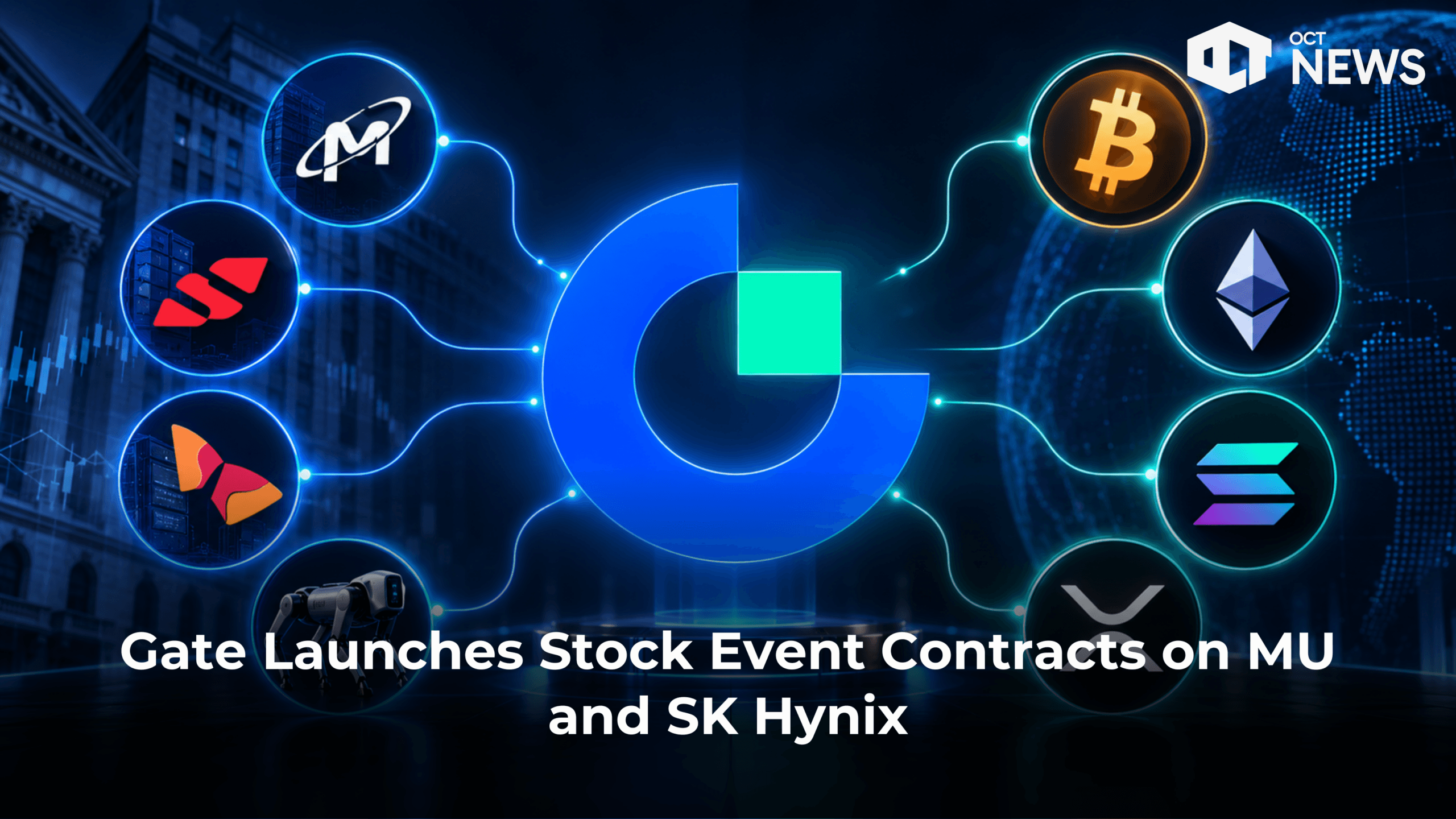
Gate launches stock event contracts for MU, SNDK, SK Hynix, and Unitree, offering 5-minute and 15-minute up-or-down bets settled in USDT.

Author: Akshay
High attention and emotional sentiment detected.
8th September 2026 – Gate launches stock event contracts on September 8, 2026, opening short-cycle bets on four named stocks. The product went live at 07:21 UTC, according to Gate’s announcement.
High Signal Summary For A Quick Glance

Macro Bombastic
@MacroBombastic

@BankXRP event contracts bridging equities and crypto is the next frontier tbh
🚀 Gate just became the first platform to launch stock event contracts. MU (Micron), SNDK (SanDisk), SK Hynix & Unitree Robotics now tradeable alongside its crypto event contracts (BTC, ETH, SOL, XRP, DOGE, HYPE, BNB). No leverage, no margin just predict the move. https://t.co/8EabIpbg2K
11:29 AM·Sep 8, 2026
Gate stock event contracts extend a wrapper the exchange already ran on crypto. Now the same bullish or bearish bet applies to individual equities. Better still for Gate, it all settles in USDT.
Each contract is a short binary bet with no strike price. A trader picks one side. Will the stock finish higher or lower than its start-of-cycle price? That is the whole bet. Gate launches stock event contracts around this simple up-or-down structure.
Cycles run for 5 or 15 minutes only. Gate says there is no leverage and no margin. As a result, the most a trader can lose is the premium paid.
The pricing works like an implied probability. Each share trades between 0.01 and 0.99 USDT. So a price of 0.62 USDT signals about a 62% chance of “up.”
A winning share pays 1.00 USDT. A losing share settles at zero. In other words, when Gate launches stock event contracts, traders are buying an outcome rather than the underlying stock itself. Traders can also close early, so they can take profit or cut losses before the cycle ends.
According to Gate’s help pages, the minimums sit at 5 USDT notional and 6 contracts. Gate charges fees only on open and close. It applies no settlement fee.
Early exits on Gate stock event contracts still carry a catch. Gate does not guarantee a fill before expiry. Because each cycle is short, liquidity can thin out fast during a fast move.
How Gate’s new stock event contracts compare.
When Gate launches stock event contracts, it starts with four underlyings: Micron (MU), SanDisk (SNDK), SK Hynix, and Unitree Robotics. Unitree is the Chinese humanoid-robot maker that listed in August.
Notably, three of the four sit in the 2026 AI-memory trade. Micron, SK Hynix, and SanDisk all rode datacenter demand this year. So retail interest in them is already high.
Unitree is the outlier. The stock debuted on Shanghai’s STAR Market on August 19. It jumped about 460% on day one. Then it fell sharply from that peak.
Each contract follows its home market’s hours. As a result, MU and SNDK orders track US sessions. Meanwhile, SK Hynix follows Korean hours and Unitree follows mainland China hours. When a market closes, Gate blocks new orders on that name.
When Gate launches stock event contracts, it calls the product the “World’s First Stock Event Contracts.” That phrase is Gate marketing. Flash wires like Odaily and PANews simply reprinted it.
Independent checks complicate the claim. Polymarket, for example, already ran MU up-or-down markets. It also lists stock perpetuals on the same memory names.
Other venues got there first too. Kalshi and Robinhood already sell regulated event contracts. Some of those reference financial outcomes. Limitless also advertised on-chain stock event contracts back in 2025.
A fairer reading is narrower. Gate may be the first major centralized crypto exchange to try this exact format. It places rolling 5- and 15-minute up-or-down bets on single stocks. Still, it is not the first platform to offer equity-linked event contracts.
Several details remain unpublished for the stock product. Most importantly, Gate launches stock event contracts without yet naming the price feed for equity settlement. That single gap matters a lot.
For crypto, Gate settles using a Chainlink time-weighted average price on BTC and ETH. For stocks, however, the company stays quiet. It has not named the data source or the averaging window. It has also set no rules for ties, halts, or bad prints.
The fee schedule is vague as well. Gate describes a “dynamic curve” rather than a fixed rate. So the true cost of frequent 5-minute trades is hard to model.
There is a legal wrinkle too. Gate’s July 2026 user agreement still defines an event contract as a “digital asset.” Yet these new contracts reference Nasdaq and A-share stocks. Gate has not published specs that reconcile the two.
Access stays restricted. Gate’s agreement says these contracts are not registered under US securities or commodities law. As a result, the company excludes US persons. It also blocks several other jurisdictions.
Market reaction stayed muted at launch. GateToken (GT) actually traded down about 3% on the day. So there is no visible price bump tied to the news. Early social engagement was thin as well. Gate also did not publish opening volume for stock event contracts in the first hours.
The context matters here. Gate rolled out crypto event contracts in July 2026, then added DOGE, HYPE, and BNB in August. Stock event contracts are the next step in that same push.
Still, the move signals where centralized exchanges are heading. As prediction markets grow, rivals will likely test similar single-stock products. That is especially true if Gate publishes clearer rules and reports real volume. For now, traders should weigh the capped-risk design against the open questions before sizing any position. This article is not financial advice.
Our Crypto Talk is committed to unbiased, transparent, and true reporting to the best of our knowledge. This news article aims to provide accurate information in a timely manner. However, we advise the readers to verify facts independently and consult a professional before making any decisions based on the content since our sources could be wrong too. Check our Terms and conditions for more info.