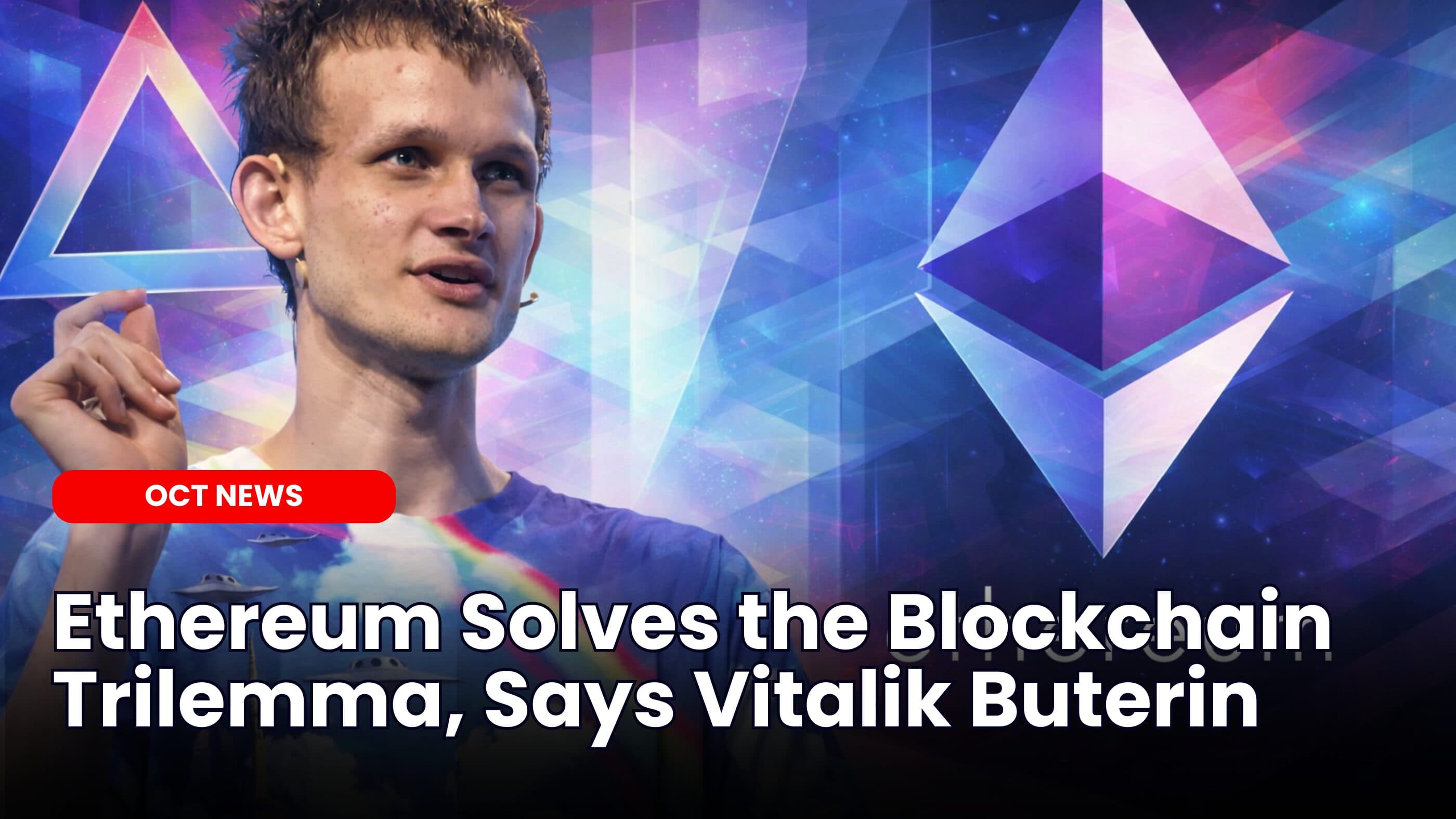
Ethereum co-founder Vitalik Buterin has declared a resolution to the blockchain trilemma in the network’s evolution.

Author: Sahil Thakur
4th January 2026 – Ethereum co-founder Vitalik Buterin has declared a resolution to the blockchain trilemma in the network’s evolution. In a detailed post on X, he explained how Ethereum is now running technologies that solve the long-standing blockchain trilemma: achieving decentralization, consensus, and high throughput together.
This breakthrough comes through the combination of ZK-EVMs and PeerDAS. These technologies are now live on Ethereum’s mainnet, with production-quality performance.
The blockchain trilemma describes a challenge in blockchain design. A network usually struggles to achieve decentralization, security, and scalability at the same time. Developers can optimize two of them. However, the third one often suffers.
Decentralization means many independent participants run the network. No single party controls it. Security means the network resists hacks and fraud. Meanwhile, scalability means it processes a high number of transactions quickly and cheaply.
Historically, tradeoffs shaped blockchain design. Bitcoin prioritized decentralization and security. As a result, it processes transactions slowly. Some faster chains sacrificed decentralization or security to scale.

Railgun Therapist not Intern
@RailgunIntern

@VitalikButerin Onward https://t.co/KHTPDe7Rbq

Now that ZKEVMs are at alpha stage (production-quality performance, remaining work is safety) and PeerDAS is live on mainnet, it's time to talk more about what this combination means for Ethereum. These are not minor improvements; they are shifting Ethereum into being a
11:56 PM·Jan 3, 2026

OFFSTAGE
@offstage_x
@VitalikButerin ELI5 translator: For 15 years we’ve been told “pick 2 of 3: decentralized, secure, or fast.” BitTorrent (2000): Fast and decentralized, but no agreement on truth Bitcoin (2009): Secure and decentralized, but slow because everyone checks everything Ethereum (2025): All three.
Now that ZKEVMs are at alpha stage (production-quality performance, remaining work is safety) and PeerDAS is live on mainnet, it's time to talk more about what this combination means for Ethereum. These are not minor improvements; they are shifting Ethereum into being a
10:47 PM·Jan 3, 2026

prpl
@PandaJacketGuy
@VitalikButerin anyone seriously look into the feasibility of decentralised block building? not just from a tech standpoint but from a game theoretic standpoint..?
Now that ZKEVMs are at alpha stage (production-quality performance, remaining work is safety) and PeerDAS is live on mainnet, it's time to talk more about what this combination means for Ethereum. These are not minor improvements; they are shifting Ethereum into being a
09:28 PM·Jan 3, 2026
Vitalik’s claim matters because Ethereum is now pushing toward all three at once. With PeerDAS and ZK‑EVMs, it can scale while staying secure and broadly decentralized. And for the first time, that vision runs live on mainnet.
Buterin framed Ethereum’s latest progress as a leap rather than a step. He compared it to earlier peer-to-peer technologies.
BitTorrent, launched in 2000, had high bandwidth and decentralization but lacked consensus. Bitcoin, introduced in 2009, brought strong decentralized consensus but with limited bandwidth. Now, with PeerDAS and ZK-EVMs, Ethereum finally brings all three elements together.
“It’s not just theory anymore,” said Buterin. “This is live, and it works. What’s left is safety work. Then, the real journey begins.”
PeerDAS, short for Peer Data Availability Sampling, changes how Ethereum nodes validate data. Before, every node had to download the entire block. Now, nodes can verify smaller pieces using probabilistic methods. This reduces the bandwidth requirement per node without compromising on security or decentralization.
Meanwhile, ZK-EVMs are becoming faster and more efficient. These systems use zero-knowledge proofs to verify computation, allowing more transactions to be processed while keeping the system secure. Though some safety audits are still ongoing, the alpha performance already looks solid.
Together, these two upgrades unlock a future where Ethereum scales without giving up on its core values.
Vitalik also shared a forward-looking roadmap:
In the long run, Ethereum aims to decentralize block building. Rather than letting one party construct entire blocks, the network could distribute this task across many participants. This approach would improve fairness and reduce centralization risks.
Ethereum’s core properties are now changing:
These upgrades are not just theoretical improvements. They represent years of research, now turning into real change.
Ethereum is entering its second decade with more momentum than ever. The shift from incremental upgrades to foundational changes is happening in real-time. As ZK-EVMs and PeerDAS become more mature, Ethereum will become more capable, more decentralized, and more scalable.
Our Crypto Talk is committed to unbiased, transparent, and true reporting to the best of our knowledge. This news article aims to provide accurate information in a timely manner. However, we advise the readers to verify facts independently and consult a professional before making any decisions based on the content since our sources could be wrong too. Check our Terms and conditions for more info.