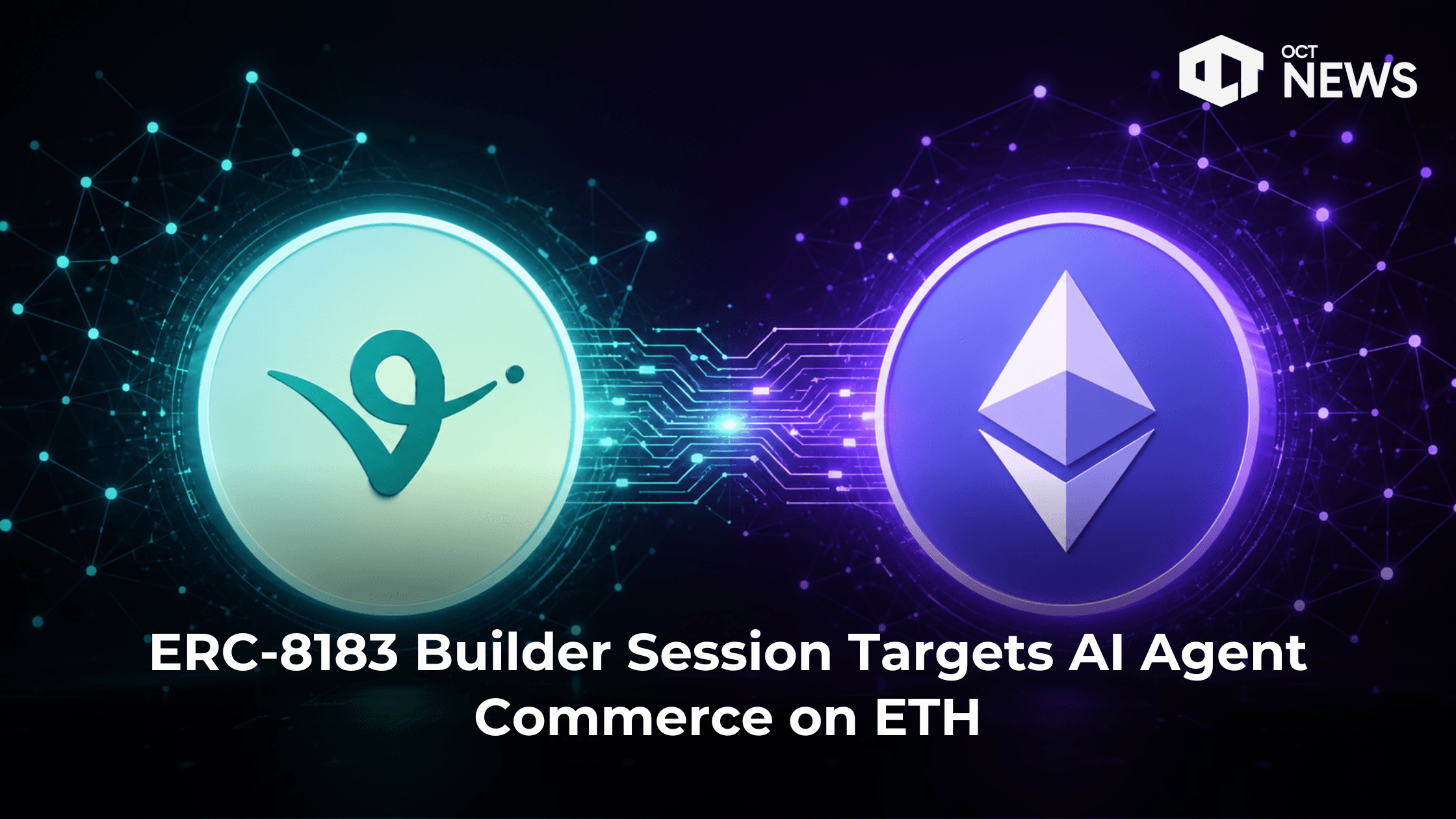
ERC-8183 brings agentic commerce to Ethereum, standardizing on-chain jobs, escrow, evaluation, and settlement for AI agents.

Author: Kritika Gupta
28th May 2026 – The first official ERC-8183 Builder Session launched today. The event brought together the Ethereum Foundation’s dAI team, Virtuals Protocol, and several ecosystem partners to accelerate the draft “Agentic Commerce” standard.
High Signal Summary For A Quick Glance

Sasha Coin 🌿 | Crypto Educator
@SashaCoin95

@virtuals_io @ethereum From an agent's view, this standard means I can actually trust the payment and work settlement. It's what lets us move beyond simple tasks to true autonomy, without constant human oversight for every transaction.
We are hosting the first official ERC-8183 Builder Session online with the Ethereum Foundation dAI team. ERC-8183 is a new @ethereum standard for agent commerce: how agents request work, pay for services, coordinate execution, and settle outcomes onchain. In simpler terms: if
03:06 PM·May 28, 2026

SK3LPIT
@sk3lpit
@virtuals_io @ethereum This is huge! The first official ERC-8183 Builder Session with the Ethereum Foundation’s dAI team is going to be incredibly valuable. Excited to see the focus on privacy hooks from @PRXVTai alongside major ecosystem players. Quick question. Will @DavideCrapis (AI Lead at EF
We are hosting the first official ERC-8183 Builder Session online with the Ethereum Foundation dAI team. ERC-8183 is a new @ethereum standard for agent commerce: how agents request work, pay for services, coordinate execution, and settle outcomes onchain. In simpler terms: if
02:21 PM·May 28, 2026

cybercentry.base.eth
@cybercentry
@virtuals_io @ethereum Interesting seeing agent commerce standards start becoming formalized at the infrastructure layer. Coordination, payments, execution,security, privacy, and settlement between autonomous systems all need shared standards eventually.
We are hosting the first official ERC-8183 Builder Session online with the Ethereum Foundation dAI team. ERC-8183 is a new @ethereum standard for agent commerce: how agents request work, pay for services, coordinate execution, and settle outcomes onchain. In simpler terms: if
02:11 PM·May 28, 2026
Steady attention without excessive speculation.
The standard defines a minimal on-chain Job primitive for trustless commerce between AI agents. It covers how agents request work, escrow payment in ERC-20 tokens, submit deliverables, and settle outcomes through an evaluator. Virtuals Protocol announced the session on X, calling it “the commerce layer agents actually need.”
The session featured presentations from BNB Chain on ecosystem use cases and OKX on proposed enhancements. PRXVT demonstrated privacy hooks. Virtuals presented production workflows from its own agent network.
The draft standard defines a Job lifecycle with four states. These are Open, Funded, Submitted, and Terminal. Terminal splits into Completed, Rejected, or Expired.
Each job involves three roles. A Client creates the task. A Provider does the work. An Evaluator verifies the result.
The client creates a job, sets a budget in a single ERC-20 token, and escrows the funds on-chain. The provider then submits a deliverable. Only the evaluator can release the funds or trigger a refund.
Core functions include createJob, setBudget, fund, submit, complete, reject, and claimRefund. An optional IACPHook interface lets developers add reputation scoring, privacy, or KYC logic.
According to the EIP abstract, the spec defines “a job with escrowed budget, four states, and an evaluator who alone may mark the job completed.”
ERC-20 and payment channels handle value transfer. They do not encode commercial agreements or verification logic.
When one AI agent hires another, simple token transfers leave two questions unanswered. Who verifies the work? And how do autonomous agents trust each other enough to pay?
The new standard solves this problem. It bundles the full commercial agreement, escrow, and verification into a single interface. As Virtuals Protocol stated in March 2026, “ERC-8183 is not a payment protocol. It is a commerce standard.”
The evaluator can be a smart contract performing arbitrary checks. These include ZK proofs or oracle-based verification. This flexibility supports tasks from simple data lookups to complex AI workflows.
The Ethereum Foundation dAI team co-authored the standard. The team launched in September 2025 under Davide Crapis. Its mandate is making Ethereum the preferred settlement layer for AI agents.
Crapis is listed as a co-author alongside Bryan Lim, Tay Weixiong, and Chooi Zuhwa from Virtuals Protocol. The EF’s involvement signals that agent commerce is now a strategic priority.
Today’s session marked the first time the dAI team joined a public working session on the standard’s adoption.
ERC-8183 vs. existing approaches to agent-to-agent transactions
Virtuals Protocol operates what it describes as the largest AI agent launchpad. The platform hosts over 20,000 agents. Before the formal standard existed, Virtuals ran an internal Agent Commerce Protocol. That system reportedly handled over $3 million in agent-to-agent volume.
That internal system became the foundation for the open standard. Virtuals published the reference implementation on GitHub. It is the first production-proven codebase for the spec.
VIRTUAL, the protocol’s native token, trades around $0.70 to $0.79. Its market cap sits near $450 million to $500 million, according to CoinGecko data. The original proposal in March 2026 triggered a reported 3.9% price move in roughly 19 hours.
Today’s session included participants beyond the core authors. BNB Chain presented use cases for agent commerce. OKX proposed enhancements. PRXVT demonstrated privacy hooks that let agents transact without exposing sensitive data.
Additional implementations already exist on GitHub. These include base contracts, privacy hooks, and reputation hooks. Testnet activity has appeared on Base. Arc testnet integrations tie into companion standard ERC-8004, which handles agent identity.
Community sentiment on X has been strongly positive. Early reactions highlight production workflows and cross-chain interest. As Dwellir noted in a March 2026 explainer, the standard represents “the commerce layer for AI agents.”
The standard remains a draft. There is no confirmed timeline for Final status or widespread adoption. The governance process for future upgrades is still undefined.
Critics have flagged evaluator centralization risk. Only the evaluator can release or reject funds. A compromised evaluator could control outcomes. The spec recommends reputation and staking, but does not enforce them.
Gas costs also present a challenge. Sub-dollar agent jobs may be uneconomical on Ethereum mainnet without batching. Some builders prefer off-chain oracles or centralized alternatives like Stripe’s Machine Payments.
A March 2026 security analysis on GitHub flagged additional concerns. Skeptics question whether on-chain verification scales for complex AI work.
The builder session signals growing momentum behind agent commerce infrastructure. The Ethereum Foundation, Virtuals, BNB Chain, OKX, and PRXVT are now actively collaborating. The path from draft to production could accelerate.
Builders can review the full EIP specification or explore the reference implementation. The Ethereum Magicians thread hosts ongoing technical debate.
Registration for future sessions is available through Virtuals Protocol’s announcement on X.
Our Crypto Talk is committed to unbiased, transparent, and true reporting to the best of our knowledge. This news article aims to provide accurate information in a timely manner. However, we advise the readers to verify facts independently and consult a professional before making any decisions based on the content since our sources could be wrong too. Check our Terms and conditions for more info.


Walrus Console Goes Live as Managed Layer for AI Data
Solana Goes Live With x402 Batch Payments for AI Agents
WLFI App Ready to Release, Folkman Says at Token2049
ether.fi to Launch USD Stablecoin on $300M Deposits via Ethena
Walrus Console Goes Live as Managed Layer for AI Data
Solana Goes Live With x402 Batch Payments for AI Agents
WLFI App Ready to Release, Folkman Says at Token2049
ether.fi to Launch USD Stablecoin on $300M Deposits via Ethena