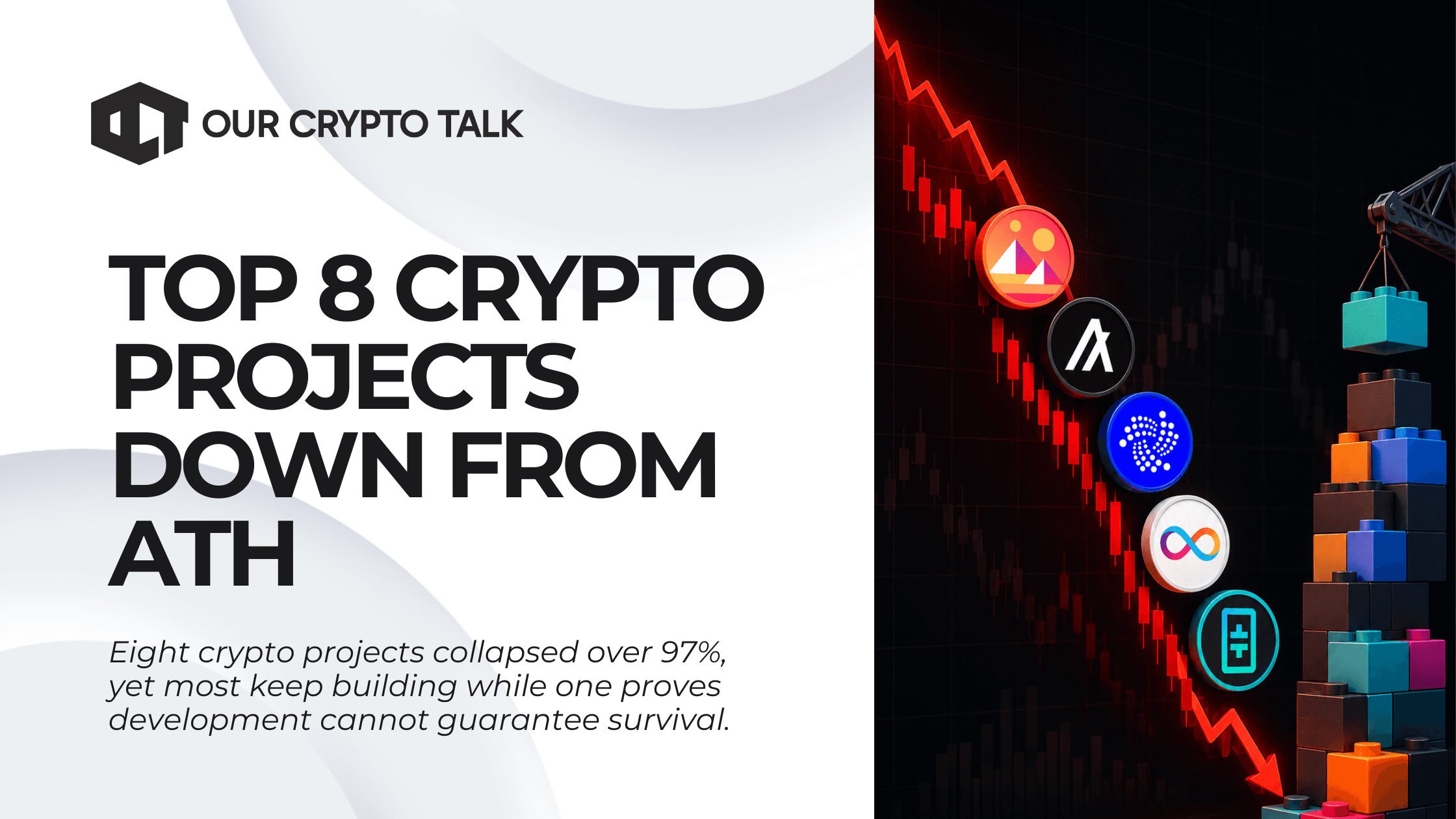
8 crypto projects are down 95% to 99.7% from their ATHs but still shipping. See the developer data that splits hidden gems from value traps.

Author: Kritika Gupta
In 2026, 99 crypto projects shut down. However, some of the market’s hardest-hit tokens are not dead at all. Several crypto projects down more than 95% from their all-time highs continue to ship code and upgrade their networks. Internet Computer trades 99.7% below its peak but records the third-highest developer activity in crypto. Filecoin has also fallen 99.7%, yet it leads the entire industry in daily GitHub commits. The market has given up on these tokens. Their teams have not.
So, are these projects value traps or generational opportunities? This article examines eight projects that lost between 95% and more than 99% of their token value while their teams continued building. Seven remain active. One died trying. Both outcomes offer valuable lessons.
CoinDesk described the August 2026 market as a “dot-com-style shakeout.” Liquidity disappeared from smaller assets, token unlocks continued to pressure thin order books, and investor attention shifted toward Bitcoin, Ethereum, and a small group of narrative leaders. Meanwhile, Forbes argued that community-driven projects that keep building regardless of macro conditions could produce the market’s next generation of winners.
Crypto history supports that possibility. Bitcoin and Ethereum both began as overlooked, low-value experiments whose developers continued building through weak markets, limited adoption, and widespread skepticism. Still, development alone cannot guarantee a recovery. A collapsing token price and a dying project represent two different events. The market determines the first. The team’s ability to keep shipping, attract users, and maintain sufficient funding determines the second.
We used four measurable filters to identify crypto projects down more than 95% from their all-time highs that continue to build. Instead of relying on press releases, social engagement, or community sentiment, we first reviewed Santiment’s January 2026 developer activity snapshot. The data filters out cosmetic commits and isolates meaningful code updates. Filecoin averaged 349 daily commits, Chainlink recorded 211, and Internet Computer posted 200. Public repositories make this activity verifiable, so these figures represent hard development data rather than marketing claims. We also examined shipped upgrades. Specifically, did each team launch mainnet features, protocol upgrades, or new products during 2025 and 2026?
Next, we assessed team status and ecosystem activity. Are the founders still involved? Has the team expanded or reduced its headcount? Did senior executives or the CEO resign? We then examined TVL, daily transactions, active users, and partnerships that generate measurable usage. In other words, does anyone actually use the product? A project can maintain high developer activity and still make a poor investment. Building does not guarantee a price recovery. However, a team that stops building almost always guarantees the project’s death. At a minimum, these eight projects are still trying.
Crypto Projects Down 97% to 99% From Their All-Time Highs
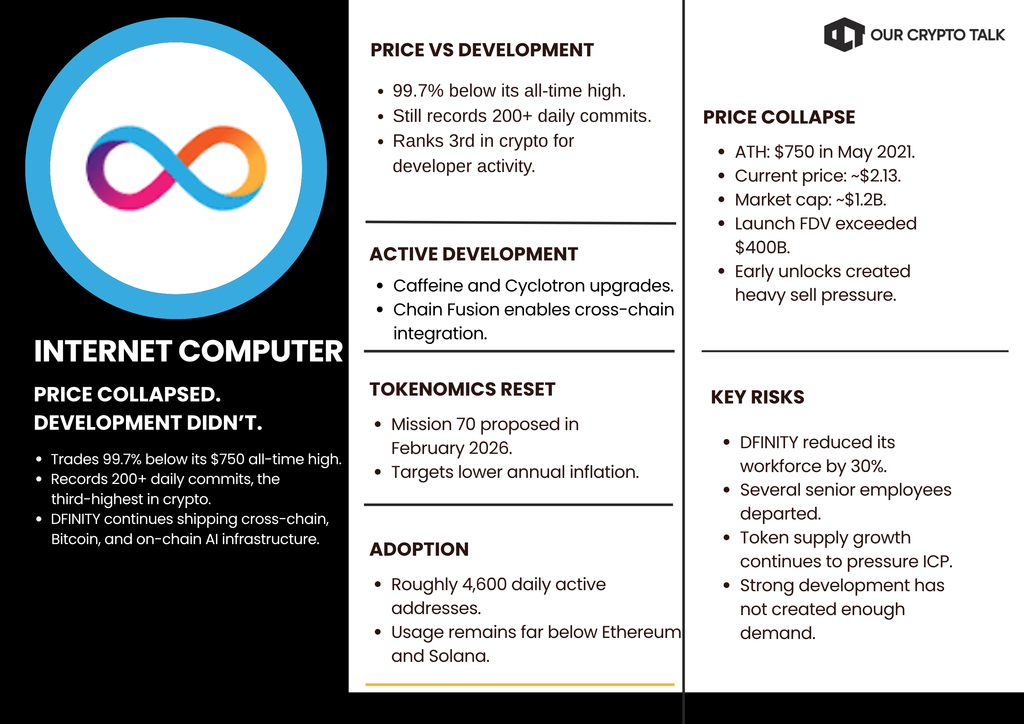
Internet Computer presents one of crypto’s most extreme examples of price and development moving in opposite directions. ICP reached an all-time high of $750 in May 2021. Today, it trades near $2.13, representing a 99.7% decline, with a market capitalization of roughly $1.2 billion. Much of the damage began at launch, when ICP entered the market with an implied fully diluted valuation above $400 billion. Early investor unlocks then flooded the market with supply, retail holders absorbed severe losses, and the stigma from that initial mispricing never disappeared.
Despite the token’s collapse, DFINITY continued shipping major infrastructure. The Caffeine and Cyclotron upgrades improved network performance and developer tooling. Chain Fusion expanded ICP’s cross-chain capabilities, while ckBTC brought Bitcoin onto the Internet Computer as a native, on-chain asset. Meanwhile, DFINITY continued experimenting with on-chain AI, moving beyond simple demonstrations toward applications that run models and AI agents directly on decentralized infrastructure.
The development data supports the argument that ICP remains active. Santiment recorded more than 200 daily commits for the project, the third-highest total in crypto. In February 2026, DFINITY also introduced Mission 70, a proposal to reduce annual token inflation from 9.72% to 5.42%. The proposal targets one of ICP’s most persistent economic problems: ongoing supply growth that weakens demand and places sustained pressure on the token. If implemented successfully, Mission 70 could improve ICP’s long-term tokenomics, although it cannot create adoption on its own.
The honest assessment remains straightforward. ICP is technically one of the most ambitious projects in crypto. It is also one of the worst-performing tokens in crypto history. Both statements are true. Furthermore, the risks remain significant. DFINITY reduced its workforce by 30%, several senior employees departed, and years of development have produced only modest adoption. ICP records roughly 4,600 daily active addresses, far below Ethereum and Solana. Therefore, the flagship question is not whether DFINITY can keep building. It clearly can. The real question is whether the network can turn that technical progress into enough users, demand, and economic activity to justify a meaningful repricing.
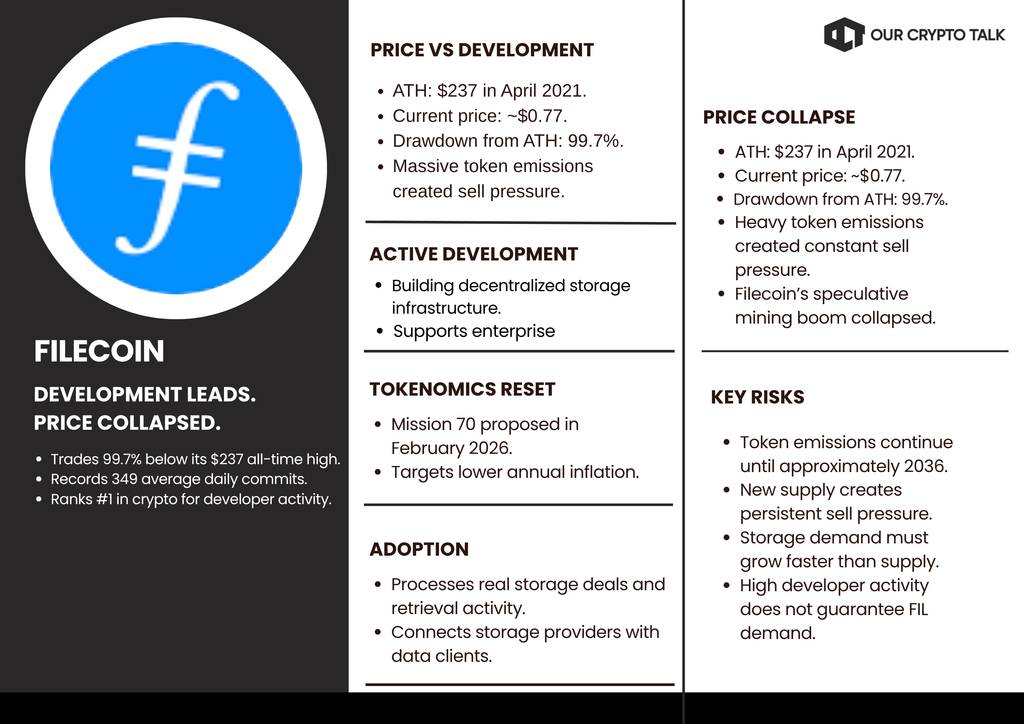
Filecoin reached an all-time high of $237 in April 2021. Today, FIL trades near $0.77, placing it 99.7% below its peak. Several factors drove the collapse. Massive token emissions created persistent sell pressure, while the speculative mining bubble that fueled Filecoin’s early growth eventually burst. At the same time, decentralized storage competitors such as Arweave and Storj challenged Filecoin’s market position.
However, the team never stopped building. Filecoin continues developing a decentralized storage network with real enterprise and archival use cases, positioning itself as an alternative to centralized services such as Amazon S3. More importantly, Santiment’s January 2026 data recorded an average of 349 daily commits for Filecoin, the highest developer activity in all of crypto. That level of output shows that Filecoin remains an active technical ecosystem, even if its token price suggests otherwise.
The honest assessment captures the contradiction. The project with the highest measured developer activity in crypto also trades 99.7% below its all-time high. That gap represents either one of the market’s largest overlooked opportunities or the clearest evidence that building means little without sufficient demand. Filecoin will continue emitting tokens until approximately 2036, creating consistent sell pressure. Therefore, storage demand and network usage must grow faster than the available supply. Until that happens, Filecoin’s development activity remains impressive, but it does not guarantee a token recovery.
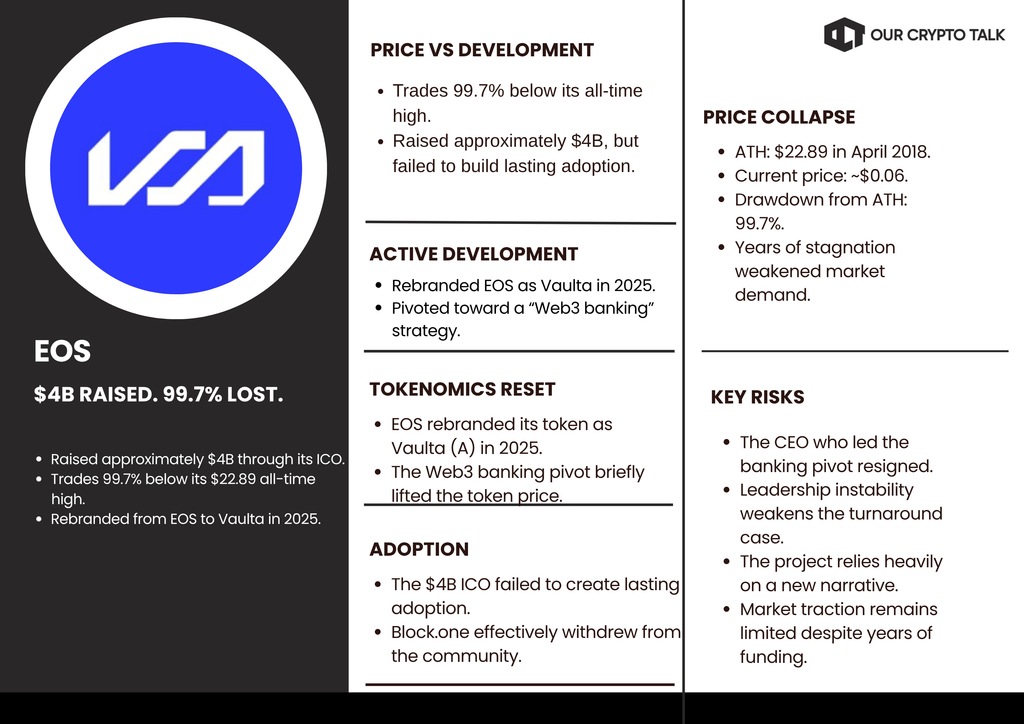
EOS reached an all-time high of $22.89 in April 2018. Today, the rebranded Vaulta token, A, trades near $0.06, placing it approximately 99.7% below that peak. The project raised around $4 billion through its 2017 and 2018 ICO, making it one of the most heavily funded launches in crypto history. However, that enormous war chest failed to produce lasting adoption. Block.one, the company that created EOS, later paid $24 million to settle with the SEC and effectively withdrew from the community. Years of stagnation followed.
In 2025, the remaining organization rebranded EOS as Vaulta and pivoted toward a “Web3 banking” strategy. The announcement briefly lifted the token, but the rally quickly collapsed. Vaulta then reached a new all-time low in January 2026 and set another low in June. Meanwhile, the CEO who led the banking pivot resigned, adding another major warning sign to an already fragile turnaround story.
Vaulta presents the weakest “still building” case on this list. The rebrand generated a short-lived market reaction but produced little evidence of meaningful protocol adoption or renewed demand. Moreover, the CEO’s resignation raises questions about the project’s leadership and long-term direction. Vaulta belongs on this list because it shows the difference between sustained technical development and a distressed project searching for a new narrative. ICP represents genuine building despite weak price performance. Vaulta looks much closer to desperate pivoting.
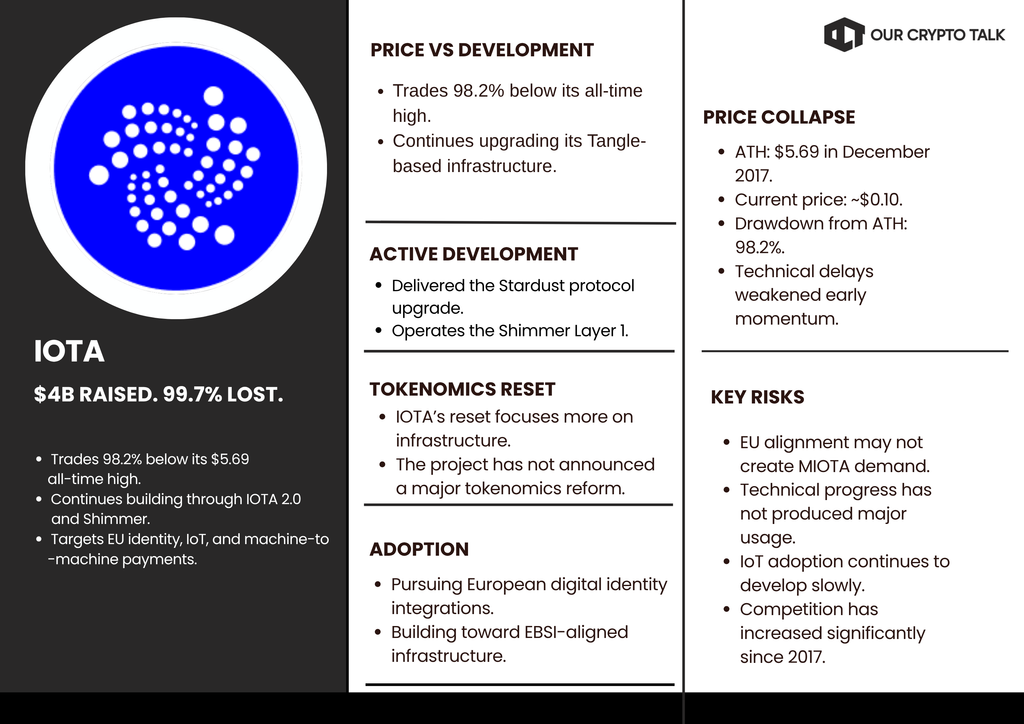
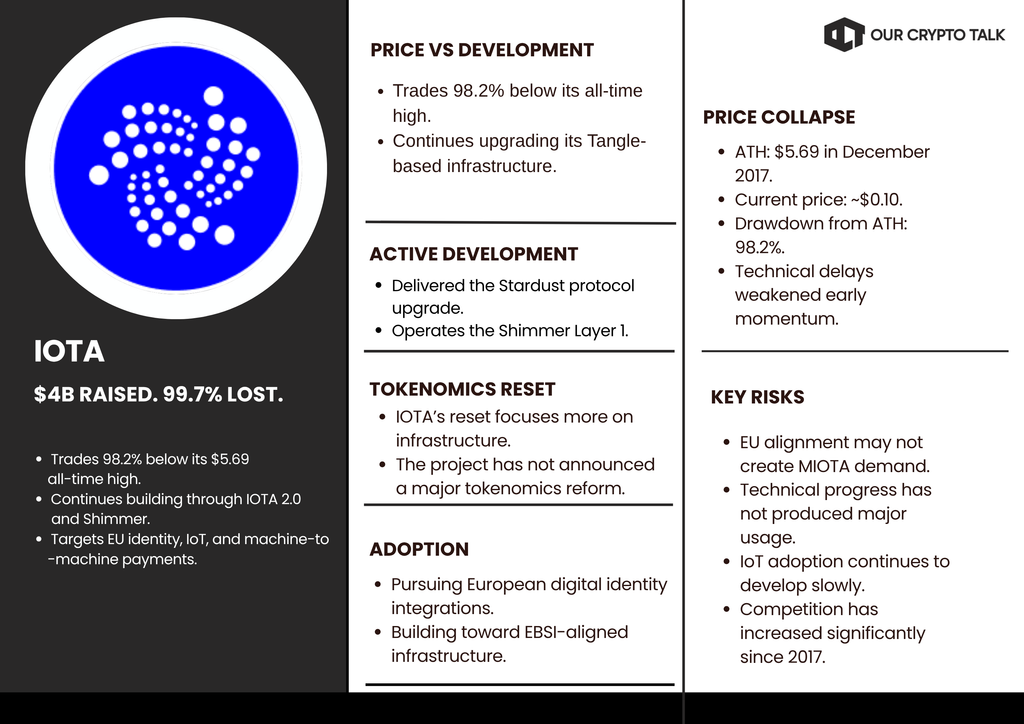
IOTA reached an all-time high of $5.69 in December 2017. Today, MIOTA trades near $0.10, placing it approximately 98.2% below its peak. The project’s original Tangle architecture promised a scalable alternative to traditional blockchains, but the technology encountered significant performance challenges. IOTA also relied on a centralized Coordinator to secure the network, which weakened its decentralization claims. Meanwhile, slow development cycles allowed faster-moving competitors to capture users, developers, and market attention.
Nevertheless, IOTA continued developing its infrastructure through the IOTA 2.0, or Stardust, upgrade and the Shimmer Layer 1 staging network. Among the crypto projects down more than 95%, IOTA stands out through its focus on European digital identity systems and compliance with the European Blockchain Services Infrastructure. This strategy supports its broader focus on IoT and machine-to-machine payments. IOTA has survived longer than most projects from the 2017 cycle, while its EU regulatory strategy gives it a more differentiated position than projects chasing the latest crypto narrative. However, survival and institutional alignment do not automatically create token demand. The key question is whether IOTA can convert its technical progress and European integrations into real network usage and long-term value for MIOTA.
Algorand reached an all-time high of $3.56 in June 2019. Today, ALGO trades near $0.09, placing it approximately 97.5% below its peak. Aggressive early token distribution created sustained sell pressure, while the network failed to maintain its momentum after the bull market ended. Although Algorand positioned itself as a fast, scalable, and institution-ready Layer 1, competing networks captured more developers, liquidity, and users.
Even so, Algorand continues to develop its underlying infrastructure. The team has shipped Algorand Virtual Machine upgrades, introduced State Proofs for cross-chain verification, and maintained its focus on institutional and government use cases. Its partnership with FIFA, including support for the FIFA+ platform, also remains active. Turing Award-winning cryptographer Silvio Micali founded Algorand, so the project’s academic and technical pedigree is real. However, the market traction has never matched that reputation. The key question is whether Algorand can convert its strong technology and institutional relationships into sustained usage and meaningful demand for ALGO.
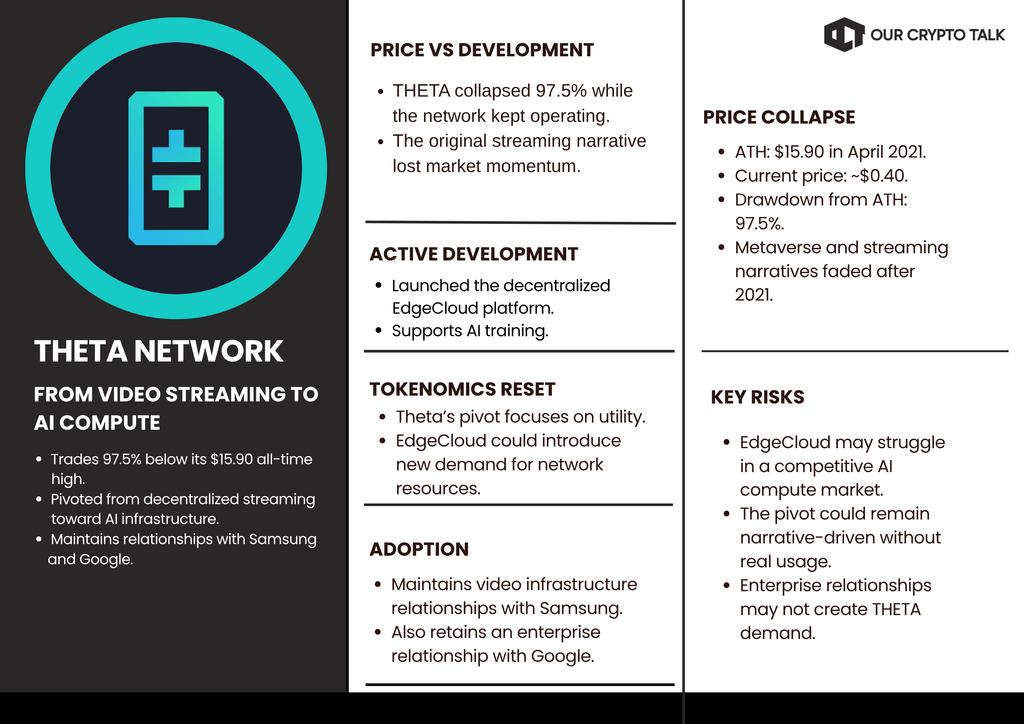
Theta Network reached an all-time high of $15.90 in April 2021. Today, THETA trades near $0.40, placing it approximately 97.5% below its peak. Among the crypto projects down more than 95%, Theta stands out for shifting from decentralized video delivery toward AI compute. The token initially benefited from strong interest in streaming, the metaverse, and creator-focused platforms. However, those narratives peaked during the 2021 bull market and quickly lost momentum. As investor attention moved elsewhere, Theta struggled to convert its early hype into sustained demand and network activity.
In response, Theta expanded beyond video delivery and launched EdgeCloud, a decentralized platform for AI training, inference, rendering, and other compute-intensive workloads. The project also maintains video infrastructure relationships with Samsung and Google, giving it more enterprise credibility than most smaller crypto networks. Strategically, the shift from streaming toward AI compute makes sense because it applies Theta’s distributed infrastructure to a faster-growing market. However, the market has not rewarded the pivot yet. Theta must now prove that EdgeCloud can attract recurring compute demand rather than simply attach an AI narrative to an older network.
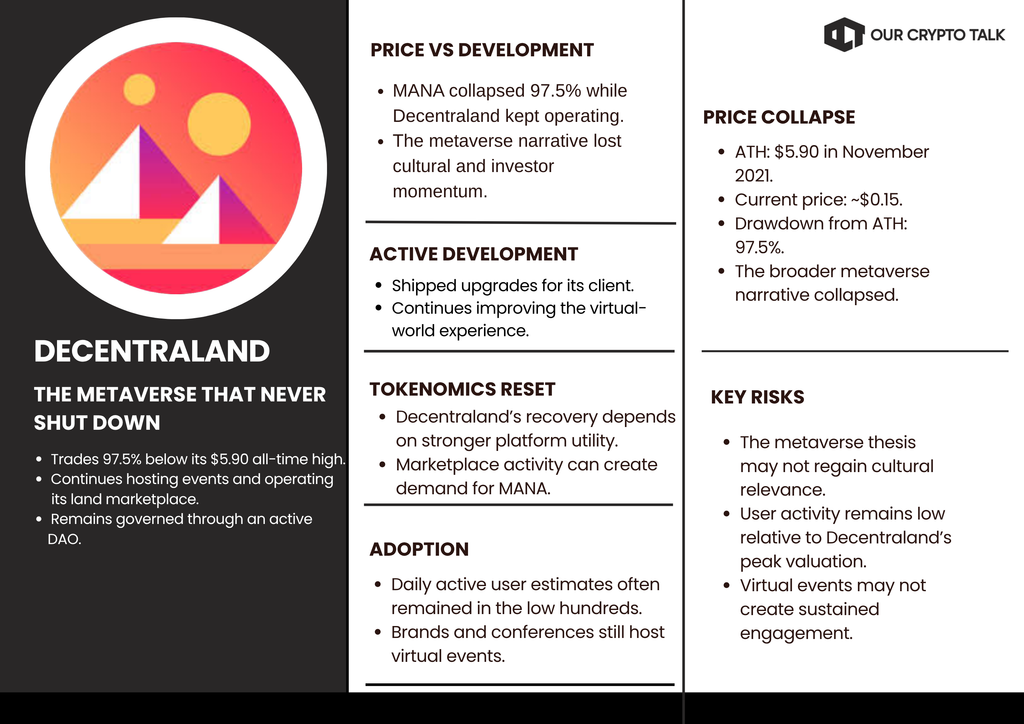
Decentraland reached an all-time high of $5.90 in November 2021. Today, MANA trades near $0.15, placing it approximately 97.5% below its peak. Among the crypto projects down more than 95%, Decentraland offers one of the clearest examples of hype separating from actual usage. The token collapsed as the broader metaverse narrative lost momentum. At its height, Decentraland carried a multibillion-dollar valuation while daily active user estimates often remained in the low hundreds. The enormous gap between the project’s market value and actual usage quickly became a recurring meme across the crypto industry.
Still, Decentraland continues to operate. The team has shipped desktop client upgrades, the DAO remains active, brands and conferences continue to host virtual events, and users still trade digital land through its marketplace. Decentraland may rank among crypto’s most mocked projects, but it never fully shut down. Whether that survival represents admirable persistence or futile stubbornness depends on one unresolved question: will the metaverse thesis ever regain cultural relevance and attract enough users to justify the network’s existence?
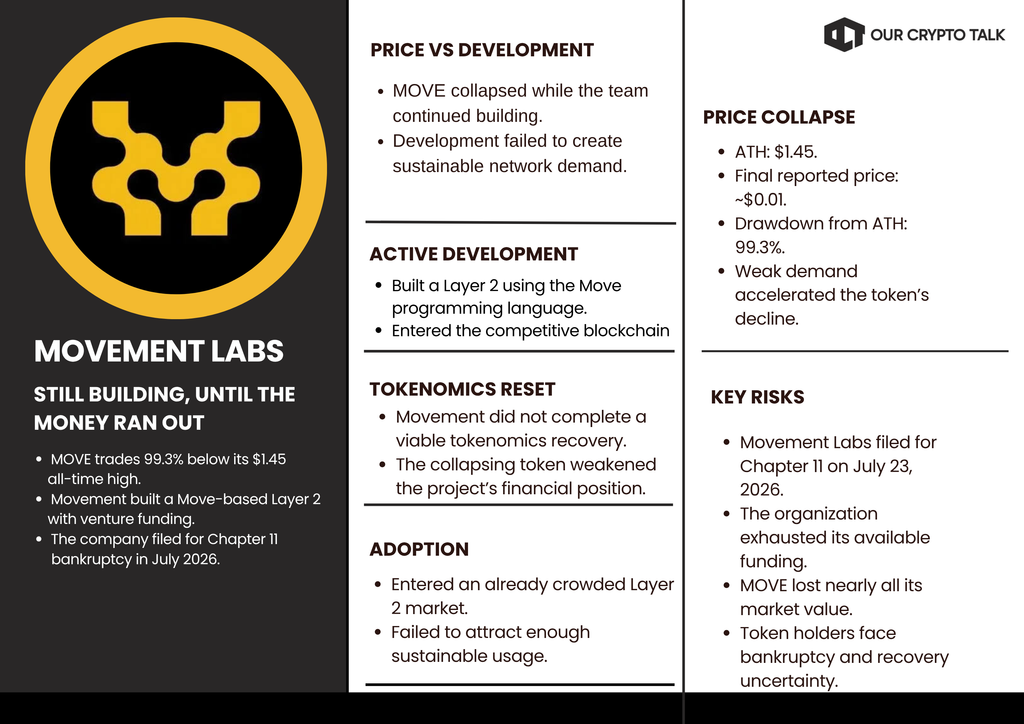
Movement Labs provides the cautionary tale that this list needs. MOVE reached an all-time high of $1.45 before falling to approximately $0.01, a 99.3% decline. On July 23, 2026, Movement Labs filed for Chapter 11 bankruptcy. The project built a Move-based Layer 2, raised venture capital, and entered an increasingly crowded infrastructure market. However, it failed to establish enough technical or commercial differentiation. As the token collapsed and funding disappeared, the organization eventually ran out of runway.
Movement proves that “still building” has a limit. Development activity cannot rescue a project that lacks sustainable demand, a viable economic model, or enough capital to continue operating. When funding runs out and the token loses nearly all its value, shipping code can only delay the end. Therefore, investors should never assume that crypto projects down 99% automatically qualify as hidden gems. Most tokens that fall this far never recover. Many projects simply die slowly while their teams continue working until the final dollar disappears.
The seven projects above are still building. Movement was too, until July. That difference often comes down to only a few months of remaining runway. Movement’s failure does not invalidate developer activity as a research signal, but it shows why investors must evaluate funding, adoption, token demand, and team stability alongside GitHub commits. Building may keep a project alive. It cannot guarantee survival.
A 99% drawdown can represent either the ultimate buying opportunity or the second-to-last stop before zero. For crypto projects down this heavily, the size of the decline alone tells investors very little. Instead, they must determine whether the project continues to create technology, users, and economic demand, or whether the remaining team is simply managing a slow decline. Developer activity offers a valuable starting point, but it cannot answer that question on its own.
First, look for verifiable signs of progress. Active commits across public GitHub repositories or filtered data from platforms such as Santiment show whether developers continue to improve the protocol. Then examine real usage metrics, including transactions, TVL, active users, storage demand, or compute consumption. These figures do not need to rival Ethereum or Solana, but they should show consistent growth. A credible opportunity should also have a funded team with several years of runway, recent product launches or protocol upgrades, and differentiated technology or partnerships that competitors cannot easily replicate.
Next, look for the warning signs of a value trap. Some projects label rebrands, website redesigns, and new marketing narratives as “development” even when the underlying protocol barely changes. Shrinking teams, departing founders, and executive resignations can also signal deeper problems. Investors should become especially cautious when years of development produce no measurable usage growth, token emissions continue to dilute holders without enough demand to absorb the new supply, or the project’s original thesis has structurally faded. A metaverse, IoT, or streaming project cannot rely on technical progress alone if the market no longer wants the product.
Finally, treat sustained development as a reason to research further, not as an automatic buy signal. GitHub commits can show that a team remains active, but they cannot prove product-market fit, protect the treasury, or create token demand. The strongest candidates combine technical progress with growing usage, controlled emissions, stable leadership, sufficient funding, and a clear reason for the token to accrue value. Developer activity helps investors distinguish a potential comeback from a dying project, but it never guarantees the outcome.


Top 8 Crypto Projects That Are 99% Down From ATH But Still Building
Crypto Launches Need Structure. Can Umia Deliver?
Monad vs MegaETH: Will These Fast Chains Pump in 2026?
Physical AI Needs 3D Data. Can OVER Deliver?
Top 8 Crypto Projects That Are 99% Down From ATH But Still Building
Crypto Launches Need Structure. Can Umia Deliver?
Monad vs MegaETH: Will These Fast Chains Pump in 2026?
Physical AI Needs 3D Data. Can OVER Deliver?