Umia is rethinking crypto fundraising with decision markets, noncustodial treasuries, and community-led token launches. Explore its model and risks.

Author: Akshat Thakur
Umia is live enough to use, but the full platform is still early. The $UMIA Tailored Auction is running on Base, while the broader venture-creation system has completed its testnet phase.
The early-bid window opened on August 26, 2026, with the public auction scheduled for August 29 to September 2. The auction uses Uniswap v4 Continuous Clearing Auctions, with live clearing prices, bid volumes, and FDV visible through the auction interface.
The testnet also generated meaningful activity. Umia reported 66,344 visitors, 159,366 auction bids, 96,119 decision-market trades, and 9,533 settlement claims. One Saturday accounted for 28.5% of all transactions on Base Sepolia.
The project has also published its legal wrapper, treasury model, and decision-market design. Certora is cited as the auditor, while Privy and card deposits support the auction experience.
The important limitation is that Umia has not yet proven itself as a multi-project venture factory. External projects are expected to begin onboarding in September, subject to legal review. The capital-formation system is live, but the broader thesis still needs third-party ventures and treasuries to validate it.
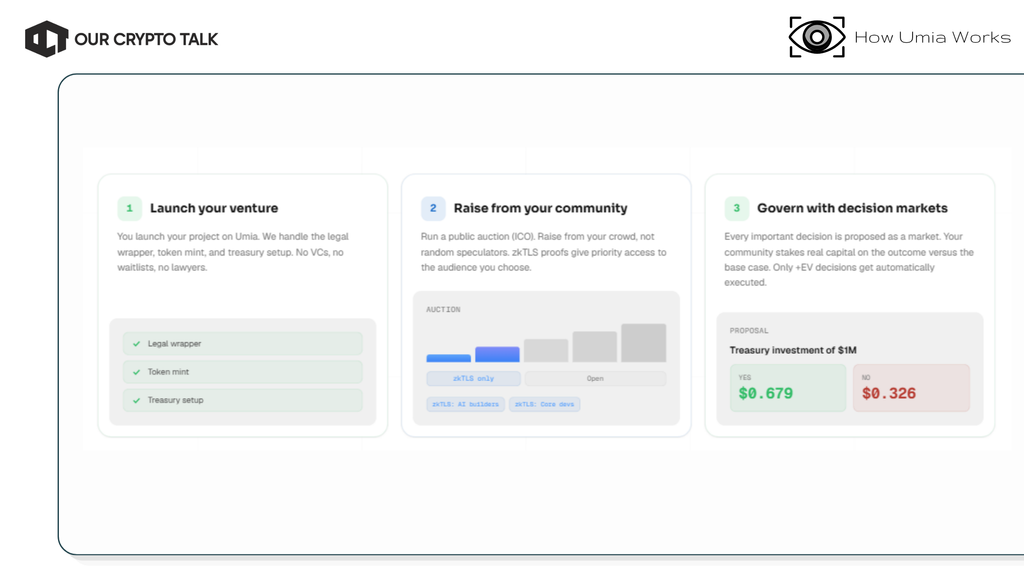
The strongest traction signal is the live $UMIA auction. Early clearing prices have reached around $0.18 to $0.19 against the $0.12 floor, implying roughly $9 million FDV on the 50 million total supply.
Bid volume has reached around $3.2 million with more than 100 bids. The auction also has a $2 million minimum raise, with funds fully refunded if the minimum is not reached.
Auction buyers receive liquid tokens without vesting after the sale closes. Early access is also restricted through zkTLS, giving builders, allocators, and decision-market participants access before the public round.
The testnet numbers provide another useful shipping signal. The 66,000+ visitors, 159,000+ bids, and 96,000+ decision-market trades show that users actually tested the infrastructure rather than simply viewing a landing page.
However, these numbers should not be treated as proof of product-market fit. Testnet activity does not equal paying customers, and auction demand does not prove that founders will use Umia for future ventures.
The real test begins when external projects launch through the platform. Umia needs to show that founders want its legal wrapper, treasury system, and decision markets instead of using MetaDAO or conventional launchpads.
$UMIA has a total supply of 50 million tokens, consisting of 40 million launch tokens and a 10 million performance reserve.
The auction floor is $0.12, which implies a $6 million FDV using the full 50 million supply. Early auction clearing has already pushed the implied valuation toward roughly $9 million.
Around 62% of the 40 million launch supply is expected to be unlocked at TGE, or approximately 24.8 million tokens. The public auction receives 17.3 million tokens, representing 43% of the launch supply, with no vesting.
Backers receive around 10.15 million tokens through Chainbound equity warrants. Those tokens have a 12-month cliff followed by vesting through month 36.
The team receives 2.5 million base tokens under a similar vesting structure. It also has access to the 10 million performance reserve, but those tokens unlock only after specific price milestones.
Service providers also receive a vested allocation, with press figures putting the amount around 3 million tokens.
This creates a relatively high initial float compared with low-float launches. Community buyers receive a large liquid allocation, while insiders face delayed unlocks and the additional team supply remains performance-gated.
The main risk is therefore not extreme insider concentration. It is valuation. Investors are pricing a platform that has not yet proven third-party venture volume or recurring protocol revenue.
$UMIA functions as the ownership and governance token for the Umia protocol. It is designed to govern Community Track launches, treasury decisions, and protocol strategy through decision markets.
The model also gives the Umia treasury a fixed percentage of the supply from Community Track projects. If the platform successfully launches multiple ventures, those assets could become part of the protocol’s economic base.
There is no mature fee switch or burn mechanism live today. That distinction matters.
At launch, $UMIA represents a claim on the future success of the venture factory rather than established cash flow. The design gives the token a real role in the system, but value accrual still depends on Umia successfully onboarding and launching external projects.
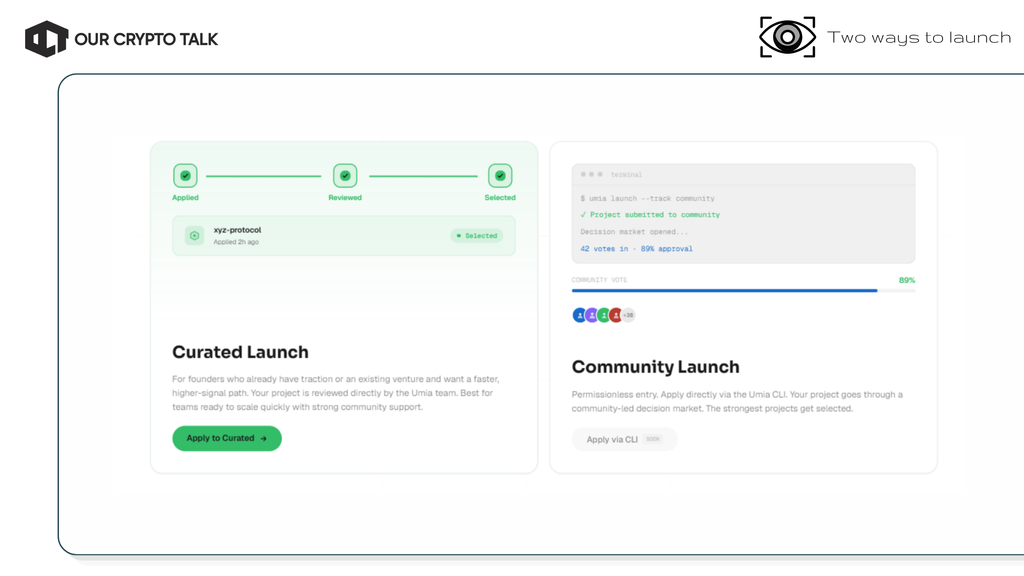
The main early opportunity is the $UMIA auction rather than a points campaign.
The early-bid window runs from August 26 to August 29, 2026, with access restricted through zkTLS. The public round begins on August 29 at 12:00 UTC and closes on September 2 at 12:00 UTC.
Participants bid a USDC budget alongside a maximum price. The auction continuously clears, while unused funds are refunded. If the $2 million minimum raise is not reached, participants receive a full refund.
Auction tokens have no vesting. Trading is expected to begin after the auction closes using protocol-owned Uniswap v4 liquidity.
The testnet has already ended, so users should not assume that previous testnet activity automatically converts into an allocation.
After TGE, participants can trade or provide liquidity for UMIA/USDC and take part in protocol decision markets once they launch. The next major opportunity will be watching the first external project auctions targeted for September.
The key point is that Umia is not offering a traditional farm right now. The auction is the early-access mechanism. The decision is therefore about whether the valuation at your maximum bid makes sense for an early venture-creation platform that has yet to prove third-party adoption.
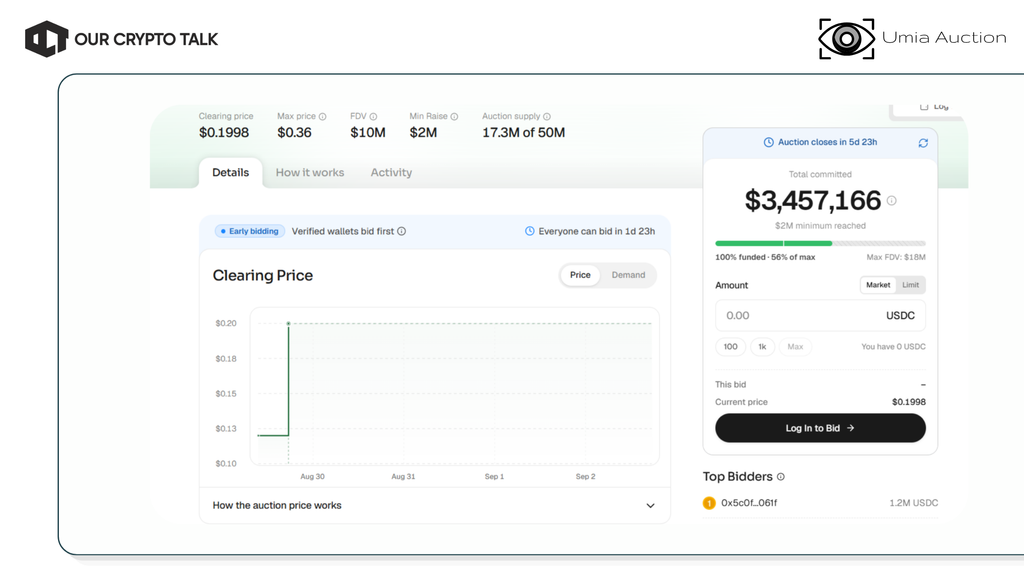
The main EV question this week is the $UMIA auction. The testnet has ended, so there is no meaningful points farm left.
Testnet participation is finished. The 159,000 auction bids and 96,000 decision-market trades were unpaid infrastructure testing, not a confirmed token allocation.
Leftover community tasks are unlikely to offer meaningful returns. This is not worth farming for rewards.
The auction uses Continuous Clearing rather than a fixed ICO price.
The floor is $0.12, implying around $6 million FDV on the 50 million total supply. Early bidding has already pushed clearing prices toward $0.18 to $0.19, or roughly $9 million FDV, with bid volume reaching the low millions of USDC.
A practical upper range around $0.36 would put the valuation in the mid-teens of millions if demand remains strong through the public round from August 29 to September 2.
The auction also has a $2 million minimum raise. If that target is missed, all bids receive a full refund. Buyers receive unvested tokens, while around 62% of the 40 million launch supply is liquid at TGE.
The closest comparison is MetaDAO and other market-governed ownership protocols. Umia brings a similar model to EVM with CCA auctions and a Cayman SPC wrapper, but it remains much earlier and has not yet proven third-party demand.
A sized auction bid can make sense if your maximum price keeps the implied FDV in the single-digit to low-teens millions.
The structure has several positives. The public allocation is the largest at 17.3 million tokens with no lock. Insiders face a 12-month cliff and 36-month vest, while the additional team allocation is performance-gated.
The refund mechanism also limits one major auction risk. If the $2 million minimum is not reached, bidders get their capital back.
The main limitation is adoption. Umia has no live external ventures, no mature protocol fee switch, and no proven founder pipeline yet.
The high TGE float also means auction buyers become much of the immediately available supply. The category already has a more established competitor in MetaDAO.
This is not a farm. It is a short, capital-at-risk opportunity that closes on September 2, 2026. The right approach is to bid only at a valuation you would accept even if external launches take longer than expected.
MetaDAO already owns much of the mindshare around ownership tokens and decision-market governance. Pump.fun-style launchpads dominate retail distribution and speed, while curated platforms and VCs control established sources of capital.
Umia needs to convince founders that its CCA auctions, legal wrapper, treasury controls, and decision markets provide enough value to switch from those alternatives. If founders continue launching elsewhere, the platform risks becoming a governance token without meaningful factory activity.
Umia depends on several narratives at once: ownership tokens, futarchy, decision markets, and AI-native ventures.
If interest in any of these areas fades, follow-on auctions could slow. The platform also faces the risk that founders simply decide conventional launchpads provide enough structure.
Regulation is one of the biggest risks.
Umia presents tokens as ownership primitives connected to a Cayman SPC, IP, operating team, and treasury. It also uses market-based governance to influence board-level decisions.
That structure can create securities and investment-contract questions across major jurisdictions. The Cayman wrapper may simplify the legal structure, but it does not eliminate offering-law or regulatory risk.
The risk becomes more significant if Umia markets future project tokens as direct ownership or financial rights.
Decision markets need sufficient liquidity and honest participation. Thin markets, manipulation, or poor market outcomes could make founders reluctant to place real treasury decisions under the system.
The large number of testnet trades proves that the infrastructure can handle activity. It does not prove that decision markets will work effectively with real money.
The next major test is external adoption.
If September launches get delayed, legal onboarding takes longer than expected, or founders do not use the CCA system, Umia could remain a technically impressive platform without meaningful factory volume.
The auction can work for $UMIA itself. The harder question is whether other projects will choose the same system.
Umia is not a code fork of MetaDAO, but the two projects operate in the same category.
Both combine market-governed ownership with community fundraising. Umia adds CCA auctions, EVM infrastructure, and a Cayman legal wrapper.
That makes the product meaningfully differentiated, but not a completely new primitive. The challenge is therefore distribution and adoption.
The immediate catalyst is the $UMIA auction.
The early-bid window runs through August 29, followed by the public auction from August 29 to September 2. The auction closes on September 2, after which claims, protocol-owned Uniswap v4 liquidity, and $UMIA spot trading are expected to go live.
The next major catalyst is external adoption. Umia is targeting its first external project launches in September, subject to legal review.
These launches will provide the first real test of whether Umia can turn its infrastructure into a functioning venture factory.
Act now only if you want auction exposure at the current clearing valuation and are comfortable with the platform’s early-stage risk.
Waiting is more appropriate if you want evidence that external founders will actually use the system. The next three months should show whether Umia can move beyond its own launch and onboard real ventures.
The auction offers the last structurally different entry point. After September 2, buyers become secondary-market participants with the full liquid supply available.
WATCH
Umia has a real capital-formation stack. The CCA auction, noncustodial treasury, decision markets, and Cayman SPC wrapper are live components rather than a concept deck.
The project also has a doxxed team with Ethereum infrastructure experience and is using its own system to launch $UMIA. The low-single-digit to roughly $9 million implied FDV and large public allocation create an interesting setup.
But Umia remains an unproven venture factory. It competes directly with MetaDAO, has yet to demonstrate external project volume, and carries meaningful regulatory risk around tokenized ownership.
The milestone that changes the rating is clear: an external venture completes a Tailored Auction, places its proceeds into the noncustodial treasury, and uses a live decision market to make a real board-level funding decision.
Until then, UMIA remains a Watch. It is cheap relative to its closest ownership-token analogs, but the factory still needs customers.
The main EV question this week is the $UMIA auction. The testnet has ended, so there is no meaningful points farm left.
Testnet participation was unpaid infrastructure testing. The 159,000 auction bids and 96,000 decision-market trades do not guarantee token rewards. Leftover community tasks are unlikely to offer meaningful returns, so farming is not worth the time.
The auction is more interesting. It uses a Continuous Clearing Auction rather than a fixed-price ICO. The floor is $0.12, which implies around $6 million FDV on the 50 million total supply. Early clearing has already reached around $0.18 to $0.19, implying roughly $9 million FDV, with bid volume in the low millions of USDC.
A practical upper range around $0.36 would put the valuation in the mid-teens of millions if demand remains strong through the August 29 to September 2 public round.
The auction has a $2 million minimum raise. If that target is missed, all bids receive a full refund. Buyers also receive unvested tokens, while around 62% of the 40 million launch supply is liquid at TGE.
The closest comparison is MetaDAO and other market-governed ownership protocols. Umia brings a similar model to EVM with CCA auctions and a Cayman SPC wrapper, but it remains much earlier and has not yet proven third-party demand.
The setup can offer positive EV if your maximum bid keeps the implied FDV in the single-digit to low-teens millions. The public allocation is the largest at 17.3 million tokens with no lock. Insiders face a 12-month cliff and 36-month vest, while the additional team allocation is performance-gated.
The main limitation is adoption. Umia has no live external ventures, no mature protocol fee switch, and no proven founder pipeline yet. The high TGE float also means auction buyers become much of the immediately available supply.
This is not a farm. It is a short, capital-at-risk opportunity that closes on September 2, 2026. Bid only at a valuation you would accept even if external launches take longer than expected.
Category competition is the first major risk. MetaDAO already owns much of the mindshare around ownership tokens and decision-market governance. Pump.fun-style launchpads dominate retail distribution and speed, while curated platforms and VCs control established sources of capital.
Umia needs to convince founders that its CCA auctions, legal wrapper, treasury controls, and decision markets offer enough value to switch from those alternatives. If founders continue launching elsewhere, the platform could become a governance token without meaningful factory activity.
Narrative risk also matters. Umia depends on ownership tokens, futarchy, decision markets, and AI-native ventures. If interest in these areas fades, follow-on auctions could slow.
Regulation is one of the biggest risks. Umia presents tokens as ownership primitives connected to a Cayman SPC, IP, operating team, and treasury. That structure can create securities and investment-contract questions across major jurisdictions.
The Cayman wrapper may simplify the legal structure, but it does not eliminate offering-law or regulatory risk. The risk becomes more significant if Umia markets future project tokens as direct ownership or financial rights.
Decision markets create another risk. They need sufficient liquidity and honest participation. Thin markets, manipulation, or poor market outcomes could make founders reluctant to place real treasury decisions under the system.
Execution and adoption remain unproven. If September launches get delayed, legal onboarding takes longer than expected, or founders do not use the CCA system, Umia could remain a technically strong platform without meaningful factory volume.
Umia is not a code fork of MetaDAO, but both projects operate in the same category. Umia adds CCA auctions, EVM infrastructure, and a Cayman legal wrapper, but its success still depends on distribution and adoption.
The immediate catalyst is the $UMIA auction. The early-bid window runs through August 29, followed by the public auction from August 29 to September 2. The auction closes on September 2, after which claims, protocol-owned Uniswap v4 liquidity, and $UMIA spot trading are expected to go live.
The next major catalyst is external adoption. Umia is targeting its first external project launches in September, subject to legal review.
Those launches will provide the first real test of whether Umia can turn its infrastructure into a functioning venture factory.
The auction is the more structurally advantaged entry point because it provides access before the platform proves third-party demand. After September 2, buyers become secondary-market participants with the full liquid supply available.
WATCH
Umia has a real capital-formation stack. The CCA auction, noncustodial treasury, decision markets, and Cayman SPC wrapper are live components rather than a concept deck.
The project also has a doxxed team with Ethereum infrastructure experience and is using its own system to launch $UMIA. The low-single-digit to roughly $9 million implied FDV and large public allocation create an interesting setup.
But Umia remains an unproven venture factory. It competes directly with MetaDAO, has yet to demonstrate external project volume, and carries meaningful regulatory risk around tokenized ownership.
The milestone that changes the rating is clear: an external venture completes a Tailored Auction, places its proceeds into the noncustodial treasury, and uses a live decision market to make a real board-level funding decision.
Until then, UMIA remains a Watch. It is cheap relative to its closest ownership-token analogs, but the factory still needs customers.
All the opinions in this article are that of the author and in no way are financial advice. Our Crypto Talk and the author always suggest you do your own research in crypto and to never take anything as financial advice that you read on the internet. Check our Terms and conditions for more info.


Tokenization of RWA yields onchain might be the biggest opportunity that no one has noticed
Cold Wallet Safety 2026: Are Hardware Wallets Still Safe?
One Token, Multiple Products. Can Zylo Deliver?
The Rise of NEAR Protocol 2026: Inside the 530% Rally and the ETF
Tokenization of RWA yields onchain might be the biggest opportunity that no one has noticed
Cold Wallet Safety 2026: Are Hardware Wallets Still Safe?
One Token, Multiple Products. Can Zylo Deliver?
The Rise of NEAR Protocol 2026: Inside the 530% Rally and the ETF