Monad vs MegaETH: we break down TPS, L1 vs L2 security, TVL, and 2026 unlock pressure to answer the one question every investor keeps asking. Will they pump?

Author: Kritika Gupta
Bitcoin fell roughly 22% in Q1 2026, while MON trades below its all-time high and MEGA has dropped about 55% from its opening levels. Monad and MegaETH promise faster EVM execution, but can their adoption outgrow competition and token unlocks? If crypto returns to a risk-on cycle, will these high-beta tokens pump or repeat the decline of earlier “faster Ethereum” chains?
Monad and MegaETH both want to solve the EVM’s performance limits, but they take fundamentally different routes. Monad built a new Layer 1 with parallel EVM execution, MonadBFT consensus, a dedicated validator network, and a custom state database. It targets 10,000 TPS, 300-millisecond blocks, and 600-millisecond finality. MegaETH built an Ethereum Layer 2 around specialized node roles and a highly optimized sequencer. It targets more than 100,000 TPS with sub-10-millisecond blocks while settling transaction results on Ethereum.
The core comparison table highlights the architectural trade-off. Monad spreads consensus across its validator network and secures the chain with staked MON. This approach gives Monad full sovereignty, but it also forces the network to bootstrap its own economic security. MegaETH concentrates normal transaction ordering and execution in a centralized sequencer to achieve near-instant performance. It avoids building an independent validator economy, but users still rely on its sequencer, proof system, data availability layer, bridge contracts, and upgrade controls.
Therefore, the comparison involves more than 10,000 TPS versus 100,000 TPS. Monad bets on combining decentralization, sovereignty, and speed. MegaETH bets that specialized infrastructure and Ethereum settlement can deliver the fastest possible EVM experience. Monad accepts a harder security bootstrap to control its full stack. MegaETH accepts greater execution centralization to reach real-time latency. The stronger model will depend on which chain converts its architectural advantage into applications, users, fees, and durable token demand.
Monad vs MegaETH: Architecture, performance, ecosystem and token comparison
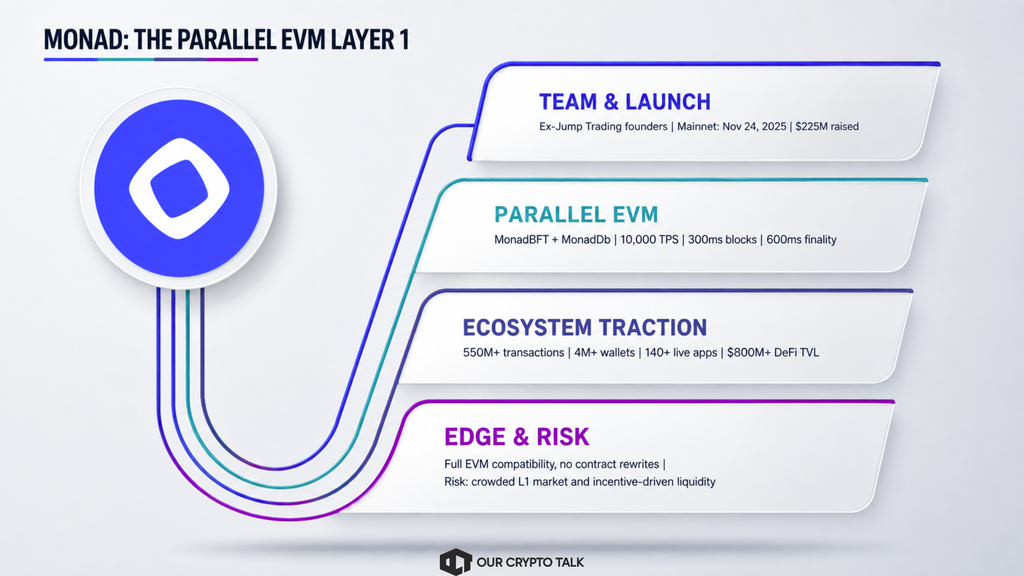
Former Jump Trading engineers Keone Hon, James Hunsaker, and Eunice Giarta founded Monad after working on high-frequency trading systems. The project raised approximately $225 million in its Paradigm-led funding round, with investors including Electric Capital, before launching its public mainnet and MON token on November 24, 2025. Additional rounds and its Coinbase public sale take broader fundraising estimates higher, although reports use different totals depending on which sales they include.
Monad accelerates the EVM through parallel execution. Instead of processing every transaction one at a time, the network executes independent transactions simultaneously and reprocesses conflicting transactions in the correct order. MonadBFT handles consensus, while MonadDb provides a custom state database optimized for parallel workloads. Following a performance upgrade, Monad now advertises 10,000 TPS, 300-millisecond blocks, and 600-millisecond finality, improving on its earlier 400-millisecond block and 800-millisecond finality figures.
Early adoption has moved beyond the March 2026 snapshot of 1.7 million to 2.1 million daily transactions, $355 million to $410 million in TVL, and more than 140 million cumulative transactions. By July 31, Monad reported more than 550 million processed transactions, over 4 million wallets, 140 live mainnet applications, and more than $800 million in DeFi TVL. Aave also went live in July instead of remaining a pending integration, surpassing $250 million in TVL within its first month. However, Monad incentives helped support some of these inflows, so investors should track whether liquidity remains after rewards decline.
Monad’s clearest advantage is full EVM bytecode compatibility. Developers can deploy existing Solidity contracts without rewriting core code and continue using familiar Ethereum wallets, RPC interfaces, and development tools. Nevertheless, easy migration does not guarantee lasting adoption. Monad still competes with Solana, Sui, Aptos, Berachain, Ethereum Layer 2s, and other high-performance networks for developers, liquidity, and users. Its long-term strength will depend on whether it turns technical compatibility into native applications and recurring fee demand rather than temporary deployments.
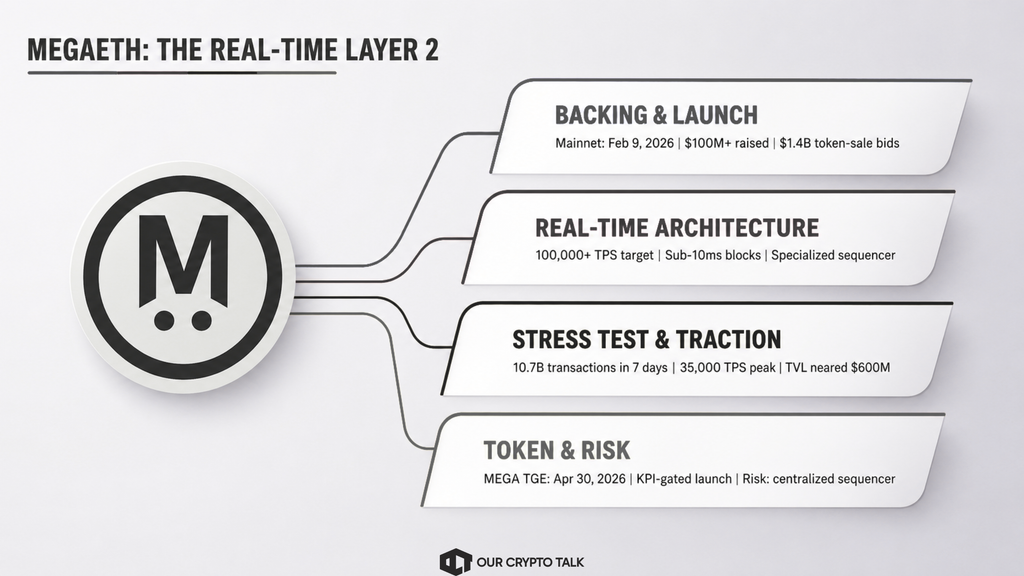
MegaETH launched its public mainnet on February 9, 2026, with backing from Ethereum co-founders Vitalik Buterin and Joe Lubin. The project raised more than $100 million across venture funding and community rounds, including a $20 million seed round led by Dragonfly Capital. Its public token sale also attracted roughly $1.4 billion in bids. However, investors should distinguish demand commitments from capital raised because the sale accepted only a limited allocation.
MegaETH calls itself a “real-time blockchain.” It separates network responsibilities across specialized node roles and uses a powerful sequencer to target more than 100,000 TPS and sub-10-millisecond blocks. Before mainnet, a seven-day stress test processed approximately 10.7 billion transactions and reached 35,000 TPS. Still, these results primarily demonstrate capacity under testing. MegaETH must now convert that speed into retained users, recurring fees, and applications that cannot operate as effectively on slower chains.
The network’s latency advantage could support real-time games, high-frequency trading systems, onchain order books, and prediction markets. Its TVL approached $600 million after the MEGA token launch, briefly placing MegaETH among the 15 largest tracked Layer 2 ecosystems and ahead of Monad in some May 2026 snapshots. Nevertheless, investors should look beyond headline TVL. Capital concentration, incentive-driven deposits, stablecoin liquidity, DEX volume, and application revenue provide a clearer view of whether the ecosystem generates sustainable activity.
MEGA launched on April 30, 2026, after MegaETH tied its TGE to measurable network milestones instead of a fixed date. The network triggered the launch after 10 MegaMafia applications met the required activity threshold. Other performance targets covered stablecoin supply, wallet activity, transaction volumes, and application fees. This structure aligned the token launch with visible adoption, but it did not prevent volatility. MEGA fell sharply after trading began, showing that performance gates cannot neutralize elevated valuations or early selling. Moreover, MegaETH still relies on a centralized sequencer for normal operation. If that sequencer fails, real-time execution stops until the network recovers or users access slower fallback mechanisms.
Monad operates as a sovereign Layer 1 with its own MonadBFT consensus and validator network. Therefore, the network derives security from staked MON rather than Ethereum. Monad must attract enough validators, distribute stake, and maintain sufficient token value to make attacks economically expensive. That security bootstrap creates more execution risk during the network’s early years, but it also gives Monad full control over its monetary policy, gas market, governance, and upgrade roadmap.
MegaETH takes the opposite approach. As a Layer 2, it settles transactions on Ethereum and does not need to create an independent validator economy from zero. This reduces one major startup challenge. However, “settled on Ethereum” does not mean every part of MegaETH inherits Ethereum’s security. Users still depend on MegaETH’s sequencer, proof system, bridge contracts, data availability layer, and upgrade controls.
MegaETH also concentrates normal transaction ordering and execution in a high-spec sequencer designed to run on infrastructure with more than 100 CPU cores and several terabytes of memory. This setup enables sub-10-millisecond blocks, but it creates a centralization and liveness risk. If the sequencer fails, MegaETH loses its normal real-time operation. Users can submit transactions through Ethereum after a delay of up to 12 hours, according to L2BEAT, so the network does not permanently stop. Still, that fallback cannot reproduce the experience that gives MegaETH its main advantage.
Monad bet on sovereignty and MegaETH bet on Ethereum settlement and specialized execution. Monad faces a harder security bootstrap but controls its full stack. MegaETH can launch without building a new validator economy, but it competes with dozens of live scaling networks and depends on centralized infrastructure during normal operation. Consequently, investors should compare validator distribution, sequencer resilience, withdrawal guarantees, and token value capture instead of ranking the two chains by TPS alone.
Technology does not determine token price. Supply dynamics do. As the unlock table shows, Monad launched with 50.6 billion of its initial 100 billion MON supply locked. However, the most important releases do not begin quarterly in mid-2026. Team, investor, and Category Labs treasury allocations face a one-year cliff from the November 2025 mainnet launch. Investor and treasury tokens then unlock monthly through late 2029, while team releases follow separate vesting conditions. Consequently, the market must begin absorbing a meaningful increase in tradable supply from November 2026 onward.
Arthur Hayes specifically criticized MON as a low-float, high-FDV venture-backed token and warned that insider unlocks could create sustained selling pressure. His argument highlights a real structural risk, although investors should treat his extreme price predictions as commentary rather than a base-case forecast. Monad’s market capitalization currently sits around $350 million. The TVL has expanded beyond $850 million from roughly $410 million in earlier 2026 snapshots. That growth improves the bull case, but TVL alone cannot absorb unlocks. Monad needs recurring fees, stablecoin activity, application revenue, and genuine MON demand to grow alongside circulating supply.
MegaETH tried to reduce immediate speculation by tying the MEGA TGE to measurable network performance. The mechanism delayed the token launch until the ecosystem met one of its predefined KPIs, but it could not eliminate selling once trading began. MEGA briefly traded above $0.22 before falling toward $0.15 during early price discovery, a decline of roughly 30%, although individual venues recorded wider intraday ranges. Its opening FDV reached approximately $1.8 billion to $2 billion before contracting. Therefore, the performance gate proved network activity before launch, but it did not solve low-float valuation pressure or turn early holders into long-term buyers.
Both Monad and MegaETH act as high-beta bets on the high-performance EVM thesis. If developers, users, and capital migrate toward these networks, rising fees and token demand could absorb new supply and amplify a broader bull market. If adoption depends on incentives or fails to produce durable revenue, unlocks can create persistent sell pressure throughout 2026 and 2027. The decisive question is not whether the technology works. It is whether organic economic activity grows faster than circulating supply.
MON vs MEGA: Supply structure, unlock schedules and potential dilution risks
Ethereum’s scaling shift has already happened. Layer 2 networks now process most Ethereum ecosystem transactions, while daily activity has grown from roughly 1 million transactions in 2023 to more than 10 million on many days. However, the growth has fragmented across dozens of networks. At the referenced snapshot, L2BEAT tracked 73 live projects and another 82 in development or review, with roughly $41 billion in aggregate value secured. Investors should note that L2BEAT’s value-secured metric differs from DeFi TVL, so the two figures should not be compared directly.
MegaETH faces this competition directly. It represented only a fraction of aggregate L2 value after its February launch. Even when its DeFi TVL approached $600 million, that equalled roughly 1.5% of a $41 billion market. Moreover, deposits do not automatically translate into active usage. MegaETH must compete with Base, Arbitrum, and other established networks for stablecoins, developers, wallets, market makers, and fee-generating applications. Monad faces the same pressure indirectly because it targets many of the same EVM developers and crypto-native users from outside the Ethereum L2 stack.
The question is not whether high-performance EVM chains provide useful infrastructure. They clearly do. The question is whether the market needs another general-purpose chain when dozens already compete for a limited pool of committed developers and productive capital. Ecosystem growth is not perfectly zero-sum because the overall crypto market can expand, but competition becomes close to zero-sum when chains use incentives to attract the same applications and liquidity. Therefore, Monad and MegaETH must create new demand rather than simply relocate activity from another network.
The market has heard the speed thesis before. Avalanche launched in 2020 with a 4,500 TPS claim and later attracted more than $11 billion in peak DeFi TVL. Today, its TVL sits far below that peak, while AVAX trades roughly 95% below its all-time high. However, Avalanche still processes substantial activity and has gained traction in stablecoins and tokenized assets. Its history shows that a functioning network can lose most of its token value when growth fails to match earlier expectations.
Fantom followed a similar cycle. It promoted fast, low-cost EVM execution and accumulated more than $7 billion in TVL before liquidity and attention declined. The ecosystem later migrated from Fantom Opera and FTM to the faster Sonic network and S token. Harmony suffered a more damaging outcome after North Korea-linked hackers stole roughly $100 million from its Horizon Bridge in 2022, destroying confidence and accelerating its loss of relevance. Meanwhile, NEAR expanded beyond the “faster Layer 1” narrative toward chain abstraction, intents, and multichain account infrastructure. That strategy may create new demand, but it also shows how difficult it is to compete on raw throughput alone.
The pattern remains consistent. New chains launch with high TPS claims, attract incentivized liquidity and developers, and then struggle to retain both when the market finds a newer platform. Meanwhile, token emissions and unlocks continue even as demand weakens. Monad and MegaETH must prove that they learned from this history. Monad needs lasting economic security and native applications, while MegaETH needs products that genuinely require real-time execution. Speed can attract attention, but only differentiated applications, recurring fees, strong security, and user retention can sustain value.
The bull case starts with distribution. Both networks support the EVM, so Solidity developers can port existing contracts without learning another programming language or rebuilding their entire stack. Monad has grown from roughly $400 million in early TVL to more than $800 million, while MegaETH approached $600 million shortly after its token launch. Paradigm-backed Monad and Vitalik Buterin-backed MegaETH also have the capital, industry access, and visibility required to attract developers and liquidity.
Both chains can offer more than benchmark numbers. Monad supports high-speed DeFi, lending, perps, and tokenized assets while maintaining an independent validator network. MegaETH’s real-time execution can improve onchain order books, games, prediction markets, and other latency-sensitive applications. If either network produces a breakout application, users, fees, liquidity, and speculative demand could reinforce one another. Moreover, new L1 and L2 tokens often behave as high-beta assets during risk-on periods, although investors should not treat a specific multiple of Bitcoin’s return as a dependable rule.
The bear case starts with dilution. Monad’s first major cliff arrives in November 2026, when team releases and monthly investor and treasury unlocks begin. Some third-party calendars estimate that roughly 17% of total supply could become available around the first anniversary, not more than 30% under the official 2026 schedule. MegaETH also launched with a relatively small circulating float and performance-linked supply releases. Therefore, both tokens need organic demand to expand fast enough to absorb new supply without relying on temporary incentives.
Competition makes that challenge harder. MegaETH competes with dozens of live Ethereum scaling networks, while Monad competes with L2s and alternative L1s. Solana is not EVM-compatible, but it already fills the broader high-performance application role with years of production history, approximately $5 billion in DeFi TVL, and deep trading liquidity. The developer market can expand, so it is not strictly zero-sum. Still, Electric Capital tracks roughly 28,000 monthly active crypto developers, which means every new ecosystem must fight for a limited number of experienced builders. Bitcoin’s roughly 22% Q1 2026 decline also demonstrated the macro risk. When liquidity contracts, low-float infrastructure tokens usually fall harder than BTC.
So, will MON and MEGA pump? In a broad bull market, probably. Both offer strong narratives, credible technology, recognizable backers, and enough liquidity to attract speculative capital. However, a cyclical rally does not guarantee long-term outperformance. The decisive test is whether fees, retained users, application revenue, and productive TVL grow faster than circulating supply. Previous “faster Ethereum” chains often rallied during their first cycle and then surrendered most of those gains. Monad and MegaETH can break that pattern, but history places the burden of proof on them.
Watch Monad if you believe sovereign Layer 1 networks can still win. Monad controls its own MonadBFT consensus, validator network, gas market, and economic security. Its former Jump Trading team also brings deep experience in low-latency systems. However, this independence means Monad must build and maintain enough distributed stake to secure the network without relying on Ethereum.
Watch MegaETH if you believe Ethereum will remain crypto’s dominant settlement layer and real-time execution will unlock a new application category. MegaETH avoids building an independent validator economy and can focus on sub-10-millisecond performance. Still, Ethereum settlement does not remove its sequencer, data availability, bridge, withdrawal, or upgrade risks. MegaETH offers the more direct real-time Ethereum thesis, but not necessarily the safer token.
For a more conservative approach, wait. Monad’s first major team release and investor unlocks begin in November 2026, while MegaETH continues to release supply through scheduled and performance-linked mechanisms. The current supply comparison also requires nuance. Only about 11.8% of MON trades publicly, even though the Foundation controls a much larger unlocked ecosystem allocation. MEGA launched with roughly 11.3% circulating and has since completed additional releases. Therefore, neither token clearly offers low dilution based on headline “unlocked” percentages alone.
For maximum upside, watch the asset with the lowest future dilution relative to genuine demand, not simply the one with more tokens technically unlocked. Compare upcoming releases with circulating supply, daily trading volume, fee revenue, and ecosystem growth. High-performance EVM chains represent real infrastructure. Whether their tokens become good investments depends on whether adoption grows faster than supply. Watch TVL quality, fees, retained users, and developer activity against the unlock schedule. That relationship matters more than any single TPS or price target.
This content is for informational and educational purposes only. It does not constitute financial, investment, or trading advice. Always conduct your own research.


Tokenization of RWA yields onchain might be the biggest opportunity that no one has noticed
Cold Wallet Safety 2026: Are Hardware Wallets Still Safe?
One Token, Multiple Products. Can Zylo Deliver?
The Rise of NEAR Protocol 2026: Inside the 530% Rally and the ETF
Tokenization of RWA yields onchain might be the biggest opportunity that no one has noticed
Cold Wallet Safety 2026: Are Hardware Wallets Still Safe?
One Token, Multiple Products. Can Zylo Deliver?
The Rise of NEAR Protocol 2026: Inside the 530% Rally and the ETF