
Banks and crypto firms have reportedly finalized a deal on stablecoin yield and the last major obstacle to the CLARITY Act is now cleared.

Author: Sahil Thakur
7th April 2026 – Banks and crypto firms have reportedly finalized a deal on stablecoin yield. As a result, the last major obstacle to the CLARITY Act is now cleared.
High Signal Summary For A Quick Glance

Bull Theory
@BullTheoryio

BREAKING: Banks and crypto firms have privately agreed on a deal for the Bitcoin market structure bill. An announcement is expected this week. The CLARITY Act has been stuck since January over one dispute, whether crypto platforms can offer yield on stablecoins. That fight https://t.co/YbCtOulJU3
07:38 PM·Apr 6, 2026

Diana
@InvestWithD
🚨CONFIRMED: CLARITY Act ENTERING Senate Banking Committee MONDAY NEXT WEEK — “WE’LL HAVE IT OUT IN APRIL” 🤯🔥 At the Vanderbilt Digital Assets Summit, Senator @SenatorHagerty CONFIRMED the CLARITY Act bill will enter the Senate Banking Committee NEXT WEEK. 🇺🇸 “We’re VERY https://t.co/Xbghk9DA4r https://t.co/9KdZZDo4bb

https://t.co/4XR9SjxBfp
07:20 PM·Apr 6, 2026

Bitcoin PulseX
@BitcoinPulseX
🚨 TODAY: SENATE BANKING COMMITTEE DIVES INTO THE CLARITY ACT 🇺🇸 REGULATORY CLARITY IS NEARLY HERE… ONCE IT LANDS, XRP IS SET TO SURGE FIRST, IGNITING A MASSIVE BULL RUN ACROSS CRYPTO. MEGA BULLISH 🎉🚀 https://t.co/dnDuqsP5HP

04:56 PM·Apr 6, 2026
High attention and emotional sentiment detected.
Senators Thom Tillis (R-NC) and Angela Alsobrooks (D-MD) brokered the compromise with White House backing. They reached the deal in principle around March 20, and both sides signed off on final terms over the weekend of April 3-4, according to sources.
Because of this breakthrough, closed-door meetings with the Senate Banking Committee are now underway. A committee markup is targeted for the second half of April.
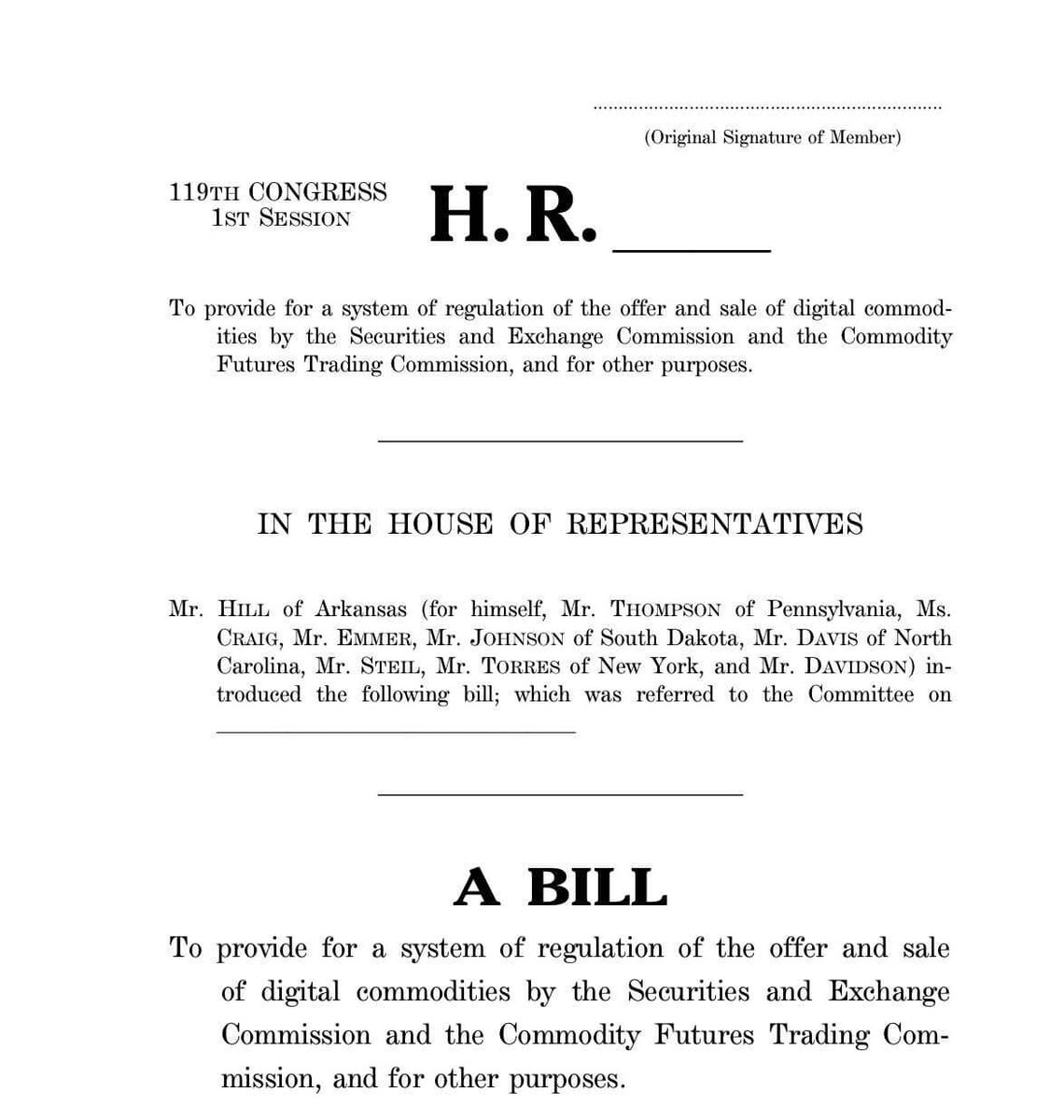
The Digital Asset Market Clarity Act of 2025 (H.R. 3633) creates a comprehensive federal framework for digital assets. Specifically, it assigns clear regulatory roles to both the CFTC and SEC.
Under the bill, the CFTC gains exclusive spot-market oversight for digital commodities like Bitcoin and Ethereum. Meanwhile, the SEC retains jurisdiction over tokens that qualify as securities.
In addition, the legislation includes rules for exchanges, intermediaries, and investor protections. Drafts also contain DeFi safe harbors, self-custody provisions, and anti-CBDC language. It builds on the GENIUS Act for stablecoin regulation.
The House passed the bill in July 2025 with a strong bipartisan 294-134 vote.
Since January 2026, a single question blocked progress on the bill. That question: can crypto platforms offer yield on stablecoins?
The banking industry, led by the American Bankers Association, argued that yield-bearing stablecoins function like deposits. According to the ABA, unrestricted stablecoin yield could trigger up to $6.6 trillion in deposit flight.
On the other side, Coinbase and other crypto firms pushed back. They argued that rewards are a core competitive feature. Banning them entirely, they said, would push innovation offshore.
Because neither side would budge, White House-brokered talks dragged on for months. As a consequence, the January 2026 Senate markup never happened.
The deal sets two clear rules for stablecoin yield on platforms.
First, it bans passive yield entirely. Platforms cannot pay rewards simply for holding a stablecoin balance. In other words, no interest-like returns on idle funds.
Second, activity-based rewards remain legal. For instance, platforms can still offer rewards tied to payments, transfers, or other platform activity.
According to CoinDesk, observers described this approach as protecting innovation while addressing deposit-flight concerns.
Senators Tillis and Alsobrooks reached the compromise around March 20, according to Politico.
Crypto firms then reviewed the draft text on March 24. Banks reviewed it the following day. Initial reactions were mixed, since some crypto firms objected to the restrictive scope.
On April 1, Coinbase Chief Legal Officer Paul Grewal confirmed progress on Fox Business. He said both sides were “very close to a deal” and expected resolution “within 48 hours.”
By the weekend of April 3-4, sources say both parties finalized the private compromise. As of April 7, an official announcement is expected this week.
Key milestones related to this development
According to Politico, Senators Thom Tillis and Angela Alsobrooks reached a compromise around March 20.
Crypto firms reviewed the draft text and gave mixed initial reactions, with some objecting to the restrictive scope.
Banks reviewed the compromise draft the following day as stakeholder feedback continued to come in.
On Fox Business, Coinbase Chief Legal Officer Paul Grewal said both sides were “very close to a deal” and expected resolution within 48 hours.
By the weekend of April 3–4, sources said both parties had finalized the private compromise.
As of April 7, an official announcement is expected sometime this week.
The Senate Banking Committee handles SEC, custody, and stablecoin provisions. It is expected to mark up the bill in late April, according to Yahoo Finance.
At the same time, the Senate Agriculture Committee oversees CFTC and digital commodities provisions. That committee has its own version, so both will need reconciliation before a full Senate vote.
If the Senate passes its version, a House-Senate conference will then reconcile differences with H.R. 3633.
If the CLARITY Act passes, it would end the regulatory ambiguity that has defined U.S. crypto markets for years. As a result, Bitcoin and other digital commodities would gain a clear CFTC pathway.
Stablecoin issuers and platforms would also operate under predictable rules. Consequently, the yield compromise gives both banks and crypto firms a framework to build around.
The bill could also accelerate institutional adoption, since many large firms have cited regulatory uncertainty as their primary reason for staying on the sidelines.
The deal remains private and has not yet appeared as final legislative text. While momentum is clearly positive, the markup schedule could still shift.
Earlier reports also noted lingering friction between parties. Since the Banking and Agriculture Committee versions must be reconciled, that process adds another layer of complexity.
Crypto social media is buzzing with optimism this week, with many calling the yield issue a “done deal.” That enthusiasm is understandable given the progress, but caution is warranted until the official text is public.
This article is for informational purposes only and does not constitute financial advice.
Our Crypto Talk is committed to unbiased, transparent, and true reporting to the best of our knowledge. This news article aims to provide accurate information in a timely manner. However, we advise the readers to verify facts independently and consult a professional before making any decisions based on the content since our sources could be wrong too. Check our Terms and conditions for more info.


Securitize Stocks Launches Tokenized Equities on Solana
OCC GENIUS Act Final Rule Sets U.S. Stablecoin Rules
Stellar Settles First Institutional Repo Using Tokenized Treasury Collateral
Kelsier Ventures Wallets Fall From $300M to Under $2M
Securitize Stocks Launches Tokenized Equities on Solana
OCC GENIUS Act Final Rule Sets U.S. Stablecoin Rules
Stellar Settles First Institutional Repo Using Tokenized Treasury Collateral
Kelsier Ventures Wallets Fall From $300M to Under $2M