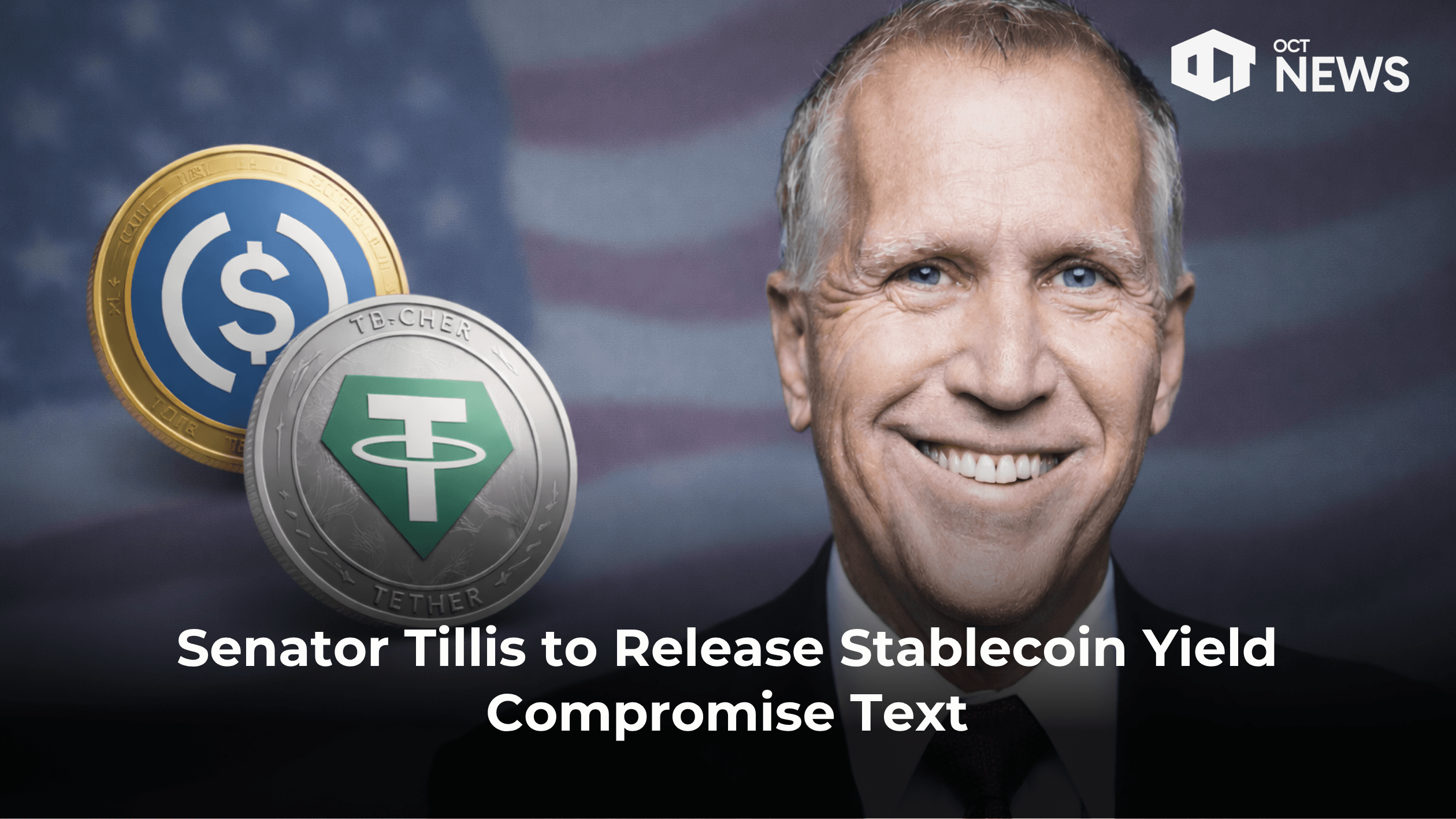
Senator Thom Tillis plans to publicly release draft legislative text for a bipartisan compromise on stablecoin yield provisions in the CLARITY Act.

Author: Sahil Thakur
14th April 2026 – Senator Thom Tillis plans to publicly release draft legislative text this week for a bipartisan compromise on stablecoin yield provisions in the CLARITY Act, according to SpendNode and Politico.
High Signal Summary For A Quick Glance

Watcher.Guru
@WatcherGuru

JUST IN: 🇺🇸 Senator Thom Tillis plans to release stablecoin yield draft agreement this week to end lobbying battle between banks and crypto.
02:13 AM·Apr 14, 2026

Cointelegraph
@Cointelegraph
🇺🇸 JUST IN: Senator Thom Tillis says he plans to release the stablecoin yield draft agreement this week to resolve the lobbying standoff between banks and crypto, per Politico. https://t.co/BX56zU72r1
01:40 AM·Apr 14, 2026
Steady attention without excessive speculation.
The move aims to break a months-long standoff between traditional banks and the crypto industry. That fight has stalled progress on the broader Digital Asset Market Clarity Act, the Senate’s primary crypto market structure bill.
Tillis, who is retiring from the Senate, has made this compromise a legacy priority. He is working alongside Sen. Angela Alsobrooks (D-MD), and the White House has provided input on the deal.
The core dispute centers on whether crypto platforms like Coinbase and Circle can pay users yield or rewards on stablecoin holdings such as USDC and USDT. Banks want those payments restricted. The crypto industry says they are essential for growth.
The GENIUS Act, passed and signed in 2025, already prohibits stablecoin issuers from paying yield solely for holding tokens. So the current fight is about third-party platforms. Exchanges, brokers, and wallets that offer earn programs on stablecoins they did not issue sit at the center of this debate.
Banks, led by groups like the American Bankers Association, argue that allowing stablecoin yield would cause massive deposit flight. They say crypto platforms operate without banking regulations, capital requirements, or deposit insurance. That creates unfair competition, especially for community banks that depend on deposits for lending.
The crypto industry sees things differently. Coinbase earns nearly 20% of its revenue from stablecoins in some quarters, according to PurposeInvest. Rewards and yield programs drive user adoption and payments innovation. Coinbase withdrew support for the CLARITY Act in January 2026 over proposed yield restrictions. That move stalled the Senate Banking Committee markup.
Based on stakeholder briefings and reporting from SpendNode, CoinDesk, and FintechWeekly, the draft includes several key provisions.
First, passive yield faces a ban. Digital asset service providers cannot offer yield on stablecoin balances simply for holding or retaining tokens. The language also prohibits anything “economically or functionally equivalent to bank interest.” That closes potential loopholes and workarounds.
Second, activity-based rewards survive. Loyalty programs, promotions, subscriptions, transaction-linked bonuses, and cashback are all permitted. The key requirement is that rewards must tie to actual user activity. A 2% cashback reward on a crypto card purchase qualifies. A 4% APY on idle USDC balances does not.
Third, regulators get 12 months after the bill passes. The SEC, CFTC, and Treasury must jointly issue rules defining qualifying rewards and anti-evasion measures.
A White House Council of Economic Advisers study released on April 9, 2026, bolstered the crypto industry’s position. The study found that a full ban on stablecoin yield would boost bank lending by only about $2.1 billion, according to CoinDesk.
That figure represents just 0.02% of total bank assets. The CEA concluded the cost-benefit ratio of a complete ban was poor. This finding undercuts the banks’ central argument about deposit flight and lending capacity.
Neither side is completely satisfied with the stablecoin yield compromise. Banks initially saw too many exemptions for crypto platforms. Crypto firms opposed limits on balance-tied rewards. Revisions occurred through late March and early April. Still, the core bank-friendly ban on passive yield remains in the draft.
The bill has passed through several milestones this year. In January 2026, the CLARITY Act stalled after Coinbase withdrew support. The Senate Banking Committee postponed its markup.
By mid-March, Tillis and Alsobrooks announced an “agreement in principle” with White House backing, according to Politico. Tillis said at the time that a deal was “very close.”
In late March and early April, industry stakeholders reviewed revised draft text in separate closed-door sessions. Crypto representatives attended one session. Banking groups attended another. Some dissatisfaction remained on both sides, as reported by CoinDesk.
After the public release, the next step is a Senate Banking Committee markup targeted for late April. Then the bill needs a full Senate floor vote requiring 60 votes. It also needs reconciliation with the House version (H.R. 3633, passed in 2025), which lacks stablecoin yield provisions. Sen. Cynthia Lummis has warned that the bill could die if delayed past May.
For stablecoin holders, the practical impact is clear. Platforms like Coinbase would likely have to restructure or drop passive earn programs. A program offering 4% APY on idle USDC would not survive under this framework.
Rewards tied to spending, transfers, or other activity remain viable. Cashback on crypto card swipes, transaction bonuses, and loyalty perks all fall within the permitted category.
The stablecoin yield compromise effectively reframes stablecoins as payment tools rather than savings vehicles. That distinction could shape how the entire stablecoin market develops in the United States.
Tillis’s public release this week could restart momentum for the CLARITY Act. Passing this legislation would deliver the most significant U.S. crypto market structure framework since the GENIUS Act.
Several open issues remain beyond stablecoin yield, including DeFi regulations and ethics provisions. The bill needs to clear both chambers and reach the president’s desk. With the May deadline looming, the next few weeks will determine whether this compromise survives or the broader bill stalls again.
This article is for informational purposes only and does not constitute financial advice.
Our Crypto Talk is committed to unbiased, transparent, and true reporting to the best of our knowledge. This news article aims to provide accurate information in a timely manner. However, we advise the readers to verify facts independently and consult a professional before making any decisions based on the content since our sources could be wrong too. Check our Terms and conditions for more info.


Securitize Stocks Launches Tokenized Equities on Solana
OCC GENIUS Act Final Rule Sets U.S. Stablecoin Rules
Stellar Settles First Institutional Repo Using Tokenized Treasury Collateral
Kelsier Ventures Wallets Fall From $300M to Under $2M
Securitize Stocks Launches Tokenized Equities on Solana
OCC GENIUS Act Final Rule Sets U.S. Stablecoin Rules
Stellar Settles First Institutional Repo Using Tokenized Treasury Collateral
Kelsier Ventures Wallets Fall From $300M to Under $2M