Boris Johnson sparks controversy at Solana Breakpoint 2026 after calling Bitcoin valuable for drug and arms dealers.

Author: Akshay
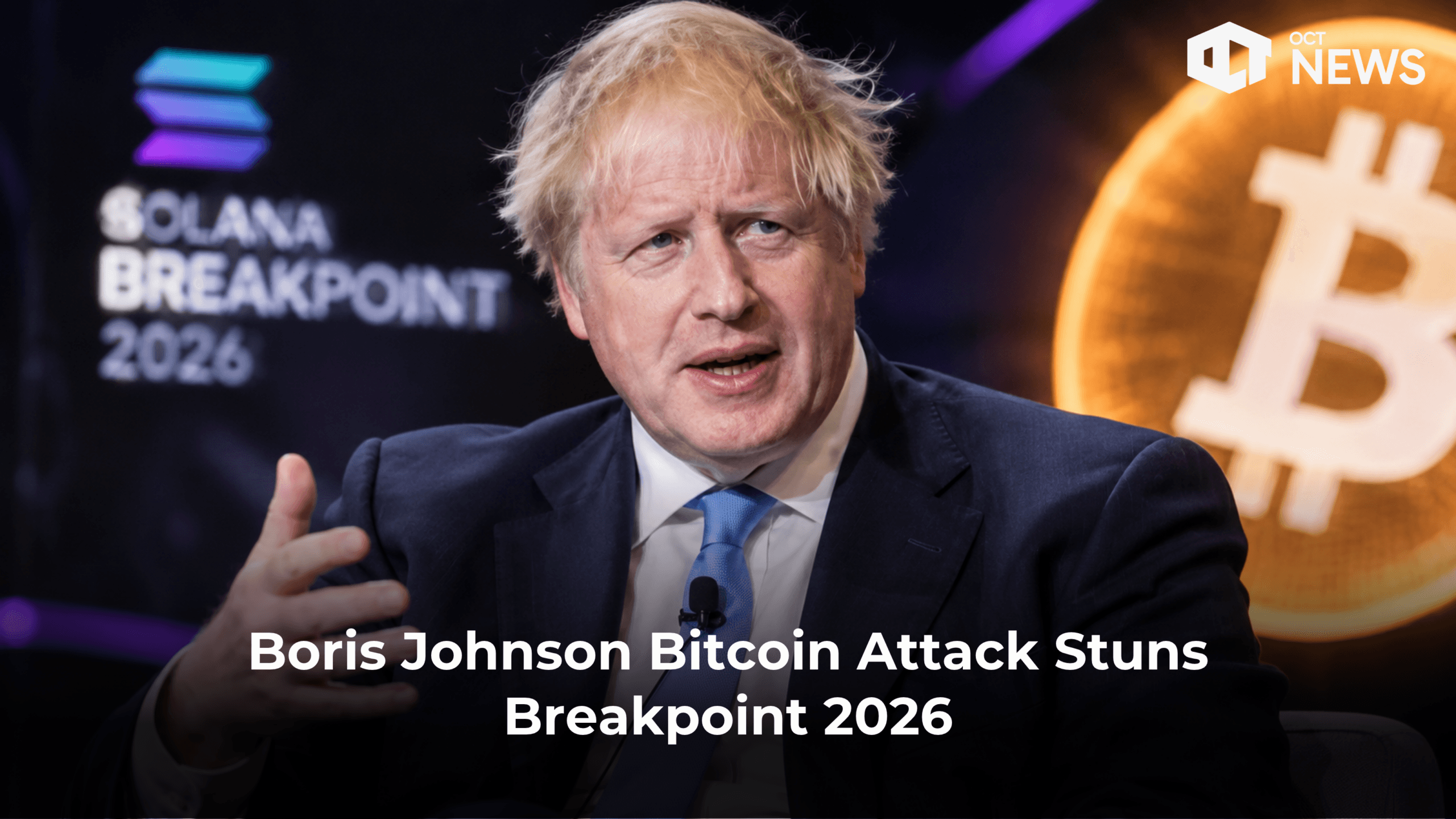
16th November 2026 – Former UK Prime Minister Boris Johnson told a Solana conference crowd that Bitcoin is “very valuable for drug dealers and arms dealers,” then admitted he knows nothing about crypto. The Boris Johnson Bitcoin remarks landed on 16 November 2026 at Breakpoint 2026 in London.
High Signal Summary For A Quick Glance

Uptrick
@Uptrick_X

@SolanaFloor @BorisJohnson saying this on stage at a Solana conference is a bold choice of venue
🚨JUST IN: Former UK Prime Minister @BorisJohnson says Bitcoin is “very valuable for drug dealers and arms dealers,” mocks Satoshi Nakamoto, and asks why it is a mystery who runs Bitcoin. - Breakpoint 2026 https://t.co/GUK3uH7OLu
02:33 PM·Nov 16, 2026

⚡️ cazzee ⚡️
@kbs924
@SolanaFloor @BorisJohnson Boris Johnson is a failure of a prime minister who takes him serious
🚨JUST IN: Former UK Prime Minister @BorisJohnson says Bitcoin is “very valuable for drug dealers and arms dealers,” mocks Satoshi Nakamoto, and asks why it is a mystery who runs Bitcoin. - Breakpoint 2026 https://t.co/GUK3uH7OLu
02:28 PM·Nov 16, 2026
High attention and emotional sentiment detected.
Johnson spoke at 14:00 GMT on the Main Stage at Olympia London. He joined a debate against Lord Ross Kempsell, moderated by Gareth Jenkinson of The Block. Minutes later, clips of the segment spread fast across X.
According to a summary from SolanaFloor, Johnson framed Bitcoin as a tool for criminals. He said it is “very valuable for drug dealers and arms dealers.” The line drew groans from a room full of builders.
Then he went further. He called “crypto” an “awful name” and said plainly, “I don’t think it’s a good sell.” Attendee posts captured the quote in real time.
He also conceded the obvious gap in his case. “I don’t know anything about crypto,” Johnson said on stage, per attendee Eleni. So the admission quickly became the day’s most-shared clip.
The session itself carried the title “Crypto Is Key to the UK’s Economic Future.” Johnson argued the opposite side. Kempsell, who has engaged positively with crypto use cases, took the pro-adoption position.
Johnson also fumbled the name of Bitcoin’s creator. Instead of Satoshi Nakamoto, he reached for “yakamoto nakasori” and “Yakko-Mucko Nakasako,” according to attendee Vinny. Reported spellings vary, since no full transcript is public yet.
He used the slip to question who controls the network. “Nobody knows who is in charge, except Yakamoto Nakasori, and I don’t know where to find him,” he said, per one French-language account of the remarks. The crowd laughed, and so did crypto Twitter.
The “crime coin” framing is common, yet the data tells a different story. According to the Chainalysis 2026 Crypto Crime Report, illicit addresses received at least $154 billion in 2025. That figure is a record in absolute terms.
Still, context matters here. The same report found that illicit activity stayed below 1% of all attributed crypto transaction volume. So the absolute number is large, while the share remains small.
Much of that illicit flow also traces back to sanctioned entities and stablecoins, not Bitcoin alone. In short, crime exists on-chain, but it does not define the asset. That nuance went missing in the Boris Johnson Bitcoin pitch.
Johnson asked who is “in charge” of Bitcoin. The honest answer is no single person. Instead, a global network of independent nodes and miners enforces the rules written in open-source code.
Satoshi Nakamoto released the Bitcoin whitepaper in 2008 and the first software in 2009. Then Satoshi mined early blocks and stepped away around 2010 to 2011. Since then, the network has run without any controlling founder or company.
Address pseudonymity is a privacy feature, not proof of a hidden boss. So the “mystery runner” idea misreads how the protocol works. Meanwhile, that design is exactly what supporters say makes Bitcoin credibly neutral.
Johnson has swung at Bitcoin before. In March 2026, his Daily Mail column called it a “giant Ponzi scheme.” He also likened Satoshi to Pikachu.
That column drew sharp pushback at the time. Michael Saylor argued a Ponzi needs a central operator paying earlier investors, which Bitcoin lacks. DL News covered the exchange in detail.
The Solana Foundation booked Johnson for Breakpoint back in October 2026, alongside Sajid Javid and Revolut’s Martin Gilbert. Organizers promoted the debate around that prior op-ed. So the clash was expected, even if the one-liners were not.
The reaction online was swift and mostly amused. Many users mocked the Satoshi mispronunciation and turned “Yakamoto Nakasori” into an instant meme. Others asked why organizers handed a known sceptic the main stage.
Builders at the event leaned critical, while few early defenses appeared. One common jab: a crypto conference paying to get “FUD” on its own stage. For now, no Reddit or Telegram aggregation has formed, since the event is only hours old.
There is also a layer of irony here. The UK is courting crypto firms as a hub, and the FCA published landmark rules in June 2026. Yet the country’s former leader used the stage to trash the asset class.
As of publication, neither Johnson’s camp nor Solana had issued a response or clarification. The full unedited session video is also not yet public. So the exact context and sequence of the remarks remain open.
Markets, meanwhile, shrugged. Bitcoin traded near $64,100 to $64,500 after the session, down about 1.5% on the day, as part of a broader weekly slide tied to ETF outflows. None of that move traces to the comments.
Expect tier-one outlets to pick up the clips as the day continues. We will update this report if Johnson, Kempsell, or the Solana Foundation adds official comment. This article is news reporting, not financial advice.
Our Crypto Talk is committed to unbiased, transparent, and true reporting to the best of our knowledge. This news article aims to provide accurate information in a timely manner. However, we advise the readers to verify facts independently and consult a professional before making any decisions based on the content since our sources could be wrong too. Check our Terms and conditions for more info.