

Author: Tanishq Bodh
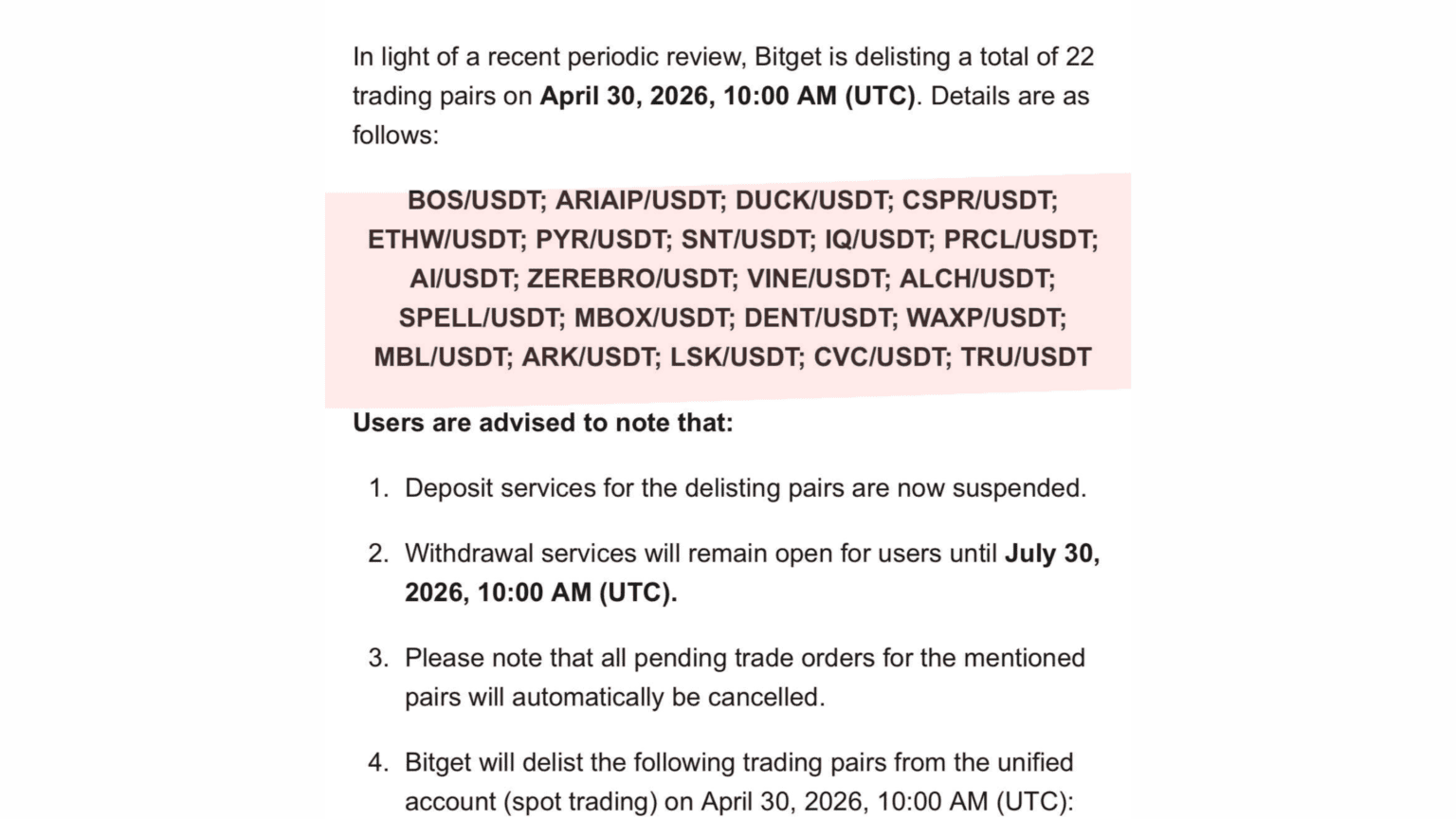
25th April 2026 – Bitget will delist 22 spot trading pairs from its platform on April 30, 2026, after completing a periodic review of listed assets.
High Signal Summary For A Quick Glance
The Singapore-based exchange confirmed the move on April 24. According to Bitget, the review evaluated trading volume, liquidity levels, community engagement, and project responsiveness. As a result, deposits for all 22 pairs have already been suspended.
The full list includes BOS/USDT, ARIAIP/USDT, DUCK/USDT, CSPR/USDT, ETHW/USDT, PYR/USDT, SNT/USDT, IQ/USDT, PRCL/USDT, AI/USDT, ZEREBRO/USDT, VINE/USDT, ALCH/USDT, SPELL/USDT, MBOX/USDT, DENT/USDT, WAXP/USDT, MBL/USDT, ARK/USDT, LSK/USDT, CVC/USDT, and TRU/USDT.
The list mixes established names with smaller projects. For instance, ARK launched in 2017 as an interoperability-focused blockchain, while LSK (Lisk) debuted in 2016 as a JavaScript-based blockchain application platform. Both have seen declining trading activity over the past year.
Similarly, WAXP powers a blockchain designed for NFTs and gaming. SPELL serves as the governance token for Abracadabra Money, a DeFi lending protocol. In contrast, newer tokens like ZEREBRO, VINE, and ALCH struggled to build sustained volume on the platform.
Also on the list are CSPR (Casper Network), an enterprise-focused Layer 1 chain, and ETHW (EthereumPoW), the proof-of-work fork that emerged from Ethereum’s merge in September 2022. All pending orders for these pairs will be automatically canceled at 10:00 AM UTC on April 30.
Bitget frames the decision as part of ongoing efforts to maintain a “high-quality trading environment.” The exchange evaluates multiple factors during its periodic reviews. These include liquidity depth, community activity, and the responsiveness of project teams.
In addition, the exchange screens for signs of negligence or unethical conduct. However, Bitget did not single out any specific project for criticism in this round.
This approach mirrors what competitors do regularly. Binance, OKX, and Bybit all conduct similar periodic reviews. Major exchanges prune low-activity pairs to concentrate resources on tokens with stronger market participation.
Traders holding any of the 22 tokens on Bitget have two main options. They can convert holdings to USDT before April 30. Alternatively, they can transfer tokens to external wallets or other exchanges where trading may continue.
Bitget will keep withdrawals open until July 30, 2026, at 10:00 AM UTC. That gives users roughly three months to move their assets after trading stops. Because of this extended window, there is no immediate urgency to act on withdrawals.
Importantly, Bitget has not announced plans to delist the underlying tokens entirely. Only the specific USDT spot trading pairs are being removed from the platform.
Delisting notices often trigger short-term selling pressure. According to market observers, low-volume tokens typically experience 10 to 20 percent price declines in the days following such announcements. Traders tend to rush to exit positions before liquidity dries up.
Several replies to Cointelegraph’s coverage of the announcement highlighted this pattern. Tokens with thin liquidity tend to absorb sell-offs poorly. As a result, downward price moves can be amplified beyond what fundamentals justify.
On the other hand, these price drops are usually temporary and localized. Tokens that trade actively on other exchanges may see less impact from a single platform’s decision to delist.
The move reflects a broader shift across the exchange sector. As regulatory scrutiny increases and competition intensifies, platforms are streamlining their offerings. Exchanges want to attract serious capital, so they focus on liquid, actively traded assets.
Bitcoin has recently tested higher price levels, and institutional interest continues to grow. In that environment, exchanges appear less willing to carry thinly traded pairs that add operational overhead without meaningful volume.
Furthermore, when Bitget delists trading pairs like these, it sends a signal about market quality standards. Other exchanges have made similar moves in recent months, suggesting this is an industry-wide trend rather than an isolated decision.
Bitget has not commented further on the review process or signaled future delistings.
Anyone holding these tokens on Bitget should review their positions before April 30. The exchange’s official support page contains the complete notice and any additional updates.
The episode highlights a recurring reality in crypto. Listings on exchanges are not permanent. Liquidity can shift, and platforms adjust their catalogs accordingly. For traders, staying aware of these changes is part of managing risk in a dynamic market.
Our Crypto Talk is committed to unbiased, transparent, and true reporting to the best of our knowledge. This news article aims to provide accurate information in a timely manner. However, we advise the readers to verify facts independently and consult a professional before making any decisions based on the content since our sources could be wrong too. Check our Terms and conditions for more info.