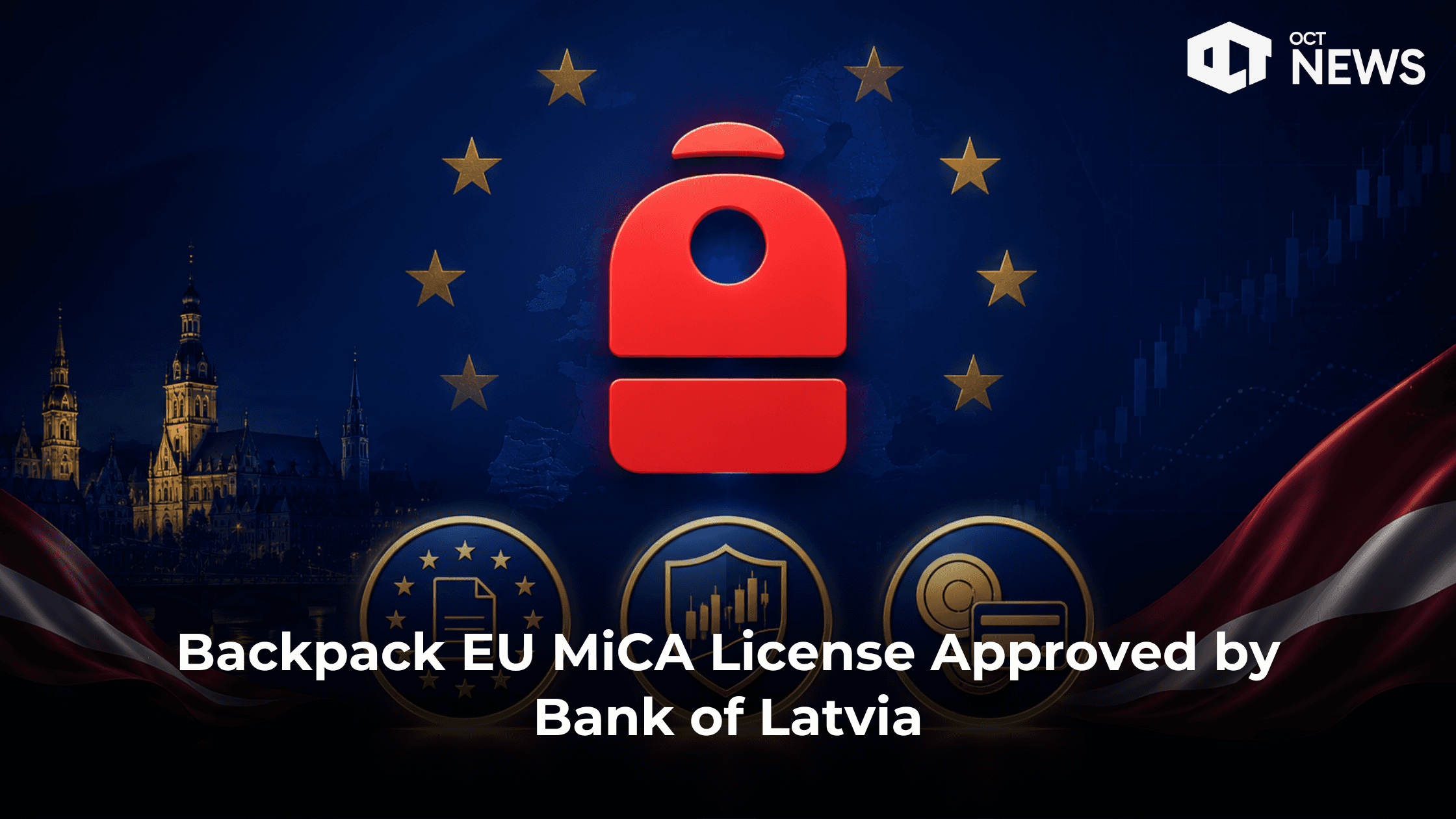
Backpack MiCA license from Bank of Latvia adds payments approval and MiFID II access, making Backpack EU tri-licensed.

Author: Kritika Gupta
1st July 2026 – Backpack EU has secured a MiCA crypto-asset service provider license and a Payment Institution license from Latvijas Banka, the Bank of Latvia. The exchange confirmed the news in a post on X.
High Signal Summary For A Quick Glance

Wu Blockchain
@WuBlockchain

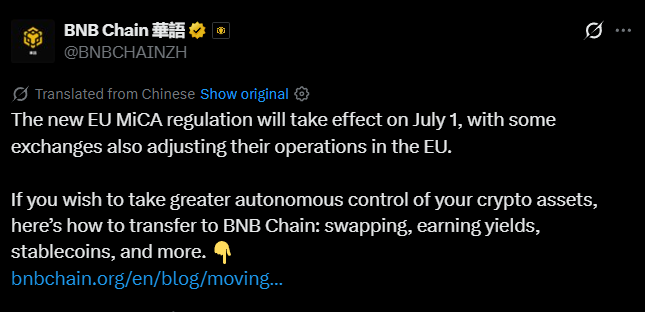
BNB Chain Releases MiCA Migration Guide Amid EU Regulatory Shifts BNB Chain has published a guide to help users move assets from centralized exchanges (CEXs) to self-custody on BNB Chain, as the EU's Markets in Crypto-Assets (MiCA) regulation fully takes effect on July 1, 2026. https://t.co/muq2dgvCPp
08:25 AM·Jul 1, 2026

DinhTien | Backpack 🎒
@DinhtienSol
Welcome everyone to @Backpack EU! In a market that increasingly values transparency, Backpack EU is taking the harder but more meaningful route into Europe: a CySEC-regulated entity, operating under MiFID II, with perpetual futures inside a regulated framework. After the FTX EU https://t.co/tCCZ7420Gl https://t.co/mz3s2HmfEW

Backpack EU has secured its MiCA license and Payment Institution license from the Bank of Latvia. Combined with our MiFID II license, Backpack EU is now tri-licensed across crypto, brokerage, and payments. This milestone strengthens our ability to serve users across all 27 EU https://t.co/h8lIJ4cw8d
07:11 AM·Jul 1, 2026

Armani Ferrante
@armaniferrante
There are three main licenses in Europe covering different regulated activities: - MiCA (crypto-asset services) - MiFID II (investment services) - PSD2 (payments) Today, only a select few companies in the digital asset industry have attained any of these. Even fewer have all https://t.co/NeftPAxKId
Backpack EU has secured its MiCA license and Payment Institution license from the Bank of Latvia. Combined with our MiFID II license, Backpack EU is now tri-licensed across crypto, brokerage, and payments. This milestone strengthens our ability to serve users across all 27 EU https://t.co/h8lIJ4cw8d
07:09 AM·Jul 1, 2026
Steady attention without excessive speculation.
According to the regulator, its Supervision Committee approved both licenses on 27 May 2026. Backpack then went public with the milestone on 1 July. As a result, its European arm now holds three separate EU authorizations at once.
Latvijas Banka issued the two licenses to Trek Technologies SIA, the legal entity behind Backpack EU. According to the Bank of Latvia announcement, the decision covers both crypto services and payments.
The MiCA license authorizes four activities. Backpack EU can now custody crypto for clients, exchange crypto for funds or other tokens, execute client orders, and provide transfer services.
Custody, in practice, means the firm can hold client assets under a supervised framework. That single permission tends to matter most to institutions weighing where to park funds.
The Payment Institution license adds a separate power. Under the PSD2 framework, it lets the firm execute payments and move funds to payment accounts. In other words, crypto rails and fiat rails now sit under one roof.
The new Backpack EU MiCA license does not stand alone. It joins an existing MiFID II license that the company gained through its purchase of FTX EU in January 2025. That license originally came from CySEC in Cyprus.
Together, the three licenses cover distinct regulated activities. MiCA governs crypto-asset services. MiFID II governs investment and brokerage services, such as regulated derivatives. PSD2, meanwhile, governs payments.
According to Backpack’s announcement, the setup makes the firm “tri-licensed across crypto, brokerage, and payments.” Founder Armani Ferrante added that only a select few digital-asset firms hold any of the three, and even fewer hold all three.
Backpack’s European base traces back to the collapse of FTX. In January 2025, the company bought FTX EU for roughly $32.7 million. That deal handed it the MiFID II license and a route into Europe.
Backpack then handled restitution for former FTX EU claimants before it relaunched services, according to the company. So the current tri-licensed entity grew directly out of that cleanup.
Ferrante founded Backpack in 2022. He is a Solana developer and the creator of the Anchor framework. The exchange also keeps close ties to Solana through the Mad Lads NFT collection.
Backpack’s EU licensing path
Backpack began as a Solana-linked wallet and crypto infrastructure brand led by Armani Ferrante.
Backpack acquired FTX EU, gaining a regulated European foothold and a pathway into derivatives access.
The FTX EU acquisition brought Backpack EU access to a MiFID II investment-services framework.
Latvijas Banka approved Trek Technologies SIA for crypto-asset services and payment services.
Backpack announced it now combines MiCA, MiFID II, and payments under its EU regulatory stack.
The license setup supports passporting across the EU, positioning Backpack against larger regulated exchanges.
The licenses matter mainly because of passporting. Under EU rules, authorization in one member state extends across all 27, plus the wider EEA. So a Latvian license can reach the entire bloc through simple notification.
MiCA’s transitional period for existing operators ran until around 1 July 2026. Because of that deadline, many exchanges raced to secure full CASP status. Coinbase, Kraken, OKX, and Bybit have each obtained MiCA approvals through various national regulators.
Latvia, meanwhile, has built a reputation as a fast MiCA jurisdiction. For Backpack, that speed offered an efficient gateway into the single market.
Trek Technologies SIA now appears in the interim EU register of authorized crypto firms, with Latvia listed as its home state. As a result, other national regulators can see the approval directly.
The timing gives Backpack a clear compliance story. As the MiCA deadline landed, the firm could point to a full stack of EU licenses rather than a pending application. For a company born from an FTX estate, that framing carries weight.
The Solana community welcomed the news quickly. Congratulatory posts framed the approval as a competitive moat, and Solana’s official account reacted on X. Still, critics of “license shopping” continue to question how fast some EU regulators move.
Backpack’s native token, $BP, moved on the announcement. The Solana-based token reportedly gained as much as 7% to 24% intraday, on trading volume in the millions of dollars. Exact figures varied across sources.
$BP has a total supply of 1 billion, with roughly 250 million in circulation. Still, the company published no new user or volume targets alongside the licensing news.
Traders often price regulatory wins quickly, then wait for real product launches. So the early move may say more about sentiment than about revenue. This article is not financial advice.
For now, Backpack has not named go-live dates for expanded products under each license. Questions also remain about wider perpetuals trading and payment features across the bloc.
The regulatory groundwork, however, is set. With the Backpack EU MiCA license and its two sister approvals in place, the exchange can push crypto trading, brokerage, and payments to users in all 27 member states as it chooses to switch them on.
Our Crypto Talk is committed to unbiased, transparent, and true reporting to the best of our knowledge. This news article aims to provide accurate information in a timely manner. However, we advise the readers to verify facts independently and consult a professional before making any decisions based on the content since our sources could be wrong too. Check our Terms and conditions for more info.


Backpack