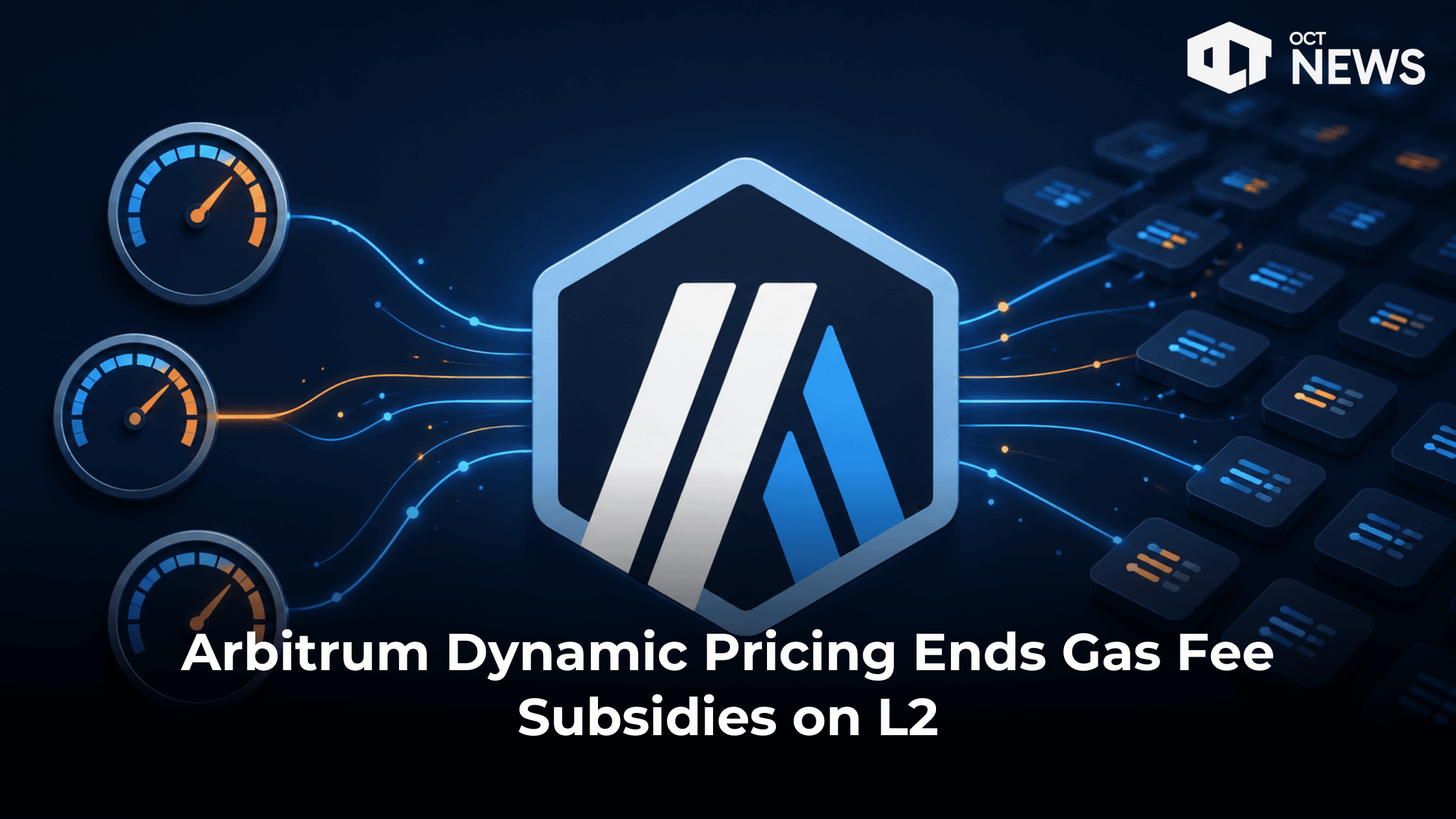
Arbitrum dynamic pricing brings resource-based gas fees to improve cost predictability, reduce fee spikes, and scale L2 throughput.

Author: Kritika Gupta
9th July 2026- Arbitrum spotlighted Arbitrum Dynamic Pricing with an official “ICYMI” post on X. The message described the resource-based gas fee model in plain terms. It pointed back to a June blog where users “only pay for what they use.”
High Signal Summary For A Quick Glance

Shuarix™
@Shuarix

Feels like a lot of people still see @arbitrum as "just another Ethereum L2", I don't think that's where the story is heading anymore The way I see it? They're quietly building the rails for where all the real money ends up moving... cheap fees are cool, but that's not even the https://t.co/0cDcJGmZhJ https://t.co/EzCIqtIHeK

ICYMI: The Arbitrum Platform is introducing a first-of-its-kind pricing model where users only pay for the resources they use. > More predicable costs > More smoother user experience > More headroom to sustain billions of transactions onchain https://t.co/8wYtJv5FDI
09:14 AM·Jul 9, 2026

Ben Terry
@BenTerry
"Over the last few months, @arbitrum has been working to make fees less volatile and more predictable with dynamic pricing." https://t.co/m6NMmxrbKL https://t.co/JX5C5estEj

https://t.co/YOyZsC8upy
12:38 PM·Jul 7, 2026
High attention and emotional sentiment detected.
The model is not brand new. Its foundations went live on Arbitrum One in January 2026 through the ArbOS 51 “Dia” upgrade. Today’s post simply pulled the change back into focus.
For years, Arbitrum priced gas the way Ethereum does. It used a single gas target and one adjustment window, so every transaction paid one uniform price.
That approach has a flaw. A one-dimensional model cannot tell apart transactions that stress different parts of the network. As a result, a light transaction could cost the same as a storage-heavy one.
Arbitrum Dynamic Pricing breaks the fee into the resources a transaction actually consumes. So a simple transfer no longer subsidizes a complex, storage-heavy contract call. In short, you pay closer to your true cost.
The full design tracks five separate resources. These are computation, state access, state growth, history growth, and calldata. Each one maps to a real cost that a node has to bear.
Calldata is a useful example. It covers the input data a transaction carries. That data affects bandwidth and the cost of posting to Ethereum. Under a flat model, that cost blended into one price. Now it can be metered on its own.
The network watches usage in every dimension against a target. When usage runs hot, that dimension builds a decaying “backlog.” The backlog then acts as a multiplier on the base fee.
In the fuller vision, the highest multiplier across all dimensions sets the price. So the scarcest resource dictates the fee, and the rest ride along. According to Arbitrum, storage-heavy transactions face pressure when storage is scarce. Compute-heavy ones face it when compute runs short.
The live version is a first step toward that goal. Instead of one gas target, Dia runs several overlapping targets on different time windows.
Fast windows react quickly to short bursts in small increments. Longer windows enforce long-term capacity limits. Together they act like a shock absorber. The final price is the product of the prices from each target-window pair.
Dia also added multi-resource instrumentation inside the State Transition Function. So the network now measures how each transaction loads the system. The same November 2025 governance proposal also raised the minimum L2 base fee to 0.02 gwei.
How Arbitrum’s resource-based model compares with its old gas model, Base, and Optimism.
Arbitrum says the new loop smooths fees when demand spikes. To test that claim, engineers replayed a high-demand event from January 31, 2026.
According to that March 2026 analysis, the simulated peak gas price came in about 98% lower than the old model. The result is a replay, not observed mainnet data. So treat it as directional.
Throughput headroom is the other selling point. Arbitrum One has reportedly demonstrated peaks near 910 MGas/s. For context, official figures put Base near 375 MGas/s, Optimism near 60 MGas/s, and Ethereum near 40 MGas/s.
The marketing language runs ahead of the code in one respect. The full “highest multiplier wins” version is not active on Arbitrum One today.
Newer ArbOS releases carry support for per-resource independent pricing. Still, Offchain Labs has kept that full model disabled on mainnets while it studies the effects. For now it is opt-in for Orbit chains that want it.
Orbit chains are the app-specific networks that run on Arbitrum’s stack. They can switch the feature on and test it in production first. That gives Arbitrum real data before any mainnet vote.
Some developers frame Dia as a smart evolution of the existing fee loop rather than a wholly new invention. The design also echoes Ethereum’s own multidimensional gas research. Arbitrum’s “first-of-its-kind” phrasing refers to its specific L2 implementation.
The near-term path runs through governance. Any move to activate full per-resource pricing on mainnet would go through the Arbitrum DAO. That runs on its usual Snapshot and on-chain process. No single go-live date exists for the complete vision yet.
Market interest stayed muted around the post. ARB traded near $0.079 to $0.085 through late June and early July, and no price spike traced to the announcement. Chain metrics held steady, with Arbitrum TVL around $1.225B on DefiLlama and roughly 2.24M daily transactions.
For builders, the practical win is steadier costs and clearer signals about which resource is scarce. Watch the next ArbOS proposals to see when the full model reaches mainnet. This article is analysis, not financial advice, and readers should do their own research before acting on any token.
Our Crypto Talk is committed to unbiased, transparent, and true reporting to the best of our knowledge. This news article aims to provide accurate information in a timely manner. However, we advise the readers to verify facts independently and consult a professional before making any decisions based on the content since our sources could be wrong too. Check our Terms and conditions for more info.


Arbitrum