ZIGChain ($ZIG) Review
ZIGChain ($ZIG) Review: A Layer-1 blockchain for fast, accessible wealth management with CosmWasm smart contracts.


Author: Akshat Thakur
Introduction
ZIGChain is a Layer-1 blockchain designed to unlock financial opportunities for everyone, regardless of income, location, or financial expertise. The protocol combines accessibility with institutional-grade infrastructure, aiming to democratize wealth generation through its modular Wealth Management Engine. By allowing developers to build innovative protocols and enabling wealth managers to deploy sophisticated investment strategies, ZIGChain bridges the gap between decentralized finance and traditional investment management.
Built on the Cosmos SDK, ZIGChain leverages the interoperability and scalability of the Cosmos ecosystem while integrating CosmWasm smart contracts for developer flexibility. This foundation ensures compatibility with other Cosmos-based projects while allowing developers to write powerful smart contracts in Rust. With a strong focus on financial empowerment, the platform offers fast, low-cost transactions, developer support programs, and a $100 million ecosystem fund to attract projects. Its vision is to create a permissionless, global network where financial tools once reserved for the wealthy become accessible to all. By aligning DeFi innovation with real-world wealth management practices, ZIGChain positions itself as both a consumer-friendly blockchain and an institutional-grade platform.
Problem Statement
- Barriers to Financial Access
Traditional finance has historically excluded individuals without significant capital or access to financial institutions. Many people worldwide lack opportunities to participate in investment strategies, wealth products, or global financial markets due to geographic, income, or educational barriers. - Complexity of DeFi for Retail Users
DeFi protocols promise financial freedom, but in practice, navigating decentralized applications, liquidity pools, staking interfaces, and yield optimization platforms remains overwhelming for everyday users. This complexity prevents mass adoption. - High Costs and Slow Settlement
Leading Layer-1 chains such as Ethereum often experience high gas fees and delayed confirmation times. For financial-grade use cases, where microtransactions and instant settlement matter, this lack of scalability creates significant inefficiencies. - Developer Limitations
Many blockchain ecosystems provide limited resources, poor documentation, or inadequate financial incentives. This creates friction for developers who want to build scalable and impactful dApps. - Inefficiencies in Wealth Management
Wealth managers face limited infrastructure in DeFi to deploy large-scale strategies, customize revenue models, or reduce operational costs. Without streamlined modules, managing decentralized investment products can be costly and inefficient. - Fragmented Interoperability
Financial products and liquidity pools are often siloed across chains. Without robust cross-chain compatibility, capital efficiency suffers, and composability across ecosystems remains limited.
Solutions Provided by ZIGChain
- Inclusive Wealth Generation
The Wealth Management Engine enables wealth managers to create and deploy sophisticated investment strategies on-chain. This opens opportunities for users globally to access strategies that were once limited to high-net-worth individuals or institutions. - Simplified DeFi Experience
Developers can create user-friendly applications that abstract away complexity. The modular nature of ZIGChain ensures that DeFi protocols can be customized to meet retail needs while maintaining professional-grade features. - Fast and Low-Cost Transactions
With transactions finalizing in less than five seconds and consistently low gas fees, ZIGChain delivers the scalability required for financial dApps that rely on speed and affordability. - Developer Support and Ecosystem Fund
A $100 million ecosystem fund, foundation programs, and detailed documentation with ready-to-use examples provide a strong developer experience. Projects receive both financial and technical support to accelerate growth. - Optimized Wealth Management Infrastructure
Wealth managers can leverage modules to reduce overhead, customize fees, and integrate advanced DeFi protocols into their strategies. This flexibility enables them to scale operations globally without the traditional frictions of DeFi. - Cross-Chain Interoperability
Using the Cosmos SDK and IBC, ZIGChain ensures seamless integration with other ecosystems. This enhances liquidity sharing, capital efficiency, and protocol composability across blockchains.
Problem–Solution Overview
Technology and Architecture
ZIGChain’s architecture is rooted in Cosmos SDK, offering scalability, modularity, and interoperability. CosmWasm support allows smart contracts to be written in Rust, giving developers both flexibility and performance.
- Consensus: Proof-of-Stake mechanism using ZIG tokens for validator participation, ensuring decentralization, security, and energy efficiency.
- Smart Contracts: CosmWasm-based contracts enable developers to build complex protocols with ease, leveraging Rust’s performance and safety.
- Wealth Management Engine: A delegated investment management module that allows managers to design and deploy strategies while users benefit from simplified access.
- Interoperability: Cosmos IBC ensures seamless cross-chain transactions, making ZIGChain part of the larger Cosmos ecosystem.
- Accounts System: Incorporates features such as hierarchical deterministic (HD) wallets, multisig accounts, and strong key management systems.
- Security: Multisig functionality, CLI tools, and cryptographic safeguards reinforce trust for both retail users and institutions.
By integrating modular design, ZIGChain ensures that new financial tools and modules can be added over time without disrupting the core network.
Technology & Architecture
Tokenomics
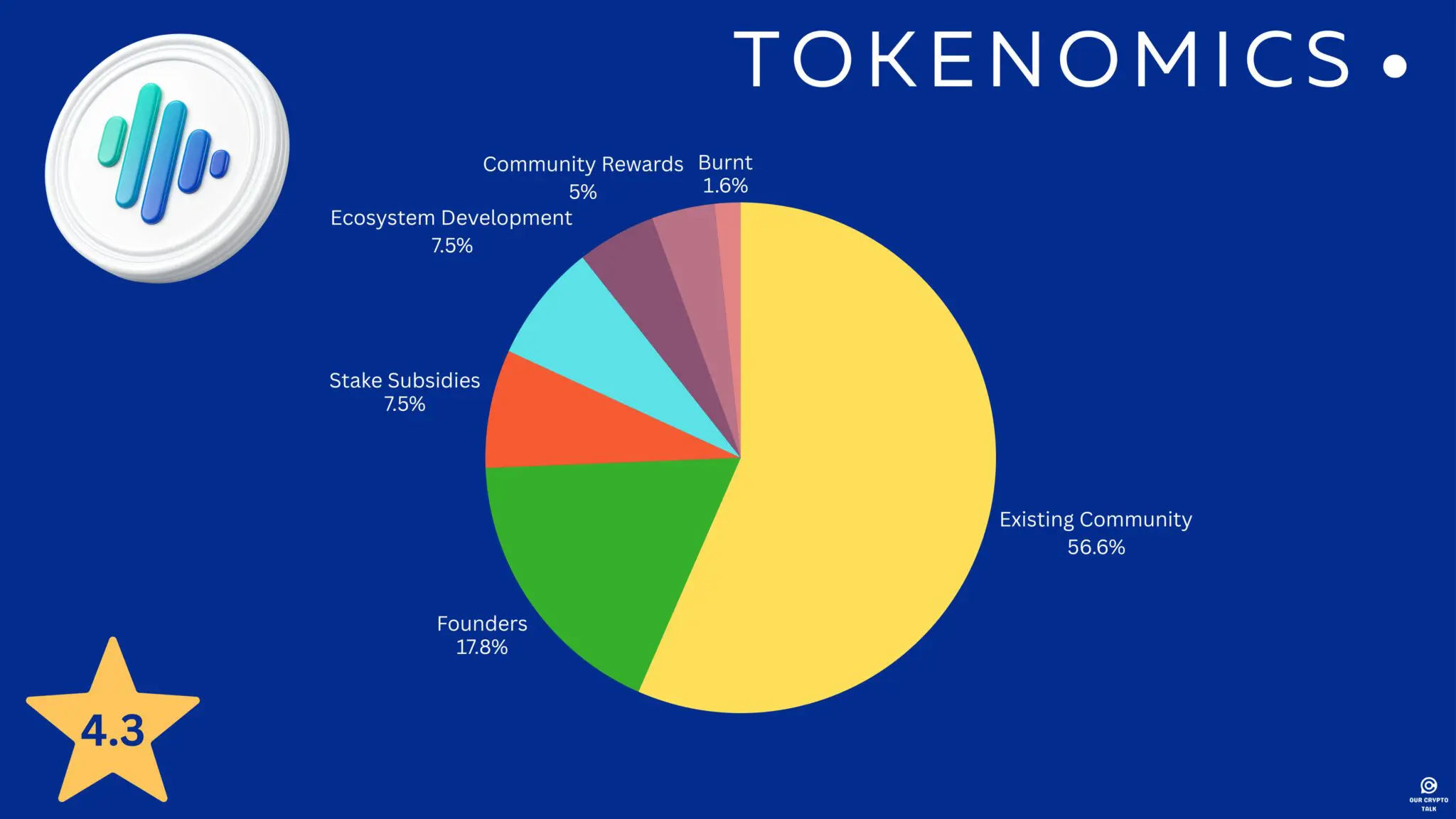
- Max Supply: 2.5 billion ZIG
- Circulating Supply: ~1.72 billion ZIG (August 2025)
- Distribution:
- Existing Community: 56.56%
- Founders: 17.8%
- Stake Subsidies: 7.5%
- Ecosystem Development: 7.5%
- Community Rewards: 5%
- Reserves: 4%
- Burnt: 1.64%
- Utility:
- Staking: Validators and delegators secure the network and earn rewards.
- Transaction Fees: Paid in ZIG, ensuring economic alignment.
- Governance: ZIG holders create and vote on proposals.
- Module Fees: Usage of Token Factory, Exchange Module, and Wealth Management Module generates fees that can be reinvested into the ecosystem or used for token buybacks and burns.
- DeFi Utility: Used as a native asset for liquidity provision, lending/borrowing collateral, and protocol rewards.
ZIG’s design integrates both traditional blockchain functions and wealth management-specific roles, ensuring that token utility extends beyond basic gas and governance functions.
Market Performance
📊 Market Performance
Team
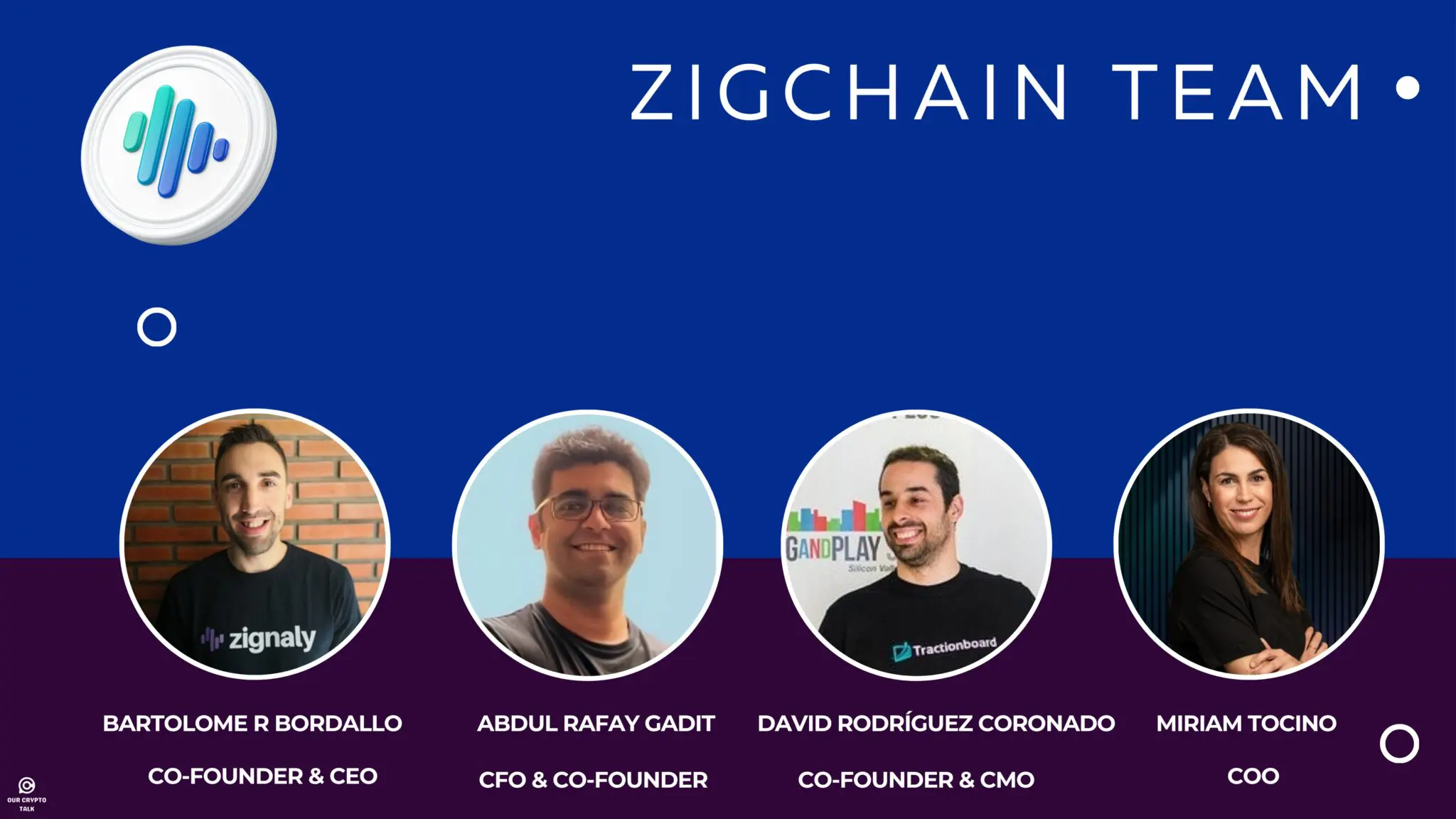
- Bartolome R Bordallo – Co-Founder & CEO
- Abdul Rafay Gadit – CFO & Co-Founder
- David Rodríguez Coronado – Co-Founder & CMO
- Miriam Tocino – COO
Project Analysis
Comparative Overview
- Vs. Algorand: Algorand focuses on sustainability and enterprise adoption. ZIGChain emphasizes democratizing wealth management and providing modular financial infrastructure.
- Vs. Avalanche: Avalanche delivers sub-second finality; ZIGChain prioritizes inclusivity and financial accessibility with its Wealth Management Engine.
- Vs. Polkadot: Polkadot’s parachains allow customization; ZIGChain leverages modular upgrades to deliver financial features without requiring separate chains.
- Vs. Sui: Sui highlights parallel execution; ZIGChain concentrates on inclusivity, wealth management, and Cosmos-native interoperability.
Strengths
- Wealth Management Engine as a unique differentiator
- Strong developer ecosystem support through funding and documentation
- Cosmos SDK foundation ensures interoperability
- Clear vision of financial inclusivity and accessibility
Challenges
- Early stage with limited adoption and liquidity
- Market competition with established L1s
- Reliance on institutional partnerships to drive traction
- Requires community growth to compete with larger ecosystems like Ethereum and Solana
ZIGChain vs Competing Layer-1s
ZIGChain –> Algorand –> Ethereum –> Solana –> Cardano –>| Project | Core Focus | Performance / Differentiators |
|---|---|---|
|
| Next-gen high-performance Layer-1 optimized for security, scalability, and developer accessibility | Consensus: Zig Consensus (variant of PoS); ~2s block finality; throughput up to ~15,000 TPS; deterministic finality; extremely low fees; built-in interoperability layer; developer-friendly SDKs and native token standard; modular upgrade framework |
|
| High-performance Layer-1 blockchain designed for instant finality, scalability, and sustainability | Pure Proof-of-Stake (PPoS) with ~4s block finality; throughput up to ~10,000 TPS; carbon-negative operations; deterministic finality (no forks); low, predictable fees; built-in Layer-1 smart contracts and ASA token standard |
|
| General-purpose smart contract platform, largest DeFi/NFT ecosystem | Proof-of-Stake since the Merge; ~15 TPS on mainnet; finality ~13 minutes (network-dependent); extremely broad developer ecosystem; rollups and sharding roadmap for scaling; highest liquidity and composability |
|
| High-throughput smart contract Layer-1 for DeFi, NFTs, and consumer apps | Proof-of-History + Proof-of-Stake hybrid; sub-second block times; theoretical throughput >50,000 TPS; low fees; periodic downtime incidents have affected reliability |
|
| High-performance Layer-1 with subnet architecture for customizable chains | Snowman consensus; ~4,500 TPS; <2s finality; subnets enable app-specific compliance/governance; EVM-compatible for easy porting |
|
| Research-driven PoS Layer-1 focused on formal verification and peer-reviewed design | Ouroboros PoS; ~250 TPS (Hydra scaling in progress); deterministic finality; emphasis on formal methods; slower upgrade cadence |
|
| Interoperable multi-chain Layer-0 connecting sovereign parachains | Nominated PoS; ~1,000 TPS per parachain; ~6s block time; shared security; cross-chain messaging; highly modular architecture |
Roadmap and the Future
- 2025 H2: Launch of Wealth Management Engine and initial pilot programs
- 2026: Deployment of advanced cross-chain DeFi modules, enabling stronger liquidity sharing
- 2026–2027: Strategic partnerships with traditional financial institutions to introduce hybrid products blending DeFi and traditional investment tools
- Long-Term Vision: To establish ZIGChain as the go-to blockchain for financial inclusivity, offering wealth management solutions to retail users worldwide
Conclusion
ZIGChain is a forward-looking Layer-1 blockchain with a mission to democratize access to wealth-generation strategies. By combining developer support, modular infrastructure, and a unique Wealth Management Engine, it creates opportunities for both developers and users to participate in financial markets in ways previously limited to the privileged few.
Its combination of Cosmos SDK scalability, fast and affordable transactions, and wealth management focus sets it apart from competitors. If ZIGChain can successfully scale its community, onboard wealth managers, and deliver on its interoperability promise, it could secure a significant role in the next phase of blockchain adoption, bridging the worlds of DeFi and traditional finance.
Explore More Reviews to Level Up Your DYOR Game.
Frequently Asked Questions — ZIGChain
What is ZIGChain in one line?
What problems does ZIGChain solve?
How does ZIGChain provide solutions?
What is ZIGChain’s core technology and architecture?
What is the ZIG token used for?
How has ZIG performed in the market?
Who is behind ZIGChain?
How does ZIGChain compare to other Layer-1s?
What are ZIGChain’s main strengths and challenges?
What does the roadmap look like?